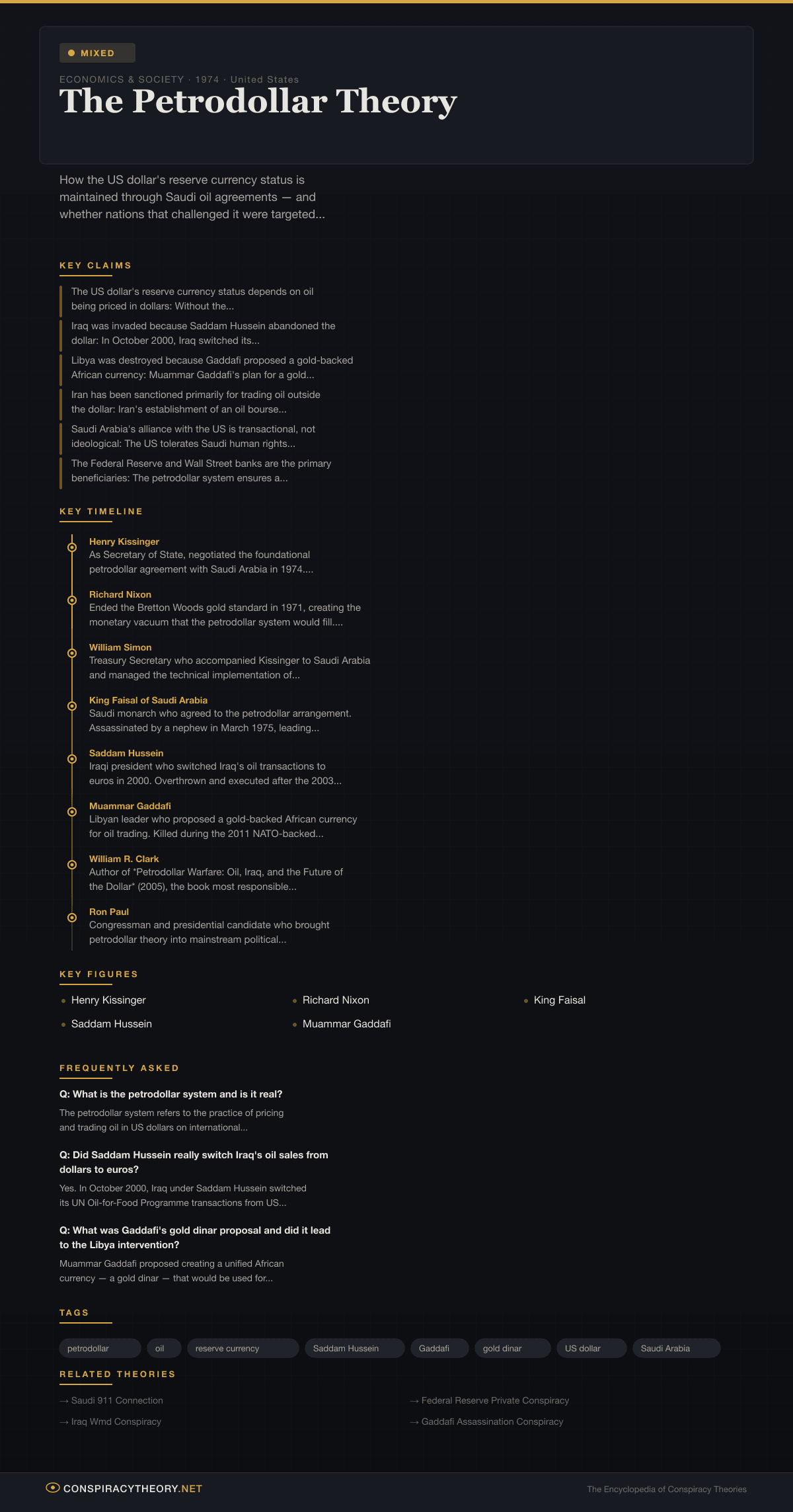
The Petrodollar Theory

Overview
The petrodollar theory posits that the United States dollar’s dominance as the world’s reserve currency is maintained not primarily through economic strength but through a deliberate geopolitical arrangement: oil — the most traded commodity on earth — must be bought and sold in dollars. Nations that have attempted to break this arrangement, the theory claims, have been met with sanctions, destabilization, or outright military invasion. The system traces back to a 1974 deal between Secretary of State Henry Kissinger and the Saudi royal family, struck in the aftermath of the Nixon Shock and the 1973 oil embargo. The confirmed elements are substantial — the petrodollar recycling system is documented in declassified US Treasury and State Department records. The contested question is how far the United States has been willing to go to defend it.
Origins & History
The petrodollar system did not emerge from thin air. It was born from crisis — specifically, from two seismic disruptions to the postwar global financial order that arrived in rapid succession.
The first was the Nixon Shock. On August 15, 1971, President Richard Nixon unilaterally suspended the convertibility of the US dollar into gold, effectively ending the Bretton Woods system that had anchored international finance since 1944. Under Bretton Woods, the dollar was pegged to gold at $35 per ounce, and other currencies were pegged to the dollar. Nixon’s decision — driven by accelerating inflation, Vietnam War spending, and a yawning balance-of-payments deficit — severed the dollar’s link to any tangible asset. For the first time in modern history, the world’s reserve currency was backed by nothing but the “full faith and credit” of the US government.
The second crisis was the 1973 OPEC oil embargo. In October 1973, Arab members of the Organization of Petroleum Exporting Countries imposed an oil embargo against the United States and other Western nations in retaliation for American support of Israel during the Yom Kippur War. Oil prices quadrupled almost overnight, from roughly $3 per barrel to nearly $12. The embargo demonstrated the staggering economic power that oil-producing nations held over the industrialized world — and it terrified Washington.
Secretary of State Henry Kissinger recognized both the danger and the opportunity. In a series of negotiations throughout 1974, Kissinger and Treasury Secretary William Simon struck a deal with Saudi Arabia’s King Faisal. The terms, which remained classified for over forty years until Bloomberg News obtained relevant Treasury documents through FOIA requests in 2016, were straightforward: Saudi Arabia would price all of its oil exports exclusively in US dollars and invest its surplus petroleum revenues in US Treasury bonds and other dollar-denominated assets. In return, the United States would provide Saudi Arabia with military equipment, training, and an implicit guarantee of the royal family’s security.
The arrangement was formalized through the US-Saudi Arabian Joint Commission on Economic Cooperation, established in June 1974. By 1975, all OPEC members had agreed to price oil exclusively in dollars. The mechanism that would come to be known as “petrodollar recycling” was in place: oil-importing nations needed dollars to buy oil, which meant they needed to either export goods to the US or borrow dollars from American banks. Oil exporters, flush with dollar revenues, recycled those dollars back into US Treasuries, financing American government spending and keeping interest rates low. The dollar had found a new anchor — not gold, but oil.
The term “petrodollar” was coined by Georgetown University professor Ibrahim Oweiss in 1973, initially as a neutral economic descriptor. Its evolution into conspiracy parlance came gradually through the 1990s and 2000s, as analysts and writers — most notably William R. Clark in his 2005 book Petrodollar Warfare — began arguing that the petrodollar system was not merely an economic arrangement but a casus belli. Clark and others contended that the United States would use military force to prevent any major oil-producing nation from abandoning dollar-denominated oil trading, because such a move would undermine global demand for dollars and, by extension, America’s ability to finance its deficits and project power.
Key Claims
-
The US dollar’s reserve currency status depends on oil being priced in dollars: Without the petrodollar arrangement, global demand for dollars would decline sharply, forcing the US to finance its debts at much higher interest rates and potentially triggering a currency crisis.
-
Iraq was invaded because Saddam Hussein abandoned the dollar: In October 2000, Iraq switched its Oil-for-Food Programme transactions from dollars to euros. Within three years, the US invaded, and one of the first acts of the Coalition Provisional Authority was switching Iraqi oil sales back to dollars.
-
Libya was destroyed because Gaddafi proposed a gold-backed African currency: Muammar Gaddafi’s plan for a gold dinar that would serve as a pan-African trading currency, particularly for oil, was a direct threat to both the dollar and the French CFA franc. NATO intervention followed.
-
Iran has been sanctioned primarily for trading oil outside the dollar: Iran’s establishment of an oil bourse trading in euros, yen, and other currencies — not its nuclear program — is the real reason for decades of economic warfare against Tehran.
-
Saudi Arabia’s alliance with the US is transactional, not ideological: The US tolerates Saudi human rights abuses, support for extremist ideology, and even the kingdom’s alleged involvement in the September 11 attacks because the Saudis uphold the petrodollar system.
-
The Federal Reserve and Wall Street banks are the primary beneficiaries: The petrodollar system ensures a permanent demand for dollars and Treasury securities, enriching the financial sector and enabling the Federal Reserve’s monetary expansion.
Evidence
Confirmed Elements
The core petrodollar arrangement is not a theory — it is documented history. In 2016, Bloomberg News obtained declassified Treasury Department documents through a Freedom of Information Act request that confirmed the 1974 Kissinger-Simon deal with Saudi Arabia. The documents showed that Saudi Arabia purchased at least $117 billion in US Treasury securities through a special arrangement that kept Saudi holdings secret from other foreign governments and the American public for over four decades.
The petrodollar recycling mechanism is described in academic economics literature without controversy. David Spiro’s 1999 book The Hidden Hand of American Hegemony: Petrodollar Recycling and International Markets provides a detailed account based on declassified documents and interviews with former Treasury officials.
Saddam Hussein’s switch to euro-denominated oil is a matter of public record. In October 2000, Iraq’s UN ambassador announced that Iraq would begin conducting its Oil-for-Food Programme transactions in euros rather than dollars. The move was reported by The Financial Times, The Guardian, and other major outlets. After the 2003 invasion, the Iraqi oil market was returned to dollar denomination.
Gaddafi’s gold dinar proposal is documented in multiple sources, including his own public speeches and African Union proceedings. The most explosive evidence came from Hillary Clinton’s emails, released through a combination of State Department FOIA processing and WikiLeaks. A March 2011 email from Sidney Blumenthal to Clinton listed among the factors driving French President Nicolas Sarkozy’s push for intervention in Libya: “a desire to gain a greater share of Libya oil production” and “concern that Qaddafi’s long term plans to supplant France as the dominant power in Francophone Africa” through a gold-backed currency.
Debated Elements
The causal claim — that the US specifically invaded Iraq and Libya because of currency decisions rather than for other stated or unstated reasons — is where the theory moves from documented fact to contested interpretation.
Critics of the petrodollar war thesis point out that the Iraq invasion had multiple motivations, including neoconservative ideology about Middle Eastern democracy, genuine (if misguided) intelligence assessments about weapons of mass destruction, control of oil production itself (not just its denomination), and the personal and political dynamics of the Bush family’s relationship with Saddam Hussein. Reducing the invasion to a single monetary motivation oversimplifies a complex geopolitical decision.
Similarly, the Libya intervention involved genuine humanitarian concerns about Gaddafi’s threatened massacre of Benghazi’s population, European energy security interests, French domestic politics, and the broader dynamics of the Arab Spring. The gold dinar was one factor among many — significant, perhaps, but not necessarily determinative.
The petrodollar system has also proven more resilient and less binary than the theory suggests. China and Russia have conducted bilateral oil trades in yuan and rubles for years without triggering US military intervention. Saudi Arabia itself has begun accepting yuan for some oil sales to China since 2023, and the kingdom allowed its petrodollar agreement with the US to expire in June 2024 without immediate catastrophic consequences for the dollar.
Debunking / Verification
Economists are divided on the petrodollar theory’s claims, though not along the lines that conspiracy theorists might expect.
Mainstream economists generally agree that oil being priced in dollars provides some structural support for dollar demand, but many argue that the effect is overstated. Barry Eichengreen, a leading scholar of international monetary systems at UC Berkeley, has argued that the dollar’s reserve currency status depends more on the depth and liquidity of US capital markets, the rule of law, and the absence of viable alternatives than on oil pricing conventions. Even if oil were priced in euros or yuan, Eichengreen contends, central banks would still hold substantial dollar reserves because of the dollar’s utility in international trade and finance beyond oil.
The “petrodollar warfare” thesis — that the US invades countries specifically to protect dollar hegemony — faces the obvious counterexample of Iran. Iran established an oil bourse trading in non-dollar currencies in 2008. Despite decades of hostile US policy toward Iran, no invasion has materialized. Venezuela under Hugo Chávez and Nicolás Maduro has openly challenged dollar dominance, traded oil in non-dollar currencies, and faced severe sanctions but not direct military intervention.
However, proponents counter that Iran and Venezuela have been subjected to punishing economic sanctions that serve the same function as military action — protecting dollar dominance through economic coercion rather than invasion. They also note that both nations have been subjects of documented US regime-change planning.
The declassified Treasury documents obtained by Bloomberg in 2016 do confirm that the US government went to extraordinary lengths to keep the Saudi petrodollar arrangement secret, suggesting officials understood its sensitivity and importance. The secrecy itself lends credibility to the claim that the arrangement was more than a routine economic relationship.
Cultural Impact
The petrodollar theory occupies a distinctive position in conspiracy culture because substantial portions of it are verifiably true, lending credibility to its more speculative claims. It has become a bridge between mainstream geopolitical analysis and deeper conspiracy thinking — a gateway theory, in the parlance of conspiracy researchers.
The theory gained mainstream visibility through Ron Paul’s presidential campaigns in 2008 and 2012. Paul, a congressman and Austrian School economist, regularly discussed petrodollar dynamics in debates and speeches, introducing the concept to millions of Americans who had never encountered it. His argument that US foreign policy was driven by monetary imperialism rather than humanitarian concerns or counterterrorism resonated with both libertarian and progressive audiences.
In the post-2008 financial crisis environment, the petrodollar theory merged with broader narratives about the Federal Reserve, fiat currency, and financial elite control. Bitcoin and cryptocurrency advocates frequently cite the petrodollar system as evidence that the dollar’s value is artificially sustained through geopolitical coercion rather than genuine economic fundamentals.
The theory has been explored in documentaries including The Hidden Wars of Desert Storm (2001), Iraq for Sale (2006), and The Four Horsemen (2012). It features prominently in books by authors ranging from credentialed academics like Michael Hudson (Super Imperialism, 2003) to more conspiratorial writers like F. William Engdahl (A Century of War, 2004).
In the BRICS era of the 2020s, the petrodollar theory has experienced a resurgence as Brazil, Russia, India, China, and South Africa — along with new members including Saudi Arabia, Iran, Egypt, Ethiopia, and the UAE — have openly discussed creating alternative payment systems and reducing dependence on the dollar. The theory’s proponents see de-dollarization as vindication: if the petrodollar doesn’t matter, they ask, why is the US so concerned about BRICS?
Key Figures
-
Henry Kissinger — As Secretary of State, negotiated the foundational petrodollar agreement with Saudi Arabia in 1974. Kissinger’s broader strategy of linking energy markets to dollar hegemony is documented in declassified State Department cables.
-
Richard Nixon — Ended the Bretton Woods gold standard in 1971, creating the monetary vacuum that the petrodollar system would fill. The “Nixon Shock” is the necessary precondition for everything that followed.
-
William Simon — Treasury Secretary who accompanied Kissinger to Saudi Arabia and managed the technical implementation of petrodollar recycling, including the secret arrangement for Saudi Treasury purchases.
-
King Faisal of Saudi Arabia — Saudi monarch who agreed to the petrodollar arrangement. Assassinated by a nephew in March 1975, leading some theorists to speculate about the killing’s connection to oil politics, though the assassination was officially attributed to personal grievances.
-
Saddam Hussein — Iraqi president who switched Iraq’s oil transactions to euros in 2000. Overthrown and executed after the 2003 US invasion.
-
Muammar Gaddafi — Libyan leader who proposed a gold-backed African currency for oil trading. Killed during the 2011 NATO-backed Libyan civil war.
-
William R. Clark — Author of Petrodollar Warfare: Oil, Iraq, and the Future of the Dollar (2005), the book most responsible for popularizing the petrodollar war thesis.
-
Ron Paul — Congressman and presidential candidate who brought petrodollar theory into mainstream political discourse through his campaigns and writings on monetary policy.
Timeline
- August 15, 1971 — Nixon suspends dollar-gold convertibility, ending Bretton Woods
- October 1973 — OPEC oil embargo begins; oil prices quadruple
- June 1974 — US-Saudi Joint Commission on Economic Cooperation established
- 1974-1975 — Kissinger-Simon petrodollar deal with Saudi Arabia; OPEC nations agree to price oil exclusively in dollars
- March 25, 1975 — King Faisal assassinated
- 1979 — Iranian Revolution disrupts petrodollar assumptions; second oil shock
- 1991 — Gulf War — some analysts later frame intervention as petrodollar protection
- October 2000 — Iraq switches Oil-for-Food transactions from dollars to euros
- March 2003 — US invasion of Iraq begins
- June 2003 — Iraqi oil sales switched back to dollars by Coalition Provisional Authority
- 2005 — William R. Clark publishes Petrodollar Warfare
- 2008 — Iran opens oil bourse trading in non-dollar currencies
- 2009 — Gaddafi proposes gold dinar as pan-African oil trading currency
- March 2011 — NATO intervention in Libya begins; Gaddafi killed in October
- 2016 — Bloomberg obtains declassified Treasury documents confirming secret Saudi-US petrodollar arrangement
- 2023 — Saudi Arabia begins accepting yuan for some Chinese oil purchases
- June 2024 — Saudi Arabia allows 50-year petrodollar agreement with US to expire without renewal
Sources & Further Reading
- Spiro, David E. The Hidden Hand of American Hegemony: Petrodollar Recycling and International Markets. Cornell University Press, 1999.
- Clark, William R. Petrodollar Warfare: Oil, Iraq, and the Future of the Dollar. New Society Publishers, 2005.
- Hudson, Michael. Super Imperialism: The Origin and Fundamentals of U.S. World Dominance. Pluto Press, 2003.
- Engdahl, F. William. A Century of War: Anglo-American Oil Politics and the New World Order. Pluto Press, 2004.
- Eichengreen, Barry. Exorbitant Privilege: The Rise and Fall of the Dollar and the Future of the International Monetary System. Oxford University Press, 2011.
- Yergin, Daniel. The Prize: The Epic Quest for Oil, Money & Power. Simon & Schuster, 1991.
- Bloomberg News. “The Untold Story Behind Saudi Arabia’s 41-Year U.S. Debt Secret.” May 30, 2016.
- Blumenthal, Sidney. Email to Hillary Clinton, March 2011. Published via WikiLeaks and State Department FOIA release.
Related Theories
- Saudi Arabia and the 9/11 Connection — The broader US-Saudi relationship and the 28 redacted pages of the 9/11 Commission Report
- The Federal Reserve Private Conspiracy — The monetary system the petrodollar supports
- Iraq WMD Conspiracy — The publicly stated justification for the invasion petrodollar theorists believe was really about currency
- Gaddafi Assassination Conspiracy — The fall of Libya and its connection to Gaddafi’s currency ambitions

Frequently Asked Questions
What is the petrodollar system and is it real?
Did Saddam Hussein really switch Iraq's oil sales from dollars to euros?
What was Gaddafi's gold dinar proposal and did it lead to the Libya intervention?

Infographic
Share this visual summary. Right-click to save.