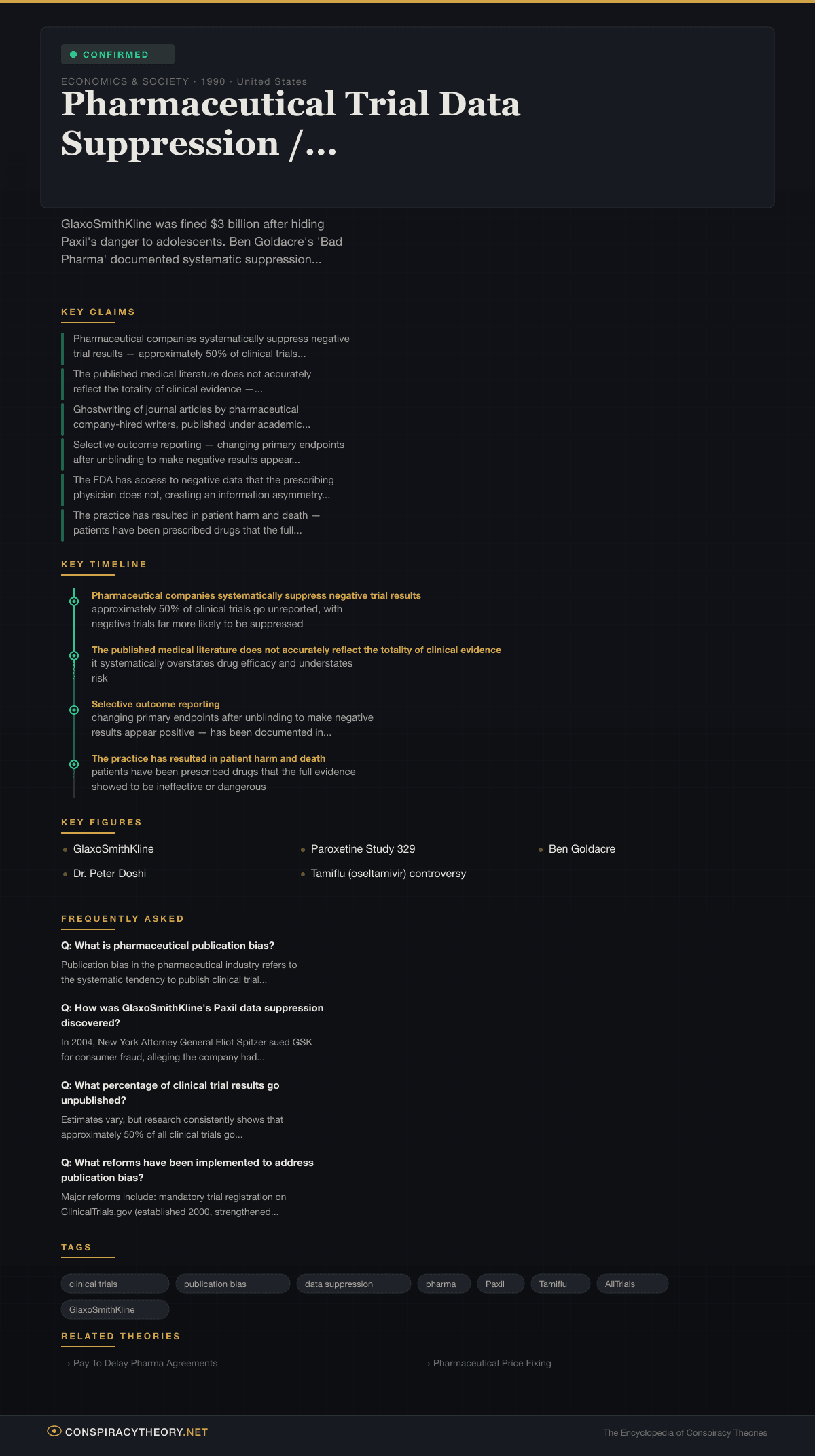
Pharmaceutical Trial Data Suppression / Publication Bias
Overview
Imagine you are a doctor choosing between two antidepressants for a teenage patient. You consult the published medical literature. Drug A has three published studies showing it is safe and effective. Drug B has one study showing modest benefit. You prescribe Drug A. What you do not know — what you cannot know, because the information has been suppressed — is that Drug A actually had seven studies conducted, and four of them showed it did not work. One showed it increased suicidal thinking in adolescents. Those studies were never published. The pharmaceutical company buried them.
This is not a hypothetical. It is exactly what happened with paroxetine (marketed as Paxil in the U.S. and Seroxat in the U.K.), manufactured by GlaxoSmithKline. And Paxil was not an anomaly. It was a case study in a systemic problem that has distorted the entire evidence base of modern medicine: the selective publication of pharmaceutical clinical trial results.
Publication bias in the pharmaceutical industry is a confirmed, documented, litigated, and ongoing reality. Drug companies have been caught suppressing negative trial data, selectively publishing favorable results, ghostwriting journal articles, and creating a body of medical literature that systematically overstates the benefits and understates the risks of their products. The practice has been the subject of congressional investigations, Department of Justice prosecutions, billions of dollars in settlements, and a fundamental rethinking of how clinical evidence should be generated, reported, and shared.
This is not a conspiracy theory in the popular sense. It is a confirmed institutional practice that has been documented by the FDA, exposed by investigative journalists, quantified by researchers, and punished — however inadequately — by courts. The “conspiracy” is not that it happened, but that it happened so systematically, for so long, with such devastating consequences for patients, and that the institutions designed to prevent it repeatedly failed.
Origins & History
The Architecture of Bias
Publication bias did not begin as a deliberate conspiracy. It emerged from the intersection of several structural features of the pharmaceutical research system:
Industry-funded research: By the 1990s, pharmaceutical companies had become the dominant funders of clinical research, conducting or sponsoring the vast majority of drug trials. This gave companies control over study design, data collection, analysis, and publication — a degree of control that created obvious conflicts of interest.
No publication requirement: For most of the modern pharmaceutical era, there was no legal requirement to publish or even register clinical trials. A company could conduct ten trials for a drug, publish the three that showed positive results, and file the seven negative ones in a drawer. The published literature would show a drug that worked every time it was tested.
Journal incentives: Medical journals preferentially publish positive, statistically significant results because these are more cited and more interesting to readers. Negative studies — trials showing no effect — are harder to publish, less prestigious, and less likely to generate media attention. This “publication bias” in journals compounded the industry’s selective reporting.
Regulatory gap: The FDA requires companies to submit all trial data as part of the drug approval process, but the agency was not required to make this data public. A drug could be approved based on a marginal benefit-risk ratio that the published literature misrepresented.
Study 329: The Paxil Scandal
The case that broke the pharmaceutical publication bias story into public consciousness was GlaxoSmithKline’s Study 329 — one of the most thoroughly dissected clinical trials in medical history.
Study 329 was a randomized, controlled trial of paroxetine (Paxil) for the treatment of major depression in adolescents, conducted in the late 1990s. When GSK analyzed the data, the results were clear: paroxetine was no more effective than placebo on the study’s primary endpoints, and the drug was associated with increased suicidal ideation and self-harm in the adolescent population.
What happened next was a masterclass in data manipulation:
The publication: In 2001, a paper was published in the Journal of the American Academy of Child and Adolescent Psychiatry under the authorship of Martin Keller and 21 other academic researchers. The paper concluded that paroxetine was “generally well tolerated and effective” for adolescent depression. This conclusion was achieved by downplaying the primary endpoints (which showed no benefit), emphasizing secondary and post-hoc analyses (which could be cherry-picked for favorable results), and reclassifying adverse events to obscure the suicidality signal.
The ghostwriting: Subsequent investigation revealed that the paper had actually been drafted by a medical communications firm hired by GSK — not by the named academic authors, who had lent their names and credentials to a manufacturer’s marketing document.
The suppression: GSK had conducted other studies of paroxetine in adolescents that also showed negative results. These studies were not published. Internal GSK documents, later disclosed in litigation, showed that the company had a deliberate strategy to “manage the dissemination of data in order to minimize any potential negative commercial impact.”
The consequences: In 2004, New York Attorney General Eliot Spitzer sued GSK for consumer fraud. In 2012, GSK paid $3 billion in criminal and civil penalties — the largest healthcare fraud settlement in U.S. history at the time — for, among other violations, promoting Paxil for adolescent use despite knowing the data did not support it.
In 2015, a team of researchers at the RIAT (Restoring Invisible and Abandoned Trials) initiative re-analyzed the raw Study 329 data and published a corrected paper in the BMJ. Their conclusion: paroxetine was neither effective nor safe in adolescents. The original 2001 paper had gotten it exactly backward.
The Scope of the Problem
Study 329 was not unique. As researchers began systematically comparing published trial results to the full data submitted to regulators, a disturbing pattern emerged:
Antidepressants (2008): Erick Turner and colleagues published a landmark analysis in the New England Journal of Medicine comparing FDA-reviewed antidepressant trials to the published literature. Among 74 FDA-reviewed trials:
- 38 were judged positive by the FDA, and 37 of those were published (97%)
- 36 were judged negative or questionable by the FDA, and only 3 of those were published as negative (8%). The rest were either unpublished (22 trials) or published with a positive spin that contradicted the FDA’s assessment (11 trials)
The published literature suggested that 94% of antidepressant trials were positive. The actual data showed 51%. The difference between these two numbers is the measure of how thoroughly publication bias can distort medical knowledge.
Tamiflu / Oseltamivir: The Cochrane Collaboration — the gold standard for systematic medical evidence review — spent years trying to evaluate the effectiveness of Tamiflu, the antiviral stockpiled by governments worldwide for influenza pandemics. Cochrane researchers discovered that the majority of clinical trial data was unpublished and that the manufacturer, Roche, refused to share it. When the data was finally obtained through regulatory freedom-of-information requests, the evidence for Tamiflu’s effectiveness was far weaker than the published literature had suggested. Ben Goldacre and Peter Doshi were instrumental in exposing this gap.
Rofecoxib (Vioxx): Merck’s arthritis drug Vioxx was withdrawn from the market in 2004 after it was linked to increased heart attack and stroke risk. Post-withdrawal analysis revealed that Merck had been aware of cardiovascular safety signals from early clinical trials but had selectively published data emphasizing the drug’s gastrointestinal safety advantages while minimizing the cardiovascular risks.
Key Claims
Confirmed Claims
- Pharmaceutical companies systematically suppress negative trial results — approximately 50% of clinical trials go unreported, with negative trials far more likely to be suppressed
- The published medical literature does not accurately reflect the totality of clinical evidence — it systematically overstates drug efficacy and understates risk
- Ghostwriting of journal articles by pharmaceutical company-hired writers, published under academic authors’ names, is a documented practice
- Selective outcome reporting — changing primary endpoints after unblinding to make negative results appear positive — has been documented in numerous trials
- The FDA has access to negative data that the prescribing physician does not, creating an information asymmetry that compromises clinical decision-making
- The practice has resulted in patient harm and death — patients have been prescribed drugs that the full evidence showed to be ineffective or dangerous
Ongoing Debates
- Whether current transparency reforms (trial registration, results reporting requirements) are sufficient to address the problem
- Whether the FDA should proactively publish all submitted trial data
- Whether individual researchers and journal editors bear responsibility for failing to demand data transparency
- Whether financial penalties are adequate deterrents or simply a cost of doing business for companies earning billions from the drugs in question
Evidence
Government Enforcement
The evidence for pharmaceutical publication bias is not theoretical — it has been established through government investigations and enforcement actions:
Department of Justice settlements:
- GlaxoSmithKline: $3 billion (2012) — suppression of Paxil adolescent data, among other violations
- Pfizer: $2.3 billion (2009) — illegal marketing including misrepresentation of clinical data
- AstraZeneca: $520 million (2010) — illegal marketing of Seroquel, including suppression of unfavorable data
- Merck: $950 million (2011) — Vioxx marketing and safety data issues
FDA analyses: The FDA’s own reviews of submitted trial data have repeatedly shown that the published literature presents a more favorable picture than the regulatory submissions support.
Congressional investigations: Multiple congressional hearings have examined pharmaceutical data suppression, with testimony from whistleblowers, FDA officials, and academic researchers documenting the scope of the problem.
Academic Research
Turner et al. (2008): The NEJM study comparing published and FDA-assessed antidepressant trials is the single most cited piece of evidence for pharmaceutical publication bias. Its findings — that the published literature overstated antidepressant efficacy by a factor of nearly 2:1 — fundamentally changed the field’s understanding of the evidence base.
Cochrane Collaboration Tamiflu review: The multi-year effort to obtain unpublished Tamiflu data demonstrated that even well-resourced, systematic review organizations could be stymied by pharmaceutical companies’ refusal to share trial data.
RIAT Initiative: The Restoring Invisible and Abandoned Trials project has systematically re-analyzed trials whose original publications misrepresented the data, publishing corrected versions that reflect the actual results.
COMPare Project: Led by Ben Goldacre at the University of Oxford, the COMPare project tracked outcome switching in clinical trials — the practice of changing which outcomes are reported between a trial’s registered protocol and its published results. The project found widespread outcome switching, even in leading medical journals.
Debunking / Verification
Pharmaceutical publication bias is classified as confirmed based on:
- Government enforcement actions resulting in billions of dollars in fines
- FDA data showing systematic discrepancies between submitted and published results
- Academic research quantifying the extent of selective publication
- Internal company documents disclosed in litigation showing deliberate suppression strategies
- Whistleblower testimony from former pharmaceutical employees and academic researchers
- Systematic re-analysis of suppressed data showing that original publications misrepresented results
There is nothing to debunk. The pharmaceutical industry has not seriously contested that publication bias exists — the defense has instead focused on arguing that individual cases were justified, that reforms have been implemented, and that the problem is less severe than critics claim.
Cultural Impact
Pharmaceutical publication bias has had profound effects on both medicine and public trust:
Medical Practice
The revelation that the published evidence base is systematically distorted has undermined the foundation of evidence-based medicine — the principle that clinical decisions should be based on the best available evidence. If the best available evidence has been systematically skewed by industry publication decisions, then evidence-based medicine has been corrupted at its source.
This has driven several major reforms:
- Trial registration (ClinicalTrials.gov, WHO International Clinical Trials Registry Platform) — requiring trials to be registered before they begin, creating a record that can be compared to publications
- Results reporting mandates (FDA Amendments Act of 2007) — requiring sponsors to report trial results within specified timeframes
- Open data policies (European Medicines Agency) — making clinical study reports publicly available
- AllTrials campaign (launched 2013 by Ben Goldacre and others) — advocating for complete transparency of all clinical trial data
Public Trust
The publication bias story has contributed significantly to public distrust of the pharmaceutical industry and, more broadly, of medical authority. When patients learn that their doctors’ prescribing decisions may have been based on manipulated evidence, it undermines the physician-patient relationship. This distrust has unfortunately been exploited by anti-vaccination and alternative medicine movements, which use documented pharmaceutical industry misconduct to justify rejecting mainstream medicine entirely — a logical leap that is not supported by the evidence but is emotionally compelling.
Ben Goldacre and the Public Conversation
British physician and science journalist Ben Goldacre has been the most prominent public advocate for trial transparency. His 2012 book Bad Pharma: How Drug Companies Mislead Doctors and Harm Patients presented the publication bias evidence in accessible, compelling prose and reached a general audience that academic papers could not. Goldacre’s AllTrials campaign, which collected support from hundreds of thousands of individuals and hundreds of organizations, helped make trial transparency a political issue in the UK and Europe.
The $3 Billion Question
GSK’s $3 billion settlement in 2012 — the largest healthcare fraud penalty in U.S. history at the time — was widely noted to be a fraction of the revenue the company had earned from the drugs in question. This sparked the ongoing debate about whether financial penalties function as genuine deterrents or merely as a cost of doing business. When hiding negative data generates billions in revenue and the fine is a fraction of that revenue, the economic incentives for data suppression remain intact.
Timeline
| Date | Event |
|---|---|
| 1984 | Hatch-Waxman Act restructures drug development and approval |
| Late 1990s | GSK conducts Study 329 on paroxetine in adolescents; results show no efficacy and increased suicidality |
| 2001 | Study 329 published in JAACAP with ghostwritten positive conclusions |
| 2000 | ClinicalTrials.gov registry established by NIH |
| 2003 | FDA adds black box warning to antidepressants for suicidality risk in youth |
| 2004 | New York AG Eliot Spitzer sues GSK for Paxil consumer fraud |
| 2004 | Vioxx withdrawn from market; Merck’s suppression of cardiovascular risk data revealed |
| 2007 | FDA Amendments Act requires trial results reporting on ClinicalTrials.gov |
| 2008 | Turner et al. publish landmark NEJM study on antidepressant publication bias |
| 2009 | Cochrane Collaboration begins multi-year effort to obtain unpublished Tamiflu data |
| 2012 | GSK pays $3 billion in healthcare fraud settlement |
| 2012 | Ben Goldacre publishes Bad Pharma |
| 2013 | AllTrials campaign launched, advocating complete trial transparency |
| 2014 | European Medicines Agency adopts policy of proactive clinical data publication |
| 2015 | RIAT initiative publishes corrected re-analysis of Study 329 in the BMJ |
| 2016 | COMPare project documents widespread outcome switching in published trials |
| 2017 | Compliance with ClinicalTrials.gov reporting requirements remains inconsistent |
| 2020s | Trial transparency reforms continue; full compliance remains elusive |
Sources & Further Reading
- Goldacre, Ben. Bad Pharma: How Drug Companies Mislead Doctors and Harm Patients. Fourth Estate, 2012.
- Turner, Erick H., et al. “Selective Publication of Antidepressant Trials and Its Influence on Apparent Efficacy.” New England Journal of Medicine 358, no. 3 (2008): 252-260.
- Le Noury, Joanna, et al. “Restoring Study 329: Efficacy and Harms of Paroxetine and Imipramine in Treatment of Major Depression in Adolescence.” BMJ 351 (2015): h4320.
- Jefferson, Tom, et al. “Neuraminidase Inhibitors for Preventing and Treating Influenza in Adults and Children.” Cochrane Database of Systematic Reviews (2014).
- Doshi, Peter. “Tamiflu: The Story of an Influenza Drug.” BMJ 349 (2014): g5312.
- Song, Fujian, et al. “Dissemination and Publication of Research Findings: An Updated Review of Related Biases.” Health Technology Assessment 14, no. 8 (2010).
- AllTrials Campaign. “About AllTrials.” alltrials.net.
- Jureidini, Jon, and Leemon B. McHenry. The Illusion of Evidence-Based Medicine: Exposing the Crisis of Credibility in Clinical Research. Wakefield Press, 2020.
Related Theories
- Pay-to-Delay Agreements — Another confirmed pharmaceutical anticompetitive practice
- Big Pharma Price Gouging — Broader pharmaceutical industry profit-maximization at patient expense
- Vioxx Cover-Up — A specific case of pharmaceutical safety data suppression
Frequently Asked Questions
What is pharmaceutical publication bias?
How was GlaxoSmithKline's Paxil data suppression discovered?
What percentage of clinical trial results go unpublished?
What reforms have been implemented to address publication bias?

Infographic
Share this visual summary. Right-click to save.