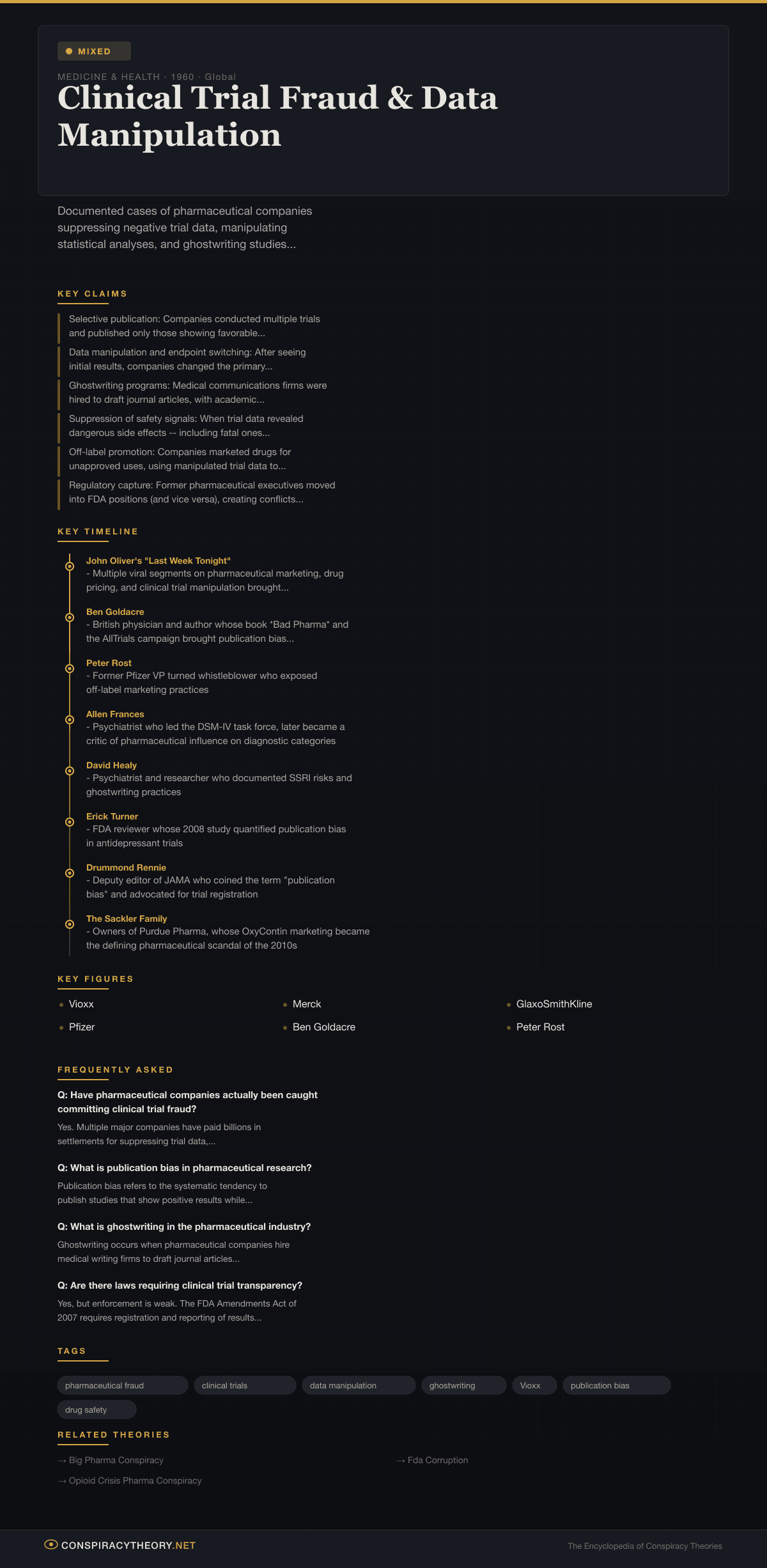
Clinical Trial Fraud & Data Manipulation
Overview
Here is something unusual about the phrase “pharmaceutical conspiracy theory”: a disturbing amount of it is just pharmaceutical history. Over the past several decades, a litany of court cases, regulatory actions, and internal document leaks have demonstrated that clinical trial fraud is not a fringe accusation but a well-documented business practice within parts of the pharmaceutical industry. Companies have suppressed data showing their drugs cause heart attacks, manipulated statistical analyses to manufacture evidence of efficacy, hired ghostwriters to produce fake academic papers, and paid billions in fines while their executives faced minimal personal consequences.
The documented cases are extraordinary in scope. Merck’s Vioxx scandal, GlaxoSmithKline’s concealment of Paxil’s risks in children, Pfizer’s illegal marketing of Bextra, the systematic suppression of negative SSRI data — these are not allegations from conspiracy theorists but findings from federal courts, congressional investigations, and peer-reviewed meta-analyses. The “mixed” status here reflects a genuine tension: the specific proven cases are devastating, but the broader conspiracy narrative — that the entire pharmaceutical industry is engaged in a coordinated campaign to poison the public for profit — extends well beyond what the evidence supports.
What makes this topic particularly treacherous is that real, proven fraud has been weaponized by anti-vaccination movements and alternative medicine grifters to discredit all pharmaceutical science. The documented crimes are serious enough on their own. They don’t need embellishment.
Origins & History
The modern history of clinical trial fraud is inseparable from the history of clinical trials themselves. Before the 1960s, drug safety regulation was minimal. The thalidomide disaster of 1961, in which a sedative caused severe birth defects in thousands of children, prompted the Kefauver-Harris Amendment of 1962, requiring for the first time that drugs be proven both safe and effective through controlled clinical trials before FDA approval.
This created a new problem. If pharmaceutical companies now needed clinical trial data to sell drugs, they had a powerful financial incentive to ensure that data looked favorable — regardless of what the trials actually showed.
Early warning signs appeared in the 1970s and 1980s, but the modern era of pharmaceutical fraud scandals really began in the late 1990s. The explosion of blockbuster drugs — medications generating over $1 billion annually — raised the financial stakes of trial outcomes to astronomical levels. A single unfavorable study could wipe billions from a company’s market capitalization overnight.
The shift toward company-sponsored research (rather than independent academic research) accelerated the problem. By 2000, roughly 70% of clinical trial funding in the United States came from industry rather than the NIH or academic institutions. This gave companies direct control over study design, data collection, statistical analysis, and publication decisions.
Key Claims
The documented practices that have been proven in court or confirmed through internal documents include:
-
Selective publication: Companies conducted multiple trials and published only those showing favorable results, burying negative studies in file drawers. This distorted the apparent evidence base that physicians relied on for prescribing decisions.
-
Data manipulation and endpoint switching: After seeing initial results, companies changed the primary endpoints of their trials (what the study was supposedly measuring) to produce more favorable-looking statistics.
-
Ghostwriting programs: Medical communications firms were hired to draft journal articles, with academic researchers recruited afterward to serve as named “authors” who lent their institutional credibility to what were essentially marketing documents.
-
Suppression of safety signals: When trial data revealed dangerous side effects — including fatal ones — companies buried or minimized the findings rather than issuing warnings.
-
Off-label promotion: Companies marketed drugs for unapproved uses, using manipulated trial data to support indications the FDA had never reviewed.
-
Regulatory capture: Former pharmaceutical executives moved into FDA positions (and vice versa), creating conflicts of interest in the approval process.
The broader conspiracy claim extends further, alleging that these are not isolated incidents but an industry-wide pattern enabled by regulatory complicity, academic corruption, and media dependence on pharmaceutical advertising revenue.
Evidence
The Vioxx Scandal (Merck)
The Vioxx case remains the most devastating example. Merck’s painkiller rofecoxib (Vioxx) was approved in 1999 and generated $2.5 billion in annual sales by 2003. Internal documents later revealed that Merck knew of cardiovascular risks as early as 2000 but actively worked to suppress and discredit the data.
The VIGOR trial, published in the New England Journal of Medicine in 2000, showed Vioxx patients had five times the rate of heart attacks compared to naproxen. Merck publicly argued this was because naproxen was cardioprotective, not because Vioxx was dangerous — an explanation their own scientists privately doubted. Internal emails showed Merck employees developing strategies to discredit physicians who raised safety concerns, including a “destroy them where they live” approach to critical researchers.
When Merck finally withdrew Vioxx in 2004, an estimated 88,000 Americans had suffered heart attacks from the drug, and roughly 38,000 had died. Merck settled the resulting lawsuits for $4.85 billion.
GlaxoSmithKline’s Paxil and Avandia Fraud
GSK’s case was equally damning. The company suppressed clinical trial data showing that its antidepressant paroxetine (Paxil) was ineffective in adolescents and actually increased suicidal thinking. The infamous Study 329, ghostwritten and published in 2001 in the Journal of the American Academy of Child and Adolescent Psychiatry, concluded that Paxil was “generally well tolerated and effective” in adolescent depression. A 2015 re-analysis of the raw data by independent researchers found the exact opposite: Paxil was no more effective than placebo and significantly increased the risk of suicidal ideation.
GSK also concealed safety data about its diabetes drug rosiglitazone (Avandia), which was later linked to a 43% increase in heart attacks. In 2012, GSK pleaded guilty to criminal charges and paid $3 billion — at the time the largest healthcare fraud settlement in U.S. history.
The Pfizer-Bextra Case
Pfizer paid $2.3 billion in 2009 to settle charges related to illegal off-label marketing of Bextra (valdecoxib) and several other drugs. The company had promoted Bextra for uses and dosages the FDA had explicitly refused to approve, specifically because of safety concerns.
Systematic Publication Bias
Beyond individual scandals, systematic analyses have revealed pervasive publication bias. A landmark 2008 study in the New England Journal of Medicine by Erick Turner and colleagues examined 74 FDA-registered antidepressant trials. Of the 38 trials the FDA deemed positive, 37 were published. Of the 36 trials the FDA deemed negative or questionable, only 3 were published as negative — 22 were never published at all, and 11 were published with a positive spin that contradicted the FDA’s assessment.
Ben Goldacre’s 2012 book Bad Pharma systematically documented the scope of the problem, drawing on hundreds of examples of publication bias, data manipulation, and regulatory failure. The AllTrials campaign, launched in 2013, found that roughly 50% of all clinical trials had never been published.
Ghostwriting Documentation
Internal documents from the Vioxx litigation revealed that Merck’s ghostwriting program for Vioxx included at least 96 published articles. Wyeth’s ghostwriting program for its hormone replacement therapy Prempro involved 26 ghostwritten papers published in major journals between 1998 and 2005. In each case, the named academic “authors” had little or no involvement in data analysis or writing.
Debunking / Verification
The individual cases listed above are not conspiracy theories — they are proven facts, established through court proceedings, regulatory findings, and analysis of internal corporate documents obtained during litigation. Merck, GSK, and Pfizer all either pleaded guilty or settled the relevant cases.
However, several important caveats apply to the broader narrative:
What is proven:
- Specific major companies committed specific acts of fraud
- Publication bias is a systemic, measurable problem
- Ghostwriting has been pervasive in industry-sponsored research
- Regulatory oversight has been inadequate
- Financial penalties have been insufficient to deter fraud (often amounting to a small fraction of drug profits)
What is overstated or unproven:
- The claim that the entire pharmaceutical industry is fundamentally corrupt
- The claim that most or all drugs are ineffective or harmful
- The claim that the FDA is knowingly complicit in a coordinated cover-up
- The extension of these legitimate criticisms to discredit vaccines, which undergo separate and more rigorous surveillance
- The claim that “natural” alternatives suppressed by pharmaceutical companies are effective replacements
The pharmaceutical industry has produced genuinely life-saving medications. Antibiotics, antiretrovirals, cancer treatments, and vaccines have saved hundreds of millions of lives. The documented fraud exists alongside genuine therapeutic innovation — which is precisely what makes it so corrosive.
Cultural Impact
The proven cases of pharmaceutical fraud have had enormous consequences for public trust in medicine. Surveys consistently show that public confidence in pharmaceutical companies ranks below almost every other industry, including oil companies and banks. A 2019 Gallup poll found that only 27% of Americans viewed the pharmaceutical industry positively — the lowest rating of any industry surveyed.
This erosion of trust has had both constructive and destructive effects. On the constructive side, it has fueled meaningful reform efforts: the AllTrials campaign, increased requirements for trial registration, the FDA Amendments Act of 2007, and greater scrutiny of industry-funded research.
On the destructive side, documented fraud has been weaponized by anti-vaccination movements, alternative medicine proponents, and health misinformation outlets. The logic is simple but fallacious: “Merck lied about Vioxx, therefore you can’t trust any vaccine.” This conflation of specific proven fraud with blanket rejection of pharmaceutical science has contributed to declining vaccination rates and the resurgence of preventable diseases.
The opioid crisis added another layer. The revelation that Purdue Pharma deliberately downplayed OxyContin’s addictiveness while aggressively marketing it to physicians — contributing to an epidemic that has killed over 500,000 Americans — made the most extreme characterizations of the industry seem understated.
In Popular Culture
- “The Constant Gardener” (2005) — John le Carre’s novel and the subsequent film depicted a pharmaceutical company conducting lethal drug trials in Africa, directly inspired by real events
- “Side Effects” (2013) — Steven Soderbergh’s thriller explored pharmaceutical manipulation and the entanglement of psychiatry with drug companies
- “Dopesick” (2021) — Hulu miniseries dramatizing Purdue Pharma’s role in the opioid crisis
- “Bad Pharma” (2012) — Ben Goldacre’s nonfiction book became a bestseller and launched the AllTrials campaign
- “Pharma Bro” documentary (2021) — While focused on Martin Shkreli’s price-gouging, it reflected broader public fury at pharmaceutical industry practices
- John Oliver’s “Last Week Tonight” — Multiple viral segments on pharmaceutical marketing, drug pricing, and clinical trial manipulation brought these issues to mainstream audiences
Key Figures
- Ben Goldacre — British physician and author whose book Bad Pharma and the AllTrials campaign brought publication bias to mainstream attention
- Peter Rost — Former Pfizer VP turned whistleblower who exposed off-label marketing practices
- Allen Frances — Psychiatrist who led the DSM-IV task force, later became a critic of pharmaceutical influence on diagnostic categories
- David Healy — Psychiatrist and researcher who documented SSRI risks and ghostwriting practices
- Erick Turner — FDA reviewer whose 2008 study quantified publication bias in antidepressant trials
- Drummond Rennie — Deputy editor of JAMA who coined the term “publication bias” and advocated for trial registration
- The Sackler Family — Owners of Purdue Pharma, whose OxyContin marketing became the defining pharmaceutical scandal of the 2010s
Timeline
| Date | Event |
|---|---|
| 1961 | Thalidomide disaster prompts overhaul of drug regulation |
| 1962 | Kefauver-Harris Amendment requires clinical trial evidence for drug approval |
| 1997 | FDA relaxes direct-to-consumer advertising rules, pharmaceutical marketing spending explodes |
| 1999 | Vioxx (rofecoxib) approved by FDA, Merck begins aggressive marketing |
| 2000 | VIGOR trial data shows elevated heart attack risk with Vioxx; Merck disputes interpretation |
| 2001 | GlaxoSmithKline’s ghostwritten Study 329 claims Paxil is effective in adolescents |
| 2004 | Merck voluntarily withdraws Vioxx from market after APPROVE trial confirms cardiovascular risk |
| 2007 | FDA Amendments Act requires registration and reporting of clinical trial results |
| 2007 | Avandia meta-analysis by Steve Nissen reveals 43% increased heart attack risk |
| 2008 | Erick Turner publishes landmark study documenting publication bias in antidepressant trials |
| 2009 | Pfizer pays $2.3 billion to settle Bextra and off-label marketing charges |
| 2012 | GlaxoSmithKline pleads guilty, pays $3 billion for Paxil, Avandia, and Wellbutrin fraud |
| 2012 | Ben Goldacre publishes Bad Pharma |
| 2013 | AllTrials campaign launches, demanding registration and publication of all clinical trials |
| 2015 | RIAT re-analysis of Study 329 reverses original conclusions about Paxil in adolescents |
| 2020 | Purdue Pharma pleads guilty to criminal charges related to OxyContin marketing |
| 2022 | Sackler family agrees to $6 billion settlement over opioid crisis |
Sources & Further Reading
- Goldacre, Ben. Bad Pharma: How Drug Companies Mislead Doctors and Harm Patients. Faber & Faber, 2012.
- Turner, Erick H., et al. “Selective Publication of Antidepressant Trials and Its Influence on Apparent Efficacy.” New England Journal of Medicine, vol. 358, no. 3, 2008, pp. 252-260.
- Le Noury, Joanna, et al. “Restoring Study 329: Efficacy and Harms of Paroxetine and Imipramine in Treatment of Major Depression in Adolescence.” BMJ, vol. 351, 2015.
- Nissen, Steven E., and Kathy Wolski. “Effect of Rosiglitazone on the Risk of Myocardial Infarction and Death from Cardiovascular Causes.” New England Journal of Medicine, vol. 356, no. 24, 2007.
- Ross, Joseph S., et al. “Guest Authorship and Ghostwriting in Publications Related to Rofecoxib.” JAMA, vol. 299, no. 15, 2008.
- U.S. Department of Justice. “GlaxoSmithKline to Plead Guilty and Pay $3 Billion.” Press release, July 2, 2012.
- Angell, Marcia. The Truth About the Drug Companies: How They Deceive Us and What to Do About It. Random House, 2004.
- AllTrials Campaign. “AllTrials: All Trials Registered, All Results Reported.” alltrials.net.
Related Theories
- Big Pharma Conspiracy — the broader theory that pharmaceutical companies systematically prioritize profit over patient welfare
- FDA Corruption — allegations that the FDA has been captured by the industries it regulates
- Opioid Crisis Pharma Conspiracy — the documented role of pharmaceutical marketing in creating the opioid epidemic
Frequently Asked Questions
Have pharmaceutical companies actually been caught committing clinical trial fraud?
What is publication bias in pharmaceutical research?
What is ghostwriting in the pharmaceutical industry?
Are there laws requiring clinical trial transparency?
Infographic
Share this visual summary. Right-click to save.