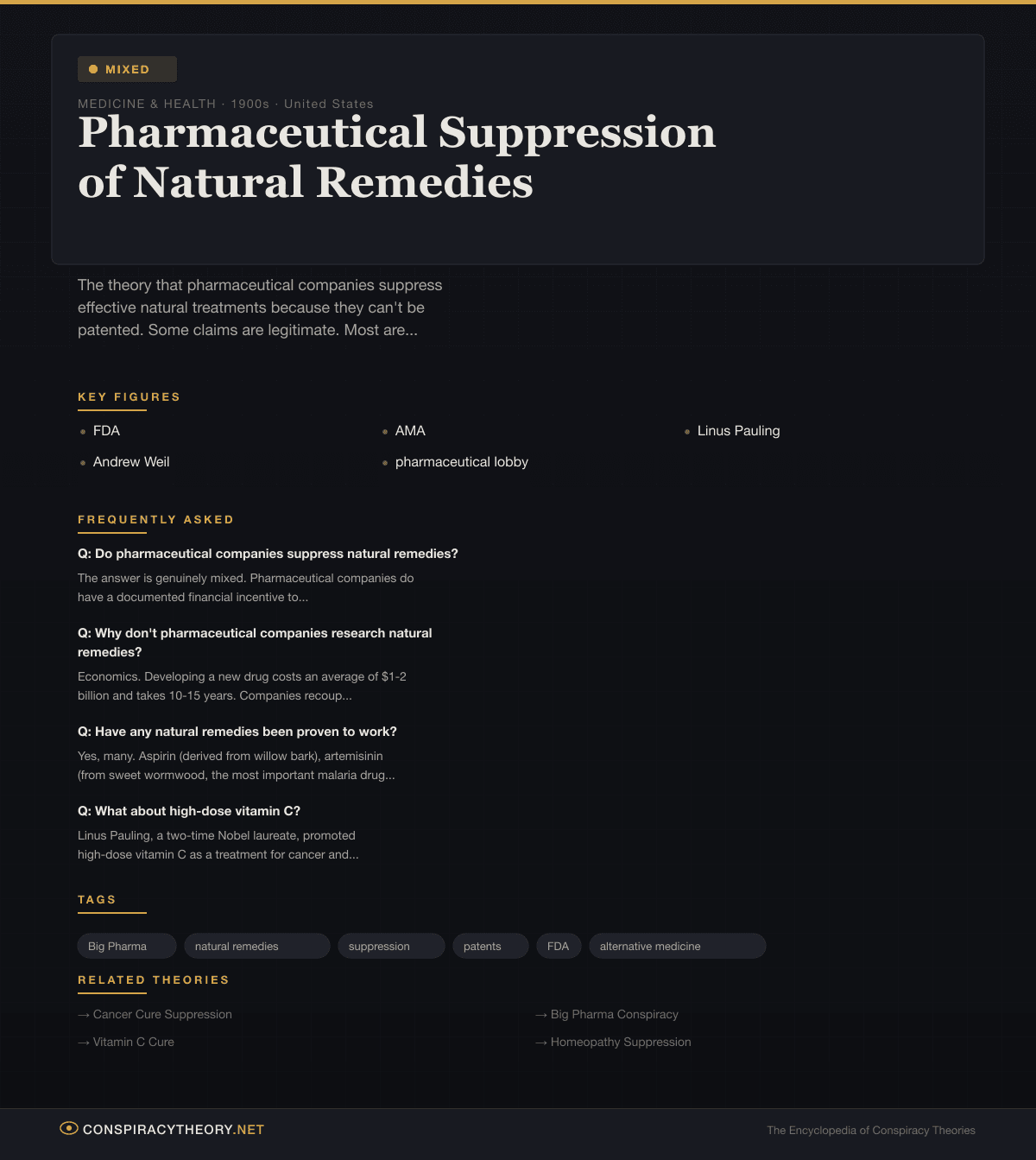
Pharmaceutical Suppression of Natural Remedies
Overview
There is a version of this theory that is nonsense: that the pharmaceutical industry has secret vaults full of miracle cures that it keeps locked away to protect its profits. That cancer has been cured, that diabetes can be reversed with cinnamon, that the common cold would have been eliminated decades ago if not for Big Pharma’s stranglehold on medicine. That version is fantasy, built on a fundamental misunderstanding of how disease and treatment work.
Then there is another version of this theory that is uncomfortably close to the truth: that the pharmaceutical industry’s business model creates systematic disincentives for researching unpatentable treatments. That billions of dollars flow toward developing patentable variations of existing drugs (“me-too” drugs) while potentially valuable natural compounds go unstudied. That the regulatory system — the FDA, the clinical trial process, the insurance reimbursement structure — is designed around patented pharmaceuticals in ways that disadvantage alternatives.
The challenge is that both versions circulate simultaneously, and distinguishing between legitimate structural criticism and snake-oil salesmanship requires more effort than most people are willing to invest. The wellness industry profits from blurring the line. And the pharmaceutical industry’s own documented misconduct — ghostwriting studies, hiding negative trial data, bribing doctors — makes it harder to dismiss claims of suppression as paranoia.
The Patent Problem
The Economics of Drug Development
The pharmaceutical suppression theory begins with a real economic fact: developing a new drug is extraordinarily expensive. The average cost of bringing a drug from discovery to market is estimated at $1-2.6 billion, depending on the study. The process takes 10-15 years. Most drugs that enter clinical trials fail — only about 12% of drugs that begin Phase I trials eventually receive FDA approval.
Companies recoup this investment through patents, which grant 20 years of exclusive sales rights. During the patent period, the company can charge high prices without competition. After the patent expires, generic manufacturers enter the market and prices drop, typically by 80-90%.
This system has a critical structural flaw: it only funds research into substances that can be patented.
Natural compounds — vitamin C, turmeric, willow bark, mushroom extracts — generally cannot be patented because they are “products of nature.” (Companies can sometimes patent specific formulations, delivery mechanisms, or synthetic analogs, but not the natural substance itself.) If a company spends $1 billion proving that a natural compound cures a disease, any competitor can sell that same compound the next day. There is no exclusivity period, no way to recoup the investment.
This means that even if a natural compound has genuine therapeutic potential, there is no business incentive to fund the rigorous clinical trials needed to prove it. The compound might work. It might save lives. But no one will pay to find out because no one can profit from the answer.
The Funding Gap
This structural problem creates what researchers call the “valley of death” for natural compound research. Academic scientists may identify promising natural compounds in laboratory studies, but they cannot fund the large-scale clinical trials needed for FDA approval. The NIH funds some such research, but its budget is limited relative to industry spending. Philanthropic organizations occasionally fund trials of natural compounds, but the overall investment is a fraction of what the pharmaceutical industry spends on patentable drugs.
The result is not active suppression — it’s passive neglect. Natural compounds aren’t being hidden in a vault. They’re sitting in published scientific literature, understudied and underfunded, because the economic system doesn’t reward investigating them.
This is a real problem. It is not, however, the same thing as a conspiracy.
The Historical Record
What’s Been Adopted
When natural compounds prove effective, the pharmaceutical industry has a strong track record of adopting them — usually by isolating the active ingredient, purifying it, and selling it as a drug:
- Aspirin: Derived from salicin in willow bark, used medicinally for thousands of years, synthesized by Bayer in 1897
- Artemisinin: Derived from sweet wormwood (Artemisia annua), discovered by Chinese chemist Tu Youyou in 1972, now the most important antimalarial drug in the world (Tu won the Nobel Prize in 2015)
- Taxol (paclitaxel): Derived from Pacific yew bark, one of the most important chemotherapy drugs
- Digoxin: Derived from foxglove, essential for treating heart failure
- Morphine: Derived from opium poppies, the gold standard for pain management
- Metformin: Derived from French lilac (Galega officinalis), the most prescribed diabetes drug in the world
An estimated 25-50% of approved pharmaceuticals are derived from or inspired by natural compounds. The pharmaceutical industry doesn’t suppress natural remedies categorically — it industrializes the ones that work.
What’s Been Oversold
The flip side: many natural remedies that have been tested rigorously have failed to demonstrate the effects their proponents claim:
- Linus Pauling’s vitamin C claims: Multiple large-scale trials failed to show that high-dose vitamin C cures cancer or prevents colds (it reduces cold duration modestly)
- Echinacea: Widely promoted for cold prevention, but major clinical trials (including a 2005 New England Journal of Medicine study) found no significant benefit
- Homeopathy: The most studied alternative therapy, consistently found to perform no better than placebo in rigorous trials
- Laetrile (amygdalin/vitamin B17): Promoted as a cancer cure, tested by the NCI, found to have no anticancer activity and significant toxicity (cyanide release)
- Shark cartilage: Promoted as a cancer treatment based on the misconception that sharks don’t get cancer (they do), found ineffective in clinical trials
The pattern is consistent: when natural remedies are subjected to the same rigorous testing as pharmaceutical drugs, most perform poorly. The ones that work become pharmaceutical drugs. The ones that don’t become the subject of suppression theories.
The Legitimate Grievances
Industry Misconduct
The pharmaceutical industry’s own behavior makes suppression theories plausible:
Publication bias: Companies have a documented pattern of publishing positive trial results while suppressing negative ones. GlaxoSmithKline’s concealment of data showing paroxetine (Paxil) was ineffective and potentially dangerous for adolescents is one of the most egregious examples.
Ghostwriting: Companies have hired medical communications firms to draft scientific papers favorable to their products, then recruited academic physicians to serve as nominal authors.
Marketing as science: The line between pharmaceutical marketing and medical education has been systematically blurred through industry-funded continuing medical education, speaker programs, and “key opinion leader” networks.
Regulatory revolving door: Former FDA officials regularly take positions in the pharmaceutical industry, and former industry executives serve at the FDA. This revolving door creates at least the appearance of regulatory capture.
These are documented practices, not conspiracy theories. They are the subject of federal lawsuits, congressional investigations, and billions of dollars in fines. When people say they don’t trust the pharmaceutical industry, they’re not being irrational — they’re responding to the industry’s own track record.
The AMA’s History
The American Medical Association has historically been hostile to competing medical traditions. In the early 20th century, the AMA actively worked to eliminate chiropractic, naturopathic, and homeopathic practitioners — not always on the basis of scientific evidence but sometimes to protect physicians’ market share. The AMA was found liable for antitrust violations against chiropractors in a 1987 federal court decision (Wilk v. American Medical Association).
This history provides legitimate grievances for alternative medicine practitioners, even when the specific claims about suppressed remedies are unsupported.
The Modern Landscape
The Wellness Industrial Complex
The irony of the pharmaceutical suppression narrative is that it’s now promoted by an industry that is itself massive and commercially motivated. The global dietary supplement market was valued at approximately $177 billion in 2023. Companies like Goop, Dr. Mercola’s enterprises, and hundreds of supplement manufacturers profit directly from the narrative that pharmaceutical companies are suppressing natural cures.
These companies are not nonprofit truth-tellers fighting Big Pharma. They are commercial operations with their own financial interests — interests that are served by maintaining the narrative of pharmaceutical suppression, regardless of whether any specific natural remedy actually works.
The supplement industry operates under dramatically lower regulatory standards than pharmaceuticals. Under the Dietary Supplement Health and Education Act (DSHEA) of 1994, supplements do not need to prove safety or efficacy before being sold. The result is an industry that criticizes pharmaceutical regulation while benefiting from its own lack of regulation.
The Bottom Line
The pharmaceutical suppression theory occupies a genuinely complicated middle ground. The structural incentive problems are real. The funding gap for natural compound research is real. The pharmaceutical industry’s history of misconduct is real. But the leap from “the system underfunds natural remedy research” to “effective cures are being suppressed” is not supported by evidence.
The most honest assessment: the pharmaceutical system is flawed in ways that disadvantage certain types of research. But the specific natural remedies most commonly promoted by suppression theorists — high-dose vitamins, herbal cancer cures, frequency therapy — have generally failed when tested rigorously. The problem is not that these treatments are being hidden. It’s that they mostly don’t work as well as their advocates believe.
Timeline
| Date | Event |
|---|---|
| 1897 | Bayer synthesizes aspirin from willow bark compound |
| Early 1900s | AMA campaigns against alternative practitioners |
| 1938 | Food, Drug, and Cosmetic Act establishes FDA drug regulation |
| 1970s | Linus Pauling promotes high-dose vitamin C |
| 1972 | Tu Youyou discovers artemisinin from sweet wormwood |
| 1987 | Federal court finds AMA liable for antitrust against chiropractors |
| 1994 | DSHEA loosens supplement regulation |
| 2004 | Vioxx withdrawn; pharmaceutical credibility damaged |
| 2012 | GlaxoSmithKline pays $3 billion for fraud and marketing violations |
| 2023 | Global supplement market reaches ~$177 billion |
Sources & Further Reading
- Angell, Marcia. The Truth About the Drug Companies. Random House, 2004.
- Goldacre, Ben. Bad Pharma: How Drug Companies Mislead Doctors and Harm Patients. Faber & Faber, 2012.
- Newman, David J., and Gordon M. Cragg. “Natural Products as Sources of New Drugs.” Journal of Natural Products, 2020.
- Ernst, Edzard. Trick or Treatment: The Undeniable Facts about Alternative Medicine. W.W. Norton, 2008.
- Wilk v. American Medical Association, 895 F.2d 352 (7th Cir. 1990).
Related Theories
- Cancer Cure Suppression — The specific cancer variant of this theory
- Big Pharma Conspiracy — The broader pharmaceutical conspiracy framework
- Vitamin C Cure — Linus Pauling’s specific claims
- Homeopathy Suppression — Claims about suppression of homeopathic medicine
Frequently Asked Questions
Do pharmaceutical companies suppress natural remedies?
Why don't pharmaceutical companies research natural remedies?
Have any natural remedies been proven to work?
What about high-dose vitamin C?
Infographic
Share this visual summary. Right-click to save.