Phoebus Cartel — Lightbulb Planned Obsolescence

Overview
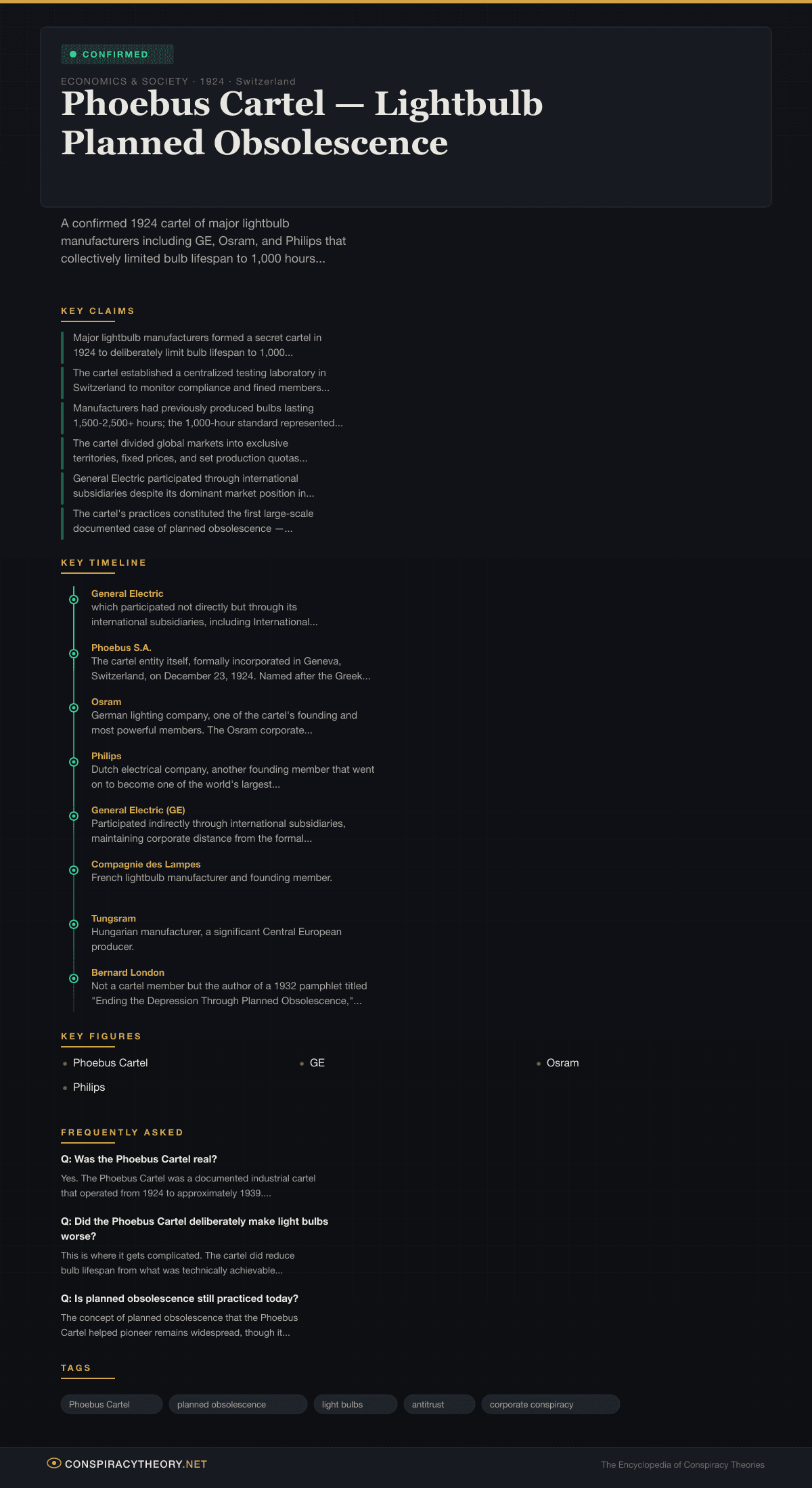
The Phoebus Cartel is the rare conspiracy theory that turned out to be entirely true — and not in the vague, circumstantial way that most “confirmed” conspiracy theories hold up. It is documented with the precision of an accounting audit: meeting minutes, penalty schedules, testing protocols, and internal correspondence that spell out, in the manufacturers’ own handwriting, a deliberate, coordinated plan to make light bulbs die sooner than they needed to.
Formed on December 23, 1924, in Geneva, Switzerland, the cartel brought together the world’s dominant lightbulb manufacturers — Osram (Germany), Philips (Netherlands), General Electric (United States, through subsidiaries), Compagnie des Lampes (France), Tungsram (Hungary), and others — to standardize the lifespan of incandescent bulbs at 1,000 hours. This was not a floor but a ceiling. At the time of the cartel’s formation, some manufacturers were producing bulbs that lasted 1,500 to 2,500 hours. The cartel agreement required them to engineer their products to fail sooner, and it backed that requirement with fines.
The Phoebus Cartel did more than sell shorter-lived light bulbs. It established the template for a concept that would come to define modern consumer capitalism: planned obsolescence — the deliberate design of products to have an artificially limited useful life, ensuring a perpetual cycle of replacement purchases. Every time you wonder why your phone’s battery cannot be replaced, why your printer stops working after a software update, or why your appliances seem to break right after the warranty expires, you are living in the world the Phoebus Cartel helped build.
Origins & History
The Business Problem of a Good Product
The incandescent light bulb, commercialized by Thomas Edison in 1879, matured rapidly as a technology. By the early 1900s, the transition from carbon filaments to drawn tungsten wire dramatically improved both efficiency and longevity. Manufacturers competed aggressively, and by the early 1920s, the state of the art had advanced to the point where some companies were producing general-service bulbs with lifespans of 1,500, 2,000, and even 2,500 hours.
This was excellent engineering. It was terrible business.
The lightbulb industry had a structural problem that every durable goods manufacturer eventually confronts: the better the product, the fewer replacements customers need to buy. A bulb that lasts 2,500 hours needs to be replaced half as often as one that lasts 1,250 hours. For an industry whose revenue depended on repeat purchases, the race to build longer-lasting bulbs was a race toward diminishing returns.
The major manufacturers understood this perfectly. They also understood that unilateral action was futile — if Osram shortened its bulb life while Philips kept selling long-lasting bulbs, Osram would simply lose market share. The solution required collective action: every major manufacturer had to agree to the same standard simultaneously. And that required a cartel.
Formation and Structure
The cartel was formally established on December 23, 1924, in Geneva, Switzerland, under the name “Phoebus S.A. Compagnie Industrielle pour le Developpement de l’Eclairage” — a deliberately innocuous corporate name that translated roughly to “Phoebus Inc., Industrial Company for the Development of Lighting.” Phoebus was the Greek god of light, an ironic choice for an organization whose primary achievement would be ensuring that light burned out more quickly.
The founding members included the most powerful names in the global electrical industry:
- Osram (Germany) — the dominant European manufacturer
- Philips (Netherlands) — already one of the world’s largest electrical companies
- Compagnie des Lampes (France) — the leading French manufacturer
- Tungsram (Hungary) — a major Central European producer
- Associated Electrical Industries (United Kingdom) — representing British manufacturing
- General Electric — which participated not directly but through its international subsidiaries, including International General Electric and its various national affiliates, maintaining a layer of corporate deniability that would become a hallmark of GE’s global strategy
At its peak, the Phoebus Cartel controlled manufacturing standards for virtually every incandescent light bulb sold outside North America and the Soviet Union. Even within North America, GE’s adherence to the same standards through its subsidiary relationships meant that the cartel’s influence was effectively global.
The 1,000-Hour Standard
The cartel’s central agreement established a standardized lifespan of 1,000 hours for general-service incandescent bulbs. This was presented in cartel documents as a technical optimization — the claim being that 1,000-hour bulbs operated at higher luminous efficiency (more light per watt) than longer-lasting alternatives. There was a kernel of truth to this: tungsten filaments that run at higher temperatures do produce more light per watt consumed, but they also evaporate faster, shortening lifespan. The physics of the trade-off between efficiency and longevity in incandescent bulbs is real.
But the cartel’s own records make clear that the 1,000-hour limit was set by commercial negotiation, not engineering calculation. The standard was not determined by asking “What bulb lifespan maximizes consumer value?” but by asking “What bulb lifespan maximizes our collective revenue?” The answer — make them die faster so people buy more — was dressed in engineering language but driven by profit.
The Enforcement Mechanism
What distinguished the Phoebus Cartel from a mere gentleman’s agreement was its enforcement infrastructure. The cartel established a centralized testing laboratory in Switzerland — a real, physical facility staffed by technicians — whose sole purpose was to verify that member companies’ bulbs conformed to the 1,000-hour specification.
Member companies were required to submit regular samples of their production to the Swiss laboratory. The samples were tested to determine actual lifespan. If a company’s bulbs consistently lasted longer than 1,000 hours, the company was fined. The penalty structure was detailed in the cartel’s internal documents and scaled with the degree of non-compliance: the further above 1,000 hours a company’s average production fell, the larger the fine.
This is the detail that makes the Phoebus Cartel so extraordinary: companies were not fined for making bad products. They were fined for making products that were too good. The enforcement mechanism was explicitly designed to prevent quality improvement — to ensure that no member company, through either genuine engineering advancement or competitive instinct, would break ranks and offer consumers a longer-lasting product.
The Decline of Bulb Lifespan in Data
The cartel’s impact is measurable in the historical data. Internal Phoebus records documented by researcher Markus Krajewski show that between 1926 and 1933, the average tested lifespan of bulbs produced by member companies dropped from approximately 1,800 hours to the mandated 1,000 hours. This was not a natural degradation of manufacturing quality. It was a deliberate, coordinated, monitored reduction in product durability, achieved through engineering changes to filament design, vacuum quality, and gas fill — changes that made bulbs die faster while maintaining acceptable light output.
The decline was not instantaneous. Some manufacturers resisted or dragged their feet, and the penalty records show fines assessed against companies whose production exceeded the target. But by the early 1930s, compliance was essentially universal, and the 1,000-hour bulb had become the global standard — a standard that would persist, remarkably, for the rest of the incandescent era.
Beyond Lifespan: Territories and Quotas
The Phoebus Cartel’s ambitions extended well beyond bulb lifespan. Like most industrial cartels, it divided the global market into exclusive territories, assigned production quotas to each member, and coordinated pricing to eliminate competition. The territorial agreements meant that Osram dominated Central Europe, Philips controlled the Netherlands and its colonies, Compagnie des Lampes held France, and so on. Cross-border competition was effectively prohibited.
Production quotas limited how many bulbs each member could manufacture, preventing any single company from gaining market share at the expense of others. This was enforced through the same monitoring infrastructure that tracked bulb lifespan — regular reporting, centralized data collection, and financial penalties for overproduction.
Dissolution
The Phoebus Cartel began to fracture in the late 1930s as rising political tensions disrupted international commerce. The outbreak of World War II effectively ended the cartel’s operations, though its institutional effects — the 1,000-hour standard, the territorial divisions, the business philosophy of managed obsolescence — persisted long after the formal organization ceased to exist.
The cartel was never prosecuted at an international level. No executives were jailed. No meaningful fines were imposed. The organization simply dissolved into the chaos of global war, its members continuing as independent companies that happened to maintain many of the same standards the cartel had established.
Key Claims
- Major lightbulb manufacturers formed a secret cartel in 1924 to deliberately limit bulb lifespan to 1,000 hours, below what was technically achievable at the time
- The cartel established a centralized testing laboratory in Switzerland to monitor compliance and fined members whose bulbs lasted too long
- Manufacturers had previously produced bulbs lasting 1,500-2,500+ hours; the 1,000-hour standard represented a deliberate reduction in product quality
- The cartel divided global markets into exclusive territories, fixed prices, and set production quotas to eliminate competition between members
- General Electric participated through international subsidiaries despite its dominant market position in the United States
- The cartel’s practices constituted the first large-scale documented case of planned obsolescence — deliberately designing products to fail sooner than necessary to drive replacement sales
- Consumers were systematically harmed through higher long-term costs while manufacturers enjoyed guaranteed repeat revenue
- The cartel’s dissolution was caused by World War II, not regulatory intervention — no members were ever meaningfully punished
- The 1,000-hour standard survived the cartel itself and became the de facto global standard for incandescent bulbs for the remainder of the technology’s commercial life
Evidence
The Documentary Record
The Phoebus Cartel is unusually well-documented for a corporate conspiracy, thanks to the survival of internal records that leave little room for ambiguity about its purpose, methods, and effects.
Researcher Markus Krajewski of the University of Basel published extensively on the Phoebus records, drawing on original German-language documents held in the Osram corporate archives. His 2014 article in IEEE Spectrum, “The Great Lightbulb Conspiracy,” brought the documentary evidence to a wide technical audience. The records include the cartel’s founding charter, which explicitly sets the 1,000-hour lifespan target; the penalty schedules imposed on non-compliant members; and internal correspondence discussing the commercial rationale for lifespan reduction.
Penalty Records
The penalty records are particularly damning because they eliminate the “engineering optimization” defense. If the 1,000-hour standard were genuinely about maximizing luminous efficiency — a legitimate engineering trade-off — then fines would be assessed against companies whose bulbs were less efficient, not against companies whose bulbs lasted longer. But the penalty structure targeted longevity, not efficiency. A company whose bulbs lasted 1,500 hours but produced slightly fewer lumens per watt would be fined; a company whose bulbs lasted 900 hours but were marginally less efficient would not.
The test data from the central Swiss laboratory tracked compliance month by month, company by company. The records show the systematic decline in average bulb lifespan from approximately 1,800 hours in 1926 to the mandated 1,000 hours by the early 1930s — documented in the cartel’s own quality control data, by the cartel’s own testing facility.
British Government Confirmation
British government investigators examined aspects of the cartel during post-war antitrust reviews. A 1951 report by the United Kingdom Monopolies and Restrictive Practices Commission on the supply of electric lamps documented the cartel’s market-division agreements and their effect on British consumers and manufacturers. The report provided official governmental confirmation of the arrangement’s existence and its anti-competitive effects, lending state-level credibility to what might otherwise have been dismissed as an academic curiosity.
The Engineering Trade-Off: Valid but Insufficient
The engineering trade-off argument deserves serious engagement because it is not entirely wrong. In incandescent bulb physics, there is a genuine inverse relationship between filament temperature and lifespan. A tungsten filament operated at a higher temperature produces more visible light per watt (higher luminous efficacy) but evaporates faster, reducing bulb life. Conversely, a filament operated at a lower temperature lasts longer but produces less light and more heat relative to visible output.
This trade-off means that a 1,000-hour bulb is, in fact, brighter per watt than a 2,500-hour bulb of the same wattage rating. The physics are undeniable. What makes the trade-off argument insufficient as a defense of the cartel is that the 1,000-hour limit was set by business negotiation, not engineering analysis. The cartel did not commission an independent study to determine the optimal efficiency-longevity balance for consumer benefit. It set a target that would maximize replacement sales, dressed the target in engineering language, and fined anyone who exceeded it regardless of their product’s actual efficiency characteristics.
Cultural Impact
The Ur-Example of Planned Obsolescence
The Phoebus Cartel has become the foundational example in virtually every discussion of planned obsolescence, from undergraduate economics and engineering courses to consumer advocacy campaigns, European regulatory proceedings, and activist documentaries. It holds this position not because it was the first instance of planned obsolescence (the concept existed informally before the cartel) but because it is the most thoroughly documented — the one case where the internal records survived in sufficient detail to eliminate all doubt.
When Vance Packard published The Waste Makers in 1960, his critique of American throwaway culture drew implicitly on the lightbulb case as proof that deliberately shortened product lifespans were not a paranoid fantasy but a documented business strategy with named participants and penalty structures.
The Centennial Light
The Centennial Light — a carbon-filament light bulb installed at a fire station in Livermore, California, in 1901 — has been burning nearly continuously for over 120 years. It has become an internet-famous symbol cited by planned obsolescence critics as proof that light bulbs can last essentially forever if not deliberately crippled.
The comparison, while emotionally powerful, requires qualification. The Centennial Light burns at approximately 4 watts — far below its original rating — and produces a dim amber glow that provides minimal useful illumination. Its longevity is a function of running a carbon filament at extremely low temperature, which reduces evaporation to near zero but also reduces light output to near uselessness. A 1,000-hour tungsten bulb at 60 watts provides vastly more useful light. The Centennial Light proves that a filament can last indefinitely under certain conditions, but those conditions are not compatible with useful illumination.
That said, the Centennial Light does demonstrate that the cartel’s 1,000-hour standard was not a law of physics but a business decision — and that is the point its advocates are making.
The Documentary Boom
The 2010 Spanish documentary The Light Bulb Conspiracy (original title Comprar, tirar, comprar — “Buy, Throw Away, Buy”), directed by Cosima Dannoritzer, brought the Phoebus story to a global audience. The film presented the cartel as the ur-example of a broader corporate pattern extending to nylon stockings, inkjet printers, iPods with non-replaceable batteries, and consumer electronics designed to become obsolete. The documentary was widely viewed, translated into multiple languages, and screened at film festivals worldwide, reinvigorating public debate about product longevity and corporate responsibility.
Right to Repair and EU Regulation
The Phoebus Cartel’s legacy directly informs the modern “right to repair” movement and European Union regulatory initiatives on product durability. The EU’s Ecodesign Directive and its subsequent implementing regulations have established minimum durability requirements for certain product categories — including, pointedly, light sources. France’s 2015 law criminalizing planned obsolescence (the first national law to do so), which carries penalties of up to two years’ imprisonment and fines of 300,000 euros, was debated in the French National Assembly with explicit reference to the Phoebus Cartel.
The Apple iPhone slowdown scandal — in which Apple was found to have deliberately throttled the performance of older iPhones through software updates, ostensibly to manage aging batteries — drew immediate comparisons to the Phoebus Cartel from consumer advocates, journalists, and regulators. The comparison was not exact (Apple claimed performance management, not planned obsolescence) but the rhetorical lineage was clear.
Key Figures
-
Phoebus S.A. — The cartel entity itself, formally incorporated in Geneva, Switzerland, on December 23, 1924. Named after the Greek god of light.
-
Osram — German lighting company, one of the cartel’s founding and most powerful members. The Osram corporate archives preserved many of the internal documents that later confirmed the cartel’s operations.
-
Philips — Dutch electrical company, another founding member that went on to become one of the world’s largest electronics conglomerates.
-
General Electric (GE) — Participated indirectly through international subsidiaries, maintaining corporate distance from the formal cartel structure while adhering to its standards.
-
Compagnie des Lampes — French lightbulb manufacturer and founding member.
-
Tungsram — Hungarian manufacturer, a significant Central European producer.
-
Bernard London — Not a cartel member but the author of a 1932 pamphlet titled “Ending the Depression Through Planned Obsolescence,” which gave the practice its formal name and argued — without irony — that the government should mandate product expiration dates to stimulate economic growth.
-
Markus Krajewski — University of Basel researcher whose archival work in the Osram corporate records and 2014 IEEE Spectrum article provided the most detailed public accounting of the cartel’s internal operations.
Timeline
- 1879 — Thomas Edison commercializes the incandescent light bulb with a carbon filament
- 1904-1911 — Drawn tungsten wire filaments replace carbon, dramatically improving bulb efficiency and longevity
- Early 1920s — Some manufacturers produce general-service bulbs lasting 1,500-2,500+ hours; industry recognizes the “replacement problem”
- December 23, 1924 — Phoebus S.A. formally established in Geneva; founding members agree to 1,000-hour lifespan standard
- 1925-1926 — Centralized testing laboratory begins operations in Switzerland; member companies submit production samples
- 1926-1933 — Average bulb lifespan drops from approximately 1,800 hours to 1,000 hours across member companies, documented in cartel testing records
- 1927 — Penalty system fully operational; fines assessed against companies whose bulbs exceed 1,000-hour target
- 1932 — Bernard London publishes “Ending the Depression Through Planned Obsolescence,” giving the practice its name
- Late 1930s — Cartel begins to fracture as political tensions disrupt international commerce
- 1939-1945 — World War II effectively ends cartel operations; members continue independently
- 1951 — UK Monopolies and Restrictive Practices Commission reports on the cartel’s market-division effects on British consumers
- 1960 — Vance Packard’s The Waste Makers cites planned obsolescence as a systemic feature of consumer capitalism
- 2010 — Cosima Dannoritzer’s documentary The Light Bulb Conspiracy reaches global audience
- 2014 — Markus Krajewski publishes “The Great Lightbulb Conspiracy” in IEEE Spectrum, providing detailed archival analysis
- 2015 — France criminalizes planned obsolescence, with Phoebus Cartel cited in legislative debates
- 2017 — Apple iPhone throttling scandal draws direct comparisons to Phoebus Cartel
- 2019-present — EU Ecodesign regulations establish minimum product durability standards, directly addressing the legacy of planned obsolescence
Sources & Further Reading
- Krajewski, Markus. “The Great Lightbulb Conspiracy.” IEEE Spectrum, September 24, 2014.
- United Kingdom Monopolies and Restrictive Practices Commission. Report on the Supply of Electric Lamps. HMSO, 1951.
- Packard, Vance. The Waste Makers. David McKay Company, 1960.
- Slade, Giles. Made to Break: Technology and Obsolescence in America. Harvard University Press, 2006.
- Dannoritzer, Cosima, dir. The Light Bulb Conspiracy (Comprar, tirar, comprar). Article Z / Media 3.14, 2010.
- London, Bernard. “Ending the Depression Through Planned Obsolescence.” Self-published pamphlet, 1932.
- Hausman, William J., et al. Global Electrification: Multinational Enterprise and International Finance in the History of Light and Power, 1878-2007. Cambridge University Press, 2008.
- Bulow, Jeremy. “An Economic Theory of Planned Obsolescence.” Quarterly Journal of Economics 101, no. 4 (1986): 729-749.
Related Theories
Frequently Asked Questions
Was the Phoebus Cartel real?
Did the Phoebus Cartel deliberately make light bulbs worse?
Is planned obsolescence still practiced today?
Infographic
Share this visual summary. Right-click to save.