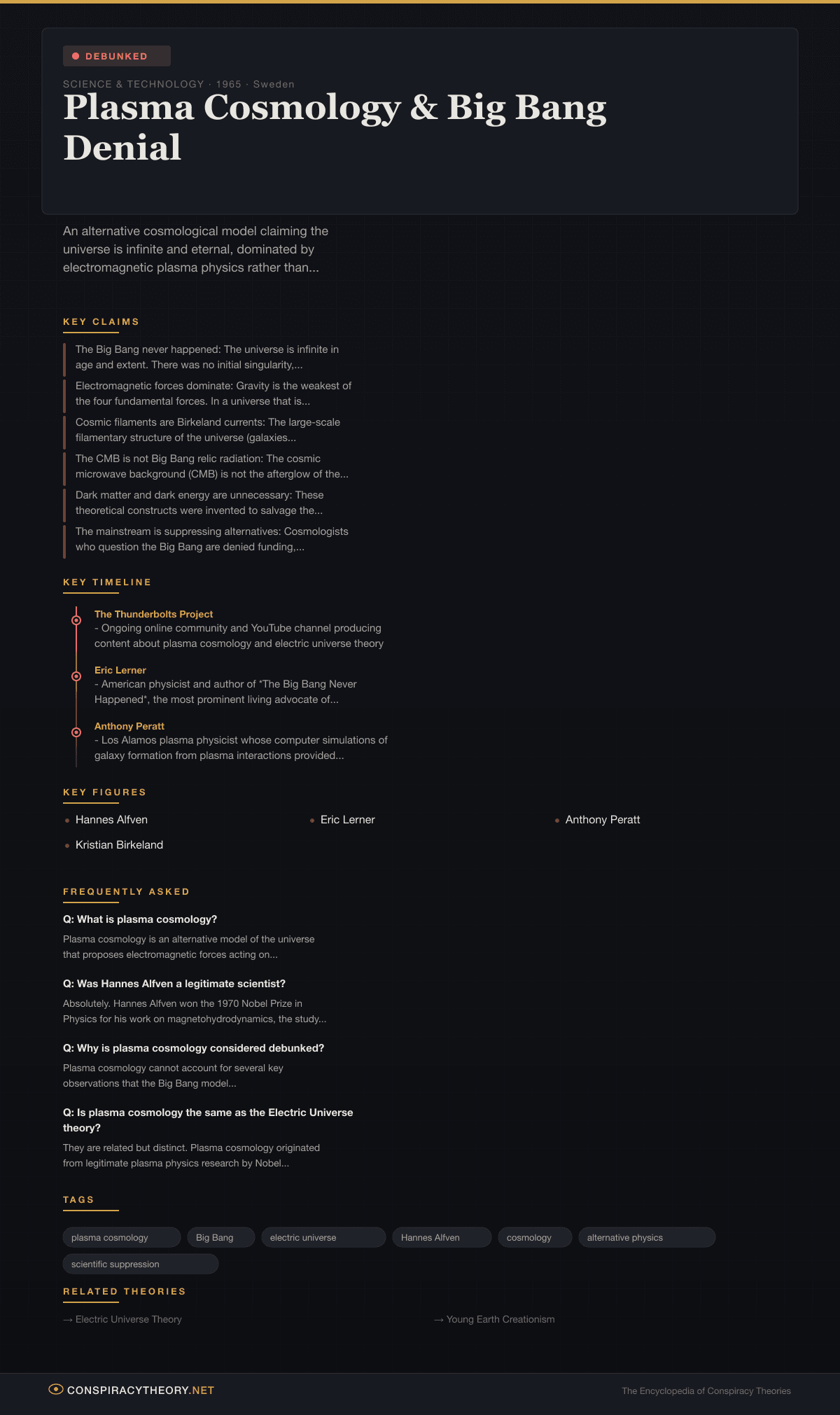
Plasma Cosmology & Big Bang Denial
Overview
Every so often, a scientific rebel with genuine credentials proposes an alternative to one of science’s most established theories, and the story that follows tells us as much about how science works — and sometimes fails to work — as it does about the theory itself. Plasma cosmology is one of those stories.
The theory originated with Hannes Alfven, a Swedish physicist who won the 1970 Nobel Prize for his pioneering work on plasma physics. Alfven proposed that the universe was not born in a cataclysmic explosion 13.8 billion years ago but is instead infinite and eternal, shaped primarily by electromagnetic forces acting on plasma — the ionized gas that constitutes over 99% of visible matter in the universe. In Alfven’s view, the Big Bang was bad science propped up by institutional inertia, and the real driver of cosmic structure was electromagnetism, not gravity.
The idea attracted a small but passionate following, most notably American physicist Eric Lerner, whose 1991 book The Big Bang Never Happened became a minor bestseller. Proponents argued that the cosmological establishment was suppressing their work, refusing to fund their research, and gatekeeping journal publication. They signed open letters, held alternative conferences, and accused mainstream cosmology of operating more like a religion than a science.
Then the data came in. And it was devastating.
The Cosmic Background Explorer (COBE), the Wilkinson Microwave Anisotropy Probe (WMAP), and the Planck satellite delivered increasingly precise measurements of the cosmic microwave background radiation — measurements that matched the Big Bang model’s predictions with extraordinary accuracy and that plasma cosmology could not explain. By the 2010s, plasma cosmology had been abandoned by virtually all working physicists. What remained was not a scientific movement but a conspiratorial subculture alleging suppression.
Origins & History
The intellectual ancestry of plasma cosmology reaches back to the early 20th century. Norwegian physicist Kristian Birkeland, working around 1900, demonstrated that auroras were caused by charged particles from the sun interacting with Earth’s magnetic field — a finding that was rejected by the mainstream for decades before being confirmed. Birkeland’s work established that electromagnetic forces play a much larger role in space than previously understood.
Hannes Alfven built on this foundation. Working at the Royal Institute of Technology in Stockholm in the 1940s, Alfven developed the theory of magnetohydrodynamics (MHD) — the study of how electrically conducting fluids behave in magnetic fields. His discovery of Alfven waves, a type of magnetohydrodynamic wave, earned him the Nobel Prize in 1970. Alfven’s contributions to plasma physics are uncontested and remain foundational to the field.
But Alfven had grander ambitions. He believed that plasma physics, not general relativity and gravity-dominated models, held the key to understanding the large-scale structure of the universe. Throughout the 1960s, 1970s, and 1980s, he developed an alternative cosmological framework in which cosmic structures — galaxies, galaxy clusters, filaments — formed through electromagnetic interactions in plasma rather than gravitational collapse.
Alfven was particularly hostile to the Big Bang theory. He viewed it as quasi-religious, pointing out that it postulated a creation event ex nihilo, which he considered philosophically unjustifiable. He preferred a steady-state or eternal universe. He also argued that the Big Bang model required too many ad hoc additions — dark matter, dark energy, inflation — patches that he saw as signs of a failing paradigm rather than genuine physics.
In 1991, Eric Lerner, an American independent physicist and fusion energy researcher, published The Big Bang Never Happened. The book presented plasma cosmology as a superior alternative and accused the cosmological establishment of dogmatism. It sold well and brought the ideas to a popular audience for the first time. Lerner argued that plasma filaments could explain large-scale cosmic structure without invoking dark matter, that the light element abundances could be explained by thermonuclear reactions in plasma pinches, and that the cosmic microwave background was not a relic of the Big Bang but reflected thermalized starlight.
Anthony Peratt, a plasma physicist at Los Alamos National Laboratory, contributed computational work showing that simulated plasma interactions could produce structures resembling galaxies. His simulations were technically interesting, though critics noted they did not reproduce the full range of observed galaxy properties and required unrealistic initial conditions.
Key Claims
-
The Big Bang never happened: The universe is infinite in age and extent. There was no initial singularity, no moment of creation, no cosmic expansion from a hot, dense state.
-
Electromagnetic forces dominate: Gravity is the weakest of the four fundamental forces. In a universe that is over 99% plasma, electromagnetic forces should play the dominant role in shaping structure — not gravity, as the standard model assumes.
-
Cosmic filaments are Birkeland currents: The large-scale filamentary structure of the universe (galaxies arranged in filaments, walls, and voids) reflects the behavior of cosmic-scale electrical currents in plasma, not gravitational structure formation.
-
The CMB is not Big Bang relic radiation: The cosmic microwave background (CMB) is not the afterglow of the Big Bang but the result of starlight being absorbed and re-emitted by cosmic plasma until it reaches thermal equilibrium.
-
Dark matter and dark energy are unnecessary: These theoretical constructs were invented to salvage the Big Bang model. A plasma cosmology model eliminates the need for them by invoking electromagnetic forces to explain galaxy rotation curves and cosmic acceleration.
-
The mainstream is suppressing alternatives: Cosmologists who question the Big Bang are denied funding, refused journal publication, and marginalized by a closed-minded scientific establishment that treats the Big Bang as dogma rather than hypothesis.
Evidence
What Proponents Cite
Alfven’s credentials: Plasma cosmology was proposed by a Nobel laureate, not a crank. This gives it more intellectual legitimacy than most alternative physics claims.
Plasma constitutes most visible matter: Over 99% of the visible matter in the universe exists as plasma. Proponents argue it is unreasonable that electromagnetic effects in this plasma would be cosmologically insignificant.
Galaxy filaments resemble plasma filaments: Laboratory plasma experiments produce filamentary structures that superficially resemble the cosmic web of galaxy filaments observed at the largest scales.
Peratt’s simulations: Anthony Peratt’s computer simulations showed that interacting plasma filaments could produce structures resembling spiral galaxies, suggesting electromagnetic processes could drive galaxy formation.
The 2004 open letter: In 2004, Lerner and 33 other scientists published an open letter in New Scientist arguing that Big Bang cosmology had become unfalsifiable and that alternative approaches deserved funding and fair evaluation. The letter attracted additional signatures and significant media attention.
What the Evidence Actually Shows
The cosmic microwave background: The CMB is the strongest evidence for the Big Bang. Its blackbody spectrum — measured by COBE in 1992 with extraordinary precision — matches the prediction of a hot, dense early universe with an accuracy of one part in 100,000. Plasma cosmology’s alternative explanation (thermalized starlight) cannot produce a perfect blackbody spectrum. To thermalize starlight, the universe would need to be opaque at microwave wavelengths, which would also block distant radio sources — and we observe them clearly.
CMB anisotropies: WMAP and Planck mapped tiny temperature fluctuations in the CMB that correspond precisely to predictions of acoustic oscillations in the early universe plasma — a phenomenon called “baryon acoustic oscillations.” These match Big Bang predictions at a level of detail that no alternative model has come close to reproducing.
Light element abundances: Big Bang nucleosynthesis predicts the observed abundances of hydrogen, helium, deuterium, and lithium with remarkable accuracy. These abundances depend on conditions in the first few minutes after the Big Bang. Plasma cosmology has no comparable mechanism for producing these specific ratios.
Cosmic expansion: Edwin Hubble’s 1929 observation that galaxies are receding from each other, confirmed by increasingly precise measurements, directly supports an expanding universe. The 1998 discovery of accelerating expansion via Type Ia supernovae further confirmed the Big Bang framework. Plasma cosmology predicts a static universe.
Galaxy evolution: We directly observe that galaxies at high redshift (distant, and therefore seen as they were billions of years ago) look systematically different from nearby galaxies — they are smaller, more irregular, and bluer. This is consistent with an evolving universe of finite age, not an eternal, static one.
Debunking / Verification
Plasma cosmology is classified as debunked because the observational evidence accumulated since the 1990s has decisively ruled it out as a viable cosmological model. Specifically:
- The CMB’s blackbody spectrum cannot be produced by the mechanisms plasma cosmology proposes
- The detailed pattern of CMB anisotropies matches Big Bang predictions and contradicts plasma cosmology
- Light element abundances are explained by Big Bang nucleosynthesis but not by plasma cosmology
- Galaxy evolution observations confirm a universe of finite age
- The accelerating expansion of the universe, measured independently by multiple teams, confirms the Big Bang framework
Regarding the suppression claims: while it is true that alternative cosmology receives less funding and fewer publication opportunities than mainstream approaches, this reflects the normal operation of science when one model has vastly more evidential support than its competitors. The scientific community’s rejection of plasma cosmology is not an example of dogmatism but of evidence-based assessment. Alfven’s Nobel Prize demonstrates that the establishment was willing to recognize his legitimate contributions — but his cosmological claims did not survive empirical testing.
It is worth noting that Alfven was correct about some things. The cosmological establishment did underestimate the importance of electromagnetic effects in astrophysics for decades, and his work on plasma physics in space was vindicated over time. But being right about magnetohydrodynamics does not make one right about cosmology.
Cultural Impact
Plasma cosmology’s most significant cultural contribution may be as a case study in how legitimate scientific dissent shades into conspiratorial thinking. Alfven’s original critique of the Big Bang contained genuine insights — his concerns about ad hoc additions to the model (inflation, dark matter, dark energy) have been echoed by some mainstream cosmologists. But as the observational evidence mounted against plasma cosmology, its proponents increasingly shifted from scientific argumentation to claims of institutional suppression.
The movement’s greatest legacy may be the Electric Universe theory, a more radical offshoot that emerged in the 2000s. Where Alfven was a Nobel laureate working within (if at the margins of) the scientific establishment, the Electric Universe community operates entirely outside it, extending plasma cosmology’s ideas into claims about comets, planetary scarring, stellar physics, and even ancient mythology. The Electric Universe has a significant online following, particularly on YouTube, where it appeals to audiences attracted to anti-establishment narratives.
Plasma cosmology has also been adopted by some young-earth creationists, who find its rejection of the Big Bang useful for arguing against a universe billions of years old — an ironic appropriation, given that Alfven proposed an infinitely old universe, not a young one.
The 2004 open letter in New Scientist raised legitimate questions about funding diversity in cosmological research. Whether or not plasma cosmology was the right alternative, the letter’s broader point — that science benefits from funding competing hypotheses — resonated beyond the plasma cosmology community.
In Popular Culture
- “The Big Bang Never Happened” (1991) — Eric Lerner’s popular science book, the most widely read presentation of plasma cosmology
- “Thunderbolts of the Gods” (2005 documentary) — Brought plasma cosmology and Electric Universe ideas to a YouTube audience
- The Thunderbolts Project — Ongoing online community and YouTube channel producing content about plasma cosmology and electric universe theory
- “Cosmos” (2014 TV series) — While not discussing plasma cosmology directly, Neil deGrasse Tyson’s presentation of the Big Bang as settled science drew criticism from plasma cosmology adherents
Key Figures
- Hannes Alfven (1908-1995) — Nobel Prize-winning Swedish physicist who founded magnetohydrodynamics and proposed plasma cosmology as an alternative to the Big Bang
- Kristian Birkeland (1867-1917) — Norwegian physicist whose work on electromagnetic phenomena in space laid the groundwork for plasma astrophysics
- Eric Lerner — American physicist and author of The Big Bang Never Happened, the most prominent living advocate of plasma cosmology
- Anthony Peratt — Los Alamos plasma physicist whose computer simulations of galaxy formation from plasma interactions provided technical support for the theory
- Fred Hoyle (1915-2001) — While not a plasma cosmologist, Hoyle’s steady-state cosmology (and his coining of the term “Big Bang” as a dismissive label) shared plasma cosmology’s rejection of a cosmic origin event
Timeline
| Date | Event |
|---|---|
| ~1900 | Kristian Birkeland demonstrates electromagnetic origins of auroras |
| 1942 | Hannes Alfven discovers magnetohydrodynamic waves (Alfven waves) |
| 1965 | Penzias and Wilson discover the cosmic microwave background, providing strong evidence for the Big Bang |
| 1970 | Alfven awarded Nobel Prize in Physics for magnetohydrodynamics |
| 1970s-80s | Alfven develops plasma cosmology as alternative cosmological framework |
| 1986 | IEEE (Institute of Electrical and Electronics Engineers) hosts first plasma cosmology conference |
| 1991 | Eric Lerner publishes The Big Bang Never Happened |
| 1992 | COBE satellite measures CMB blackbody spectrum with extraordinary precision, severely constraining plasma cosmology |
| 1998 | Discovery of accelerating cosmic expansion via Type Ia supernovae contradicts plasma cosmology’s static universe |
| 2003 | WMAP maps CMB anisotropies matching Big Bang predictions in detail |
| 2004 | Open letter by 33 scientists published in New Scientist criticizing Big Bang dogmatism |
| 2005 | Thunderbolts of the Gods documentary extends plasma cosmology into Electric Universe theory |
| 2013 | Planck satellite provides highest-precision CMB measurements, further confirming Big Bang predictions |
| 2020s | Plasma cosmology persists primarily as online subculture within Electric Universe community |
Sources & Further Reading
- Alfven, Hannes. Cosmic Plasma. D. Reidel Publishing, 1981.
- Lerner, Eric. The Big Bang Never Happened. Vintage Books, 1991.
- Peratt, Anthony L. “Physics of the Plasma Universe.” IEEE Transactions on Plasma Science, vol. 20, no. 6, 1992.
- Lerner, Eric, et al. “An Open Letter to the Scientific Community.” New Scientist, May 22, 2004.
- Wright, Edward L. “Errors in the ‘The Big Bang Never Happened.’” UCLA Astronomy, 1994. (Point-by-point scientific rebuttal.)
- Peebles, P.J.E., et al. “Finding the Big Bang.” Cambridge University Press, 2009.
- Planck Collaboration. “Planck 2018 Results. VI. Cosmological Parameters.” Astronomy & Astrophysics, vol. 641, 2020.
- Scott, Douglas, and Martin White. “Cosmic Background Radiation Mini-Review.” Review of Particle Physics, 2006.
Related Theories
- Electric Universe Theory — a more radical offshoot of plasma cosmology that extends electromagnetic explanations to stellar physics, planetary science, and mythology
- Young-Earth Creationism — some creationists have adopted Big Bang denial from plasma cosmology, despite fundamental differences in their cosmological frameworks
Frequently Asked Questions
What is plasma cosmology?
Was Hannes Alfven a legitimate scientist?
Why is plasma cosmology considered debunked?
Is plasma cosmology the same as the Electric Universe theory?

Infographic
Share this visual summary. Right-click to save.