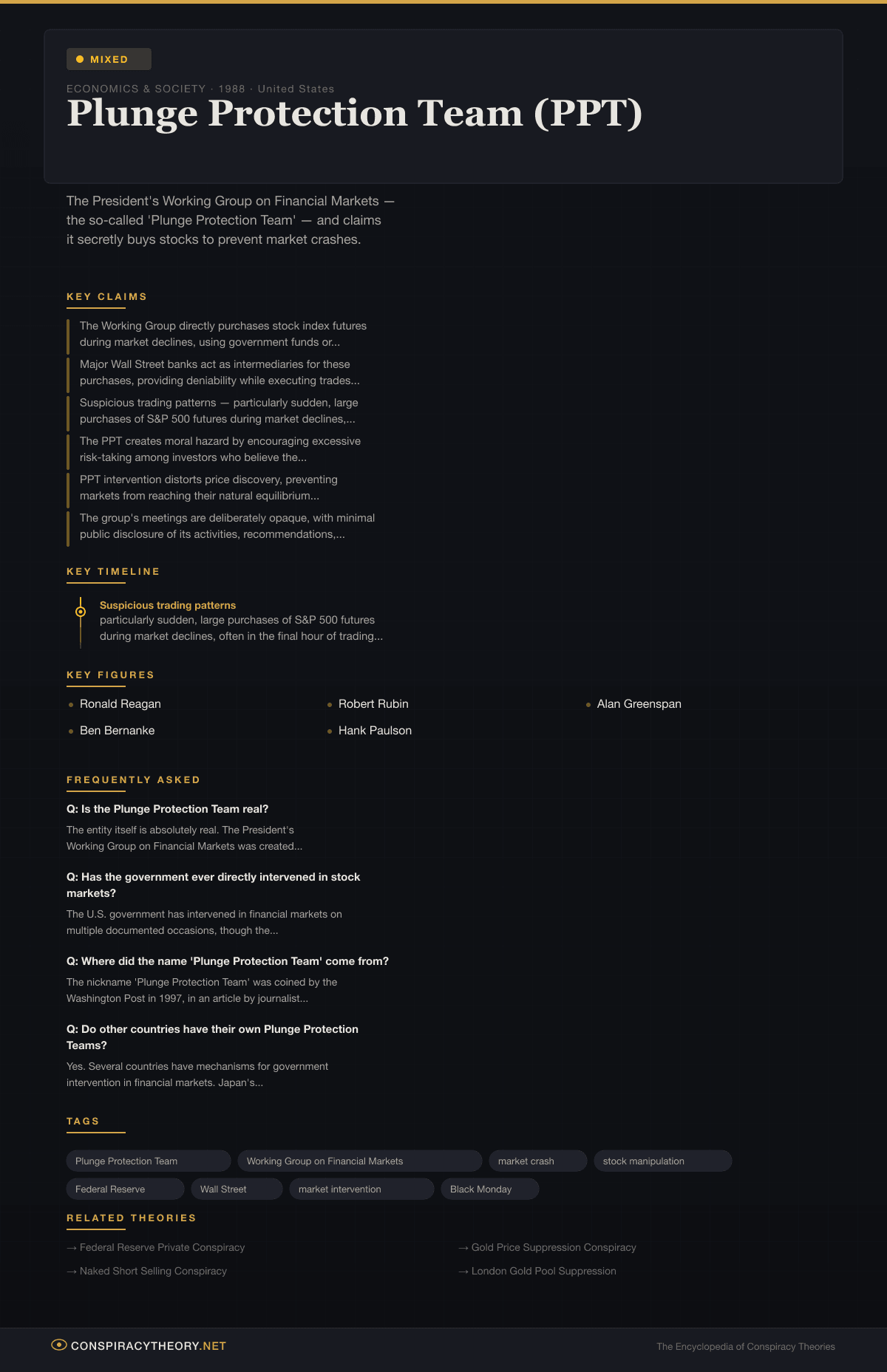
Plunge Protection Team (PPT)

Overview
Sometime during the chaotic afternoon of October 19, 1987 — the day known as Black Monday, when the Dow Jones Industrial Average plummeted 22.6 percent in a single session, the largest one-day percentage decline in its history — something happened. The market, which had been in freefall for hours, briefly and inexplicably stabilized. Trading volume in certain futures contracts spiked in ways that didn’t match the prevailing panic. And then, just as suddenly, the crisis was contained. The market did not collapse entirely. The financial system did not implode. Something — or someone — had stepped in.
Five months later, President Ronald Reagan signed Executive Order 12631, creating the President’s Working Group on Financial Markets. Its stated mission was to “enhance the integrity, efficiency, orderliness, and competitiveness of our Nation’s financial markets” and to “maintain investor confidence.” Its members were the Secretary of the Treasury, the Chairman of the Federal Reserve, the Chairman of the Securities and Exchange Commission, and the Chairman of the Commodity Futures Trading Commission. Its mandate was to study market volatility and recommend legislative and regulatory solutions.
On paper, it was a study group. In the imagination of Wall Street and its observers, it was something far more potent: the Plunge Protection Team, a shadowy government body with the power and willingness to secretly intervene in financial markets to prevent crashes, propping up stock prices with public money to avoid the political consequences of economic free-fall. The question of whether the PPT has ever actually done what its critics allege — and the related question of whether it would necessarily be wrong to do so — has been one of the most persistent and consequential debates in financial conspiracy theory for nearly four decades.
Origins & History
Black Monday and the Birth of the Working Group
The context of the Working Group’s creation matters enormously. Black Monday was not merely a bad day on Wall Street — it was the single most terrifying event in the modern financial system’s history. The Dow fell 508 points, equivalent to $500 billion in market value evaporating in a single session. Trading systems were overwhelmed. Major market makers stopped answering their phones. The New York Stock Exchange came within minutes of suspending trading entirely, an action that Fed Chairman Alan Greenspan feared would trigger a cascade of exchange closures worldwide.
Greenspan, who had been on the job for exactly two months, responded with a one-sentence statement the following morning that has become legendary in financial circles: “The Federal Reserve, consistent with its responsibilities as the Nation’s central bank, affirmed today its readiness to serve as a source of liquidity to support the economic and financial system.” Behind the scenes, the Fed flooded the banking system with money, made clear to major banks that credit lines to securities firms should remain open, and effectively backstopped the entire financial system.
The market recovered. The crisis passed. And the lesson learned by policymakers was that early, decisive, coordinated intervention by government financial authorities could prevent a market crash from becoming an economic catastrophe. The Working Group was created to institutionalize that lesson — to ensure that the next time markets seized up, the government’s response would be coordinated rather than improvised.
The Washington Post Coins a Name
For its first decade, the Working Group on Financial Markets operated in relative obscurity. Its meetings were not publicized in detail, its recommendations were largely technical, and its public profile was negligible. That changed on February 23, 1997, when Washington Post reporter Brett D. Fromson published an article titled “Plunge Protection Team,” describing the Working Group’s role in coordinating the government’s response to market disruptions.
Fromson’s article was largely straightforward — it described how officials from the four member agencies would convene during market stress to coordinate responses, share information, and present a unified front to the financial community. But the nickname stuck. “Plunge Protection Team” had an irresistible quality that “President’s Working Group on Financial Markets” lacked. It suggested active intervention, not passive study. It implied that the government was not merely observing markets but manipulating them. And it launched a conspiracy theory that would grow more elaborate with each subsequent market crisis.
The Dot-Com Crash and Growing Suspicion
The 2000-2002 dot-com crash, during which the NASDAQ fell approximately 78 percent from its peak, generated the first sustained wave of PPT conspiracy theorizing. Market observers noted several instances where sharp declines were followed by sudden, unexplained reversals, particularly in stock index futures markets. The timing of these reversals — often occurring in the final hour of trading or just before market open — led traders and commentators to speculate that the Working Group was directly purchasing futures contracts to arrest the decline.
Former Clinton administration Treasury official George Stephanopoulos appeared to lend credibility to these suspicions in a September 2001 interview on ABC’s Good Morning America, when he said of the Working Group: “They have what amounts to a secret government fund to try to prop up the market.” It was unclear whether Stephanopoulos was describing actual practice or paraphrasing conspiracy theories, but his statement was widely cited as an insider confirmation.
2008: The Crisis That Changed Everything
The 2008 financial crisis both validated and complicated the PPT narrative. On one hand, the government’s response to the crisis — the $700 billion Troubled Asset Relief Program (TARP), the Federal Reserve’s quantitative easing programs, the bailout of AIG, the forced mergers of failing investment banks, and the temporary ban on short selling of financial stocks — represented a level of direct government market intervention that far exceeded anything the PPT conspiracy theorists had previously imagined.
On the other hand, the crisis was so severe that the markets crashed despite whatever the Working Group may have been doing. The Dow fell from over 14,000 in October 2007 to under 6,600 in March 2009, a decline of more than 50 percent. If the PPT was buying, it was not buying enough. The financial system nearly collapsed anyway, requiring emergency legislation, unprecedented Federal Reserve action, and the explicit socialization of losses on a scale not seen since the Great Depression.
The 2008 crisis shifted the debate in an important way. Before 2008, PPT conspiracy theorists were claiming the government was secretly doing something it denied. After 2008, the government was openly doing things even more dramatic than what had been alleged — buying toxic assets, backstopping entire industries, effectively guaranteeing the survival of institutions deemed “too big to fail.” The conspiracy moved from “is the government doing this?” to “how far is the government willing to go?”
Post-2008: Quantitative Easing and the New Normal
The Federal Reserve’s quantitative easing programs, which involved the purchase of trillions of dollars in government bonds and mortgage-backed securities between 2008 and 2014 (and again during the COVID-19 pandemic in 2020), created a new framework for understanding government market intervention. While QE technically involved bond purchases rather than direct stock purchases, the effect was to push investors toward riskier assets — including stocks — by driving down yields on safer investments.
This phenomenon, known as the “Fed put” or “Greenspan put” (later the “Bernanke put,” the “Yellen put,” and the “Powell put”), created an expectation among market participants that the Federal Reserve would intervene to prevent severe market declines. Whether this constituted the kind of market manipulation alleged by PPT conspiracy theorists or simply prudent monetary policy was — and remains — a matter of fierce debate among economists, traders, and policymakers.
Key Claims
The Plunge Protection Team conspiracy theory encompasses several related claims:
- The Working Group directly purchases stock index futures during market declines, using government funds or Federal Reserve money to create artificial demand and arrest selloffs
- Major Wall Street banks act as intermediaries for these purchases, providing deniability while executing trades on the government’s behalf
- Suspicious trading patterns — particularly sudden, large purchases of S&P 500 futures during market declines, often in the final hour of trading — constitute evidence of PPT activity
- The PPT creates moral hazard by encouraging excessive risk-taking among investors who believe the government will always prevent severe losses
- PPT intervention distorts price discovery, preventing markets from reaching their natural equilibrium and creating the conditions for even larger future crashes
- The group’s meetings are deliberately opaque, with minimal public disclosure of its activities, recommendations, or the content of its discussions with major financial institutions
Evidence
What Is Known
The Working Group’s existence and mandate are matters of public record. Executive Order 12631 is available in full. The group’s membership is specified. Its meetings, while not publicized in real time, are occasionally referenced in government communications.
Several pieces of circumstantial evidence support the theory of direct market intervention:
The Exchange Stabilization Fund: The Treasury Department’s Exchange Stabilization Fund (ESF), originally created in 1934 to stabilize the dollar’s exchange rate, has broad discretion to invest in a wide range of financial instruments. The ESF’s operations are largely exempt from congressional appropriation oversight, giving the Treasury Secretary significant latitude to deploy funds with minimal disclosure.
International precedents: The Bank of Japan has purchased Japanese equities through exchange-traded funds. China’s “national team” has openly bought stocks during market panics. Hong Kong’s government purchased $15 billion in stocks during the 1998 Asian financial crisis. If these governments do it, the argument runs, it would be naive to assume the U.S. government does not.
Insider statements: Beyond Stephanopoulos, former Federal Reserve officials and Treasury staffers have occasionally made comments suggesting that market stabilization is part of the Working Group’s function, though these statements are invariably ambiguous and typically walked back.
What Remains Unproven
No definitive evidence has emerged that the Working Group has directly purchased stocks or stock futures to prop up the U.S. market. Key evidentiary gaps include:
- No whistleblower from within the Working Group, the Treasury, or the Federal Reserve has provided documentation of direct stock purchases
- Trading records that would demonstrate government buying have not been produced through FOIA requests or congressional investigations
- The “suspicious” trading patterns cited by PPT theorists are consistent with other explanations, including institutional rebalancing, algorithmic trading, and normal market dynamics
- The 2008 financial crisis, in which the market declined more than 50 percent, is difficult to reconcile with a theory that assumes the PPT can effectively prevent severe declines
Cultural Impact
Market Psychology and Moral Hazard
Whether or not the PPT engages in direct market intervention, the belief that it does has real economic consequences. The widespread assumption among traders and investors that the government will step in to prevent severe market declines — the “Fed put” — has been cited by economists as a source of moral hazard, encouraging excessive risk-taking and leverage. If investors believe losses are capped by government intervention, they will rationally take on more risk than they otherwise would, potentially making the financial system more fragile.
The Overton Window of Intervention
The PPT debate has shifted the boundaries of what is considered acceptable government intervention in financial markets. Practices that would have been considered extraordinary or conspiratorial before 2008 — direct asset purchases, bans on short selling, bailouts of private institutions — are now part of the standard crisis management toolkit. The conspiracy theory, in a sense, became policy. The question is no longer whether the government should intervene in markets but how, when, and how transparently.
Financial Media and Trader Culture
“PPT” has become shorthand in financial media and trading communities for any unexplained market reversal. When stocks inexplicably bounce during a selloff, traders reflexively reference the Plunge Protection Team, whether seriously or sarcastically. The term has become part of the vocabulary of financial markets, influencing how market participants interpret price action and, potentially, how they trade.
Timeline
| Date | Event |
|---|---|
| October 19, 1987 | Black Monday: Dow falls 22.6% in largest single-day percentage decline in history |
| October 20, 1987 | Federal Reserve issues statement pledging to serve as “source of liquidity”; markets stabilize |
| March 18, 1988 | President Reagan signs Executive Order 12631 creating the President’s Working Group on Financial Markets |
| February 23, 1997 | Washington Post coins the term “Plunge Protection Team” |
| September 11, 2001 | Working Group coordinates response to market disruption following terrorist attacks; markets closed for four days |
| September 17, 2001 | George Stephanopoulos references “secret government fund to prop up the market” |
| 2001-2002 | PPT allegations intensify during dot-com crash as traders note suspicious market reversals |
| September 2008 | SEC temporarily bans short selling of financial stocks during financial crisis |
| October 2008 | TARP signed into law, authorizing $700 billion in government purchases of financial assets |
| 2008-2014 | Federal Reserve conducts quantitative easing, purchasing trillions in bonds |
| March 2020 | Federal Reserve announces unlimited quantitative easing in response to COVID-19 market crash |
| March 2020 | Fed announces unprecedented purchases of corporate bonds and ETFs for first time in history |
| 2021-2022 | ”Meme stock” movement renews public interest in market manipulation theories |
Sources & Further Reading
- Fromson, Brett D. “Plunge Protection Team.” Washington Post, February 23, 1997
- Fleckenstein, William, and Frederick Sheehan. Greenspan’s Bubbles: The Age of Ignorance at the Federal Reserve. McGraw-Hill, 2008
- Bernanke, Ben S. The Courage to Act: A Memoir of a Crisis and Its Aftermath. W.W. Norton, 2015
- Paulson, Henry M. On the Brink: Inside the Race to Stop the Collapse of the Global Financial System. Business Plus, 2010
- Geithner, Timothy F. Stress Test: Reflections on Financial Crises. Crown, 2014
- Executive Order 12631, “Working Group on Financial Markets,” March 18, 1988
- Lowenstein, Roger. When Genius Failed: The Rise and Fall of Long-Term Capital Management. Random House, 2000
- Bookstaber, Richard. A Demon of Our Own Design: Markets, Hedge Funds, and the Perils of Financial Innovation. Wiley, 2007
- Taibbi, Matt. “The Great American Bubble Machine.” Rolling Stone, April 5, 2010
Related Theories
- Gold Price Suppression — Allegations of government manipulation of precious metals markets
- Naked Short Selling Conspiracy — Claims that Wall Street manipulates stock prices through illegal shorting practices
- London Gold Pool — A documented case of government-coordinated market intervention

Frequently Asked Questions
Is the Plunge Protection Team real?
Has the government ever directly intervened in stock markets?
Where did the name 'Plunge Protection Team' come from?
Do other countries have their own Plunge Protection Teams?
Infographic
Share this visual summary. Right-click to save.