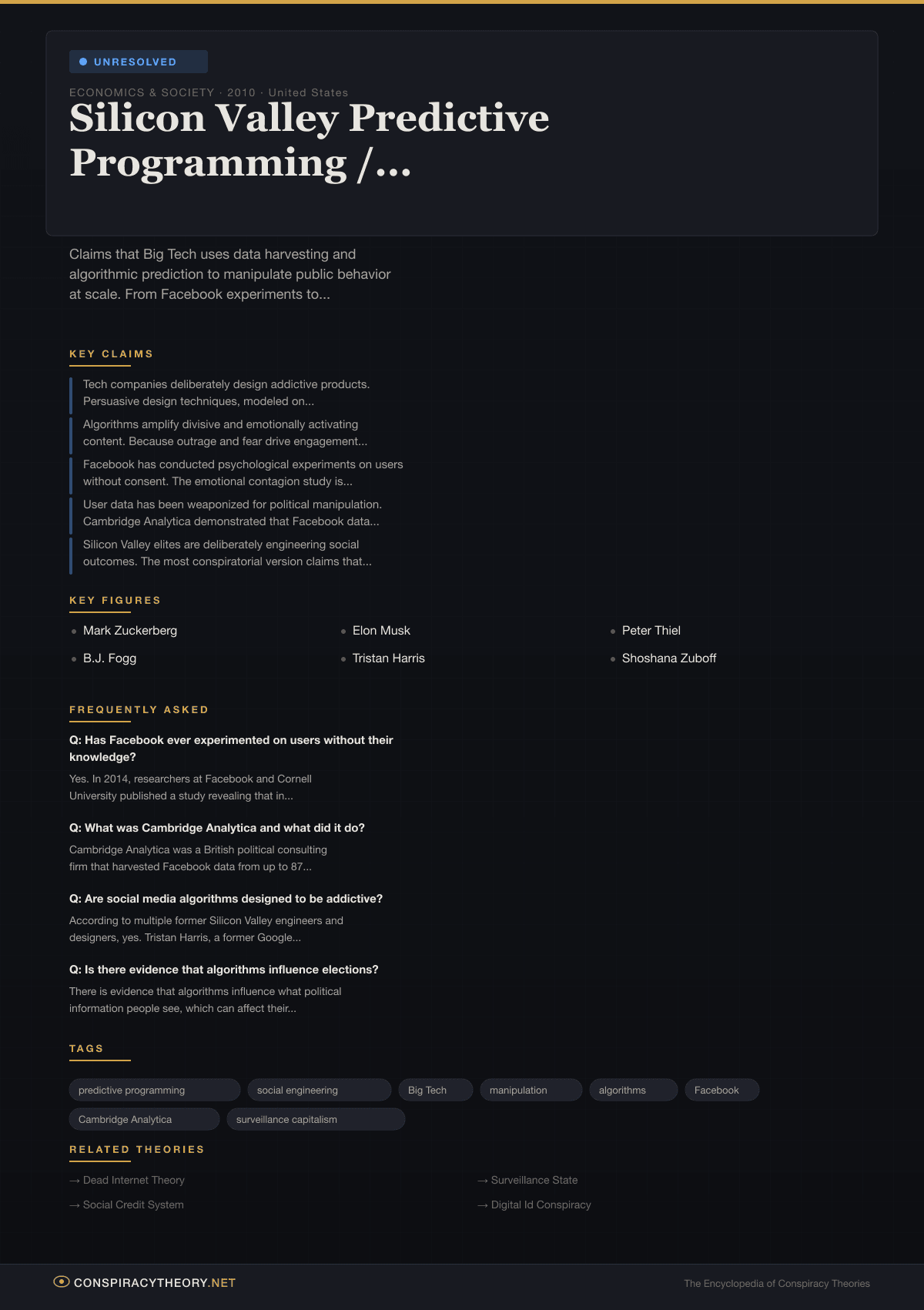
Silicon Valley Predictive Programming / Social Engineering

Overview
In January 2012, a data scientist at Facebook named Adam Kramer and two researchers from Cornell University ran an experiment. They modified the news feeds of 689,003 Facebook users — without telling them — to show either disproportionately positive or disproportionately negative content from their friends. Then they measured whether the manipulation changed what those users posted. It did. Users who saw more negative content produced more negative posts. Users who saw more positive content produced more positive posts. The researchers had demonstrated, in a live experiment on nearly seven hundred thousand unwitting subjects, that Facebook could alter people’s emotional states by adjusting an algorithm.
When the study was published in the Proceedings of the National Academy of Sciences in 2014, the reaction was a mixture of outrage and something that felt uncomfortably like recognition. Of course Facebook could do this. The entire business model of the attention economy depends on manipulating what people see, feel, and do. The experiment was not a revelation of a hidden capability. It was a peer-reviewed confirmation of what everyone who had spent twenty minutes rage-scrolling their news feed had already suspected: the algorithm was not neutral. It was not showing you the world as it was. It was showing you the world as it needed you to see it in order to keep you on the platform as long as possible.
The conspiracy theory about Silicon Valley social engineering starts from this documented foundation and extrapolates outward. The moderate version argues that tech companies are conducting mass psychological manipulation for profit — using persuasive design, algorithmic curation, and data harvesting to shape behavior, addict users, and sell the resulting attention to advertisers. This version is, by any reasonable standard, true. The more extreme version argues that this manipulation is coordinated, intentional, and political — that Silicon Valley elites are not merely optimizing for engagement but actively engineering social outcomes, steering elections, programming beliefs, and reshaping human cognition in a direction that serves their interests.
The distance between the moderate and extreme versions is shorter than it should be. And that is what makes this theory so difficult to classify.
Origins & History
B.J. Fogg and the Persuasive Technology Lab
The intellectual origins of Silicon Valley’s behavioral manipulation capabilities can be traced to a single laboratory at Stanford University. The Persuasive Technology Lab, founded by B.J. Fogg in 1998, studied how computers could be designed to change people’s attitudes and behaviors. Fogg’s 2003 book Persuasive Technology: Using Computers to Change What We Think and Do laid out a framework — the Fogg Behavior Model — that described how technology could be designed to trigger specific behaviors by combining motivation, ability, and prompts.
Fogg’s lab was not a sinister operation. It was an academic research program that studied persuasion the way psychologists study persuasion in any context — advertising, public health campaigns, political messaging. But its students went on to build the apps and platforms that would apply persuasive design principles at a scale Fogg never anticipated. Instagram co-founder Mike Krieger studied at the lab. Nir Eyal, whose book Hooked: How to Build Habit-Forming Products (2014) became a Silicon Valley bible, drew on Fogg’s work. The designers who created infinite scroll, autoplay, push notifications, and the Facebook “like” button all operated within a framework that treated behavioral manipulation as a design objective, not a side effect.
Fogg himself has expressed discomfort with how his work has been applied. In interviews, he has drawn a distinction between persuasion (helping people do things they already want to do) and manipulation (inducing people to act against their interests). But the platforms built by his students did not always maintain that distinction. When your business model depends on maximizing the time people spend staring at a screen, the line between persuasion and manipulation becomes uncomfortably thin.
The Attention Economy
The business model that enabled Silicon Valley’s manipulation capabilities is straightforward: platforms provide free services, harvest user data, and sell targeted advertising. The more time users spend on the platform, the more ads they see, the more data they generate, and the more valuable the advertising becomes. This creates an economic incentive to maximize engagement — to make the platform as compelling, as hard to leave, and as emotionally activating as possible.
The tools for maximizing engagement were borrowed from behavioral psychology. Variable-ratio reinforcement — the same mechanism that makes slot machines addictive — was implemented through notification systems and social media feeds. Sometimes you check your phone and there is nothing. Sometimes there is a flood of likes, comments, and messages. The unpredictability is the point. Infinite scroll eliminated natural stopping points, removing the cue that tells a user “this is enough.” Autoplay on YouTube and Netflix ensured that consuming content required no decision — stopping required one. Push notifications interrupted whatever you were doing to pull you back to the app.
These were not accidental design choices. Aza Raskin, the designer who invented infinite scroll, has publicly described it as one of his biggest regrets. Loren Brichter, who created the pull-to-refresh mechanism used in Twitter and other apps, has said the feature was designed to exploit the same psychology as a slot machine lever. Tristan Harris, a former Google design ethicist, left the company in 2016 and co-founded the Center for Humane Technology, which has campaigned against what Harris calls “the race to the bottom of the brain stem.”
Facebook’s Emotional Contagion Experiment
The 2012 emotional contagion experiment, published in 2014, was the moment the abstract concern about algorithmic manipulation became concrete. The study demonstrated three things:
First, Facebook could manipulate users’ emotional states by modifying what appeared in their news feeds. This was not theoretical. It was tested, measured, and statistically significant.
Second, Facebook considered this kind of experimentation acceptable. The company argued that its data use policy (which users agreed to upon creating an account) constituted sufficient consent for research, a position that was rejected by the academic community. The Cornell University IRB (Institutional Review Board) later stated that it had not reviewed the experiment because Facebook had conducted the manipulation; Cornell researchers had only analyzed the data. The legal and ethical framework for experiments on social media users was, and largely remains, inadequate.
Third, the experiment was small by Facebook’s standards. Manipulating the emotional content seen by 689,003 users was a minor operational adjustment for a platform serving over a billion. If Facebook was running experiments of this scale on fewer than one million users — and willing to publish the results — the question of what experiments it might be running on its full user base, without publishing, was impossible to ignore.
Cambridge Analytica and Political Manipulation
If the emotional contagion experiment demonstrated capability, the Cambridge Analytica scandal demonstrated application. In 2018, reporting by The Guardian, The New York Times, and Channel 4 News revealed that Cambridge Analytica, a British political consulting firm, had harvested Facebook data from up to 87 million users through a personality quiz app called “thisisyourdigitallife.”
The mechanism exploited Facebook’s data-sharing architecture. Users who took the quiz gave the app access not only to their own data but to the data of all their Facebook friends — a feature that Facebook had provided to developers as an incentive for building apps on its platform. Approximately 270,000 people took the quiz. Through their friend networks, the app harvested data from tens of millions.
Cambridge Analytica used this data to build psychographic profiles of voters — classifications based on personality traits (openness, conscientiousness, extraversion, agreeableness, neuroticism) inferred from Facebook activity. The firm then used these profiles to target voters with tailored political advertising. Cambridge Analytica worked for the Trump 2016 presidential campaign and was connected to the Vote Leave campaign in the UK Brexit referendum.
The actual effectiveness of Cambridge Analytica’s methods is disputed. Some researchers argue that psychographic targeting is no more effective than conventional demographic targeting. Cambridge Analytica’s own former employees have given conflicting accounts of the firm’s capabilities. CEO Alexander Nix was filmed by Channel 4 News boasting about using bribery, entrapment, and fabricated information in political campaigns — claims that may have been self-promotional exaggeration as much as confession.
But the debate about Cambridge Analytica’s effectiveness is, in some ways, beside the point. What the scandal demonstrated was that the infrastructure for mass political manipulation existed. A platform serving billions of users had designed its systems in a way that allowed a single app to harvest data from 87 million people. A political consulting firm had used that data to attempt to influence elections in the world’s oldest and most powerful democracies. Whether it worked perfectly was less important than the fact that it was attempted, that it was technically feasible, and that no law had prevented it.
The Social Dilemma and the Tech Insider Revolt
The public’s understanding of Silicon Valley’s manipulation capabilities was significantly shaped by The Social Dilemma, a 2020 Netflix documentary that featured interviews with former tech company employees — including Tristan Harris, Aza Raskin, and former Facebook and Twitter executives — describing the deliberate use of addictive design, algorithmic amplification of divisive content, and the commodification of human attention.
The documentary was effective partly because its witnesses were not outsiders or conspiracy theorists but architects of the systems they were criticizing. When a former Facebook executive says the platform was designed to exploit psychological vulnerabilities, or when a former Google designer describes the attention economy as “extractive,” the testimony carries a weight that academic research and journalistic investigation alone do not.
The tech insider revolt extended beyond the documentary. Roger McNamee, an early Facebook investor and mentor to Mark Zuckerberg, published Zucked: Waking Up to the Facebook Catastrophe (2019), arguing that Facebook had been designed to amplify emotional content — particularly outrage and fear — because such content drives engagement. Shoshana Zuboff’s The Age of Surveillance Capitalism (2019) provided an academic framework for understanding the tech industry’s business model as a new form of capitalism in which human experience is the raw material and behavioral prediction is the product.
Key Claims
-
Tech companies deliberately design addictive products. Persuasive design techniques, modeled on gambling psychology, are used to maximize time-on-app. This is confirmed by the testimony of the designers themselves.
-
Algorithms amplify divisive and emotionally activating content. Because outrage and fear drive engagement more effectively than calm and nuance, algorithmic curation systematically promotes extreme content. This is supported by internal company research and academic studies.
-
Facebook has conducted psychological experiments on users without consent. The emotional contagion study is the documented example. The question is how many other experiments have been conducted without being published.
-
User data has been weaponized for political manipulation. Cambridge Analytica demonstrated that Facebook data could be harvested and used for targeted political advertising. The effectiveness is debated; the capability is not.
-
Silicon Valley elites are deliberately engineering social outcomes. The most conspiratorial version claims that the manipulation is not merely a byproduct of advertising optimization but a deliberate effort by tech billionaires to reshape society according to their preferences.
Evidence & Analysis
What Is Documented
The following are established by evidence from company documents, academic research, whistleblower testimony, and journalistic investigation:
- Tech companies use persuasive design techniques to maximize engagement. (Confirmed by designers and documented in company practices)
- Algorithms prioritize content that generates strong emotional reactions. (Confirmed by internal Facebook research disclosed by whistleblower Frances Haugen in 2021)
- Facebook conducted at least one psychological experiment on users without informed consent. (Published in PNAS, 2014)
- Cambridge Analytica harvested data from 87 million Facebook users for political targeting. (Confirmed by Facebook’s own investigation and congressional testimony)
- Facebook’s own internal research found that Instagram was harmful to teenage mental health. (Disclosed by Frances Haugen, confirmed by internal documents)
Where the Conspiracy Theory Diverges
The documented facts establish that tech companies manipulate user behavior for profit and that the tools of manipulation can be applied to political ends. The conspiracy theory version extends these facts in several directions that are not supported by evidence:
Coordinated intent. The theory often assumes that tech billionaires — Zuckerberg, Musk, Thiel, Bezos — are coordinating their efforts toward a shared social engineering agenda. In reality, these individuals disagree profoundly on politics, compete fiercely in business, and have publicly feuded. The manipulation that occurs is driven by shared business incentives (maximize engagement to sell advertising), not coordinated ideology.
Total control. The theory tends to present algorithmic manipulation as deterministic — that tech companies can make people believe or do whatever they want. The evidence suggests that algorithms influence behavior at the margins, amplify existing tendencies, and shape information environments, but do not exercise the kind of total control the conspiracy theory implies. The 2023 Meta election study, published in Science and Nature, found that reducing algorithmic curation on Facebook changed what users saw but had limited measurable effect on political attitudes.
Predictive programming as foreknowledge. The traditional “predictive programming” concept — the idea that elites embed advance warnings of future events in entertainment media to psychologically prepare the public — is sometimes applied to Silicon Valley, with the suggestion that tech companies’ knowledge of behavioral trends amounts to foreknowledge of events they intend to engineer. This conflates prediction (an obvious capability of companies that possess vast behavioral data) with causation.
The Uncomfortable Middle Ground
The most honest assessment of Silicon Valley social engineering is that it occupies a space between legitimate concern and conspiratorial overreach. The documented facts are alarming enough without extrapolation. A small number of companies control the information environment for billions of people. Those companies are optimized for engagement, not truth. The resulting information ecosystem amplifies extremism, degrades mental health, and can be weaponized for political manipulation. These are not conspiracy theories. They are conclusions supported by the tech companies’ own internal research.
The question of whether this constitutes a “conspiracy” depends on how you define the term. If a conspiracy requires coordinated, secret planning toward a shared goal, the evidence does not support one. If it merely requires that powerful actors make decisions that harm the public while concealing the nature and extent of that harm, the evidence is overwhelming.
Cultural Impact
The Silicon Valley social engineering narrative has reshaped public discourse about technology in profound ways. The phrase “surveillance capitalism,” coined by Shoshana Zuboff, has entered common usage. The concept of “algorithmic amplification” is now part of mainstream political vocabulary. Congressional hearings featuring tech CEOs — once focused on antitrust and market power — now regularly address questions of algorithmic manipulation, mental health, and election integrity.
The narrative has also created unlikely political coalitions. Concerns about Big Tech manipulation are shared by progressive critics (who focus on corporate power, mental health, and misinformation) and conservative critics (who focus on censorship, political bias, and cultural manipulation). The specifics differ, but the underlying conviction — that Silicon Valley has too much power over what people see, think, and do — spans the political spectrum.
The tech insider revolt has given the narrative a credibility that most conspiracy theories lack. When the people who built the systems describe them as manipulative, the label “conspiracy theory” becomes strained. This may be the rare case where the conspiracy-adjacent framing is less useful than a straightforward analysis of documented corporate behavior.
Timeline
| Date | Event |
|---|---|
| 1998 | B.J. Fogg founds the Stanford Persuasive Technology Lab |
| 2004 | Facebook launches; attention economy model begins scaling |
| 2009 | Facebook introduces algorithmic news feed, replacing chronological display |
| 2012 | Facebook emotional contagion experiment conducted on 689,003 users |
| 2014 | Emotional contagion study published in PNAS; public backlash follows |
| 2014 | Nir Eyal publishes Hooked: How to Build Habit-Forming Products |
| 2015-2016 | Cambridge Analytica harvests data from up to 87 million Facebook users |
| 2016 | Tristan Harris leaves Google; begins public campaign against attention economy |
| 2018 | Cambridge Analytica scandal exposed by The Guardian and New York Times |
| 2018 | Cambridge Analytica shuts down; Facebook fined $5 billion by FTC |
| 2019 | Shoshana Zuboff publishes The Age of Surveillance Capitalism |
| 2020 | The Social Dilemma documentary released on Netflix |
| 2021 | Frances Haugen discloses internal Facebook research showing Instagram harms teen mental health |
| 2023 | Meta election studies published in Science and Nature |
| 2024-present | AI-generated content and deepfakes add new dimensions to manipulation concerns |
Sources & Further Reading
- Kramer, Adam D.I., et al. “Experimental Evidence of Massive-Scale Emotional Contagion Through Social Networks.” Proceedings of the National Academy of Sciences, June 2014
- Zuboff, Shoshana. The Age of Surveillance Capitalism. PublicAffairs, 2019
- McNamee, Roger. Zucked: Waking Up to the Facebook Catastrophe. Penguin Press, 2019
- Harris, Tristan. “How Technology Is Hijacking Your Mind.” Thrive Global, May 2016
- Eyal, Nir. Hooked: How to Build Habit-Forming Products. Portfolio, 2014
- Fogg, B.J. Persuasive Technology: Using Computers to Change What We Think and Do. Morgan Kaufmann, 2003
- Cadwalladr, Carole, and Emma Graham-Harrison. “Revealed: 50 Million Facebook Profiles Harvested for Cambridge Analytica.” The Guardian, March 17, 2018
- Haugen, Frances. Testimony before the U.S. Senate Commerce Committee, October 5, 2021
- Orlowski, Jeff. The Social Dilemma (documentary). Netflix, 2020
- Guess, Andrew M., et al. “Reshares on Social Media Amplify Political News but Do Not Detectably Affect Beliefs or Opinions.” Science, July 2023
Related Theories
- Dead Internet Theory — The claim that most internet activity is now generated by bots, not humans
- Social Credit System — Behavioral scoring as the end goal of data-driven social engineering
- Digital ID Conspiracy — Digital identity as the infrastructure linking data harvesting to individual control
- Predictive Programming — The traditional theory about media conditioning, applied to tech
Frequently Asked Questions
Has Facebook ever experimented on users without their knowledge?
What was Cambridge Analytica and what did it do?
Are social media algorithms designed to be addictive?
Is there evidence that algorithms influence elections?
Infographic
Share this visual summary. Right-click to save.