Prison-Industrial Complex Conspiracy

Overview
The prison-industrial complex conspiracy theory argues that the United States’ status as the world’s leading incarcerator — with approximately 1.9 million people behind bars and a total of nearly 5 million under correctional supervision — is not an organic response to crime rates but a system deliberately constructed and maintained for profit, political advantage, and racial control. The term “prison-industrial complex,” coined by analogy with President Eisenhower’s “military-industrial complex,” describes the overlapping interests of government, private prison corporations, prison suppliers, construction companies, surveillance technology firms, and prison labor users who benefit financially from mass incarceration.
The theory encompasses several interconnected claims: that the War on Drugs was launched as a tool for political repression of Black communities and anti-war activists; that private prison companies lobby for and profit from harsh sentencing policies; that the 100:1 crack-to-powder cocaine sentencing disparity was a racially targeted policy; that prison labor exploits incarcerated people as a cheap workforce; and that the criminal justice system systematically produces racial disparities through policing, prosecution, and sentencing practices.
This theory occupies a “mixed” status because many of its factual claims are well-documented while its overarching conspiratorial narrative — that all of these elements represent a coordinated, deliberate plan — remains debated. The War on Drugs did disproportionately target communities of color, and there is direct testimony from Nixon administration officials confirming racial motivations. Private prison companies have lobbied for harsh sentencing. Prison labor does operate at wages far below market rates. However, mass incarceration also resulted from genuine public fear of crime during the crack epidemic, bipartisan “tough on crime” politics supported by many Black community leaders, and a complex web of institutional incentives that may not require conspiracy to explain.
Origins & History
The roots of the prison-industrial complex narrative lie in the dramatic expansion of the American carceral state that began in the early 1970s. In 1970, the total number of incarcerated people in the United States was approximately 338,000. By 2008, that number had risen to over 2.3 million — a nearly sevenfold increase during a period when the general population grew by less than 50%. This explosion in incarceration had no parallel in American history or among peer nations.
The expansion began with President Richard Nixon’s declaration of a “War on Drugs” in 1971. Nixon identified drug abuse as “public enemy number one” and created the Drug Enforcement Administration (DEA) in 1973. The racial dimensions of this war became a central element of the conspiracy theory, particularly after the posthumous publication of a 1994 interview with Nixon’s domestic policy chief, John Ehrlichman. In the interview, published by journalist Dan Baum in Harper’s Magazine in 2016, Ehrlichman explicitly described the drug war as a tool for disrupting Black communities and the anti-war left.
The Ehrlichman quote is contested. Some Nixon scholars and Ehrlichman’s family have questioned its accuracy, noting that it was published more than two decades after the interview and that Ehrlichman, who died in 1999, could not confirm or deny it. However, other evidence supports the thrust of the claim. Nixon’s White House tapes contain numerous racial slurs and racialized discussions of crime policy. The documented pattern of enforcement — with Black Americans arrested for drug offenses at rates far exceeding their rates of drug use — provides circumstantial corroboration.
The 1980s dramatically accelerated mass incarceration. The emergence of crack cocaine in urban communities coincided with the Reagan administration’s escalation of the drug war. The Anti-Drug Abuse Act of 1986 established mandatory minimum sentences and created the infamous 100:1 disparity between crack and powder cocaine: possession of 5 grams of crack triggered the same mandatory five-year sentence as 500 grams of powder cocaine. Since crack was more prevalent in Black communities and powder cocaine in white communities, this disparity produced starkly racial outcomes.
The same era saw the birth of the private prison industry. The Corrections Corporation of America (now CoreCivic) was founded in 1983, winning its first government contract to operate a facility in Houston, Texas. The Wackenhut Corrections Corporation (now GEO Group) followed shortly after. The private prison industry grew rapidly throughout the 1990s and 2000s, with companies increasingly lobbying for policies that would ensure a steady supply of inmates.
The 1990s saw bipartisan escalation. President Bill Clinton signed the Violent Crime Control and Law Enforcement Act of 1994, which provided funding for 100,000 new police officers, expanded the federal death penalty, and included the “three strikes” provision mandating life sentences for repeat offenders. The law was supported by many Black leaders and the Congressional Black Caucus at a time of genuinely high violent crime rates, a fact that complicates simplistic narratives about racial targeting.
The abolition of federal parole in 1987 and the adoption of “truth in sentencing” laws requiring inmates to serve at least 85% of their sentences further increased the prison population. Immigration enforcement expansion under both Democratic and Republican administrations added another dimension, with private prison companies securing lucrative contracts to detain immigrants.
Key Claims
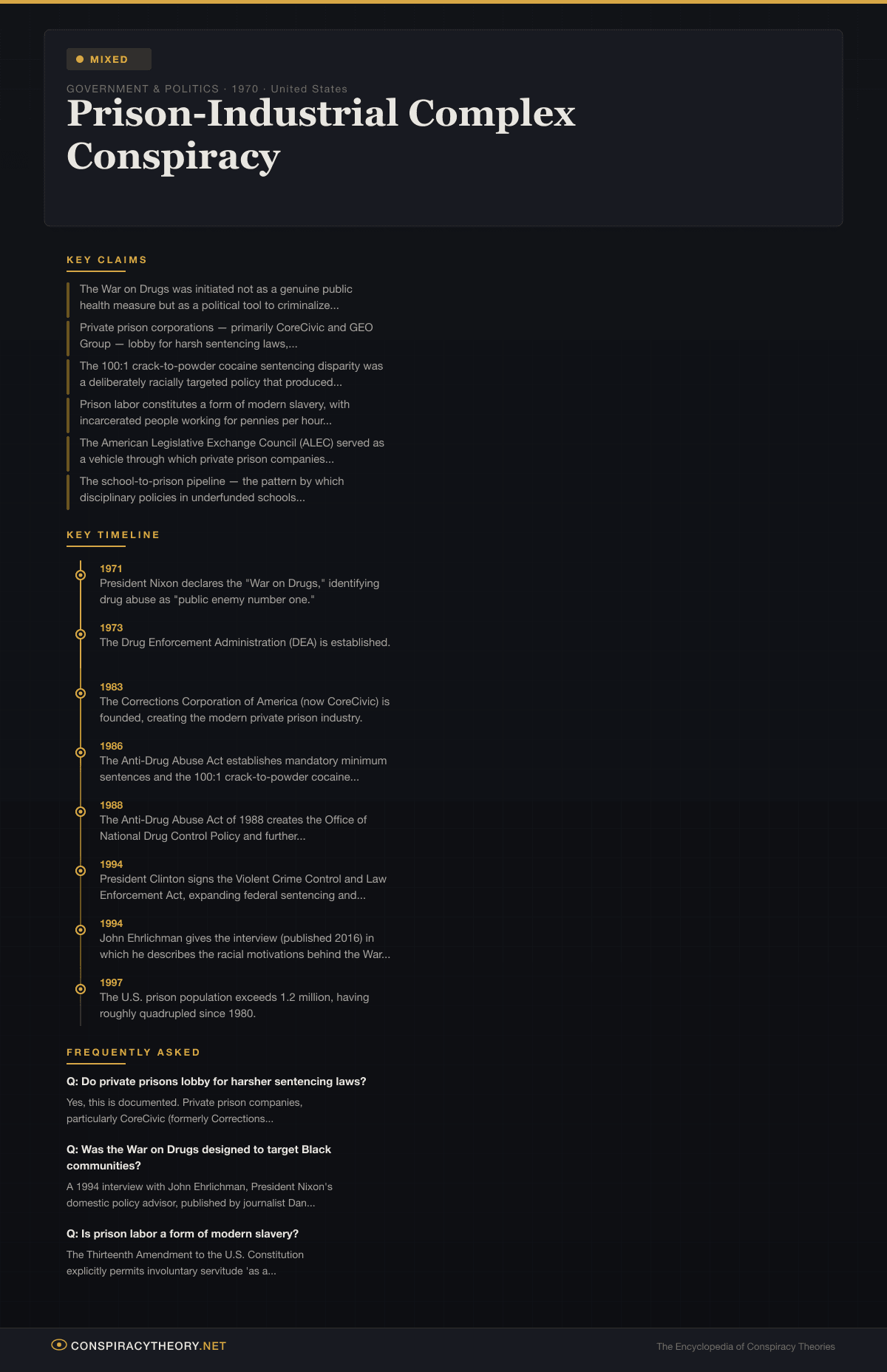
- The War on Drugs was initiated not as a genuine public health measure but as a political tool to criminalize and disrupt Black communities and the anti-war movement.
- Private prison corporations — primarily CoreCivic and GEO Group — lobby for harsh sentencing laws, mandatory minimums, and immigration enforcement policies to maintain high incarceration rates that drive their profits.
- The 100:1 crack-to-powder cocaine sentencing disparity was a deliberately racially targeted policy that produced mass incarceration of Black Americans for conduct that received far lighter penalties when committed by white Americans.
- Prison labor constitutes a form of modern slavery, with incarcerated people working for pennies per hour to produce goods and services for both the government and private corporations, enabled by the Thirteenth Amendment’s exception for convicted criminals.
- The American Legislative Exchange Council (ALEC) served as a vehicle through which private prison companies drafted “model legislation” for mandatory minimums, three-strikes laws, and truth-in-sentencing requirements that state legislatures then adopted.
- The school-to-prison pipeline — the pattern by which disciplinary policies in underfunded schools funnel minority students into the criminal justice system — is a structural feature rather than an unfortunate accident.
- Police departments and prosecutors’ offices have institutional incentives (asset forfeiture revenue, conviction rate metrics, career advancement) that favor aggressive enforcement against vulnerable communities.
- The current system represents a continuation of racial social control that progressed from slavery to convict leasing to Jim Crow segregation to mass incarceration.
Evidence
Documented Facts
Incarceration Statistics: The United States incarcerates more people than any other country in the world, both in absolute numbers and per capita. As of 2024, the U.S. had an incarceration rate of approximately 531 per 100,000 people, compared to 129 in the United Kingdom, 93 in Canada, and 64 in Germany. Black Americans are incarcerated at approximately five times the rate of white Americans.
The Ehrlichman Interview: John Ehrlichman’s statement to Dan Baum, while contested in some quarters, provides direct testimony from a senior Nixon official confirming racial motivations behind the War on Drugs. The statement appeared in Baum’s 2016 Harper’s article: “The Nixon campaign in 1968, and the Nixon White House after that, had two enemies: the antiwar left and Black people… We could disrupt those communities.”
Sentencing Disparities: The 100:1 crack-to-powder cocaine sentencing disparity was codified in the Anti-Drug Abuse Act of 1986 and was not reduced until the Fair Sentencing Act of 2010 narrowed it to 18:1. The United States Sentencing Commission repeatedly found that the disparity produced racially disproportionate outcomes and recommended its elimination.
Private Prison Lobbying: The Justice Policy Institute and other watchdog organizations have documented millions of dollars in lobbying expenditures and campaign contributions by private prison companies. CoreCivic and GEO Group have been significant political donors, with GEO Group’s political action committee donating $475,000 to a pro-Trump super PAC in 2016. Both companies participated in ALEC, which drafted model sentencing legislation.
ALEC and Model Legislation: Reporting by the Center for Media and Democracy and others has documented ALEC’s role in drafting model “truth in sentencing,” “three strikes,” and mandatory minimum laws that were subsequently adopted by numerous state legislatures. Private prison companies were corporate members of ALEC’s criminal justice task force.
Prison Labor: The U.S. Bureau of Justice Statistics has confirmed that incarcerated people in federal prisons earn between $0.23 and $1.15 per hour, while state prison wages range from nothing (in several states) to a few dollars per hour. Federal Prison Industries (UNICOR) generates over $500 million in annual revenue. Numerous corporations have used prison labor, including in manufacturing, agriculture, and call center operations.
Asset Forfeiture: The Institute for Justice has documented the widespread use of civil asset forfeiture — the practice by which law enforcement agencies seize property suspected of involvement in criminal activity without necessarily charging the owner with a crime. Federal, state, and local agencies have seized billions of dollars in assets, with proceeds often flowing back to the seizing agencies, creating a direct financial incentive for aggressive enforcement.
Academic Research
Michelle Alexander’s 2010 book The New Jim Crow: Mass Incarceration in the Age of Colorblindness synthesized existing research into a comprehensive argument that mass incarceration functioned as a racial caste system. The book became enormously influential in both academic and popular discourse.
The National Research Council’s 2014 report The Growth of Incarceration in the United States concluded that the prison population increase was driven primarily by policy changes — particularly sentencing laws and enforcement priorities — rather than by changes in crime rates.
Research by economists has found that mass incarceration has had limited effects on crime reduction. The Brennan Center for Justice estimated that increased incarceration accounted for approximately 5% of the decline in crime during the 1990s, while other factors — demographic changes, economic conditions, policing strategies, and the decline of the crack epidemic — played larger roles.
Debunking / Verification
What is well-established: The racial disparities in the criminal justice system are extensively documented by government agencies, academic researchers, and nonpartisan organizations. The War on Drugs did disproportionately target communities of color. Private prison companies did lobby for harsh sentencing. Prison labor does operate at exploitative wages. The crack-powder sentencing disparity did produce racially skewed outcomes. ALEC did draft model criminal justice legislation benefiting private prison companies.
Where the theory overreaches: The conspiracy framing can obscure the complexity of the historical record. The 1994 crime bill was supported by many Black community leaders, including members of the Congressional Black Caucus, who represented communities devastated by the crack epidemic and violent crime. Crime rates in the late 1980s and early 1990s were genuinely high, and public demand for tough law enforcement crossed racial lines. The theory sometimes attributes entirely to racial animus what was partly driven by genuine fear of violent crime.
The private prison overemphasis: While private prison lobbying is real, private facilities hold only about 8% of the total incarcerated population. The vast majority of mass incarceration occurs in publicly operated facilities. Public-sector correctional officer unions — most notably the California Correctional Peace Officers Association — have also lobbied heavily for tough sentencing. Attributing mass incarceration primarily to private prison profits misidentifies the primary drivers.
Reform complicates the narrative: Significant criminal justice reform has occurred in recent years, often with bipartisan support. The Fair Sentencing Act of 2010 reduced the crack-powder disparity. The First Step Act of 2018 was signed by President Trump with support from both parties. Multiple states have reduced their prison populations through sentencing reform. If a unified conspiracy to maintain mass incarceration existed, these reforms would be difficult to explain.
International comparison: While the United States is an extreme outlier in incarceration rates, other countries with different racial demographics and political structures also have significant incarceration. Russia, Rwanda, Turkmenistan, and El Salvador have high incarceration rates, suggesting that factors beyond American racial dynamics — including authoritarian governance, poverty, and political instability — also drive imprisonment.
Cultural Impact
The prison-industrial complex theory has profoundly influenced American political discourse, popular culture, and policy reform efforts. It has moved from academic and activist circles into mainstream political debate.
The theory was central to the Black Lives Matter movement, which emerged in 2013 and reached its peak influence following the police killings of George Floyd, Breonna Taylor, and others in 2020. BLM explicitly connected policing violence to the broader system of mass incarceration and called for defunding police, ending cash bail, and abolishing private prisons.
In popular culture, the Netflix documentary 13th (2016), directed by Ava DuVernay, directly presented the prison-industrial complex thesis, tracing a line from the Thirteenth Amendment’s slavery exception through convict leasing, Jim Crow, and the War on Drugs to contemporary mass incarceration. The documentary was nominated for an Academy Award and was viewed widely. The Netflix series Orange Is the New Black (2013-2019) brought issues of women’s incarceration and prison conditions to a mainstream audience, with later seasons focusing explicitly on private prison profiteering.
Michelle Alexander’s The New Jim Crow became one of the most influential nonfiction books of the 2010s, remaining on the New York Times bestseller list for years and becoming assigned reading at universities across the country. The book shifted the frame of the criminal justice debate from individual cases to systemic analysis.
The theory influenced concrete policy changes. Multiple states and cities have banned private prisons. President Biden signed an executive order in 2021 directing the Department of Justice not to renew contracts with private prison companies for federal inmates (though this did not affect immigration detention facilities or state-level contracts). Criminal justice reform has become a bipartisan issue, with conservative groups like Right on Crime and the Koch-funded organizations advocating for reduced incarceration on fiscal and libertarian grounds.
The 2020 presidential campaign saw criminal justice reform become a central issue, with candidates competing to present the most comprehensive reform platforms. The theory’s influence was visible in calls to decriminalize marijuana, end cash bail, reduce mandatory minimums, and address racial disparities in sentencing.
Key Figures
Richard Nixon — 37th President of the United States, who declared the “War on Drugs” in 1971. His administration’s racial motivations were later revealed through the Ehrlichman interview and White House tape recordings.
John Ehrlichman — Nixon’s domestic policy advisor, whose posthumously published interview provided direct testimony that the drug war was designed to target Black communities and the anti-war left.
Ronald Reagan — 40th President, who dramatically escalated the War on Drugs in the 1980s, signed the Anti-Drug Abuse Act of 1986 establishing the crack-powder sentencing disparity, and oversaw a major expansion of the federal prison population.
Bill Clinton — 42nd President, who signed the 1994 Violent Crime Control and Law Enforcement Act, expanding federal sentencing and providing incentives for state-level incarceration expansion. He later expressed regret for the law’s mass incarceration effects.
Michelle Alexander — Legal scholar and author of The New Jim Crow: Mass Incarceration in the Age of Colorblindness (2010), which became the most influential articulation of the prison-industrial complex thesis.
Angela Davis — Scholar, activist, and author who has been among the most prominent advocates of prison abolition and was one of the earliest to use the term “prison-industrial complex” in the 1990s.
CoreCivic (formerly CCA) — The largest private prison company in the United States, founded in 1983, which has operated facilities housing tens of thousands of federal, state, and immigration detainees.
GEO Group — The second-largest private prison company, which has faced numerous lawsuits over facility conditions and has been a significant political donor and lobbying presence.
Timeline
- 1971 — President Nixon declares the “War on Drugs,” identifying drug abuse as “public enemy number one.”
- 1973 — The Drug Enforcement Administration (DEA) is established.
- 1983 — The Corrections Corporation of America (now CoreCivic) is founded, creating the modern private prison industry.
- 1986 — The Anti-Drug Abuse Act establishes mandatory minimum sentences and the 100:1 crack-to-powder cocaine sentencing disparity.
- 1988 — The Anti-Drug Abuse Act of 1988 creates the Office of National Drug Control Policy and further increases penalties.
- 1994 — President Clinton signs the Violent Crime Control and Law Enforcement Act, expanding federal sentencing and funding for police and prisons.
- 1994 — John Ehrlichman gives the interview (published 2016) in which he describes the racial motivations behind the War on Drugs.
- 1997 — The U.S. prison population exceeds 1.2 million, having roughly quadrupled since 1980.
- 2008 — The U.S. prison population peaks at approximately 2.3 million, giving the United States the highest incarceration rate in the world.
- 2010 — Michelle Alexander publishes The New Jim Crow, bringing the prison-industrial complex thesis to mainstream attention.
- 2010 — The Fair Sentencing Act reduces the crack-to-powder cocaine sentencing disparity from 100:1 to 18:1.
- 2013 — The Black Lives Matter movement is founded, connecting policing and incarceration to systemic racism.
- 2016 — Ava DuVernay’s documentary 13th is released, presenting the prison-industrial complex argument to a mass audience.
- 2016 — Dan Baum publishes the Ehrlichman interview in Harper’s Magazine.
- 2018 — President Trump signs the First Step Act, the first major federal criminal justice reform in a generation, reducing some mandatory minimums and expanding early release programs.
- 2020 — The killing of George Floyd sparks nationwide protests and renewed calls for criminal justice reform.
- 2021 — President Biden signs an executive order directing the DOJ not to renew private prison contracts for federal inmates.
- 2022 — Several states pass marijuana legalization measures, with some including provisions for expunging prior convictions.
Sources & Further Reading
- Alexander, Michelle. The New Jim Crow: Mass Incarceration in the Age of Colorblindness. New York: The New Press, 2010.
- Baum, Dan. “Legalize It All: How to Win the War on Drugs.” Harper’s Magazine, April 2016.
- National Research Council. The Growth of Incarceration in the United States: Exploring Causes and Consequences. Washington, D.C.: The National Academies Press, 2014.
- DuVernay, Ava, dir. 13th. Netflix, 2016.
- Davis, Angela Y. Are Prisons Obsolete? New York: Seven Stories Press, 2003.
- Pfaff, John. Locked In: The True Causes of Mass Incarceration and How to Achieve Real Reform. New York: Basic Books, 2017.
- Gottschalk, Marie. Caught: The Prison State and the Lockdown of American Politics. Princeton: Princeton University Press, 2016.
- Sentencing Project. “Report to the United Nations on Racial Disparities in the U.S. Criminal Justice System.” 2018.
- Justice Policy Institute. “Gaming the System: How the Political Strategies of Private Prison Companies Promote Ineffective Incarceration Policies.” 2011.
- Bureau of Justice Statistics. Annual reports on prison populations and correctional supervision.
- Brennan Center for Justice. “What Caused the Crime Decline?” 2015.
- American Civil Liberties Union. “Banking on Bondage: Private Prisons and Mass Incarceration.” 2011.
Related Theories
- CIA Drug Trafficking — Allegations that the Central Intelligence Agency facilitated drug trafficking into the United States, including the crack cocaine epidemic, to fund covert operations.
- Crack Epidemic Conspiracy — The specific claim that the crack cocaine epidemic of the 1980s was deliberately introduced into Black communities by intelligence agencies.
- COINTELPRO — The confirmed FBI counterintelligence program that targeted civil rights leaders, Black nationalist organizations, and anti-war groups through surveillance, infiltration, and disruption.

Frequently Asked Questions
Do private prisons lobby for harsher sentencing laws?
Was the War on Drugs designed to target Black communities?
Is prison labor a form of modern slavery?
Infographic
Share this visual summary. Right-click to save.