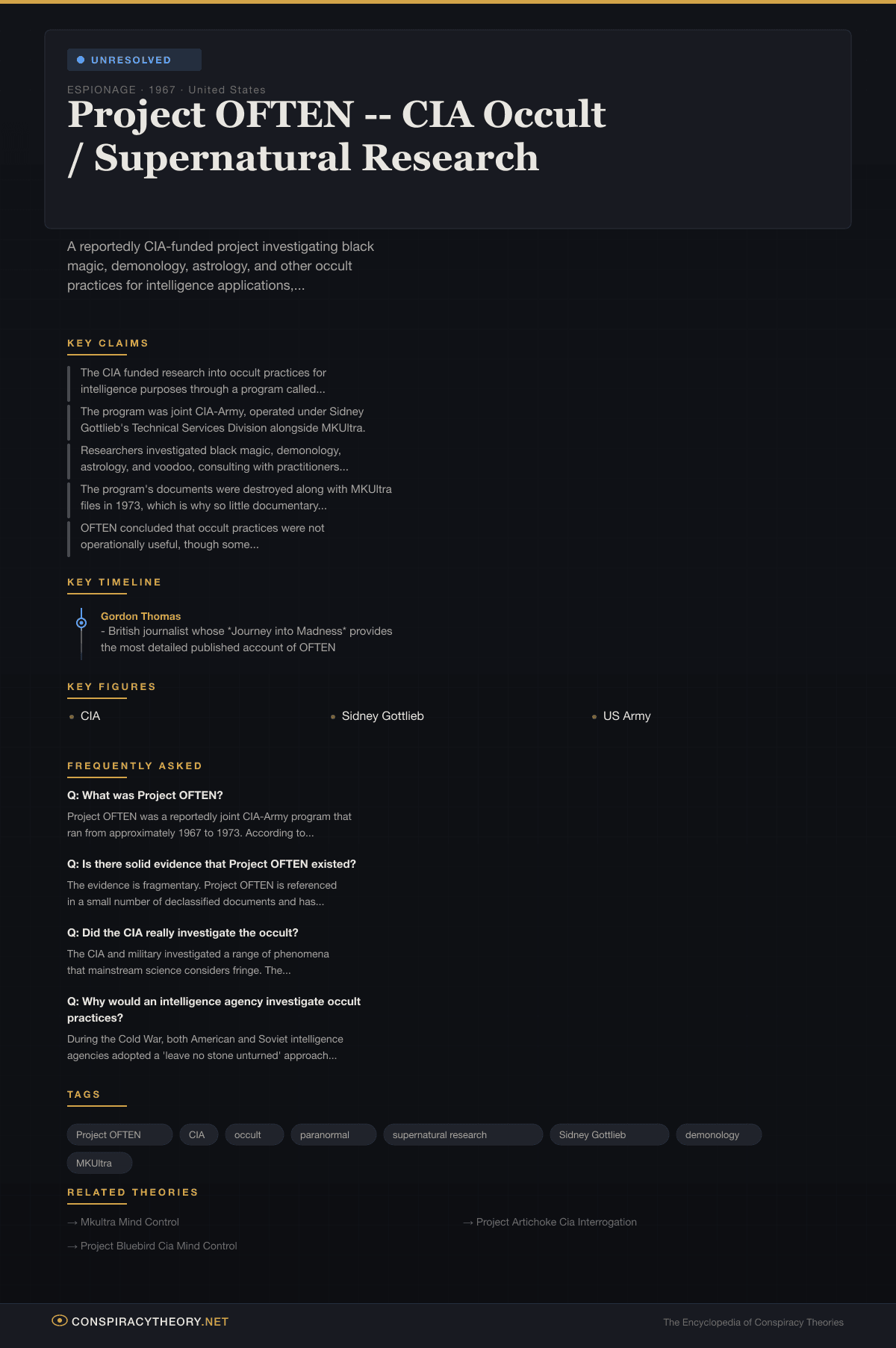
Project OFTEN -- CIA Occult / Supernatural Research
Overview
Somewhere in the strange hinterland where the Cold War intelligence community met the counterculture, the CIA apparently decided that if drugs, hypnosis, and sensory deprivation couldn’t crack the mind control problem, maybe black magic could.
Project OFTEN is one of the most obscure and poorly documented programs in the CIA’s behavioral research history. According to the limited sources available, it was a joint CIA-U.S. Army project that ran from approximately 1967 to 1973, investigating the intelligence applications of occult practices — demonology, astrology, black magic, and various supernatural traditions. The program allegedly operated under Sidney Gottlieb’s Technical Services Division, the same unit that ran MKUltra, and was shut down at roughly the same time, when CIA Director Richard Helms ordered the destruction of mind control program files.
The difficulty with OFTEN is that it sits in an informational no-man’s-land. It is referenced in enough credible sources that its existence is plausible — perhaps even probable. But the documentary evidence is too thin to confirm its scope, methods, or findings with the same confidence that applies to BLUEBIRD, ARTICHOKE, or MKUltra. What we know, or think we know, comes primarily from secondary sources: journalists who interviewed former CIA personnel, researchers who followed the paper trail as far as it went, and fragments that survived the 1973 document purge.
The result is a story that is simultaneously plausible (given what we know about the CIA’s willingness to investigate anything that might provide an intelligence advantage), frustrating (because the evidence is so limited), and irresistible (because the image of Langley’s finest consulting with demonologists is inherently riveting).
Origins & History
The MKUltra Universe
To understand OFTEN, you need to understand the institutional culture that produced MKUltra. By the mid-1960s, Sidney Gottlieb’s Technical Services Division had been running MKUltra for over a decade, funding 149 sub-projects across universities, hospitals, prisons, and CIA facilities. The projects ranged from the methodical (LSD dose-response studies) to the bizarre (investigating whether ESP could be used for intelligence communication).
MKUltra’s mandate was breathtakingly broad: explore any method that might allow the CIA to influence, control, or predict human behavior. This institutional openness to unconventional approaches created an environment in which investigating the occult was not the wild departure it might seem from the outside. If you were already funding experiments with LSD, sensory deprivation, and electroconvulsive shock, investigating whether ancient magical practices contained any kernel of usable knowledge was merely another item on a very long list.
What the Sources Say
The most detailed published account of Project OFTEN comes from Gordon Thomas’s 1989 book Journey into Madness: The True Story of Secret CIA Mind Control and Medical Abuse. Thomas, a British journalist who spent years investigating MKUltra, described OFTEN as a joint CIA-Army initiative launched in 1967 with the specific goal of evaluating offensive and defensive uses of occult practices.
According to Thomas, the program investigated:
Demonology and black magic: Researchers allegedly consulted with practitioners of various magical traditions to assess whether their techniques — ritual invocations, curses, and other practices — had any demonstrable effect that could be weaponized or defended against.
Astrology and divination: The program reportedly studied whether astrological and other divinatory methods could be used for intelligence analysis or prediction — essentially whether ancient predictive systems contained any statistical validity.
Psychic phenomena: Building on MKUltra’s existing interest in ESP, OFTEN allegedly expanded the investigation into a wider range of claimed psychic abilities.
Voodoo and folk magic: Some accounts describe researchers traveling to Haiti and other locations to study local magical practices firsthand.
Thomas reported that Gottlieb himself took a direct interest in the program and that CIA agents visited practitioners of black magic and voodoo in various countries. The program allegedly concluded, unsurprisingly, that occult practices did not provide reliable intelligence tools, but that some practitioners demonstrated psychological manipulation techniques that were of professional interest.
The Broader Context
OFTEN did not exist in isolation. The U.S. intelligence community’s interest in the paranormal and unconventional was broader than any single program:
The Stargate Program (1978-1995): The CIA and Defense Intelligence Agency spent $20 million over 17 years investigating “remote viewing” — the claimed ability to psychically perceive distant locations. The program employed several individuals who claimed remote viewing abilities and attempted to use them for intelligence gathering. It was declassified in 1995.
Andrija Puharich: A former Army medical officer with connections to intelligence circles, Puharich conducted extensive research into psychic phenomena and traveled to Israel in the 1970s to study Uri Geller, the self-proclaimed psychic spoon-bender. Puharich’s connections to intelligence agencies have been documented but the full extent of his official role remains unclear.
MKUltra Sub-project 136: This specific MKUltra sub-project investigated electrosleep, telepathy, and various altered states of consciousness, demonstrating that MKUltra’s scope already overlapped with territory that OFTEN allegedly covered.
Key Claims
-
The CIA funded research into occult practices for intelligence purposes through a program called OFTEN, running approximately 1967-1973.
-
The program was joint CIA-Army, operated under Sidney Gottlieb’s Technical Services Division alongside MKUltra.
-
Researchers investigated black magic, demonology, astrology, and voodoo, consulting with practitioners and attempting to assess whether any occult techniques had demonstrable, weaponizable effects.
-
The program’s documents were destroyed along with MKUltra files in 1973, which is why so little documentary evidence survives.
-
OFTEN concluded that occult practices were not operationally useful, though some psychological manipulation techniques employed by practitioners were noted as potentially applicable.
Evidence
Documentary Evidence
The documentary evidence for OFTEN is thin. Unlike MKUltra, which is supported by thousands of declassified pages, OFTEN rests on:
-
References in surviving MKUltra documents: Some declassified MKUltra administrative documents mention OFTEN by name, confirming at minimum that a program with that designation existed within the Technical Services Division.
-
Financial records: Some accounts cite financial records indicating funding for a project codenamed OFTEN, though the details are vague.
-
CIA Inspector General references: Internal CIA reviews of the Technical Services Division’s programs reportedly reference OFTEN, though the full text of these reviews remains classified.
Secondary Sources
-
Gordon Thomas, Journey into Madness (1989): The most detailed published account, based on interviews with former CIA personnel and examination of declassified documents.
-
John Marks, The Search for the “Manchurian Candidate” (1979): Marks, who obtained MKUltra documents through FOIA and conducted the most thorough journalistic investigation of the programs, mentions OFTEN briefly in the context of Gottlieb’s wider operations.
-
H.P. Albarelli, A Terrible Mistake (2009): References OFTEN in the context of the broader network of CIA behavioral research programs.
Limitations
The evidence is insufficient to confirm the specific claims about OFTEN’s investigation of demonology and black magic. The program’s existence is probable, but the detailed descriptions of occult research come primarily from Gordon Thomas, whose account, while well-researched, has been questioned by some intelligence historians who note that he relied heavily on unnamed sources.
It is entirely possible that OFTEN was a real program but that its actual activities were less dramatic than the occult research narrative suggests. It could have been a more conventional behavioral research program whose investigation of “superstition” and “belief systems” was later embellished into a story about the CIA consulting with demonologists.
Debunking / Verification
OFTEN is classified as “unresolved” because:
In favor of the standard narrative:
- A program codenamed OFTEN did exist within the CIA’s Technical Services Division
- The broader pattern of CIA investigation into unconventional phenomena (Stargate, MKUltra sub-projects) makes occult research plausible
- The 1973 document destruction explains the lack of detailed records
- Multiple independent researchers reference OFTEN in consistent ways
Against the standard narrative:
- No substantial body of declassified OFTEN documents has been produced
- The most detailed claims come from secondary sources relying on anonymous or deceased informants
- The story has a “too good to be true” quality that should prompt skepticism
- It is possible the occult angle has been exaggerated or mischaracterized
Without access to the destroyed documents or primary source testimony from verified OFTEN personnel, a definitive verdict is not possible. The program probably existed. Its investigation of the occult may have occurred as described. But the evidence falls short of the standard that would warrant a “confirmed” classification.
Cultural Impact
Project OFTEN, whether real in its fullest claimed form or partly embellished, has had an outsized cultural impact relative to its evidentiary base. The image of the CIA investigating black magic and demonology has become one of the most memorable and frequently cited elements of the MKUltra story, adding a dimension of occult horror to what is already a disturbing history.
The program has been particularly influential in conspiracy culture, where it serves as evidence for the claim that the highest levels of the American intelligence community dabble in the occult. This narrative connects to broader conspiracy theories about elite participation in occult rituals, Satanic practices, and supernatural manipulation.
In skeptical and scientific communities, OFTEN is sometimes cited as the reductio ad absurdum of intelligence agencies’ willingness to pursue any lead, no matter how irrational. The argument goes: if the CIA was willing to investigate black magic, it tells you more about the institutional culture of Cold War intelligence than about the efficacy of occult practices.
The relationship between OFTEN and the Stargate Program is worth noting. Stargate, which spent $20 million investigating remote viewing over nearly two decades, demonstrates that the intelligence community’s interest in the paranormal was not a brief anomaly but a sustained institutional commitment. Whether OFTEN represents the extreme end of this commitment — investigating outright magic rather than merely psychic phenomena — remains an open question.
In Popular Culture
- “Stranger Things” (2016-present) — While based on MKUltra and Montauk rather than OFTEN specifically, the show’s depiction of government scientists exploring psychic and dimensional phenomena echoes OFTEN’s alleged territory
- “The Men Who Stare at Goats” (2004 book/2009 film) — The military’s investigation of paranormal abilities parallels OFTEN’s alleged mission
- “Hellboy” (comics and films) — The fictional Bureau for Paranormal Research and Defense mirrors the concept of a government agency investigating supernatural phenomena
- “The X-Files” (1993-2018) — The FBI’s fictional paranormal investigation unit reflects the real intelligence community’s documented interest in unconventional phenomena
- “American Horror Story: Coven” (2013-2014) — While not directly referencing OFTEN, the intersection of government power and occult practices echoes the program’s reported activities
Key Figures
- Sidney Gottlieb (1918-1999) — Head of the CIA’s Technical Services Division who oversaw both MKUltra and, reportedly, Project OFTEN
- Richard Helms (1913-2002) — CIA Director who ordered the destruction of MKUltra/OFTEN documents in 1973
- Gordon Thomas — British journalist whose Journey into Madness provides the most detailed published account of OFTEN
- Andrija Puharich (1918-1995) — Army medical officer and parapsychology researcher with intelligence connections who operated in the same milieu as OFTEN
Timeline
| Date | Event |
|---|---|
| 1953 | MKUltra established under Sidney Gottlieb; creates institutional framework for unconventional research |
| 1962 | MKUltra’s scope expands to include altered states of consciousness and parapsychological research |
| 1967 | Project OFTEN reportedly established as joint CIA-Army program |
| Late 1960s | OFTEN researchers allegedly consult with practitioners of various occult traditions |
| 1970s | Andrija Puharich’s parapsychology research operates in parallel with intelligence community programs |
| 1973 | CIA Director Helms orders destruction of MKUltra files; OFTEN documents reportedly included |
| 1973 | Project OFTEN reportedly terminated alongside MKUltra |
| 1975 | Church Committee investigates CIA programs; OFTEN receives limited mention |
| 1977 | Surviving financial records reveal fragments of MKUltra-related programs |
| 1978 | Stargate Program established, continuing intelligence community’s investigation of paranormal phenomena |
| 1979 | John Marks publishes The Search for the “Manchurian Candidate”, briefly referencing OFTEN |
| 1989 | Gordon Thomas publishes Journey into Madness with most detailed OFTEN account |
| 1995 | Stargate Program declassified and terminated |
Sources & Further Reading
- Thomas, Gordon. Journey into Madness: The True Story of Secret CIA Mind Control and Medical Abuse. Bantam Books, 1989.
- Marks, John. The Search for the “Manchurian Candidate”: The CIA and Mind Control. W.W. Norton, 1979.
- Albarelli, H.P. A Terrible Mistake: The Murder of Frank Olson and the CIA’s Secret Cold War Experiments. Trine Day, 2009.
- Kinzer, Stephen. Poisoner in Chief: Sidney Gottlieb and the CIA Search for Mind Control. Henry Holt, 2019.
- Targ, Russell, and Harold Puthoff. Mind-Reach: Scientists Look at Psychic Abilities. Delacorte Press, 1977.
- McRae, Ronald. Mind Wars: The True Story of Government Research into the Military Potential of Psychic Weapons. St. Martin’s Press, 1984.
Related Theories
- MKUltra — the larger CIA mind control program under which OFTEN reportedly operated
- Project ARTICHOKE — earlier CIA behavior modification program that established the institutional patterns OFTEN inherited
- Project BLUEBIRD — the first CIA mind control program, grandparent of the institutional lineage that produced OFTEN
Frequently Asked Questions
What was Project OFTEN?
Is there solid evidence that Project OFTEN existed?
Did the CIA really investigate the occult?
Why would an intelligence agency investigate occult practices?

Infographic
Share this visual summary. Right-click to save.