State Propaganda Machine

Overview
In 1928, a young nephew of Sigmund Freud published a slim book titled Propaganda. Its opening line was disarmingly blunt: “The conscious and intelligent manipulation of the organized habits and opinions of the masses is an important element in democratic society.” The author, Edward Bernays, was not warning the public about propaganda. He was writing a manual for practitioners.
Bernays had learned the craft working for the Committee on Public Information during World War I, where the US government successfully convinced a reluctant nation to support a European war through a systematic campaign of emotional manipulation, staged events, and controlled messaging. After the war, Bernays took those techniques and repackaged them for corporate America, inventing what he called “public relations” — because, as he noted, “propaganda” had acquired negative connotations after the war.
The story of state propaganda in the 20th and 21st centuries is one of the few conspiracy-adjacent topics where the documented reality is so extensive and well-sourced that the “conspiracy theory” label feels almost inappropriate. The US government has engaged in systematic propaganda operations for over a century, ranging from the overt (the Committee on Public Information, Voice of America, Radio Free Europe) to the covert (Operation Mockingbird, the Military Analyst Program, paid columnists). Other governments have done the same, often with fewer pretenses about democratic transparency.
The “mixed” classification reflects the gap between what is documented and what is alleged. The documented history of government propaganda is extensive and damning. The conspiracy theory layer — that all major media are controlled by a unified “propaganda machine” operating under centralized government direction — extends beyond what the evidence supports, even though specific instances of media manipulation have been proven repeatedly.
Origins & History
The Committee on Public Information (1917-1919)
The modern era of American government propaganda begins on April 13, 1917, when President Woodrow Wilson established the Committee on Public Information by executive order, just days after the US entered World War I. Led by journalist George Creel, the CPI was tasked with building public support for a war that much of the country opposed.
The CPI’s methods were sophisticated for their time and established templates still used today. The committee recruited 75,000 volunteer “Four Minute Men” who delivered short patriotic speeches in movie theaters, churches, and public gatherings across the country. It produced propaganda films, designed iconic recruitment posters (including James Montgomery Flagg’s “Uncle Sam Wants You”), censored domestic news through “voluntary” guidelines that editors understood were not really voluntary, and fed journalists pre-packaged stories favorable to the war effort.
Among the young men who worked for the CPI were Walter Lippmann, who would become one of the 20th century’s most influential political commentators, and Edward Bernays, who would become the father of public relations. Both drew direct lessons from the CPI experience. Lippmann concluded that democratic publics were too irrational to be trusted with self-governance and that “manufactured consent” by expert elites was necessary. Bernays concluded that the CPI’s techniques worked brilliantly and could be applied to any domain — selling products, shaping politics, or managing public opinion.
Bernays and the Birth of PR
After the war, Bernays applied propaganda techniques to commercial and political clients with remarkable success. His cigarette campaign for American Tobacco in 1929 is a famous case study: to break the social taboo against women smoking in public, Bernays hired debutantes to light up Lucky Strikes during the Easter Sunday parade in New York, with press photographers pre-positioned to capture the moment. He framed the cigarettes as “torches of freedom” — a feminist symbol of liberation. Cigarette sales among women soared.
Bernays also worked directly for governments. In 1954, he helped the United Fruit Company and the CIA build public support for the overthrow of Guatemala’s democratically elected president, Jacobo Arbenz. Bernays organized press tours, cultivated journalists, and framed the coup as an anti-Communist liberation rather than a corporate-sponsored regime change.
The Cold War Propaganda Apparatus
During the Cold War, the US government built a permanent propaganda infrastructure:
Voice of America (VOA): Established in 1942, VOA broadcast news and programming to foreign audiences, presenting an American perspective on world events. While officially committed to factual reporting, VOA operated under government oversight and served clear propaganda functions.
Radio Free Europe / Radio Liberty: Funded covertly by the CIA from their founding in 1949/1953 until the 1970s, these broadcasters targeted audiences behind the Iron Curtain. They were presented as private organizations but were instruments of US foreign policy.
United States Information Agency (USIA): Created in 1953, USIA operated cultural centers, libraries, and media programs worldwide, projecting American soft power. It produced films, publications, and exhibitions designed to promote favorable views of the United States.
Operation Mockingbird: According to reporting by Carl Bernstein and findings of the Church Committee, the CIA cultivated relationships with American journalists and media executives from the 1950s onward, using them to plant stories, suppress unfavorable coverage, and amplify Agency-friendly narratives. The full scope of Mockingbird remains debated, but the CIA’s media relationships have been confirmed through multiple sources.
The Gulf War and Beyond
The Nayirah testimony of 1990 represents one of the most brazen proven examples of wartime propaganda. A 15-year-old girl, identified only as “Nayirah,” tearfully testified before the Congressional Human Rights Caucus that she had witnessed Iraqi soldiers pulling Kuwaiti babies from incubators and leaving them to die on the floor. The testimony was widely cited by President George H.W. Bush and was instrumental in building public support for the Gulf War.
It was later revealed that “Nayirah” was Nayirah al-Sabah, the daughter of the Kuwaiti ambassador to the United States. Her testimony had been coached by the public relations firm Hill & Knowlton, which had been hired by Citizens for a Free Kuwait (a Kuwaiti government front group) for $10.7 million. Independent investigations found no credible evidence that the incubator atrocity had occurred as described.
The Iraq War Media Operations
The 2003 Iraq War generated some of the most extensively documented propaganda operations in US history:
The embedded press program: The Pentagon offered journalists the opportunity to embed with military units — providing access in exchange for implicit alignment with the military perspective. While embedding produced some outstanding war journalism, critics noted that it structurally biased coverage toward the military viewpoint and away from civilian perspectives.
The Military Analyst Program (2002-2008): Retired military officers who appeared on television as “independent” analysts were secretly attending Pentagon briefings, receiving talking points, and in many cases had financial ties to defense contractors who benefited from pro-war coverage. The program was revealed by the New York Times in 2008.
Paid columnists: The Bush administration paid syndicated columnist Armstrong Williams $240,000 to promote the No Child Left Behind Act in his columns and television appearances without disclosing the payment. Other columnists, including Maggie Gallagher and Michael McManus, received similar payments to promote administration policies.
Curveball and the WMD narrative: The intelligence community’s reliance on the source codenamed “Curveball” — an Iraqi defector who fabricated claims about mobile biological weapons labs — to justify the Iraq invasion has been extensively documented. While this was more intelligence failure than deliberate propaganda, the Bush administration’s selective use of intelligence to build the public case for war crossed the line into propaganda.
Key Claims
What is Documented
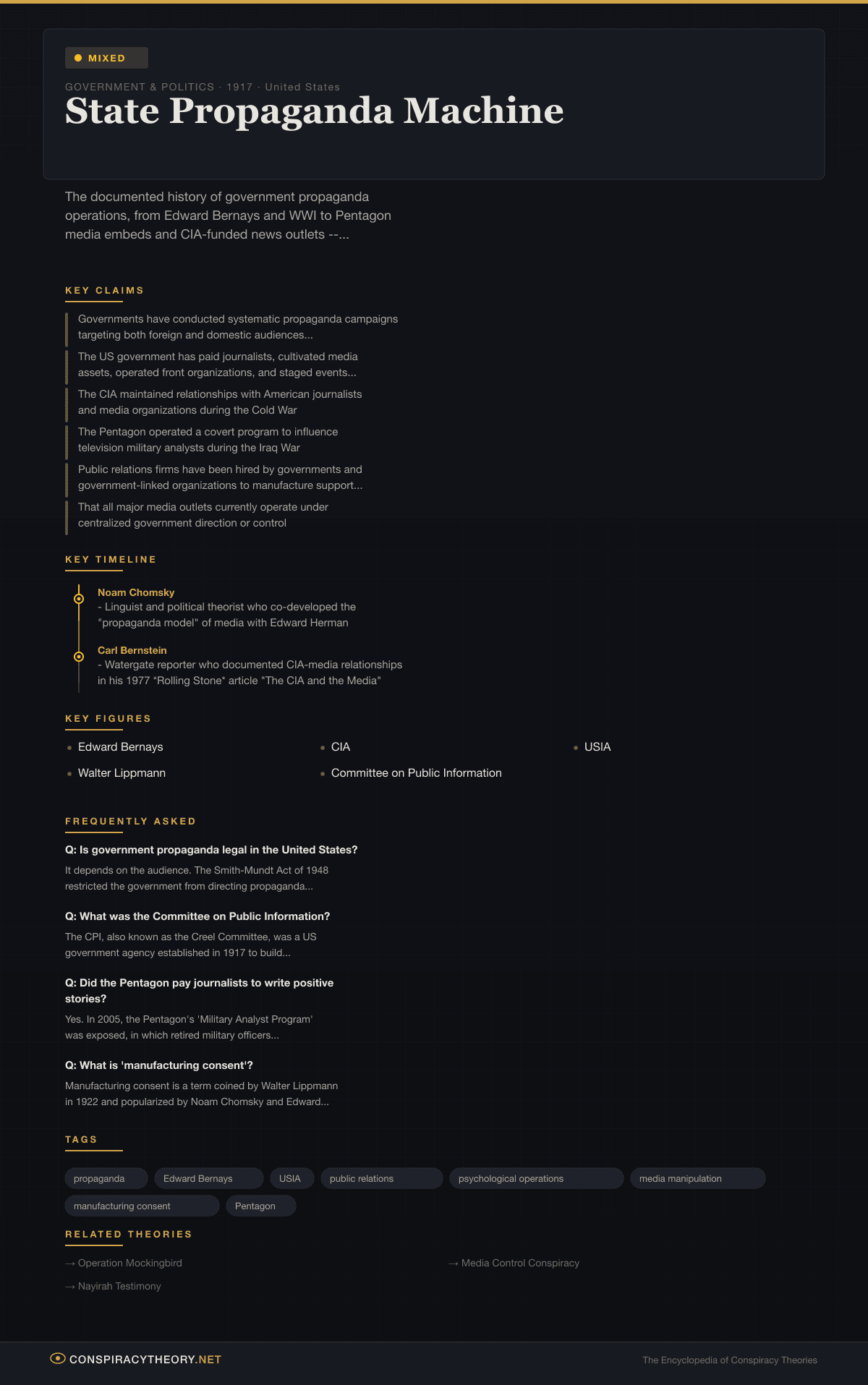
- Governments have conducted systematic propaganda campaigns targeting both foreign and domestic audiences throughout the 20th and 21st centuries
- The US government has paid journalists, cultivated media assets, operated front organizations, and staged events to shape public opinion
- The CIA maintained relationships with American journalists and media organizations during the Cold War
- The Pentagon operated a covert program to influence television military analysts during the Iraq War
- Public relations firms have been hired by governments and government-linked organizations to manufacture support for military interventions
What is Alleged but Unproven
- That all major media outlets currently operate under centralized government direction or control
- That a unified “propaganda machine” coordinates messaging across all platforms and outlets
- That the media is a monolithic entity serving a single master rather than a complex ecosystem with competing interests
- That “mainstream media” is fundamentally incapable of independent journalism due to structural capture by government and corporate interests
Evidence
Primary Source Documentation
The documented evidence for government propaganda is extensive:
Congressional hearings: The Church Committee (1975), the Senate Select Committee on Intelligence, and various House committees have produced volumes of testimony and documentary evidence about government media operations.
Declassified documents: CIA, USIA, and Pentagon documents obtained through FOIA reveal the scope and methods of propaganda programs.
Court proceedings: Lawsuits related to paid commentary, the Nayirah testimony, and other propaganda operations have produced sworn testimony and documentary evidence.
Pentagon Inspector General reports: Internal investigations of the Military Analyst Program and other operations have confirmed their existence and scope.
Journalism: Investigative reporting by the New York Times, Washington Post, Rolling Stone, Carl Bernstein, and others has documented specific propaganda operations with primary source evidence.
Academic Analysis
Noam Chomsky and Edward Herman, Manufacturing Consent (1988): The “propaganda model” of media identifies five “filters” — ownership, advertising, sourcing, flak, and ideology — that structurally bias media output toward elite interests without requiring an active conspiracy.
Walter Lippmann, Public Opinion (1922): Lippmann’s analysis of how media creates “pictures in our heads” that may bear little relation to reality remains foundational.
Jacques Ellul, Propaganda: The Formation of Men’s Attitudes (1962): The French sociologist’s analysis of propaganda as a structural feature of modern technological society, not merely a tool of governments, broadened the analytical framework.
Debunking / Verification
The documented cases of government propaganda are proven and not subject to debunking. However, the broader conspiracy narrative — that “the media” is a centrally controlled propaganda apparatus — conflates proven instances with a systemic claim that the evidence does not fully support.
What the evidence supports: Government propaganda operations have been extensive, sophisticated, and sometimes successful. Media outlets have been manipulated, individual journalists have been compromised, and structural pressures do create bias.
What the evidence does not support: That the media is a monolithic entity controlled by a single authority. American media is a chaotic ecosystem of competing corporations, independent outlets, individual journalists, social media platforms, and international sources. The same media that was manipulated by the Pentagon’s analyst program also exposed it. The same press that amplified the WMD narrative also produced the investigative reporting that debunked it.
The truth is more complex and, in some ways, more troubling than the conspiracy narrative suggests. Media manipulation does not require central control; it operates through structural incentives, access journalism, advertising pressure, and the economics of attention. The result can look like coordinated propaganda without anyone consciously directing it.
Cultural Impact
The documented history of government propaganda has had profound effects on public trust in media institutions. In the United States, trust in mass media has declined from over 70% in the mid-1970s to roughly 30% by the 2020s, according to Gallup polling. While this decline has multiple causes, the repeated revelation of government media manipulation has been a significant factor.
The erosion of trust has had contradictory effects. On one hand, a healthily skeptical public is less susceptible to government propaganda. On the other hand, blanket distrust of “the media” has made portions of the public susceptible to alternative propaganda — misinformation, conspiracy theories, and foreign influence operations that position themselves as the authentic truth that “mainstream media” suppresses.
The concept of “manufacturing consent” has become so widely understood that it functions as a cultural commons. Politicians of all stripes accuse media of bias and manipulation. Citizens across the political spectrum distrust news coverage. The very techniques Bernays pioneered — emotional manipulation, staged events, controlled narratives — are now recognized and discussed openly, even as they remain effective.
In Popular Culture
- “Manufacturing Consent: Noam Chomsky and the Media” (1992 documentary) — Definitive film presentation of the propaganda model
- “Wag the Dog” (1997 film) — Barry Levinson’s satire about a president who manufactures a fake war to distract from scandal; released shortly before the Clinton-Lewinsky scandal and the bombing of Sudan
- “The Century of the Self” (2002 BBC documentary by Adam Curtis) — Four-part series tracing the influence of Bernays and Freudian psychology on propaganda and public relations
- “Network” (1976 film) — Sidney Lumet’s prescient satire about the manipulation of television news for ratings and corporate profit
- “Propaganda” (1928 book by Edward Bernays) — The foundational text of public relations, still in print and widely read
- “Good Night, and Good Luck” (2005 film) — George Clooney’s film about Edward R. Murrow’s challenge to McCarthyism, depicting both government pressure on media and media’s capacity for independent journalism
- “Vice” (2018 film) — Dramatization of the Bush administration’s media management during the Iraq War
Key Figures
- Edward Bernays (1891-1995) — Nephew of Freud, father of public relations, author of Propaganda; applied wartime persuasion techniques to commercial and political campaigns
- Walter Lippmann (1889-1974) — Political commentator who coined “manufacturing consent” and argued for elite management of public opinion
- George Creel (1876-1953) — Led the Committee on Public Information during World War I
- Noam Chomsky — Linguist and political theorist who co-developed the “propaganda model” of media with Edward Herman
- Carl Bernstein — Watergate reporter who documented CIA-media relationships in his 1977 Rolling Stone article “The CIA and the Media”
- Jacques Ellul (1912-1994) — French sociologist who analyzed propaganda as a structural feature of modern technological societies
Timeline
| Date | Event |
|---|---|
| 1917 | Committee on Public Information established to build WWI support |
| 1919 | CPI disbanded; Bernays and Lippmann apply lessons to private sector |
| 1922 | Walter Lippmann publishes Public Opinion, introducing “manufacturing consent” concept |
| 1928 | Edward Bernays publishes Propaganda |
| 1942 | Voice of America established |
| 1948 | Smith-Mundt Act restricts government propaganda targeting domestic audiences |
| 1949-1953 | Radio Free Europe and Radio Liberty established, covertly funded by CIA |
| 1953 | United States Information Agency created |
| 1954 | Bernays assists CIA in building public support for Guatemalan coup |
| 1970s | CIA covert funding of Radio Free Europe revealed |
| 1975 | Church Committee investigates CIA media operations |
| 1977 | Carl Bernstein publishes “The CIA and the Media” in Rolling Stone |
| 1988 | Chomsky and Herman publish Manufacturing Consent |
| 1990 | Nayirah testimony fabricated to build support for Gulf War |
| 2002-2008 | Pentagon Military Analyst Program secretly briefs TV military analysts |
| 2005 | Armstrong Williams paid $240,000 to promote administration policy |
| 2008 | New York Times exposes Pentagon analyst program |
| 2012 | Smith-Mundt Modernization Act loosens restrictions on domestic access to government-produced content |
Sources & Further Reading
- Bernays, Edward. Propaganda. Horace Liveright, 1928.
- Lippmann, Walter. Public Opinion. Harcourt, Brace and Company, 1922.
- Chomsky, Noam, and Edward Herman. Manufacturing Consent: The Political Economy of the Mass Media. Pantheon Books, 1988.
- Ellul, Jacques. Propaganda: The Formation of Men’s Attitudes. Vintage Books, 1962 (English translation 1965).
- Bernstein, Carl. “The CIA and the Media.” Rolling Stone, October 20, 1977.
- Barstow, David. “Behind TV Analysts, Pentagon’s Hidden Hand.” New York Times, April 20, 2008.
- Tye, Larry. The Father of Spin: Edward L. Bernays and the Birth of Public Relations. Crown, 1998.
- Rampton, Sheldon, and John Stauber. Weapons of Mass Deception: The Uses of Propaganda in Bush’s War on Iraq. Jeremy P. Tarcher, 2003.
- Curtis, Adam. The Century of the Self. BBC documentary, 2002.
Related Theories
- Operation Mockingbird — the alleged CIA program to infiltrate and influence American media during the Cold War
- Media Control Conspiracy — the broader theory that mainstream media is controlled by a small group of elites
- Nayirah Testimony — the fabricated Congressional testimony used to build support for the 1991 Gulf War
Watch: Documentaries & Videos
Related documentaries available on YouTube.
Human Resources: Social Engineering in the 20th Century
Frequently Asked Questions
Is government propaganda legal in the United States?
What was the Committee on Public Information?
Did the Pentagon pay journalists to write positive stories?
What is 'manufacturing consent'?
Infographic
Share this visual summary. Right-click to save.