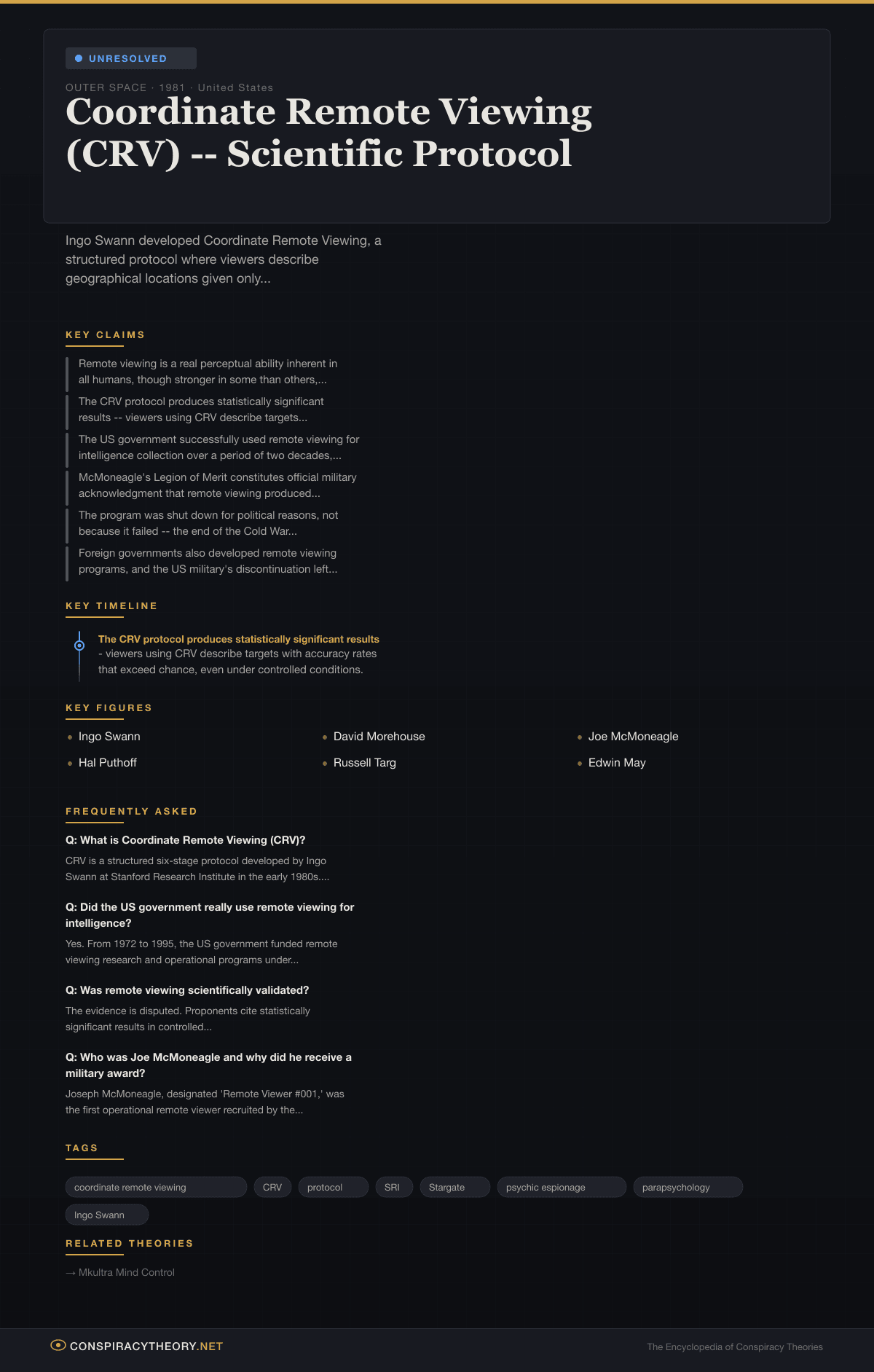
Coordinate Remote Viewing (CRV) -- Scientific Protocol
Overview
In 1972, the Central Intelligence Agency quietly began funding research into something that sounded more like science fiction than espionage: the possibility that human beings could perceive distant locations using nothing but their minds. Over the next twenty-three years, the US government would spend roughly $20 million on remote viewing programs, employ dozens of military and civilian “psychic spies,” and generate thousands of pages of classified session transcripts — all in pursuit of a capability that mainstream science considers impossible.
At the center of this story sits Coordinate Remote Viewing (CRV), a formalized protocol developed by artist and psychic researcher Ingo Swann at Stanford Research Institute (SRI) in the early 1980s. CRV was not free-form mysticism. It was a structured, six-stage methodology designed to systematize whatever it was that remote viewers appeared to be doing — turning subjective psychic impressions into a repeatable, trainable process. Whether CRV actually works remains one of the most contentious questions at the intersection of science, intelligence, and the paranormal. The US government spent two decades betting that it might.
Origins & History
The SRI Beginnings (1972-1978)
The remote viewing saga began at Stanford Research Institute (later SRI International) in Menlo Park, California, where physicists Harold “Hal” Puthoff and Russell Targ established a program to investigate psychic phenomena with CIA funding. Their initial subject was Ingo Swann, a New York artist who had demonstrated apparent psychic abilities in tests at the American Society for Psychical Research.
In early experiments, Swann was asked to describe locations identified only by their geographical coordinates — latitude and longitude. He reportedly provided descriptions that matched target sites with what researchers considered significant accuracy. These “coordinate remote viewing” sessions caught the CIA’s attention, and funding increased under the project name SCANATE (scan by coordinate).
The early methodology was relatively loose. A viewer received coordinates and described whatever impressions arose. There was no standardized procedure, no structured approach to separating genuine psychic impressions from imagination, memory, or analytical overlay (the viewer’s conscious mind trying to “make sense” of fragmentary data). Results were inconsistent, and critics argued that the experimental protocols were insufficiently rigorous.
Ingo Swann’s Protocol Revolution (1981-1984)
Swann recognized that the lack of structure was a fundamental problem. If remote viewing was a real perceptual ability, it needed a systematic training methodology — the same way any other skill is developed. Beginning around 1981, Swann developed what became known as the CRV protocol, a six-stage process designed to guide a viewer from initial, vague impressions to increasingly detailed and specific descriptions.
The six stages of CRV:
- Stage I — Major Gestalts: The viewer contacts the target and records immediate, spontaneous impressions of basic categories: is it natural or man-made? Land or water? Motion or stillness?
- Stage II — Sensory Data: The viewer describes sensory impressions: colors, textures, temperatures, sounds, smells. No analysis permitted — only raw sensory fragments.
- Stage III — Dimensional Data: The viewer sketches spatial relationships, dimensions, and basic geometry of the target.
- Stage IV — Emotional and Aesthetic Impact: The viewer records emotional responses, the “feel” of the target, and begins to perceive more complex qualitative data.
- Stage V — Interrogation: The viewer engages in more focused exploration, asking internal questions and recording detailed impressions of specific aspects of the target.
- Stage VI — Three-Dimensional Modeling: The viewer constructs detailed models, diagrams, and descriptions, integrating data from all previous stages.
A critical concept in CRV is Analytical Overlay (AOL) — the tendency of the conscious mind to jump to conclusions and construct narratives from fragmentary data. Swann’s protocol treated AOL as contamination to be identified and set aside, not followed. If a viewer perceived “metal, tall, pointed” and their mind immediately thought “Eiffel Tower,” the protocol required them to note “AOL: Eiffel Tower” and return to recording raw impressions rather than pursuing the analytical conclusion.
Fort Meade Operations (1978-1995)
While Swann developed his protocol at SRI, the operational side of remote viewing migrated to Fort Meade, Maryland, home of the National Security Agency and the Army’s Intelligence and Security Command (INSCOM). The operational unit went through multiple name changes and reorganizations:
- GONDOLA WISH (1977-1979) — Initial Army feasibility study
- GRILL FLAME (1978-1983) — First operational unit
- CENTER LANE (1983-1985) — Restructured under INSCOM
- SUN STREAK (1986-1990) — Expanded program under DIA
- STARGATE (1991-1995) — Final iteration before closure
The unit’s first recruit was Joseph McMoneagle, a Vietnam veteran and Army warrant officer who had experienced what he described as a near-death experience. Designated Remote Viewer #001, McMoneagle would become the program’s most prolific and decorated member. In 1984, he received the Legion of Merit for “producing critical intelligence unavailable from any other source.” The specific intelligence contributions remain classified, though McMoneagle has publicly described sessions involving a new class of Soviet submarine (the Typhoon class) and the location of a kidnapped US general (Brigadier General James Dozier, held by the Red Brigades in Italy in 1981).
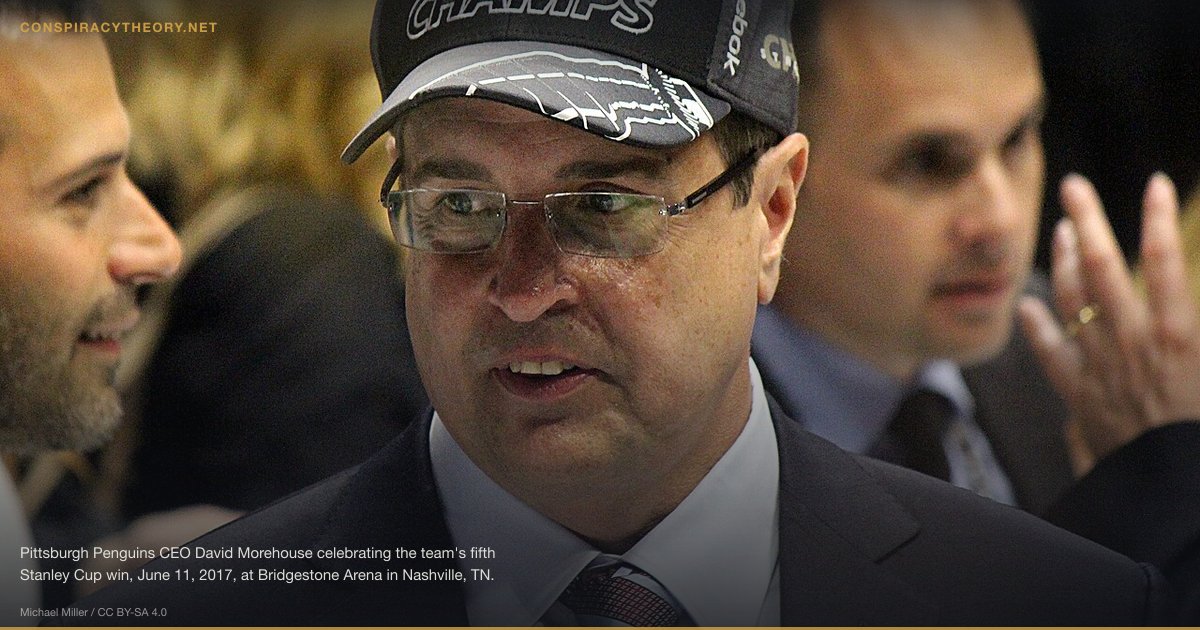
Other notable viewers who trained in Swann’s CRV protocol included David Morehouse (who later wrote the controversial memoir Psychic Warrior), Lyn Buchanan, Mel Riley, and Paul H. Smith (who authored the technical reference Reading the Enemy’s Mind).
Key Claims
- Remote viewing is a real perceptual ability inherent in all humans, though stronger in some than others, and trainable through structured protocols like CRV.
- The CRV protocol produces statistically significant results — viewers using CRV describe targets with accuracy rates that exceed chance, even under controlled conditions.
- The US government successfully used remote viewing for intelligence collection over a period of two decades, and operational results contributed to actual intelligence assessments.
- McMoneagle’s Legion of Merit constitutes official military acknowledgment that remote viewing produced actionable intelligence.
- The program was shut down for political reasons, not because it failed — the end of the Cold War reduced willingness to fund unconventional intelligence methods, and bureaucratic hostility from skeptics within the intelligence community killed the program despite evidence of its utility.
- Foreign governments also developed remote viewing programs, and the US military’s discontinuation left an intelligence gap.
Evidence
Supporting Evidence
- Statistical significance in laboratory experiments: The most rigorous review, the 1995 AIR (American Institutes for Research) evaluation commissioned by the CIA, analyzed all available experimental data. Statistician Jessica Utts concluded that the statistical evidence for a real effect was “overwhelming” and that “the phenomenon has been replicated in a number of forms across laboratories and cultures.”
- McMoneagle’s Legion of Merit: This is a matter of public military record. The citation references intelligence production, though specific operational details remain classified.
- Declassified session transcripts: Thousands of pages of remote viewing sessions have been declassified. Some show striking correspondences between viewer descriptions and actual targets, including the description of a previously unknown Soviet submarine construction facility at Severodvinsk.
- Longevity of funding: The US government funded the program continuously for 23 years across multiple administrations and intelligence agencies. Programs that produce nothing do not typically survive this long in the intelligence bureaucracy.
- Independently replicated studies: Researchers at the Princeton Engineering Anomalies Research (PEAR) lab and other institutions reported statistically significant results in related “anomalous cognition” experiments.
Against
- The 1995 AIR review also concluded: While acknowledging statistical significance, psychologist Ray Hyman found that “the laboratory experiments have not produced a single replicable finding” and that the operational utility was “not clear.” The review ultimately recommended discontinuing the program.
- Methodological criticisms: Skeptics argue that positive results can be attributed to sensory leakage (viewers receiving subtle cues), subjective judging (evaluators seeing matches where none exist), optional stopping (ending experiments when results look good), and the file drawer effect (unpublished negative results).
- Inconsistency: Even proponents acknowledge that remote viewing is unreliable. McMoneagle himself has stated that accuracy rates vary widely and that viewers cannot consistently produce high-quality intelligence on demand.
- No mechanism: There is no known physical mechanism by which the human brain could perceive distant locations. Remote viewing would require a fundamental revision of physics.
- Replication failures: Multiple independent attempts to replicate SRI’s results under tighter experimental controls have failed or produced ambiguous results.
Debunking / Verification
Status: Unresolved. This is one of those rare cases where “unresolved” genuinely means “the evidence is contradictory and the scientific community has not reached consensus.”
The statistical evidence from controlled experiments is stronger than skeptics typically acknowledge — Jessica Utts’ analysis has not been convincingly rebutted on purely statistical grounds. However, statistics alone cannot establish the existence of a phenomenon that contradicts known physics. The operational evidence (including McMoneagle’s military decoration) suggests that at least some intelligence professionals found value in remote viewing, but the classified nature of the most compelling claimed successes makes independent verification impossible.
The honest assessment is that something anomalous may have occurred in these experiments, but that the evidence falls short of the extraordinary standard required for a claim that would overturn fundamental physics. The CRV protocol itself is elegant and systematic — but elegance is not evidence of efficacy.
Cultural Impact
The declassification of the STARGATE program files in 1995 created a lasting cultural fascination with government psychic espionage:
Training industry: Multiple former military remote viewers, including McMoneagle, Paul H. Smith, Lyn Buchanan, and David Morehouse, established private training companies offering CRV instruction to civilians. A small but dedicated community of civilian remote viewers practices CRV today, participating in online experiments and competitions.
Intelligence community influence: Despite the program’s official termination, the concept of “anomalous cognition” continues to appear in intelligence community discussions. The DIA’s Advanced Aerospace Threat Identification Program (AATIP), which investigated UAPs from 2007-2012, reportedly included research into “anomalous mental phenomena.”
Parapsychology legitimacy debate: The STARGATE program remains the most high-profile case of a major government investing significant resources in parapsychological research. It is routinely cited in debates about whether psi phenomena deserve serious scientific investigation.
New Age and wellness culture: CRV has been adopted and adapted by the New Age community, often stripped of its military and scientific context and blended with meditation, channeling, and other practices that bear little resemblance to Swann’s original protocol.
In Popular Culture
- The Men Who Stare at Goats (2004 book / 2009 film) — Jon Ronson’s exploration of the US military’s psychic programs, with George Clooney, Jeff Bridges, and Kevin Spacey in the film adaptation
- Suspect Zero (2004) — Thriller starring Ben Kingsley as a remote viewer hunting serial killers
- Third Eye Spies (2019) — Documentary featuring Russell Targ and other original SRI researchers
- Stranger Things (2016-2025) — Netflix series featuring government psychic programs clearly inspired by STARGATE and MKUltra
- Psychic Warrior (1996) — David Morehouse’s controversial memoir of his time as a military remote viewer
- Reading the Enemy’s Mind (2005) — Paul H. Smith’s detailed account of the CRV protocol and its military application
Key Figures
| Figure | Role |
|---|---|
| Ingo Swann | Artist and psychic; developed the CRV protocol at SRI; died 2013 |
| Harold “Hal” Puthoff | Physicist; co-founded SRI remote viewing program; later involved in AATIP/UAP research |
| Russell Targ | Physicist; co-founded SRI program; author of multiple books on remote viewing |
| Joe McMoneagle | Remote Viewer #001; received Legion of Merit; most prolific operational viewer |
| Edwin May | Physicist; directed SRI program from 1985-1995; conducted most rigorous statistical analyses |
| David Morehouse | Army officer and CRV-trained viewer; author of Psychic Warrior; later founded training company |
| Paul H. Smith | Army officer; trained by Swann; author of Reading the Enemy’s Mind; CRV instructor |
| Lyn Buchanan | Army sergeant; CRV viewer and trainer; founded Problems Solutions Innovations |
Timeline
| Date | Event |
|---|---|
| 1972 | CIA funds Puthoff and Targ at SRI to investigate psychic phenomena; Ingo Swann is initial subject |
| 1973 | Project SCANATE (scan by coordinate) established |
| 1977-1978 | Army GONDOLA WISH program evaluates operational feasibility |
| 1978 | Joe McMoneagle recruited as Remote Viewer #001; GRILL FLAME operational unit established at Fort Meade |
| 1981-1984 | Ingo Swann develops the formal six-stage CRV protocol at SRI |
| 1983 | Program reorganized as CENTER LANE under INSCOM |
| 1984 | McMoneagle receives Legion of Merit for intelligence contributions |
| 1986 | Program renamed SUN STREAK under Defense Intelligence Agency |
| 1991 | Program renamed STARGATE |
| 1995 | AIR review produces mixed findings; CIA terminates STARGATE program; classified files begin declassification |
| 1996 | David Morehouse publishes Psychic Warrior; former viewers begin offering civilian CRV training |
| 2017 | CIA releases approximately 13 million pages of declassified documents, including extensive STARGATE files |
Sources & Further Reading
- Targ, Russell, and Harold Puthoff. Mind-Reach: Scientists Look at Psychic Abilities. Delacorte Press, 1977.
- Smith, Paul H. Reading the Enemy’s Mind: Inside Star Gate — America’s Psychic Espionage Program. Forge Books, 2005.
- McMoneagle, Joseph. Remote Viewing Secrets: A Handbook. Hampton Roads Publishing, 2000.
- Utts, Jessica. “An Assessment of the Evidence for Psychic Functioning.” Journal of Scientific Exploration 10, no. 1 (1996): 3-30.
- Hyman, Ray. “Evaluation of a Program on Anomalous Mental Phenomena.” Journal of Scientific Exploration 10, no. 1 (1996): 31-58.
- Mumford, Michael D., et al. “An Evaluation of Remote Viewing: Research and Applications.” American Institutes for Research, 1995.
- Jacobsen, Annie. Phenomena: The Secret History of the U.S. Government’s Investigations into Extrasensory Perception and Psychokinesis. Little, Brown and Company, 2017.
Related Theories
- MKUltra — The broader context of US government mind/consciousness research programs
- Stargate Project — The umbrella program under which CRV was operationally deployed
Frequently Asked Questions
What is Coordinate Remote Viewing (CRV)?
Did the US government really use remote viewing for intelligence?
Was remote viewing scientifically validated?
Who was Joe McMoneagle and why did he receive a military award?
Infographic
Share this visual summary. Right-click to save.