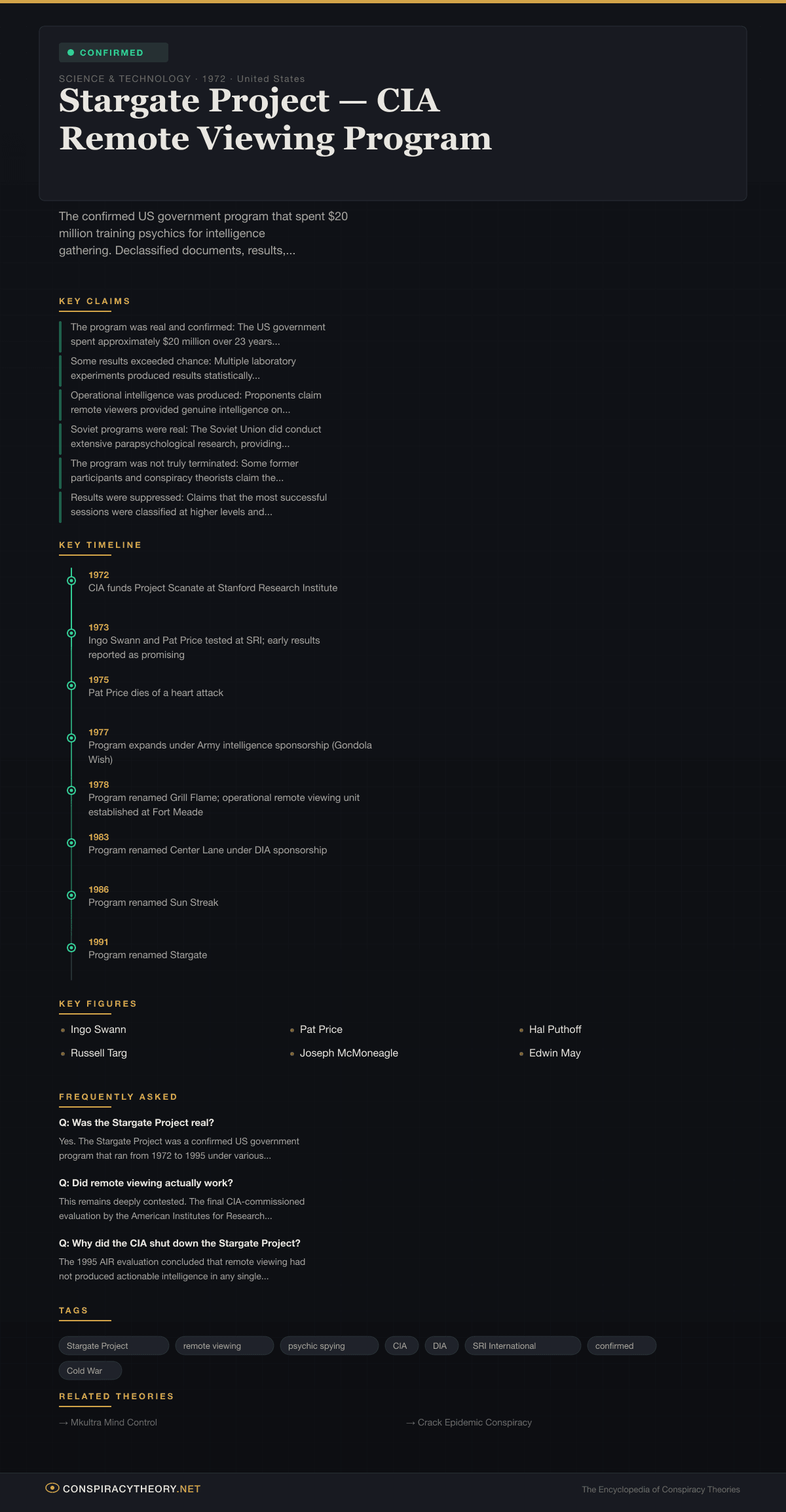
Stargate Project — CIA Remote Viewing Program
Overview
The Stargate Project was a confirmed United States government program that investigated and operationally employed remote viewing — the claimed psychic ability to perceive distant locations, events, or objects without using normal sensory channels. Running from 1972 to 1995 under a series of code names, the program was funded by the CIA, the Defense Intelligence Agency (DIA), and other intelligence community elements at a total cost of approximately $20 million.
The program originated during the Cold War amid fears that the Soviet Union was developing psychic warfare capabilities. Research was conducted primarily at Stanford Research Institute (later SRI International) by physicists Harold Puthoff and Russell Targ, who tested and trained a cadre of self-described psychic operatives. At its peak, the program employed several remote viewers who were tasked with locating hostages, describing Soviet military installations, and identifying drug trafficking operations.
The Stargate Project is classified as confirmed because its existence, funding, and operational deployment are established facts documented in tens of thousands of declassified pages. However, the question of whether remote viewing actually works remains scientifically contested. The program’s final evaluation found that while some laboratory results exceeded chance expectations, the intelligence produced was never operationally useful. The program represents one of the most unusual confirmed expenditures of US intelligence resources during the Cold War.
Origins & History
Cold War Psychic Arms Race
The program’s origins trace to the early 1970s, when US intelligence agencies became alarmed by reports that the Soviet Union was investing heavily in parapsychological research. Soviet programs reportedly explored telepathy, psychokinesis, and remote perception for military applications. The concern was not necessarily that these phenomena were real, but that if the Soviets achieved a breakthrough, the US would be at a strategic disadvantage — a logic that mirrored the nuclear arms race.
In 1972, the CIA funded a small research program at Stanford Research Institute (SRI) in Menlo Park, California, under the code name Project Scanate. Physicists Harold Puthoff and Russell Targ were tasked with evaluating the potential of remote viewing for intelligence collection.
The SRI Experiments
Puthoff and Targ’s initial experiments involved testing subjects who claimed psychic abilities. The most notable early subject was Ingo Swann, a New York artist who coined the term “remote viewing.” In controlled experiments, Swann was given geographic coordinates and asked to describe what was at those locations. Puthoff and Targ reported that Swann produced descriptions that were significantly more accurate than chance would predict.
Another early subject, former Burbank police commissioner Pat Price, reportedly provided strikingly accurate descriptions of a Soviet military research facility at Semipalatinsk when given only its coordinates. Price died of a heart attack in 1975 under circumstances that some conspiracy theorists consider suspicious, though no evidence of foul play has been established.
Operational Deployment
By the late 1970s, the program had expanded beyond laboratory research into operational intelligence collection. Under code names including Gondola Wish, Grill Flame, Center Lane, and Sun Streak, military remote viewers at Fort Meade, Maryland, were tasked with real intelligence targets. The program’s most celebrated operative was Joseph McMoneagle (designated “Remote Viewer #001”), a US Army warrant officer who participated in over 450 remote viewing sessions.
Proponents cite several alleged operational successes. McMoneagle claims to have accurately described a new type of Soviet submarine under construction at a secret shipyard — a claim partially corroborated when satellite imagery later revealed the submarine. Remote viewers were also reportedly tasked with locating American hostages in Iran (1979), tracking Libyan leader Muammar Gaddafi, and identifying drug trafficking operations.
The 1995 Evaluation and Termination
By the mid-1990s, the program had cycled through multiple sponsoring agencies and faced increasing internal skepticism. In 1995, the CIA commissioned the American Institutes for Research (AIR) to conduct a final evaluation. The review panel included statistician Jessica Utts, who concluded that the statistical evidence for remote viewing was significant, and psychologist Ray Hyman, who argued that methodological problems explained the results.
The AIR’s overall conclusion was damning for operational purposes: even if some anomalous effect existed in laboratory settings, it had never produced intelligence specific enough to guide operations. The CIA accepted the recommendation to terminate the program and declassified its existence on November 28, 1995.
Key Claims
- The program was real and confirmed: The US government spent approximately $20 million over 23 years researching and deploying psychic intelligence gathering — fully documented in declassified records
- Some results exceeded chance: Multiple laboratory experiments produced results statistically significantly above chance expectations, a finding acknowledged even by skeptical reviewers
- Operational intelligence was produced: Proponents claim remote viewers provided genuine intelligence on Soviet weapons systems, hostage locations, and other targets
- Soviet programs were real: The Soviet Union did conduct extensive parapsychological research, providing the strategic rationale for the US program
- The program was not truly terminated: Some former participants and conspiracy theorists claim the program continued under deeper classification after the 1995 “termination”
- Results were suppressed: Claims that the most successful sessions were classified at higher levels and excluded from the AIR evaluation
Evidence & Analysis
The Statistical Evidence
The most rigorous defense of remote viewing comes from the statistical record. Jessica Utts, a professor of statistics at UC Davis, analyzed the laboratory data and concluded that the results were statistically significant with odds against chance of approximately 10^20 to 1. She stated: “Using the standards applied to any other area of science, it is concluded that psychic functioning has been well established.”
However, Ray Hyman countered that statistical significance does not equal proof of psychic phenomena. He identified potential methodological issues including sensory leakage (subtle cues that could inform viewers), selection bias in which sessions were reported, and the “file drawer problem” (unreported negative results). The scientific community remains divided.
The Operational Record
The operational success claims are harder to evaluate because much of the evidence remains classified or relies on participant testimony. Skeptics note a fundamental problem: for every claimed “hit,” there were many more sessions that produced vague or inaccurate results. Intelligence analysts could have achieved similar hit rates through conventional analysis, educated guessing, and the human tendency to find matches after the fact.
The DIA’s own internal assessments during the program’s operation were mixed, with some analysts finding value in remote viewing as a supplementary source and others dismissing it entirely.
Why Did It Last So Long?
One of the most interesting questions about Stargate is not whether remote viewing works, but why the program survived for 23 years if the results were so ambiguous. Several factors likely contributed: the genuine fear of Soviet psychic capabilities, the relatively low cost ($20 million over 23 years is trivial by intelligence community standards), bureaucratic inertia, and the program’s champions within the intelligence community who genuinely believed in its value.
Cultural Impact
Parapsychology Legitimacy
The Stargate Project is the most frequently cited evidence by parapsychology advocates that mainstream science has unfairly dismissed psychic phenomena. The fact that the US government spent millions investigating remote viewing is presented as proof that the evidence is stronger than skeptics acknowledge.
Popular Culture
The program inspired the 2004 Jon Ronson book The Men Who Stare at Goats and its 2009 film adaptation starring George Clooney. While the film was a comedy, it brought widespread public awareness to the program. Remote viewing has since become a staple of science fiction and conspiracy media.
The Continuing Remote Viewing Community
After the program’s termination, several former military remote viewers established private consulting practices offering remote viewing services to corporations, law enforcement, and private clients. This commercial remote viewing community remains active, conducting training courses and publishing results.
Timeline
- 1972 — CIA funds Project Scanate at Stanford Research Institute
- 1973 — Ingo Swann and Pat Price tested at SRI; early results reported as promising
- 1975 — Pat Price dies of a heart attack
- 1977 — Program expands under Army intelligence sponsorship (Gondola Wish)
- 1978 — Program renamed Grill Flame; operational remote viewing unit established at Fort Meade
- 1983 — Program renamed Center Lane under DIA sponsorship
- 1986 — Program renamed Sun Streak
- 1991 — Program renamed Stargate
- 1995 — CIA commissions American Institutes for Research evaluation
- November 1995 — AIR recommends termination; CIA declassifies the program
- 1996 — Former remote viewers begin publishing accounts and offering private services
- 2004 — Jon Ronson publishes The Men Who Stare at Goats
- 2009 — Film adaptation released
- 2017 — Additional CIA documents declassified and posted online through CREST database
Sources & Further Reading
- Targ, Russell, and Harold Puthoff. Mind-Reach: Scientists Look at Psychic Abilities. Delacorte Press, 1977.
- McMoneagle, Joseph. Remote Viewing Secrets. Hampton Roads Publishing, 2000.
- Ronson, Jon. The Men Who Stare at Goats. Simon & Schuster, 2004.
- Utts, Jessica. “An Assessment of the Evidence for Psychic Functioning.” Journal of Scientific Exploration, 1996.
- Hyman, Ray. “Evaluation of the Military’s Twenty-Year Program on Psychic Spying.” Skeptical Inquirer, 1996.
- American Institutes for Research. “An Evaluation of Remote Viewing: Research and Applications.” 1995.
- Smith, Paul H. Reading the Enemy’s Mind: Inside Star Gate — America’s Psychic Espionage Program. Forge Books, 2005.
- CIA CREST Database. Stargate Collection. Declassified documents.
Frequently Asked Questions
Was the Stargate Project real?
Did remote viewing actually work?
Why did the CIA shut down the Stargate Project?
Infographic
Share this visual summary. Right-click to save.