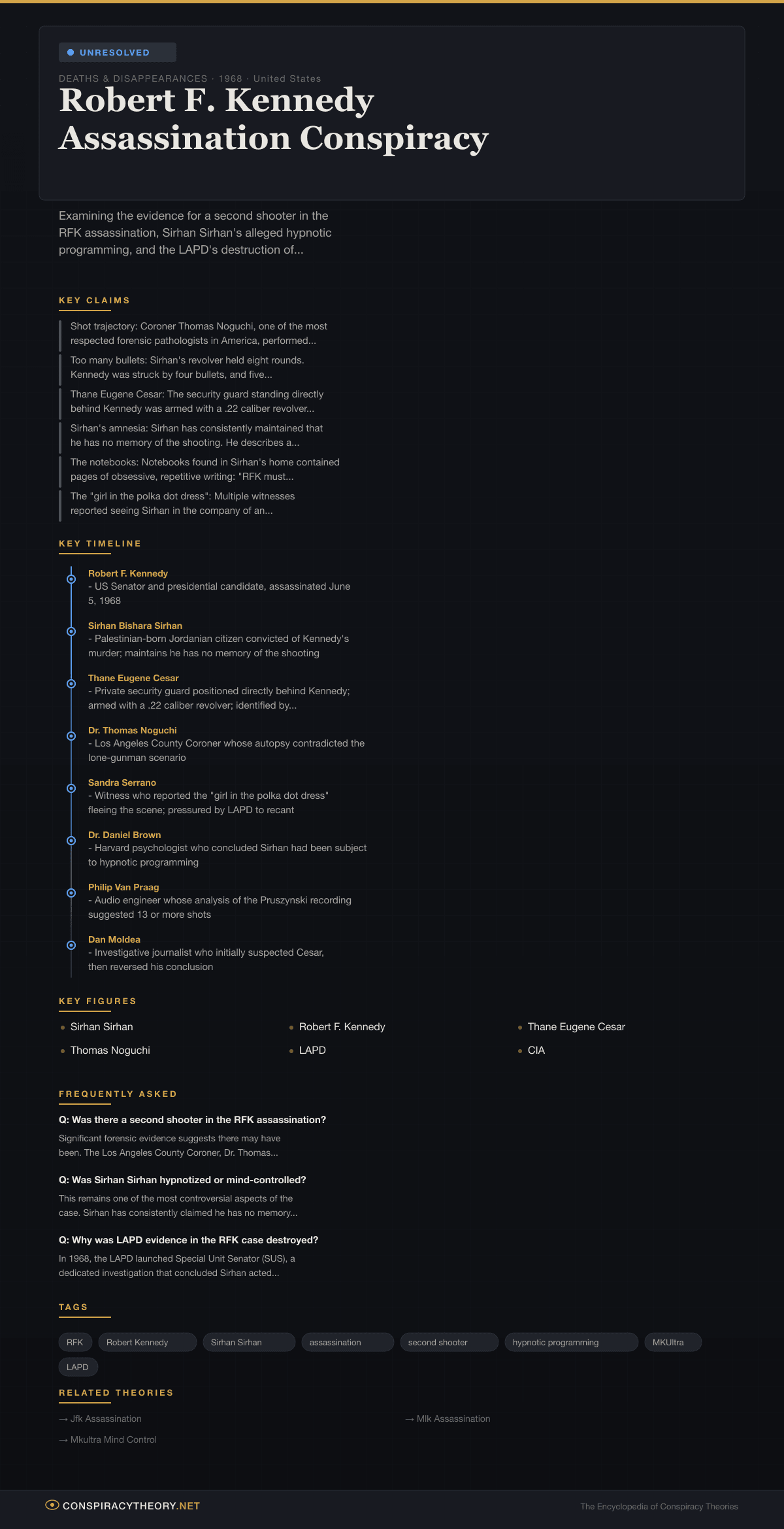
Robert F. Kennedy Assassination Conspiracy
Overview
Robert F. Kennedy had just won the California Democratic presidential primary. It was shortly after midnight on June 5, 1968, and the senator was making his way through the kitchen pantry of the Ambassador Hotel in Los Angeles, heading from his victory speech to a press conference. A slight, dark-haired young man named Sirhan Bishara Sirhan stepped forward and opened fire with a .22 caliber Iver-Johnson Cadet revolver. Kennedy fell to the floor. Twenty-six hours later, he was dead.
It should have been an open-and-shut case. Sirhan was captured at the scene, the gun literally wrestled from his hand by former NFL lineman Rosey Grier and Olympic decathlete Rafer Johnson, with dozens of witnesses watching. And yet, from the very beginning, the forensic evidence refused to cooperate with the official narrative.
The coroner said the fatal shot came from behind Kennedy, about an inch from his head. Every witness said Sirhan was in front of Kennedy, several feet away. The coroner counted four bullet wounds in Kennedy’s body and clothing. Sirhan’s gun held eight rounds. But investigators found bullet holes in the pantry that, combined with the wounds to Kennedy and five other victims, suggested as many as thirteen shots had been fired. An eight-round revolver cannot fire thirteen shots.
These are not ambiguities invented by conspiracy theorists. They are the findings of the official coroner and the observations of law enforcement officials, journalists, and witnesses who were in the room when Robert Kennedy was killed. The RFK assassination is one of the most forensically troubled cases in American history, and more than fifty years later, its central questions remain unanswered.
Origins & History
Bobby Kennedy in 1968
To understand why the RFK assassination has attracted conspiracy theories, you need to understand who Robert Kennedy was in June 1968 — and who wanted him stopped.
Bobby Kennedy had entered the presidential race in March 1968, running on a platform of ending the Vietnam War, addressing racial injustice, and challenging the power of the military-industrial complex. He was, in the eyes of many, the most dangerous man in America — dangerous to the war establishment, dangerous to organized crime (which he had prosecuted aggressively as Attorney General), dangerous to the CIA (whose leaders he had clashed with after the Bay of Pigs), and dangerous to the political status quo.
His brother’s assassination five years earlier had given Bobby an intimate understanding of how the machinery of power could destroy its opponents. He reportedly told aides that he believed the CIA and the Mafia were involved in JFK’s death and that if he won the presidency, he would reopen the investigation. This made him, in conspiratorial terms, a man with powerful enemies who had both the motive and the means to eliminate him.
The Night at the Ambassador Hotel
On June 4, 1968, Kennedy won the California and South Dakota Democratic primaries, making him the frontrunner for the Democratic presidential nomination. He addressed supporters in the ballroom of the Ambassador Hotel in Los Angeles and then was directed through the kitchen pantry to reach the press room.
The pantry was crowded and chaotic. Kennedy was flanked by a loose security detail — he had declined Secret Service protection, which at the time was not mandatory for presidential candidates. Among those in the immediate vicinity was Thane Eugene Cesar, a private security guard employed by Ace Guard Service who had been assigned to the event that evening. Cesar was positioned directly behind and to the right of Kennedy.
Sirhan Sirhan approached from the front and began firing. In the pandemonium that followed, Kennedy was struck by four bullets (or bullet fragments), and five bystanders were also wounded. Sirhan was tackled and restrained. Kennedy was rushed to Good Samaritan Hospital, where he underwent surgery but never regained consciousness. He was pronounced dead at 1:44 a.m. on June 6, 1968.
The Investigation
The LAPD established Special Unit Senator (SUS) to investigate the assassination. The investigation concluded that Sirhan Sirhan had acted alone, motivated by Kennedy’s support for Israel (Sirhan was a Palestinian-born Jordanian citizen). Sirhan was convicted of first-degree murder in 1969 and sentenced to death, later commuted to life in prison when California abolished the death penalty in 1972.
However, the investigation was marred by irregularities from the beginning. The LAPD conducted its inquiry largely in secret, refused to share evidence with outside researchers, and ultimately destroyed critical physical evidence that might have resolved the central forensic questions.
Key Claims
The Second Shooter
The strongest pillar of the RFK conspiracy case is the forensic evidence suggesting a second gunman:
- Shot trajectory: Coroner Thomas Noguchi, one of the most respected forensic pathologists in America, performed the autopsy and determined that the fatal shot entered behind Kennedy’s right ear from a distance of approximately one inch, traveling front-to-back and slightly upward. Two other shots struck Kennedy from behind, one under the right armpit and one through the back of his coat. A fourth shot grazed his forehead. Every eyewitness placed Sirhan in front of Kennedy, at a distance of three to six feet — directly contradicting the autopsy evidence
- Too many bullets: Sirhan’s revolver held eight rounds. Kennedy was struck by four bullets, and five bystanders were wounded (though some may have been struck by the same bullets that passed through Kennedy). However, investigators identified bullet holes in the door frames and ceiling of the pantry that, when added to the wound totals, suggested more shots than eight had been fired. If more than eight shots were fired, a second gun was present
- Thane Eugene Cesar: The security guard standing directly behind Kennedy was armed with a .22 caliber revolver — the same caliber as Sirhan’s weapon. Cesar initially told police he had drawn his weapon but not fired. He later sold the gun before investigators could test it. Researcher Dan Moldea initially identified Cesar as a prime suspect, then reversed his position after interviewing him. Cesar’s political views were strongly anti-Kennedy, and his exact actions during the shooting have never been definitively established
Hypnotic Programming / MKUltra Connection
- Sirhan’s amnesia: Sirhan has consistently maintained that he has no memory of the shooting. He describes a dreamlike state and says his last clear memory is drinking coffee with a woman in the hotel. Multiple psychologists who have examined him have described his condition as consistent with a hypnotic or dissociative state
- The notebooks: Notebooks found in Sirhan’s home contained pages of obsessive, repetitive writing: “RFK must die,” “RFK must be assassinated,” and other phrases written over and over in a pattern that some psychologists associate with hypnotic programming or self-hypnosis
- The “girl in the polka dot dress”: Multiple witnesses reported seeing Sirhan in the company of an attractive young woman in a polka-dot dress before the shooting. Witness Sandra Serrano testified that she saw the woman fleeing the hotel after the shooting, exclaiming, “We shot him! We shot Kennedy!” The LAPD pressured Serrano to recant her testimony, a fact documented in recordings of her interrogation
- Dr. William Bryan connection: Some researchers have alleged that Dr. William Joseph Bryan Jr., a prominent hypnotist who boasted of his work with the CIA and claimed to have been involved in the Candy Jones hypno-programming case, may have been connected to Sirhan’s conditioning. Bryan was found dead in a Las Vegas hotel room in 1977. The connection remains speculative
LAPD Evidence Destruction
- In 1975, the LAPD destroyed approximately 2,400 photographs from the crime scene
- Ceiling tiles and door frames from the pantry that may have contained bullet holes were destroyed
- The pantry door frame through which bullets had reportedly passed was removed and destroyed rather than preserved
- Audio recordings of witness interviews were erased or lost
- These actions occurred while the case was still technically open and while questions about the evidence were being publicly raised
Evidence
Evidence Supporting a Conspiracy
The Noguchi autopsy: Dr. Noguchi’s findings are the bedrock of the second-shooter theory. The autopsy was thorough, well-documented, and conducted by a coroner with an impeccable reputation. His conclusion — that the fatal shot was fired from contact range behind Kennedy’s right ear — is irreconcilable with every witness account of Sirhan’s position in front of Kennedy at a distance of several feet. This is not an interpretation of ambiguous evidence; it is a direct contradiction between the forensic findings and the eyewitness testimony.
The Pruszynski recording: In 2005, audio engineer Philip Van Praag analyzed a recording made by Polish journalist Stanislaw Pruszynski, which captured the shooting. Van Praag concluded that the recording showed at least 13 shots fired from two different weapons. His analysis, published in a peer-reviewed paper, identified shots fired at intervals too close together to have come from a single revolver. This analysis has been disputed by other audio experts.
Witness testimony about the woman: The “girl in the polka dot dress” was independently reported by multiple witnesses, not only Sandra Serrano. Witness accounts describe Sirhan in her company before the shooting and the woman fleeing afterward. The LAPD’s aggressive efforts to discredit these witnesses, documented in the case files, suggest the department was intent on maintaining the lone-gunman conclusion rather than following evidence.
Dr. Daniel Brown’s assessment: In 2008 and 2011, Dr. Daniel Brown, an associate professor of psychology at Harvard Medical School’s Beth Israel Deaconess Medical Center, examined Sirhan in prison. Brown concluded that Sirhan had been subjected to a form of hypnotic programming, that his amnesia for the shooting was genuine, and that he may have been triggered by a cue (possibly the “girl in the polka dot dress”) to enter a dissociative state. Brown’s assessment was presented in Sirhan’s 2011 parole hearing.
Evidence Against a Conspiracy
- Sirhan was captured with the gun: Unlike the JFK assassination, there is no question about who fired a weapon. Sirhan was wrestled to the ground with the gun in his hand, still pulling the trigger
- Political motive: Sirhan’s Palestinian background and his notebooks referencing Kennedy’s support for Israel provide a straightforward political motive
- The second-shooter evidence is disputed: Other audio experts have challenged Van Praag’s analysis. The bullet-hole evidence was never definitively established because the LAPD destroyed the physical evidence
- Hypnosis skepticism: Many psychologists are skeptical that hypnosis can be used to program an individual to commit murder, despite the CIA’s documented interest in the subject through MKUltra
- Cesar cooperation: Thane Eugene Cesar cooperated with researchers and passed a lie detector test administered by journalist Dan Moldea, who ultimately concluded Cesar was not involved
Cultural Impact
The RFK assassination conspiracy has been overshadowed in public consciousness by the JFK assassination but is arguably a stronger case on the forensic evidence. The contradiction between the autopsy findings and the eyewitness testimony is stark and has never been resolved.
The case has been the subject of numerous books, documentaries, and investigations. Shane O’Sullivan’s 2007 documentary RFK Must Die examined the second-shooter and MKUltra angles. Laurie Dusek’s work on behalf of Sirhan Sirhan’s defense team brought renewed attention to the case in the 2010s. Robert F. Kennedy Jr. publicly stated that he believes his father was killed by a second shooter and visited Sirhan in prison.
The LAPD’s destruction of evidence has become one of the most cited examples of law enforcement evidence tampering in conspiracy literature. The case contributed to the passage of California’s Public Records Act and broader demands for transparency in criminal investigations.
The MKUltra angle connects the RFK assassination to the broader history of CIA mind control programs, which were confirmed by the Church Committee investigations of 1975-1976 and the subsequent release of surviving MKUltra documents. While no direct connection between MKUltra and the RFK assassination has been proven, the documented reality of CIA hypnotic programming experiments gives the theory a foundation that purely speculative conspiracy claims lack.
Sirhan Sirhan was denied parole multiple times despite being recommended for release by a parole panel in 2021. California Governor Gavin Newsom reversed the decision in 2022, citing the severity of the crime.
Key Figures
- Robert F. Kennedy — US Senator and presidential candidate, assassinated June 5, 1968
- Sirhan Bishara Sirhan — Palestinian-born Jordanian citizen convicted of Kennedy’s murder; maintains he has no memory of the shooting
- Thane Eugene Cesar — Private security guard positioned directly behind Kennedy; armed with a .22 caliber revolver; identified by some researchers as a potential second shooter
- Dr. Thomas Noguchi — Los Angeles County Coroner whose autopsy contradicted the lone-gunman scenario
- Sandra Serrano — Witness who reported the “girl in the polka dot dress” fleeing the scene; pressured by LAPD to recant
- Dr. Daniel Brown — Harvard psychologist who concluded Sirhan had been subject to hypnotic programming
- Philip Van Praag — Audio engineer whose analysis of the Pruszynski recording suggested 13 or more shots
- Dan Moldea — Investigative journalist who initially suspected Cesar, then reversed his conclusion
Timeline
| Date | Event |
|---|---|
| June 4-5, 1968 | RFK wins California primary; shot in Ambassador Hotel kitchen pantry shortly after midnight |
| June 6, 1968 | Robert F. Kennedy dies at Good Samaritan Hospital |
| June 1968 | Sirhan Sirhan charged with first-degree murder |
| 1969 | Sirhan convicted and sentenced to death |
| 1972 | Death sentence commuted to life in prison |
| 1975 | LAPD destroys approximately 2,400 crime scene photographs, ceiling tiles, and door frames |
| 1975-1976 | Church Committee reveals CIA MKUltra mind control program |
| 1977 | Dr. William Joseph Bryan found dead in Las Vegas |
| 1988 | Dan Moldea publishes The Killing of Robert F. Kennedy |
| 1997 | Coroner Thomas Noguchi reaffirms his autopsy findings in interviews |
| 2005 | Philip Van Praag begins audio analysis of Pruszynski recording |
| 2007 | Shane O’Sullivan’s documentary RFK Must Die released |
| 2008 | Dr. Daniel Brown examines Sirhan in prison, concludes hypnotic programming |
| 2011 | Brown’s assessment presented at Sirhan’s parole hearing |
| 2018 | Robert F. Kennedy Jr. publicly states he believes a second shooter killed his father |
| 2021 | California parole board recommends Sirhan’s release |
| 2022 | Governor Gavin Newsom reverses parole decision |
Sources & Further Reading
- Moldea, Dan E. The Killing of Robert F. Kennedy: An Investigation of Motive, Means, and Opportunity. W.W. Norton, 1995
- Turner, William, and Jonn Christian. The Assassination of Robert F. Kennedy: The Conspiracy and Cover-Up. Thunder’s Mouth Press, 2006
- Noguchi, Thomas. Coroner. Simon & Schuster, 1983
- Melanson, Philip H. The Robert F. Kennedy Assassination: New Revelations on the Conspiracy and Cover-Up. S.P.I. Books, 1991
- Pease, Lisa. A Lie Too Big to Fail: The Real History of the Assassination of Robert F. Kennedy. Feral House, 2018
- O’Sullivan, Shane. Who Killed Bobby? The Unsolved Murder of Robert F. Kennedy. Sterling, 2008
- Van Praag, Philip, and Robert Joling. “An Open and Shut Case.” American Academy of Forensic Sciences presentation, 2008
- Brown, Daniel P. “Sirhan’s Gun: Circumstantial Forensic Evidence and Expert Testimony.” Parole hearing documentation, 2011
- Kaiser, Robert Blair. “R.F.K. Must Die!” A History of the Robert Kennedy Assassination and Its Aftermath. E.P. Dutton, 1970
- Klaber, William, and Philip Melanson. Shadow Play: The Murder of Robert F. Kennedy, the Trial of Sirhan Sirhan, and the Failure of American Justice. St. Martin’s Press, 1997
Related Theories
- JFK Assassination — The assassination of Robert Kennedy’s brother, President John F. Kennedy
- MLK Assassination — The assassination of Martin Luther King Jr., two months before RFK
- MKUltra — The confirmed CIA mind control program connected to the hypnotic programming theory

Frequently Asked Questions
Was there a second shooter in the RFK assassination?
Was Sirhan Sirhan hypnotized or mind-controlled?
Why was LAPD evidence in the RFK case destroyed?

Infographic
Share this visual summary. Right-click to save.