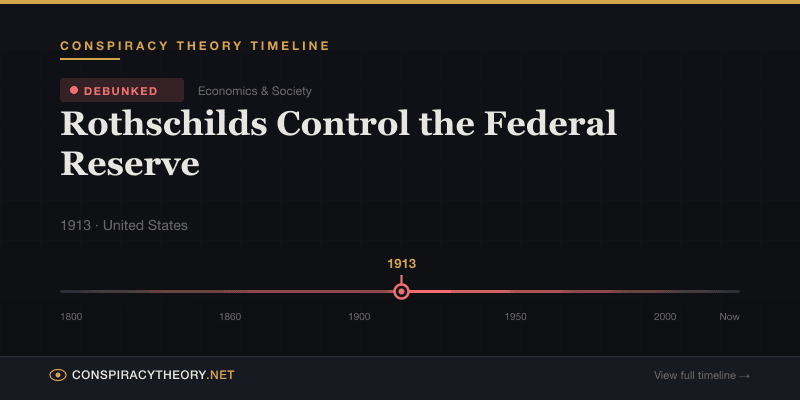
Rothschilds Control the Federal Reserve
Overview
The claim that the Rothschild family secretly owns or controls the United States Federal Reserve System is one of the most persistent conspiracy theories in modern political discourse. The theory alleges that the Rothschild banking dynasty, through proxy institutions, nominee shareholders, and behind-the-scenes influence, exercises covert control over American monetary policy, interest rates, and the money supply. By extension, proponents argue that this control gives the Rothschilds effective power over the U.S. and global economy.
The theory is debunked. The Federal Reserve’s governance structure is publicly documented and subject to congressional oversight. Its Board of Governors is appointed by the President and confirmed by the Senate. While the regional Federal Reserve Banks are technically owned by their member commercial banks, this ownership structure does not function like corporate ownership and confers no policy control. No Rothschild family member or institution controlled by the family holds any position within the Federal Reserve System.
The theory draws on kernels of real history — the involvement of bankers in the Fed’s design, the secrecy of the 1910 Jekyll Island meeting, and the Rothschild family’s genuine historical prominence in European finance — but distorts these facts into a narrative of hidden control that relies heavily on antisemitic tropes about Jewish financial domination.
Origins & History
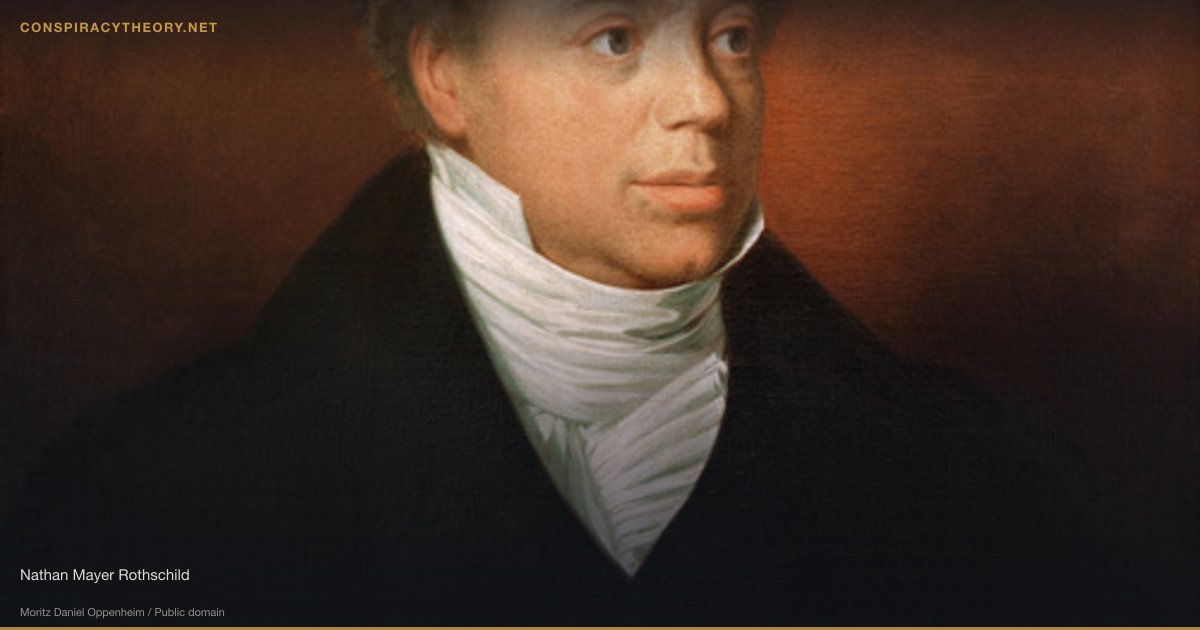
The Rothschild family established one of the most successful banking operations in European history, beginning with Mayer Amschel Rothschild in Frankfurt in the late eighteenth century. His five sons established banking houses in London, Paris, Frankfurt, Vienna, and Naples, creating an international financial network that was instrumental in financing European governments during the nineteenth century. The family’s genuine wealth and influence made them a target for conspiracy theories from the early 1800s onward.
The Federal Reserve System was created by the Federal Reserve Act of 1913. The design process involved a secret meeting at Jekyll Island, Georgia in November 1910, attended by Senator Nelson Aldrich, Assistant Secretary of the Treasury Abraham Piatt Andrew, and several prominent bankers including Paul Warburg (of Kuhn, Loeb & Co.), Frank Vanderlip (president of National City Bank), Henry P. Davison (a J.P. Morgan partner), Charles D. Norton (president of First National Bank of New York), and Benjamin Strong (representing J.P. Morgan). The secrecy of this meeting was real and acknowledged by participants — they used first names only and traveled to Jekyll Island in a private railcar.
The conspiracy theory connecting the Rothschilds to the Federal Reserve was first systematically articulated by Eustace Mullins in his 1952 book The Secrets of the Federal Reserve (originally titled Mullins on the Federal Reserve). Mullins wrote the book while visiting poet Ezra Pound at St. Elizabeths Hospital in Washington, D.C., where Pound was confined after being charged with treason for his pro-Mussolini radio broadcasts during World War II. Pound, who held deeply antisemitic views, encouraged Mullins to investigate the Federal Reserve.
Mullins argued that the Federal Reserve was owned by a consortium of banks that were themselves controlled by European banking families, with the Rothschilds at the apex. He traced chains of supposed ownership through various banking institutions to argue that the Fed was ultimately a tool of foreign financial interests.
The theory was later amplified by G. Edward Griffin in The Creature from Jekyll Island (1994), which while less overtly antisemitic than Mullins’ work, presented the Federal Reserve as a cartel created by and for banking interests. Griffin’s book became a bestseller in libertarian and constitutionalist circles.
Key Claims
- The Federal Reserve is not a government institution but a privately owned bank controlled by the Rothschild family and their proxies
- The 1910 Jekyll Island meeting was a conspiracy by international bankers (allegedly including Rothschild representatives) to create a central bank that would serve their interests
- Member bank ownership of Federal Reserve stock constitutes actual corporate ownership, giving private bankers control over monetary policy
- The Federal Reserve creates money “out of thin air” and charges the government interest, enriching its private owners
- The Rothschilds control multiple central banks worldwide through similar mechanisms
- Presidents who opposed central banking (Andrew Jackson, Abraham Lincoln, John F. Kennedy) were targeted for assassination
- The Federal Reserve Act was passed by subterfuge during Christmas recess when most congressmen were absent
Evidence
What the theory gets right: The Jekyll Island meeting was real and was conducted in secrecy. Paul Warburg, who was instrumental in designing the Federal Reserve System, was indeed a partner at Kuhn, Loeb & Co., an investment bank with historical connections to European financial networks. The Federal Reserve Banks are technically owned by their member banks. The Rothschild family was genuinely one of the most powerful banking families in nineteenth-century Europe.
What the theory distorts or fabricates: The Rothschild family had no representative at the Jekyll Island meeting and no documented role in designing the Federal Reserve System. Paul Warburg, while connected to European banking through his family’s Hamburg-based bank (M.M. Warburg & Co.), was acting as an American banker advocating for a central banking system. His primary model was the German Reichsbank, not a Rothschild institution.
Federal Reserve Bank stock is fundamentally different from normal corporate stock. Member banks are required by law to purchase stock in their regional Federal Reserve Bank, but this stock cannot be sold or traded, pays a fixed 6% dividend, and does not confer voting rights on monetary policy decisions. The Board of Governors, which actually sets monetary policy, is a federal government agency with no private ownership component.
The claim that the Federal Reserve Act was passed during Christmas recess when Congress was nearly empty is false. The House passed the bill 298-60 on December 22, 1913, with a large majority present. The Senate passed it 43-25 on December 23, also with substantial attendance.
The connection between opposition to central banking and presidential assassinations is fabricated. Andrew Jackson, who opposed the Second Bank of the United States, survived his presidency and died of natural causes at 78. Lincoln’s assassination had no documented connection to monetary policy. Kennedy’s Executive Order 11110, sometimes cited as evidence that he was challenging the Fed, actually delegated existing presidential authority over silver certificates to the Treasury Secretary and did nothing to undermine the Federal Reserve.
Debunking / Verification
This theory is classified as debunked. The key factual findings are:
- Federal Reserve governance is public: The Board of Governors is a federal agency; its members are presidentially appointed and Senate-confirmed
- Federal Reserve Bank ownership is nominal: Stock cannot be sold or traded and confers no policy authority
- No Rothschild involvement: No Rothschild family member or institution participated in designing or governing the Federal Reserve
- The Jekyll Island meeting: While secretive, its participants are documented and did not include Rothschild representatives
- Congressional passage: The Federal Reserve Act was passed by large majorities with substantial attendance
- Financial audits: The Federal Reserve is audited annually and its financial statements are public
The theory persists because it combines legitimate criticisms of central banking (concerns about monetary policy, inflation, and the relationship between government and financial institutions) with conspiratorial explanations that are simpler and more emotionally satisfying than the complex reality of monetary economics.
Cultural Impact
The Rothschild-Federal Reserve theory has been among the most widely circulated financial conspiracy theories for decades. It exists at the intersection of legitimate populist concern about the power of financial institutions and deeply problematic antisemitic narratives about Jewish financial control.
The theory has been embraced across the political spectrum, appearing in both left-populist critiques of financial capitalism and right-wing nationalist discourse. It has been particularly influential in libertarian, constitutionalist, and “sovereign citizen” movements, which view the Federal Reserve as inherently illegitimate.
The antisemitic dimension of the theory cannot be ignored. The specific focus on the Rothschild family — rather than on the documented American banking interests that were actually involved in the Fed’s creation — reflects centuries-old stereotypes about Jewish financial manipulation. Many purveyors of the theory explicitly connect it to broader narratives about Jewish world domination, the Protocols of the Elders of Zion, and other antisemitic conspiracy frameworks.
The theory has influenced political discourse around the “Audit the Fed” movement, which advocates for greater congressional oversight of the Federal Reserve. While the desire for transparency in monetary policy is legitimate, some proponents of auditing the Fed are motivated by conspiratorial beliefs about hidden ownership rather than genuine policy concerns.
Timeline
- 1790s — Mayer Amschel Rothschild establishes international banking operations from Frankfurt
- 1816 — Second Bank of the United States chartered
- 1836 — President Andrew Jackson vetoes recharter of the Second Bank
- November 1910 — Jekyll Island meeting to design central banking plan
- December 1913 — Federal Reserve Act signed by President Woodrow Wilson
- 1952 — Eustace Mullins publishes The Secrets of the Federal Reserve
- 1994 — G. Edward Griffin publishes The Creature from Jekyll Island
- 2007-2009 — Financial crisis increases public scrutiny of the Federal Reserve
- 2009-2010 — Ron Paul’s “Audit the Fed” campaign brings Federal Reserve criticism into mainstream politics
- 2010s-present — Theory circulates widely on social media, often stripped of explicit antisemitic framing but retaining the core narrative
Sources & Further Reading
- Meltzer, Allan H. A History of the Federal Reserve, Volume 1: 1913-1951. University of Chicago Press, 2003.
- Lowenstein, Roger. America’s Bank: The Epic Struggle to Create the Federal Reserve. Penguin Press, 2015.
- Ferguson, Niall. The House of Rothschild: Money’s Prophets, 1798-1848. Viking, 1998.
- Board of Governors of the Federal Reserve System. “Who Owns the Federal Reserve?” FAQ section, federalreserve.gov.
- Wicker, Elmus. The Great Debate on Banking Reform: Nelson Aldrich and the Origins of the Fed. Ohio State University Press, 2005.
- Brustein, William I., and Louisa Roberts. The Socialism of Fools? Leftist Origins of Modern Anti-Semitism. Cambridge University Press, 2015.
Frequently Asked Questions
Do the Rothschilds own the Federal Reserve?
Where did the theory about Rothschilds controlling the Federal Reserve come from?
Did the Rothschilds play any role in creating the Federal Reserve?
Infographic
Share this visual summary. Right-click to save.
