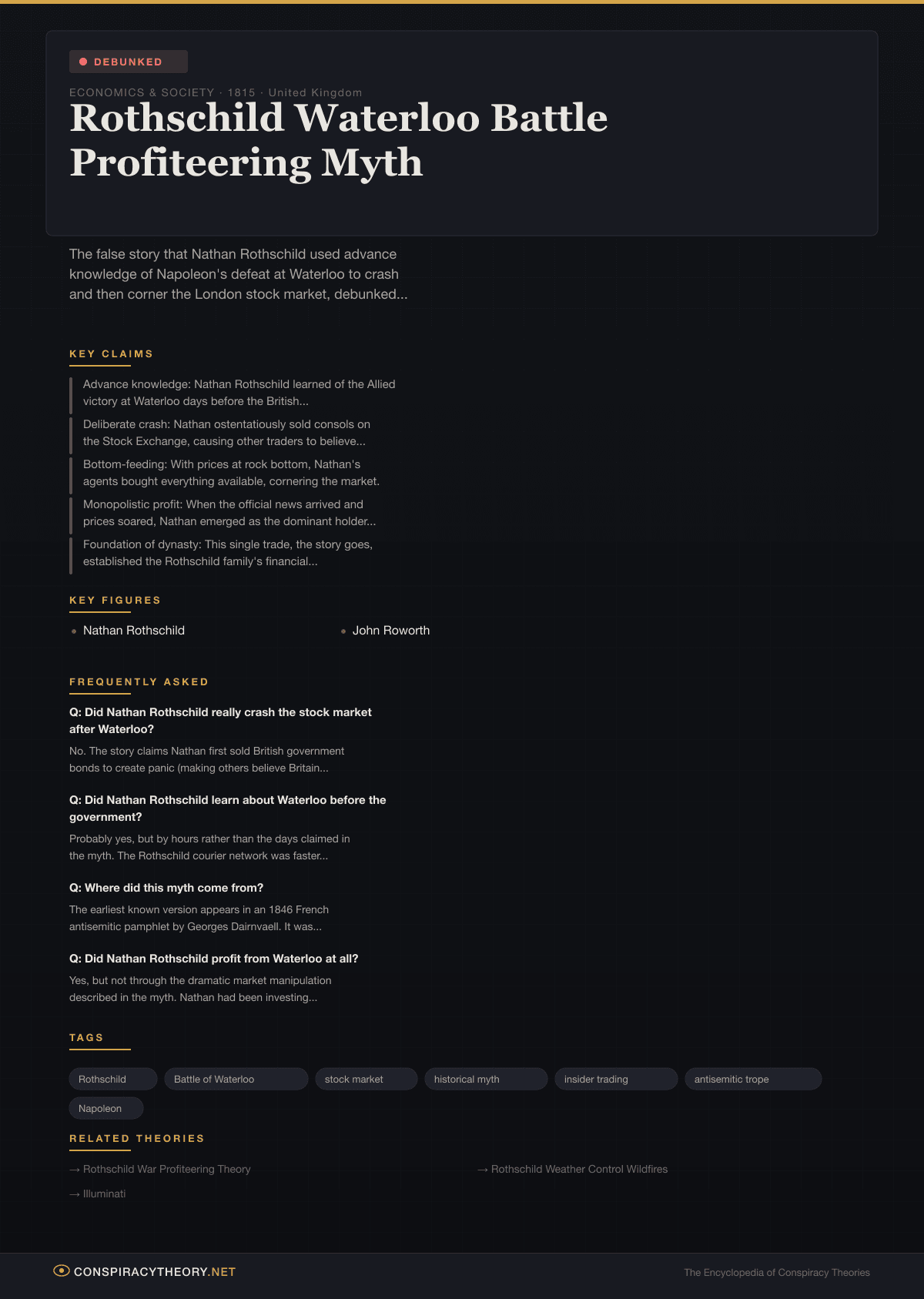
Rothschild Waterloo Battle Profiteering Myth
Overview
It is perhaps the most famous insider trading story ever told. On June 18, 1815, Napoleon Bonaparte was defeated at Waterloo by the Duke of Wellington and Prussian Field Marshal Blucher. According to legend, Nathan Mayer Rothschild, operating from his customary post on the London Stock Exchange, learned of the Allied victory a full day or more before the British government did — thanks to his family’s private courier network. Armed with this advance knowledge, Nathan allegedly executed one of history’s greatest financial coups: he ostentatiously began selling British government bonds (consols), causing other traders to panic and sell their own holdings, crashing the bond market. Then, when prices hit rock bottom, Nathan’s agents swept in and bought everything at a fraction of the true value. When official news of the victory finally arrived and prices soared, Nathan had cornered the bond market and made a fortune estimated at the modern equivalent of hundreds of millions of dollars.
It is a brilliant story. It has been told and retold for over two centuries. It appears in countless books, documentaries, and social media posts. It is also — according to the best available historical evidence — substantially false.
Origins & History
What Actually Happened on June 18-21, 1815
The Battle of Waterloo was fought on June 18, 1815, near Brussels. The outcome was decisive: Napoleon’s army was routed, ending his Hundred Days return to power and his military career. The news then had to travel to London, a journey that took between one and three days depending on weather and method of transport.
Nathan Rothschild did have a private courier system — the family’s network of agents, couriers, and packet boats was faster than most government communication of the era. Historical evidence suggests that Nathan received news of the victory on June 20, likely through a courier named John Roworth who crossed the English Channel from Ostend. The official government dispatch, carried by Major Henry Percy, arrived on the evening of June 21.
So Nathan had roughly a 24-hour advantage, not the several-day head start claimed in the more dramatic versions of the myth.
What Nathan Actually Did
Historian Niall Ferguson, drawing on the Rothschild family archives for his two-volume history The House of Rothschild (1998), reconstructed Nathan’s actual financial activity around Waterloo. The picture that emerges is substantially different from the legend:
Nathan had been buying British government bonds (consols) in the months leading up to Waterloo, betting on a British victory. This was a calculated bet based on his assessment of the military situation, not insider knowledge of the battle’s outcome.
When news of the victory reached Nathan, he appears to have increased his purchases of consols, not sold them. The evidence does not support the claim that he deliberately crashed the market through selling before buying back. Bond prices did fluctuate in the days around Waterloo, but the dramatic crash-and-corner narrative has no documentary basis in the Rothschild archives or in contemporary market records.
Nathan did profit from the bonds’ subsequent rise in value. Ferguson estimates the profit was real but modest by Rothschild standards — significant but not the market-cornering fortune of legend. Much of Nathan’s real Waterloo-era profit came from his role in facilitating the transfer of British government subsidies to continental allies, an ongoing commission-based business.
The Myth’s Origins
The earliest known version of the Waterloo myth appears in Georges Dairnvaell’s Histoire edifiante et curieuse de Rothschild Ier, roi des juifs (Edifying and Curious History of Rothschild I, King of the Jews), an antisemitic pamphlet published in France in 1846 — thirty-one years after the battle. Dairnvaell’s account was explicitly framed as an indictment of Jewish financial power and was written in the context of rising populist anger against the Rothschild bank’s influence in French politics.
The story was picked up and elaborated by subsequent authors, gaining detail with each retelling. By the late 19th century, it had become a standard set piece in antisemitic literature, cited alongside the Protocols of the Elders of Zion and other fabrications as evidence of Jewish financial manipulation.
Nazi Amplification
The Rothschild Waterloo myth received its most powerful amplification through Nazi propaganda. The 1940 German film Die Rothschilds depicted the Waterloo episode in dramatic detail, portraying Nathan as a cold-blooded manipulator exploiting soldiers’ deaths for profit. The film’s message was clear: Jewish financiers were parasites who thrived on the blood of European nations.
This propagandistic version entered the broader cultural bloodstream and has proven remarkably persistent. Many people who repeat the story today have no idea they are transmitting a narrative that was refined as Nazi propaganda, but the genealogy is clear and traceable.
The Modern Circulation
The myth gained renewed circulation in the internet age through viral videos, social media memes, and conspiracy documentaries. The 2007 online film Zeitgeist presented the Waterloo story as historical fact, reaching millions of viewers. It has become a staple of content criticizing central banking, the Federal Reserve, and “international bankers” — often serving as an antisemitic dog whistle whether or not the content creator is consciously aware of the tradition they are drawing on.
Key Claims
- Advance knowledge: Nathan Rothschild learned of the Allied victory at Waterloo days before the British government, through his private courier network.
- Deliberate crash: Nathan ostentatiously sold consols on the Stock Exchange, causing other traders to believe that Britain had lost and triggering a panic sell-off.
- Bottom-feeding: With prices at rock bottom, Nathan’s agents bought everything available, cornering the market.
- Monopolistic profit: When the official news arrived and prices soared, Nathan emerged as the dominant holder of British government debt, having made a fortune estimated at anywhere from 20 to 230 million pounds (depending on the source).
- Foundation of dynasty: This single trade, the story goes, established the Rothschild family’s financial dominance for the next two centuries.
Evidence
What Supports Partial Truth
- Nathan Rothschild did have a faster courier network than the British government. This is well-documented.
- He did likely learn of the Waterloo outcome before official channels — by hours, not days.
- He did profit from Waterloo — but through pre-existing bond positions and his role in government finance, not through market manipulation.
- He was a major figure on the London Stock Exchange and did trade actively in government bonds.
What the Evidence Contradicts
- No evidence of deliberate selling: Ferguson’s archival research found no evidence that Nathan sold consols to crash the market. His trading records suggest purchasing, not selling.
- No market crash: Contemporary records of consol prices around June 18-21, 1815, do not show the dramatic crash-and-recovery pattern the myth describes. Prices did fluctuate, but not with the violence claimed.
- The 1846 origin: The first known telling of the story appeared thirty-one years after the event, in an explicitly antisemitic pamphlet, with no earlier sources corroborating it.
- Scale of profit: Ferguson estimates Nathan’s Waterloo-related profit was approximately 7,000 to 10,000 pounds — significant, but a fraction of the millions claimed in the myth. The Rothschild fortune was built over decades of shrewd banking, not a single trade.
- Logistical problems: The myth requires Nathan to have orchestrated a complex, multi-stage market manipulation (sell, wait for crash, buy back) within an extremely tight time window (hours, not days). The London Stock Exchange of 1815 was a small, face-to-face market where such manipulation would have been immediately obvious to other sophisticated traders.
Debunking / Verification
Status: Debunked. The Rothschild Waterloo myth has been debunked by every serious historian who has examined it, most comprehensively by Niall Ferguson using the Rothschild family archives themselves. The specific claims — deliberate selling to crash the market, cornering the bond market, making a fortune of hundreds of millions — are not supported by archival evidence, contemporary market records, or the logistical realities of early 19th-century finance.
Nathan Rothschild did profit from Waterloo. But he profited from a correctly placed bet and his ongoing role in government finance, not from the cinematic market manipulation described in the myth.
The story persists not because of its historical accuracy but because of its narrative power and its utility as an antisemitic trope. It provides a satisfying origin story for a narrative of Jewish financial control that has circulated for centuries.
Cultural Impact
The Waterloo myth has had outsized influence relative to its factual basis:
Financial mythology: The story is often cited as the first and greatest “insider trade” in history, shaping popular perceptions of how financial markets can be manipulated. It has influenced the way people think about information asymmetry, market manipulation, and the relationship between finance and geopolitics.
Antisemitic template: The myth provides a narrative template — the Jewish financier who profits from gentile suffering — that has been recycled across two centuries of conspiracy theories. It is the prototype for every subsequent “bankers control the world” narrative.
Conspiracy theory infrastructure: The Waterloo story serves as historical “evidence” in a vast web of conspiracy claims about the Rothschilds, central banking, and world government. Remove this foundational myth, and much of the narrative structure weakens.
Meme culture: The story circulates widely on social media, often accompanied by invented quotes (“I care not what puppet is placed upon the throne of England”) that have no documented source but sound plausible enough to go viral.
In Popular Culture
- Die Rothschilds (1940) — Nazi propaganda film dramatizing the Waterloo episode
- The House of Rothschild (1934) — Hollywood film that includes a version of the Waterloo scene (notably, clips were later repurposed in Nazi propaganda)
- Zeitgeist (2007) — Internet documentary presenting the myth as historical fact
- The Ascent of Money (2008) — Niall Ferguson’s PBS series, which addresses and debunks the myth
- Numerous books, both academic and conspiratorial, retell the story with varying degrees of accuracy
- Widely shared social media infographics and memes
Key Figures
| Figure | Role |
|---|---|
| Nathan Mayer Rothschild | London-based Rothschild banker; subject of the myth |
| John Roworth | Rothschild agent believed to have carried the Waterloo news across the Channel |
| Georges Dairnvaell | French pamphleteer who published the first known version of the myth (1846) |
| Niall Ferguson | Historian whose archival research debunked the myth’s specific claims |
| Duke of Wellington | British commander at Waterloo; his victory was the event Nathan allegedly exploited |
Timeline
| Date | Event |
|---|---|
| Jun 18, 1815 | Battle of Waterloo; Napoleon defeated |
| Jun 19-20, 1815 | Rothschild courier reportedly carries news across the Channel |
| Jun 20, 1815 | Nathan Rothschild likely learns of the victory (approximately 24 hours before official dispatch) |
| Jun 21, 1815 | Official news reaches London via Major Henry Percy |
| 1846 | Georges Dairnvaell publishes the first known version of the market manipulation myth |
| 1940 | Nazi film Die Rothschilds dramatizes the Waterloo episode for propaganda purposes |
| 1998 | Niall Ferguson publishes The House of Rothschild, debunking the myth using family archives |
| 2007 | Zeitgeist film spreads the myth to a new internet audience |
Sources & Further Reading
- Ferguson, Niall. The House of Rothschild: Money’s Prophets, 1798-1848. Viking, 1998.
- Kaplan, Herbert H. Nathan Mayer Rothschild and the Creation of a Dynasty. Stanford University Press, 2006.
- Davis, Richard. The English Rothschilds. University of North Carolina Press, 1983.
- Landes, David S. “The Bleichroeder Bank: An Interim Report.” Leo Baeck Institute Year Book 5, no. 1 (1960): 201-220.
- Anti-Defamation League. “A Hoary Myth: The Rothschilds and Waterloo.” ADL resource page.
Related Theories
- Rothschild War Profiteering — The broader myth of Rothschild financing both sides of every war
- Rothschild Weather Control / Space Laser — Modern adaptation of the Rothschild conspiracy tradition
- Protocols of the Elders of Zion — The forged text that shares the same antisemitic DNA
- Illuminati — Often linked to Rothschild conspiracy narratives
Frequently Asked Questions
Did Nathan Rothschild really crash the stock market after Waterloo?
Did Nathan Rothschild learn about Waterloo before the government?
Where did this myth come from?
Did Nathan Rothschild profit from Waterloo at all?
Infographic
Share this visual summary. Right-click to save.