Secret Societies
Overview
Secret societies occupy a central position in conspiracy theory culture, serving as the organizing principle for narratives about hidden power, elite coordination, and the manipulation of world events by shadowy groups operating beyond public scrutiny. The fascination with secret societies is as old as the societies themselves — from the moment powerful individuals began meeting in private, outsiders began speculating about what they discussed and what they planned.
The reality is more nuanced than either dismissal or paranoia allows. Many of the organizations labeled “secret societies” genuinely exist, hold real meetings, and count among their members some of the most powerful people in the world. Skull and Bones at Yale has produced presidents, Supreme Court justices, and intelligence chiefs. The Bilderberg Group annually convenes heads of state, central bankers, and corporate titans. Bohemian Grove hosts a retreat where political leaders and business moguls socialize under conditions of deliberate secrecy. The Council on Foreign Relations and the Trilateral Commission have produced a disproportionate number of senior government officials across multiple administrations.
The “mixed” status of this topic reflects the tension between what is confirmed and what is alleged. The existence of these organizations, their membership rosters, and their preference for discretion are documented facts. The leap to claims that they constitute a unified conspiracy controlling world events, manipulating economies, staging wars, or implementing a “New World Order” rests on inference, pattern recognition, and — in some cases — antisemitic tropes that have attached themselves to secret society narratives over centuries.
Origins & History
The modern secret society conspiracy tradition begins with the Bavarian Illuminati, founded by Adam Weishaupt, a professor of canon law at the University of Ingolstadt, on May 1, 1776. Weishaupt’s order was part of the broader Enlightenment project — it sought to promote rational thought, oppose superstition and religious interference in public life, and resist abuses of state power. The Illuminati recruited from existing Masonic lodges and attracted members from the educated classes, including writers, academics, and minor nobles.
At its peak, the order had between 2,000 and 3,000 members across Bavaria and other German-speaking territories. Its structure was hierarchical and secretive, with members using pseudonyms and codes. In 1784-1785, the Bavarian Elector Karl Theodor issued decrees banning all secret societies, including the Illuminati. Government raids seized Illuminati documents, which were subsequently published, revealing the organization’s rituals, internal communications, and membership lists. The order was effectively dissolved by 1787.
However, the Illuminati’s afterlife in conspiracy theory far exceeded its actual historical existence. In 1797, Scottish physicist John Robison published Proofs of a Conspiracy Against All the Religions and Governments of Europe, and French Jesuit Augustin Barruel published Memoirs Illustrating the History of Jacobinism, both arguing that the Illuminati had survived its suppression and was responsible for the French Revolution. These works established a template that persists to this day: the idea that a hidden group of plotters manipulates world events from behind the scenes.
Freemasonry, which predates the Illuminati by centuries, has been the most enduringly suspected secret society. The fraternal organization traces its origins to medieval stonemason guilds and established its modern form with the founding of the Grand Lodge of England in 1717. Freemasonry’s use of secret signs, rituals, and hierarchical degrees of initiation made it a natural target for suspicion. In the United States, the Anti-Masonic movement of the 1820s and 1830s — America’s first third-party political movement — was fueled by fears of Masonic influence after the disappearance and presumed murder of William Morgan, who had threatened to publish Masonic secrets.
In the twentieth century, new organizations attracted conspiratorial attention. Skull and Bones, the Yale secret society founded in 1832 by William Huntington Russell, became a subject of intense speculation due to its extraordinary roster of members. The society’s “tomb” on the Yale campus, its rituals (including, according to some accounts, lying in a coffin and recounting one’s sexual history to fellow members), and its alumni network attracted scrutiny, particularly after researcher Antony Sutton published works alleging that Bones members had systematically influenced American foreign policy, finance, and intelligence.
The Bilderberg Group was founded in 1954 at the Hotel de Bilderberg in the Netherlands, organized by Polish politician Jozef Retinger, Prince Bernhard of the Netherlands, and others who sought to foster dialogue between North America and Western Europe during the Cold War. From its inception, the group’s invitation-only meetings, held under conditions of strict privacy, attracted suspicion. The group publishes participant lists and general agendas but does not release transcripts or allow media coverage of discussions.
The Council on Foreign Relations (CFR), founded in 1921, and the Trilateral Commission, founded in 1973 by David Rockefeller and Zbigniew Brzezinski, similarly brought together elites from government, business, and academia. The Trilateral Commission was explicitly created to coordinate policy approaches among North America, Western Europe, and Japan, and its critics argued this coordination amounted to undemocratic governance by unelected elites.
Bohemian Grove, a 2,700-acre campground in Monte Rio, California, owned by the Bohemian Club of San Francisco, has hosted an annual two-week retreat for wealthy and powerful men since the 1870s. The retreat features theatrical performances, lectures, and a ritualistic ceremony called the “Cremation of Care,” in which an effigy is burned before a large owl statue. In 2000, radio host Alex Jones infiltrated the Grove and filmed the Cremation of Care ceremony, bringing it to widespread public attention.
Key Claims
Conspiracy theories about secret societies encompass a wide range of claims:
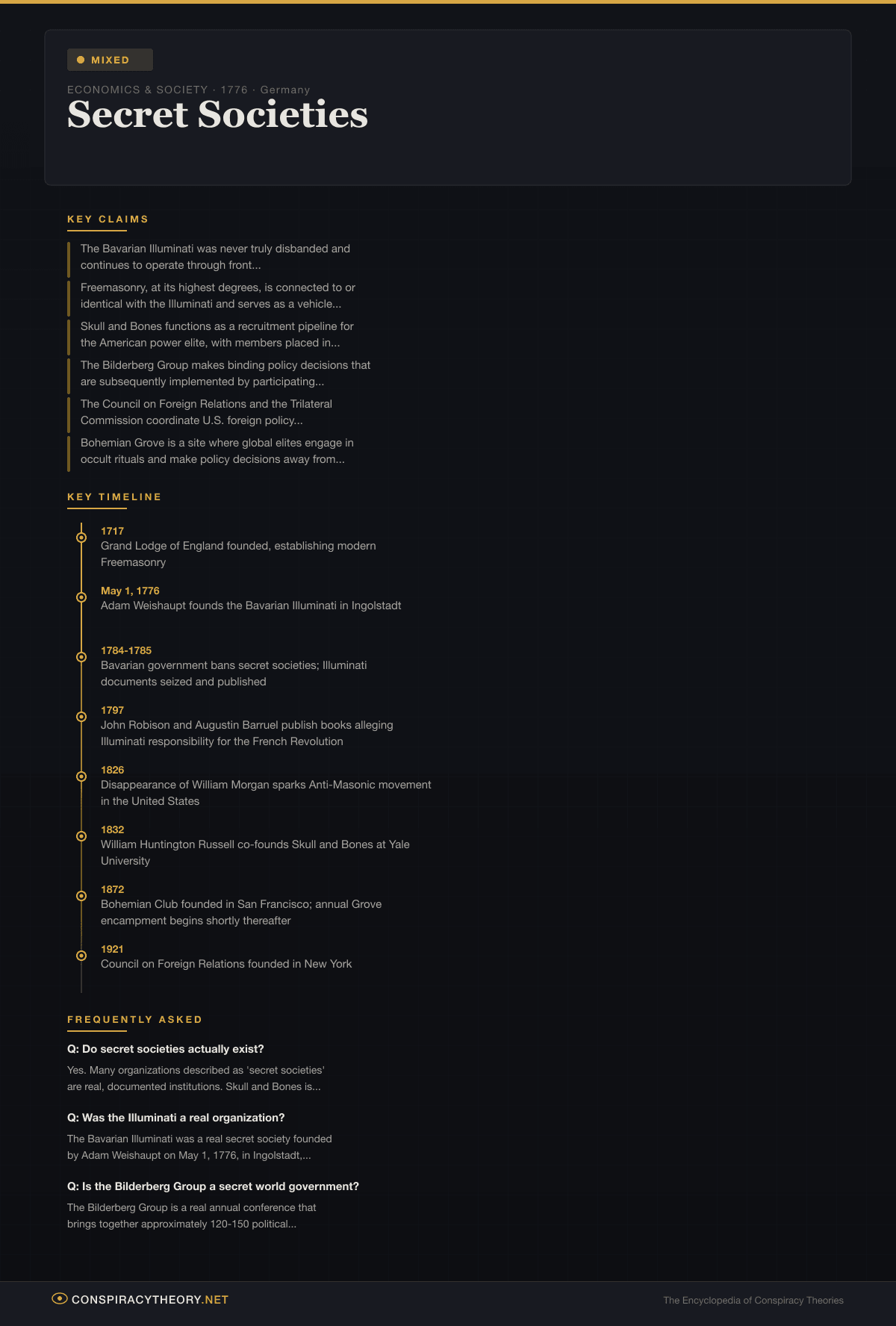
- The Bavarian Illuminati was never truly disbanded and continues to operate through front organizations, controlling world events from the shadows
- Freemasonry, at its highest degrees, is connected to or identical with the Illuminati and serves as a vehicle for a hidden agenda of world governance
- Skull and Bones functions as a recruitment pipeline for the American power elite, with members placed in key positions across government, intelligence, finance, and media to advance a coordinated agenda
- The Bilderberg Group makes binding policy decisions that are subsequently implemented by participating governments and corporations, functioning as an unelected world government
- The Council on Foreign Relations and the Trilateral Commission coordinate U.S. foreign policy outside democratic processes, ensuring continuity of elite objectives regardless of which party holds power
- Bohemian Grove is a site where global elites engage in occult rituals and make policy decisions away from public scrutiny
- These various organizations are interconnected, with overlapping memberships forming a network of elite coordination that amounts to a shadow government or “New World Order”
- Secret society influence explains the consistency of certain policies (globalization, military interventionism, central banking) across different administrations and countries
- Members of these organizations are bound by oaths of loyalty that supersede their obligations to the public or democratic institutions
Evidence
Documented existence and membership. The organizations in question are real, and much of their membership is publicly known. Skull and Bones membership lists have been published covering more than a century. These lists include William Howard Taft (president), George H.W. Bush (president, CIA director), George W. Bush (president), John Kerry (senator, secretary of state), and numerous other prominent figures. The 2004 presidential election between Bush and Kerry — both Skull and Bones members — provided a vivid illustration of the society’s reach into the highest levels of American politics.
Bilderberg participant lists. The Bilderberg Group has published participant lists since 2010, confirming attendance by sitting heads of state, central bank governors, NATO leaders, and CEOs of major corporations. Previous attendance lists were compiled by researchers and journalists and have been largely confirmed.
CFR and Trilateral Commission influence. The disproportionate representation of CFR members in senior government positions across administrations is documented. Political scientist Laurence Shoup calculated that CFR members occupied roughly one-third of senior foreign policy positions across multiple decades. The Trilateral Commission’s membership has included presidents (Jimmy Carter, George H.W. Bush), vice presidents, secretaries of state, and national security advisors.
Bohemian Grove documentation. Alex Jones’s 2000 footage of the Cremation of Care ceremony confirmed the existence of the ritual, which had been described in print but not previously captured on video. Journalist Philip Weiss’s 1989 article in Spy magazine provided a detailed account of the Grove’s activities based on his own infiltration. Richard Nixon was captured on the White House tapes describing the Grove as “the most faggy goddamned thing you could ever imagine.”
Historical documentation of the Illuminati. The Bavarian government’s seizure and publication of Illuminati documents in the 1780s provides primary source evidence of the organization’s structure, goals, and methods. These documents are held in German state archives and have been studied by historians.
Carroll Quigley’s testimony. Georgetown historian Carroll Quigley, who served as a mentor to Bill Clinton, wrote in Tragedy and Hope (1966) that he had been given access to the records of an international network of financial elites that sought to create a world system of financial control. Quigley did not condemn this network — he largely agreed with its aims — but his academic description of elite coordination from within the establishment provided powerful ammunition for conspiracy theorists.
Antony Sutton’s research. Researcher Antony Sutton published extensive analyses of Skull and Bones, including membership lists, and argued that Bones members had systematically influenced American policy. While Sutton’s conclusions were often more sweeping than his evidence supported, his documentation of Bones membership and the members’ subsequent career trajectories was meticulous.
Debunking / Verification
The Illuminati survival claim. There is no credible historical evidence that the Bavarian Illuminati survived beyond the late 1780s as a functioning organization. The seized documents show an organization in disarray before the ban, with internal conflicts and defections. While some members undoubtedly continued to hold Enlightenment views, the organizational structure was destroyed. Claims of Illuminati survival rely on unfounded assertions of continuity and the confusion of influence with organizational persistence.
Coordination versus conspiracy. The most significant criticism of secret society conspiracy theories is the conflation of elite networking with conspiratorial control. That powerful people know each other, attend the same conferences, and share policy perspectives does not require a conspiracy — it is a natural function of social networks among elites. The Bilderberg Group facilitates conversation, but there is no evidence it issues binding directives. The CFR publishes its policy recommendations openly through its journal Foreign Affairs.
Antisemitic undercurrents. Many secret society conspiracy theories carry antisemitic overtones, linking these organizations to alleged Jewish control of finance and media. The association of Freemasonry with Jewish conspiracy was a staple of Nazi propaganda, codified in documents like The Protocols of the Elders of Zion, a forgery created by Russian secret police in the early 1900s. Modern conspiracy theorists often use “globalist” or “international banker” as coded language that maps onto antisemitic tropes. Responsible analysis must acknowledge and reject these elements.
Bohemian Grove rituals. The Cremation of Care ceremony, while visually dramatic, appears to be a theatrical tradition — a symbolic “cremation” of worldly concerns to mark the beginning of the retreat — rather than a genuine occult practice. The Grove’s activities, while exclusive and secretive, appear to center on socializing, networking, and entertainment rather than policy-making, though informal conversations among powerful attendees undoubtedly occur.
Overlap versus unified conspiracy. While membership overlap exists between organizations like Skull and Bones, the CFR, the Trilateral Commission, and the Bilderberg Group, this overlap reflects the relatively small size of the American and Western power elite rather than evidence of a unified conspiratorial structure. People who attend elite universities, enter government service, and lead major corporations naturally intersect in multiple forums.
Cultural Impact
Secret society conspiracy theories have profoundly shaped popular culture and political discourse. The Illuminati has become perhaps the most recognizable conspiracy symbol in the world, referenced in music, film, and internet culture to the point of becoming a meme. Hip-hop culture, in particular, has embraced and amplified Illuminati symbolism, with artists like Jay-Z, Kanye West, and Beyonce accused of displaying Illuminati symbols and simultaneously incorporating those symbols into their imagery.
The concept of secret elite coordination has influenced political movements across the spectrum. On the right, fears of a “New World Order” driven by secret societies fueled the militia movement of the 1990s, the Tea Party movement, and elements of the MAGA movement. On the left, concerns about Bilderberg and the Trilateral Commission informed critiques of globalization and corporate power.
The secret society narrative provides a template for understanding political events that transcends partisan boundaries. When policies seem consistent across administrations regardless of party, when wealthy individuals appear to face different rules than ordinary citizens, and when democratic processes seem to produce outcomes that benefit a narrow elite, secret society theories offer an explanatory framework — even if that framework often oversimplifies complex institutional dynamics.
In Popular Culture
Secret societies have been a staple of fiction for centuries. Dan Brown’s The Da Vinci Code (2003) and Angels and Demons (2000) drew on Illuminati, Priory of Sion, and Vatican conspiracy themes to create international bestsellers. Umberto Eco’s Foucault’s Pendulum (1988) offered a more literary and satirical take on the same material, exploring how conspiracy theories are constructed and how they can take on a life of their own.
The National Treasure films (2004, 2007) used Freemasonic conspiracy as a framework for adventure storytelling. Television series including The X-Files, Alias, and Westworld incorporated secret society themes. The Illuminati has appeared as an antagonist in video games including the Deus Ex series and Assassin’s Creed.
Alex Jones’s 2000 documentary Dark Secrets: Inside Bohemian Grove brought the Grove to widespread public attention and launched Jones’s career as a conspiracy media figure. The documentary’s footage of the Cremation of Care ceremony has been viewed millions of times and remains a touchstone of conspiracy culture.
Jon Ronson’s book Them: Adventures with Extremists (2001) provided a journalist’s account of infiltrating conspiracy subcultures, including a visit to Bohemian Grove alongside Alex Jones.
Key Figures
Adam Weishaupt — Founder of the Bavarian Illuminati in 1776. A professor of canon law at the University of Ingolstadt, Weishaupt sought to promote Enlightenment rationalism through a secret society modeled on Masonic structures.
William Huntington Russell — Co-founder of Skull and Bones at Yale in 1832. Russell reportedly conceived the society after exposure to a German student society during a year abroad.
David Rockefeller — Banker, philanthropist, and central figure in multiple organizations identified in conspiracy theories. Co-founder of the Trilateral Commission, longtime chairman of the Council on Foreign Relations, and regular Bilderberg attendee. Rockefeller’s autobiography acknowledged his family’s involvement in internationalist projects and he did not shy from his role in promoting global cooperation.
Zbigniew Brzezinski — Political scientist and National Security Advisor to President Carter who co-founded the Trilateral Commission with David Rockefeller. Brzezinski’s academic writings on technocratic governance and the management of global systems provided intellectual foundations that conspiracy theorists interpreted as blueprints for elite control.
Henry Kissinger — Secretary of State, National Security Advisor, and member of the CFR, Bilderberg Group, and Bohemian Club. Kissinger’s long career in foreign policy, spanning multiple decades and administrations, made him an emblematic figure in conspiracy narratives about elite continuity.
Alex Jones — Radio host and conspiracy media figure who infiltrated Bohemian Grove in 2000 and filmed the Cremation of Care ceremony. Jones’s coverage brought the Grove to mainstream conspiracy attention.
Antony Sutton — British-American researcher who published extensive analyses of Skull and Bones and alleged that its members systematically influenced American policy in finance, education, and foreign affairs.
Carroll Quigley — Georgetown University historian whose book Tragedy and Hope described elite networks of financial coordination from an insider perspective, providing conspiracy theorists with academic credibility for claims about elite coordination.
John Robison — Scottish scientist whose 1797 book Proofs of a Conspiracy argued that the Illuminati survived its suppression and orchestrated the French Revolution, establishing the template for modern Illuminati conspiracy theories.
Timeline
- 1717 — Grand Lodge of England founded, establishing modern Freemasonry
- May 1, 1776 — Adam Weishaupt founds the Bavarian Illuminati in Ingolstadt
- 1784-1785 — Bavarian government bans secret societies; Illuminati documents seized and published
- 1797 — John Robison and Augustin Barruel publish books alleging Illuminati responsibility for the French Revolution
- 1826 — Disappearance of William Morgan sparks Anti-Masonic movement in the United States
- 1832 — William Huntington Russell co-founds Skull and Bones at Yale University
- 1872 — Bohemian Club founded in San Francisco; annual Grove encampment begins shortly thereafter
- 1921 — Council on Foreign Relations founded in New York
- 1954 — First Bilderberg Group meeting held at Hotel de Bilderberg in the Netherlands
- 1966 — Carroll Quigley publishes Tragedy and Hope, describing elite financial networks
- 1973 — Trilateral Commission founded by David Rockefeller and Zbigniew Brzezinski
- 1983 — Antony Sutton publishes America’s Secret Establishment: An Introduction to the Order of Skull and Bones
- 1989 — Philip Weiss infiltrates Bohemian Grove and publishes account in Spy magazine
- 2000 — Alex Jones infiltrates Bohemian Grove and films the Cremation of Care ceremony
- 2004 — Presidential election between Skull and Bones members George W. Bush and John Kerry; Dan Brown’s The Da Vinci Code becomes a global bestseller
- 2010 — Bilderberg Group begins publishing official participant lists
- 2013 — Bilderberg Group launches official website with information about its history and purpose
Sources & Further Reading
- Robison, John. Proofs of a Conspiracy Against All the Religions and Governments of Europe. 1797.
- Quigley, Carroll. Tragedy and Hope: A History of the World in Our Time. Macmillan, 1966.
- Sutton, Antony C. America’s Secret Establishment: An Introduction to the Order of Skull and Bones. TrineDay, 1983 (reissued 2002).
- Ronson, Jon. Them: Adventures with Extremists. Simon & Schuster, 2001.
- Domhoff, G. William. The Bohemian Grove and Other Retreats: A Study in Ruling-Class Cohesiveness. Harper & Row, 1974.
- Shoup, Laurence H., and William Minter. Imperial Brain Trust: The Council on Foreign Relations and United States Foreign Policy. Monthly Review Press, 1977.
- Stauffer, Vernon. New England and the Bavarian Illuminati. Columbia University Press, 1918.
- Melanson, Terry. Perfectibilists: The 18th Century Bavarian Order of the Illuminati. Trine Day, 2009.
- Bilderberg Group official website: bilderbergmeetings.org
- Weiss, Philip. “Inside Bohemian Grove.” Spy magazine, November 1989.
Related Theories
- Illuminati — Detailed examination of the Bavarian Illuminati and modern theories about its alleged survival and influence
- Bilderberg Group — The annual invitation-only conference of Western political and business leaders
- Bohemian Grove — The private retreat in Northern California where wealthy and powerful men gather annually
- Skull and Bones — Yale University’s most famous secret society and its influence on American politics
- Freemasonry Conspiracy — Theories about Masonic influence in government, architecture, and world events
- Committee of 300 — The alleged group of 300 elite individuals said to control world affairs
- Trilateral Commission — The organization founded to coordinate policy between North America, Europe, and Japan
Frequently Asked Questions
Do secret societies actually exist?
Was the Illuminati a real organization?
Is the Bilderberg Group a secret world government?
Infographic
Share this visual summary. Right-click to save.