Shergar Kidnapping — The Racehorse That Vanished
Overview
On the night of February 8, 1983, a group of armed men drove through the gates of Ballymany Stud in County Kildare, Ireland, and took one of the most valuable racehorses in the world. Shergar — winner of the 1981 Epsom Derby by ten lengths, one of the most dominant performances in the race’s 200-year history — was loaded into a horse trailer and driven into the Irish night.
He was never seen again.
The Shergar case is one of the great unsolved mysteries of 20th-century crime — not because the perpetrators are genuinely unknown (virtually everyone involved in the investigation believes it was the Provisional Irish Republican Army), but because the horse was never recovered, no one was ever charged, and the precise details of what happened after the kidnapping remain contested more than four decades later. It is a story about the intersection of spectacular sporting fame, the grim economics of political violence, a ransom demand that couldn’t be met because of the horse’s unusual ownership structure, and a cover-up maintained by paramilitary omerta.
The case is classified as unresolved because, despite strong circumstantial evidence pointing to the IRA, no individual has been convicted, Shergar’s remains have never been found, and some alternative theories — however unlikely — cannot be definitively ruled out.
Origins & History
Shergar’s Racing Career
To understand why anyone would steal a racehorse, you need to understand what Shergar was worth — and to understand that, you need to understand what Shergar did.
Shergar was a bay colt bred and owned by His Highness the Aga Khan IV, the spiritual leader of the Ismaili Muslims and one of the world’s wealthiest individuals. The horse was trained by Michael Stoute at Newmarket, England, and his racing career was brief, spectacular, and effectively unprecedented.
In 1981, Shergar won the Guardian Classic Trial at Sandown, the Chester Vase, and then, on June 3, 1981, lined up for the Epsom Derby — the most prestigious flat race in British horse racing. What followed was one of the most extraordinary performances in the history of the sport. Ridden by 19-year-old Walter Swinburn, Shergar took the lead early and simply kept extending it. He won by ten lengths — the widest margin in the 202-year history of the race at that point, a record that still stands.
He went on to win the Irish Derby by four lengths, the King George VI and Queen Elizabeth Stakes at Ascot by four lengths, and the St Leger Trial at Knavesmire. His only defeat came in his final race, the St Leger itself, where he finished fourth — a rare poor performance attributed to soft ground and a possible injury.
Shergar was retired to stud at the end of 1981 with a career record that marked him as one of the greatest racehorses of his era. The Aga Khan syndicated his breeding rights into 40 shares at 250,000 Irish pounds each, valuing the horse at 10 million pounds — a staggering sum in 1983 terms.
The Syndication Problem
The syndication would prove to be the kidnappers’ undoing — though they did not know it at the time.
Unlike a horse owned by a single individual who could decide to pay or refuse a ransom, Shergar was owned by 40 shareholders, each with their own financial interests, risk tolerances, and views on negotiating with paramilitaries. Getting 40 independent owners to agree on anything was difficult. Getting them to agree on paying a 2-million-pound ransom to the IRA — with no guarantee the horse would be returned alive and in breeding condition — was effectively impossible.
The kidnapping appears to have been planned by people who knew the value of thoroughbred stallions but did not understand the implications of syndicated ownership. It was a plan built on a faulty assumption.
The Night of the Kidnapping
At approximately 8:30 PM on Tuesday, February 8, 1983, a group of masked, armed men arrived at Ballymany Stud, which sits on the edge of the Curragh, Ireland’s most famous racing plain. The farm housed multiple stallions owned by the Aga Khan, including Shergar.
The gang went directly to the home of head groom Jim Fitzgerald, who lived on the property with his family. Fitzgerald was confronted at gunpoint and forced to identify Shergar among the stallions in the barn. The gang then loaded the horse into a horse trailer — a process Fitzgerald later described as chaotic, with the men clearly inexperienced in handling horses. Shergar was reportedly nervous and difficult to load.
Fitzgerald was taken along in a car, blindfolded, and driven for several hours before being released in County Offaly with a message: the Aga Khan had four days to pay a ransom of 2 million Irish pounds. If he refused, the horse would be killed.
Fitzgerald walked to a farmhouse and called the police. The Gardai (Irish police) were alerted, and what would become one of Ireland’s largest-ever criminal investigations was launched.
The Failed Negotiations
What followed was an exercise in frustration on all sides.
The Aga Khan’s representatives attempted to negotiate, but the syndicate structure made a unified response impossible. Some shareholders were willing to contribute to a ransom; others refused on principle; still others wanted guarantees that the horse was alive and unharmed before any money changed hands. The negotiations were handled by a Dublin veterinary surgeon, Stan Cosgrove, who served as intermediary, but communications with the kidnappers were sporadic and the callers changed their demands and contact methods.
The Gardai mounted a massive search operation, including roadblocks across the country and surveillance of suspected IRA figures, but turned up nothing. Interpol was contacted. False leads proliferated — Shergar was supposedly spotted in France, in Libya (Muammar Gaddafi was known to own racehorses and was a financial supporter of the IRA), and in various locations across Ireland.
After approximately a week, the phone calls from the kidnappers stopped. No ransom was paid. No horse was returned.
Key Claims & Theories
The IRA Theory (Most Widely Accepted)
The dominant account — supported by multiple former IRA members and considered highly credible by investigators — is that Shergar’s kidnapping was organized by the Provisional IRA as a fundraising operation. The Troubles were at their height, and the IRA needed funds for weapons and operations. A racehorse worth 10 million pounds seemed like an ideal ransom target.
The operation was reportedly planned by Kevin Mallon, a senior IRA figure from County Tyrone. According to former IRA member and informer Sean O’Callaghan, who went public with his account in the 1990s, the plan went wrong almost immediately. The kidnappers had no expertise with horses. Shergar — a highly strung thoroughbred accustomed to careful, experienced handling — became agitated and uncontrollable. The horse was reportedly injured (possibly a leg injury) during or shortly after transport.
O’Callaghan claimed that within days, it became clear that the ransom would not be paid and that the horse was injured and distressed. A decision was made to kill Shergar, and the horse was shot and buried on farmland. O’Callaghan never claimed to know the exact burial location, and no one who allegedly did has ever come forward.
Former Sinn Fein member and IRA veteran Martin Ferris was also linked to the operation, though he denied involvement. In 1999, former IRA member Andrew Flynn reportedly told a journalist that Shergar had been killed within hours of the kidnapping — a claim that, if true, means the subsequent ransom calls were a bluff by a gang that had already lost its leverage.
The Libya Connection
A persistent theory links the kidnapping to Colonel Muammar Gaddafi’s Libya. Gaddafi was a known financial supporter of the IRA and owned thoroughbred horses. Some theorists suggested that Shergar was smuggled out of Ireland and transported to Libya, where he lived out his days in Gaddafi’s stables or was used for clandestine breeding.
This theory is considered unlikely by most investigators. Smuggling a world-famous, easily identifiable stallion out of Ireland during a massive police search would have been extraordinarily difficult. Thoroughbred identification includes detailed records of markings, whorls, and scars, and by the 1980s, blood-typing was available for verification. Shergar would have been recognized by any knowledgeable horseperson, making secret breeding nearly impossible. Additionally, the IRA informer accounts consistently state the horse was killed in Ireland.
The Insurance Fraud Theory
A minority theory suggests that the kidnapping was staged or exploited for insurance purposes. Shergar was heavily insured, and some of his shareholders stood to lose significant money if his breeding career underperformed expectations. Under this theory, the kidnapping provided a convenient cover for a financial exit.
This theory has little supporting evidence and is considered a fringe view. The insurance complications were, in fact, enormous — Lloyd’s of London paid out approximately 7 million pounds in insurance claims after the kidnapping was confirmed, but the process was protracted and contentious. The notion that 40 independent shareholders coordinated an elaborate insurance fraud involving an armed paramilitary group strains credibility.
The Eastern European Sale Theory
Another theory proposes that Shergar was not killed but was sold through underground channels to buyers in Eastern Europe or the Middle East, where he lived out his life under a false identity. This theory occasionally resurfaces when unverified claims emerge of a “mystery stallion” resembling Shergar seen at various locations.
Like the Libya theory, this scenario requires that a world-famous horse with distinctive markings was successfully hidden from the entire global thoroughbred industry — an industry with strong financial incentives to identify valuable bloodlines and extensive mechanisms for doing so. It also conflicts with the IRA informer testimony.
Evidence
What Supports the IRA Theory
- Sean O’Callaghan’s testimony: O’Callaghan was a confirmed IRA member who became a Garda informer and later publicly revealed details of multiple IRA operations. His account of the Shergar kidnapping has been largely consistent over time and is considered credible by the Gardai
- Kevin Mallon connection: Mallon was arrested in 1983 in possession of a large sum of money and firearms, and was imprisoned for IRA-related offenses. He was named by multiple sources as the operation’s organizer
- Operational characteristics: The kidnapping bore hallmarks of an IRA operation — armed men, military-style execution, demands routed through intermediaries, and the absence of forensic evidence suggesting professional planning
- No alternative credible claim: No other group has ever claimed responsibility, and no evidence has emerged supporting any non-IRA theory
What Remains Unknown
- The exact burial site: Despite searches of multiple locations, Shergar’s remains have never been found
- The precise timeline: Whether Shergar was killed within hours, days, or weeks of the kidnapping is disputed among sources
- The full list of participants: While Mallon and a few others have been named, the complete gang has never been identified
- Why no prosecution: Despite substantial intelligence, no one has ever been charged — raising questions about whether political considerations influenced the investigation
The Garda Investigation
The Garda investigation was hampered by several factors. The crime scene was not secured promptly — Fitzgerald’s delay in reaching authorities meant hours passed before police arrived at Ballymany. The kidnappers left minimal forensic evidence. The IRA’s cellular structure meant that even members who knew about the operation might not know the burial location. And the political sensitivities of the Troubles era meant that intelligence about IRA operations was often held by security services rather than shared with civilian police investigators.
Chief Superintendent James Murphy led the investigation and reportedly became convinced early on that the IRA was responsible, but converting intelligence into prosecutable evidence proved impossible. The case was never formally closed.
Cultural Impact
The Troubles Through a Different Lens
The Shergar kidnapping brought the Northern Irish conflict to an audience that had tuned out decades of political violence. People who had become numb to news of bombings and shootings suddenly engaged with a story about a stolen horse. The case humanized (or rather, animalized) the Troubles in a way that made the conflict accessible to international audiences who might otherwise have ignored Irish politics.
This created an uncomfortable dynamic. Critics noted that the disappearance of a horse generated more sustained media interest than the disappearance of numerous human beings during the Troubles — including the so-called “Disappeared,” victims murdered and secretly buried by the IRA whose remains were not recovered for decades.
Media and Entertainment
The case has inspired multiple books, documentaries, and dramatizations. The 1999 film Shergar, starring Ian Holm and Mickey Rourke, offered a fictionalized account (and was not well received). Several documentaries have revisited the case, most notably a 2012 BBC production that explored the burial site theory.
The case became shorthand in British and Irish culture for an unsolvable mystery — “doing a Shergar” briefly entered colloquial usage as slang for disappearing without a trace.
Impact on Thoroughbred Security
The kidnapping transformed security practices at thoroughbred stud farms worldwide. Before Shergar, even the most valuable stallions were kept at facilities with minimal security — gates, fencing, and a resident groom were considered adequate. After 1983, major stud operations invested in CCTV, alarm systems, security guards, perimeter monitoring, and in some cases, armed protection. The National Stud in Kildare and major operations like Coolmore and Godolphin implemented security protocols that would have been considered excessive before the Shergar case.
The case also led to changes in how thoroughbred identification was managed, with microchipping eventually becoming standard practice for high-value horses — partly to prevent exactly this kind of situation from recurring.
The Disappeared
The Shergar case has uncomfortable parallels with the broader issue of the IRA’s “Disappeared” — individuals murdered and secretly buried by the IRA during the Troubles. The Independent Commission for the Location of Victims’ Remains was established in 1999 to find these bodies, and searches have been conducted across Ireland for decades, with some remains recovered but others still missing. The inability to find Shergar’s remains despite decades of effort mirrors the difficulty of locating human victims buried by the same organization.
Timeline
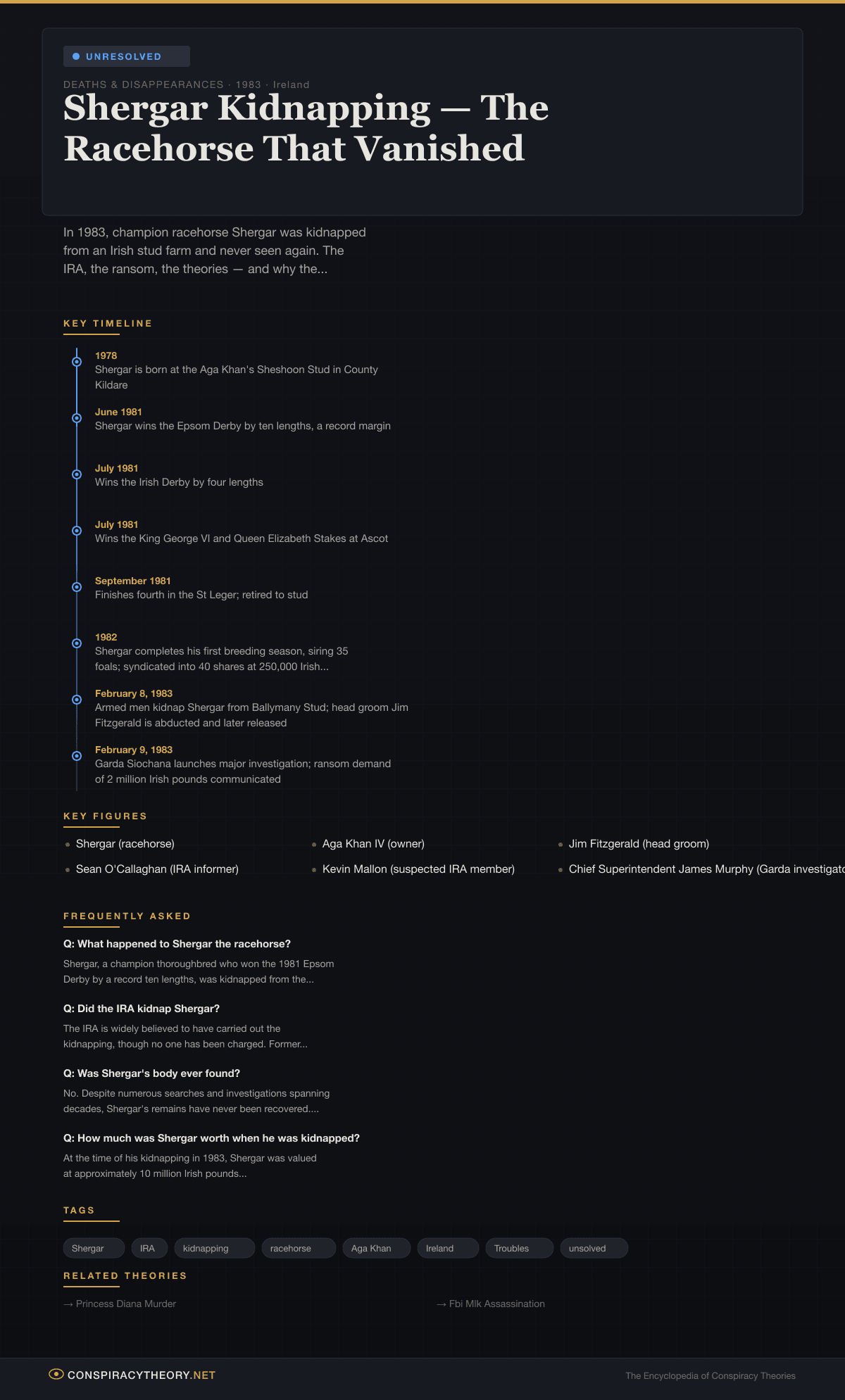
- 1978 — Shergar is born at the Aga Khan’s Sheshoon Stud in County Kildare
- June 1981 — Shergar wins the Epsom Derby by ten lengths, a record margin
- July 1981 — Wins the Irish Derby by four lengths
- July 1981 — Wins the King George VI and Queen Elizabeth Stakes at Ascot
- September 1981 — Finishes fourth in the St Leger; retired to stud
- 1982 — Shergar completes his first breeding season, siring 35 foals; syndicated into 40 shares at 250,000 Irish pounds each
- February 8, 1983 — Armed men kidnap Shergar from Ballymany Stud; head groom Jim Fitzgerald is abducted and later released
- February 9, 1983 — Garda Siochana launches major investigation; ransom demand of 2 million Irish pounds communicated
- February 9-18, 1983 — Sporadic contact from kidnappers; ransom negotiations fail due to syndicate ownership structure
- Late February 1983 — Contact from kidnappers ceases; investigation continues without leads
- 1983 — Kevin Mallon arrested on firearms and IRA-related charges (later convicted)
- 1992 — Sean O’Callaghan publicly identifies the kidnapping as an IRA operation
- 1999 — Feature film Shergar released
- 2000s — Multiple searches of alleged burial sites yield no remains
- 2012 — BBC documentary re-examines the case, suggesting burial site near Aughnasheelin, County Leitrim
- 2023 — 40th anniversary prompts renewed media coverage; case remains officially open
Sources & Further Reading
- O’Callaghan, Sean. The Informer. Corgi Books, 1999
- Sharkey, John. Dopping, Shergar and Dublin: The Untold Story. Gill & Macmillan, 2001
- Thompson, Laura. Newmarket: From James I to the Present Day. Virgin Books, 2000
- Hale, Christopher. Himmler’s Crusade. John Wiley & Sons, 2003
- Kee, Robert. The Green Flag: A History of Irish Nationalism. Penguin, 2000
- BBC. “Shergar: The Riddle of the Missing Racehorse.” Documentary, 2012
- Magee, Sean. Ascot: The History. Methuen, 2002
- McKittrick, David, et al. Lost Lives: The Stories of the Men, Women and Children Who Died as a Result of the Northern Ireland Troubles. Mainstream Publishing, 1999
- Racing Post archives, 1981-1983
Related Theories
- Princess Diana Murder — another high-profile British and Irish case with conspiracy dimensions
- FBI & MLK Assassination — a case where paramilitary and state actors intersected with unresolved questions
Frequently Asked Questions
What happened to Shergar the racehorse?
Did the IRA kidnap Shergar?
Was Shergar's body ever found?
How much was Shergar worth when he was kidnapped?
Infographic
Share this visual summary. Right-click to save.