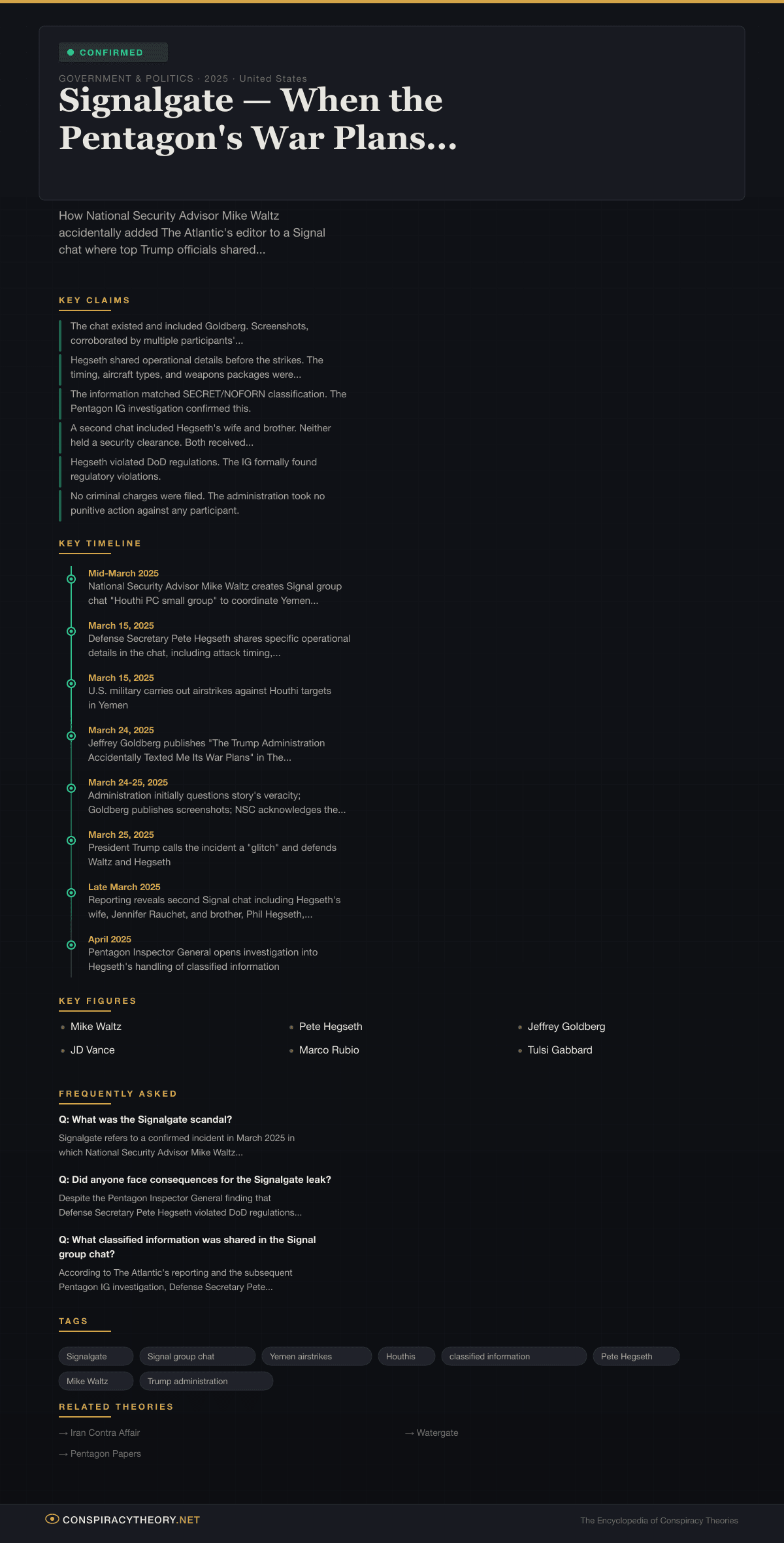
Signalgate — When the Pentagon's War Plans Landed in a Journalist's Group Chat
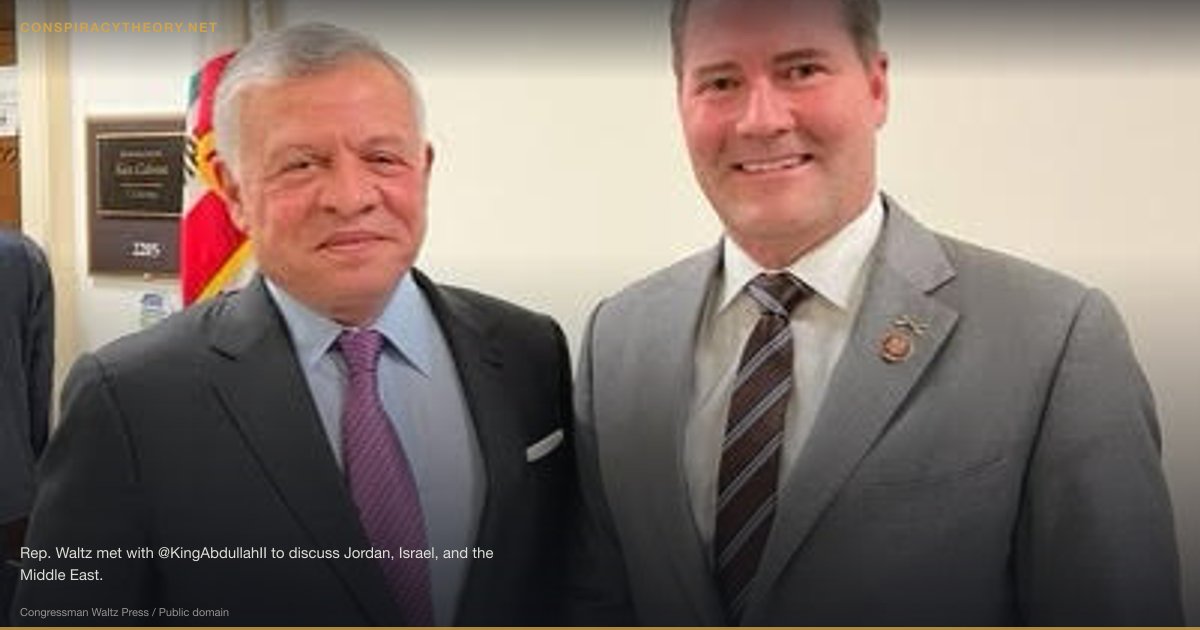
Overview
Here is the single most absurd sentence in modern American national security history: The editor-in-chief of The Atlantic was accidentally added to a group chat where the Vice President of the United States, the Secretary of Defense, and a handful of other senior officials were actively planning a military strike on a foreign country.
Not a hypothetical. Not a drill. Not a war game. Real bombs, real targets, real timelines — shared on a consumer messaging app, in a chat that now included a journalist. And nobody noticed for days.
The scandal that became known as “Signalgate” erupted in March 2025 when Jeffrey Goldberg, The Atlantic’s top editor, published a stunning account of finding himself inexplicably added to a Signal group chat titled “Houthi PC small group.” In it, he watched in real time as the most powerful national security officials in the Trump administration discussed classified plans for airstrikes against Houthi targets in Yemen. Defense Secretary Pete Hegseth shared specific attack windows, aircraft types, weapons packages, and sequencing — the kind of granular operational intelligence that, in any previous administration, would have triggered immediate investigations, security clearance revocations, and possibly criminal referrals.
Instead, the administration called it a “glitch.”
Signalgate is not a conspiracy theory in the traditional sense. It is a confirmed, documented, Inspector General-investigated breach of classified information protocols at the highest levels of the U.S. government. No shadowy informants. No leaked documents obtained through clandestine operations. Just a national security advisor who apparently fat-fingered a contact and added one of America’s most prominent journalists to a war planning chat. What makes it worthy of examination alongside the great intelligence scandals of American history — the Pentagon Papers, Iran-Contra, Watergate — is not the complexity of the scheme but its breathtaking casualness. This was not a carefully orchestrated leak. It was operational security collapsing in real time, on a platform designed for teenagers to send disappearing selfies.
How It Happened
The Accidental Add
In mid-March 2025, National Security Advisor Mike Waltz created a Signal group chat to coordinate among senior officials regarding planned U.S. military operations against the Houthis, the Iran-backed Yemeni militia that had been attacking commercial shipping in the Red Sea. The group — titled “Houthi PC small group” with “PC” likely standing for “Principals Committee” — included Vice President JD Vance, Defense Secretary Pete Hegseth, Secretary of State Marco Rubio, Director of National Intelligence Tulsi Gabbard, CIA Director John Ratcliffe, Treasury Secretary Scott Bessent, White House Chief of Staff Susie Wiles, Senior Advisor Stephen Miller, and several other officials.
At some point during the chat’s creation or shortly after, Waltz added Jeffrey Goldberg’s phone number. How this happened has never been fully explained. The most charitable interpretation is that Waltz had Goldberg’s contact information in his phone — the two likely had a professional relationship from Waltz’s years in Congress and in the foreign policy establishment — and either autocomplete or a mis-tap added the wrong person. A less charitable interpretation, floated by some observers, is that Waltz intentionally added Goldberg as a subtle act of dissent or information sharing, though no evidence supports this theory and Goldberg himself has dismissed it.
What is not disputed is the result: one of the country’s most well-known journalists was now silently sitting in a group chat where active military operations were being planned.
The Messages
Goldberg did not announce his presence. He watched. And what he saw was extraordinary.
On March 15, 2025, roughly two hours before American bombs started falling on Houthi positions, Pete Hegseth typed out a remarkably detailed operational summary. The message included the specific window during which strikes would commence, the fact that F-18 fighter jets would be involved, details about weapons packages, and the sequencing of the attack — which assets would strike first and what would follow. This was not the kind of vague, sanitized language you might see in a White House press briefing. This was the kind of information that, if intercepted by an adversary, could have allowed them to prepare, reposition, or target American pilots.
Hegseth sent this information to a group chat on a commercial messaging app. On people’s personal phones. On a platform with no government oversight, no classification markings, no access controls beyond the chat’s member list — which, again, included a journalist.
Other officials chimed in with their own contributions. Vice President Vance offered what appeared to be strategic commentary. Gabbard provided intelligence assessments. The chat functioned, for all intents and purposes, as an ad hoc Situation Room — except the Situation Room has SCIFs, secure communications equipment, cleared personnel, and a staff whose entire job is to prevent exactly this kind of breach.
The Revelation
Goldberg sat on the information until after the strikes had been carried out, a decision he later described as driven by concerns about not wanting to endanger U.S. service members. On March 24, 2025, he published his account in The Atlantic under the headline “The Trump Administration Accidentally Texted Me Its War Plans.” The article was immediately, overwhelmingly explosive.
The administration’s initial response was denial. Several officials questioned whether the story was fabricated. Then Goldberg published the receipts — screenshots of the chat, with the messages, the participants, the timestamps. The denial pivoted to minimization. National Security Council spokesperson Brian Hughes issued a statement acknowledging the chat’s existence but claiming it contained no classified information. President Trump called the incident a “glitch” and said Waltz had made an honest mistake.
The Second Chat
The story got worse. Reporting in the weeks following Goldberg’s initial article revealed the existence of a second Signal group chat, also used by Hegseth to discuss Yemen operations, that included two people with no security clearance, no government role, and no conceivable need to know classified military plans: Hegseth’s wife, Jennifer Rauchet, and his brother, Phil Hegseth.
Phil Hegseth served as a personal aide to the Defense Secretary — a role that does not come with a security clearance or authorization to access classified operational details. Jennifer Rauchet was a former Fox News producer. The revelation that the Secretary of Defense was sharing active strike plans with family members on a consumer messaging app transformed the scandal from an embarrassing accident into something more structurally alarming. This was not a one-time mistake. It was a pattern.
The Pentagon Inspector General Investigation
The Department of Defense Inspector General launched an investigation into Hegseth’s handling of classified information. The IG’s findings, released in a report that the Pentagon initially attempted to suppress, were damning.
The investigation concluded that the information Hegseth shared in both Signal chats — the operational timelines, weapons specifics, and aircraft details — was consistent with information classified at the SECRET/NOFORN level. “NOFORN” means “Not Releasable to Foreign Nationals.” The classification exists specifically because the information, if disclosed, could cause “serious damage” to national security.
The IG found that Hegseth had violated Department of Defense regulations governing the handling of classified information. Specifically, the use of an unclassified commercial messaging application to transmit information classified at the SECRET level constituted a breach of DoD Manual 5200.01 and related directives.
Despite these findings, the political consequences were minimal. The Trump administration stood by Hegseth. Trump publicly stated that Hegseth had done “nothing wrong.” No criminal referral was made to the Department of Justice. No security clearances were revoked.
Key Claims and Evidence
What Is Confirmed
- The chat existed and included Goldberg. Screenshots, corroborated by multiple participants’ acknowledgments. The NSC confirmed the chat’s existence.
- Hegseth shared operational details before the strikes. The timing, aircraft types, and weapons packages were shared approximately two hours before the operation began.
- The information matched SECRET/NOFORN classification. The Pentagon IG investigation confirmed this.
- A second chat included Hegseth’s wife and brother. Neither held a security clearance. Both received operational details.
- Hegseth violated DoD regulations. The IG formally found regulatory violations.
- No criminal charges were filed. The administration took no punitive action against any participant.
What Remains Debated
- How Goldberg was added. The precise mechanism — autocomplete, deliberate addition, phone number confusion — has not been definitively established.
- Whether troops were endangered. The administration maintains no harm resulted. Critics, including former military and intelligence officials, argue that the disclosure of real-time operational details to an unsecured platform inherently risked compromise, particularly given the possibility that foreign intelligence services monitor metadata or have compromised individual devices.
- The scope of classified discussions on Signal. Whether similar chats existed for other military operations remains unknown. Former officials have suggested this was likely not an isolated practice.
Cultural Impact
The OPSEC Meltdown
Signalgate became an instant cultural flashpoint and a potent symbol of what critics described as the Trump administration’s cavalier approach to institutional norms and national security protocols. For military and intelligence professionals — people who spend careers operating under strict communications security discipline, who have watched colleagues lose clearances over far less — the scandal was viscerally infuriating. Service members are routinely briefed that even seemingly minor OPSEC violations can get people killed. Here was the Secretary of Defense casually texting strike plans to a family group chat.
The term “Signalgate” itself, following the venerable tradition of appending “-gate” to any scandal of consequence, entered the lexicon almost immediately. Memes proliferated. The phrase “Houthi PC small group” became shorthand for catastrophic operational security failures. Late-night comedians had a field day. Saturday Night Live produced multiple sketches.
The Classification Double Standard
The scandal arrived at a particularly charged moment in the national conversation about classified information. The Trump administration had spent considerable political energy attacking President Biden over classified documents found at his home and office, and had previously pursued aggressive rhetoric about Hillary Clinton’s use of a private email server for State Department communications. The irony of senior Trump officials sharing active war plans on a consumer messaging app was not lost on critics, who drew sharp parallels.
Former intelligence officers and legal analysts noted that lower-ranking military personnel and government employees had been prosecuted, imprisoned, and had careers destroyed for mishandling classified information that was far less sensitive than active strike plans. Reality Winner served over four years in prison for leaking a single classified NSA document. Here, the Secretary of Defense shared real-time operational details with his wife — and kept his job.
Congressional Response
Democrats demanded investigations, hearings, and Hegseth’s resignation. The Senate Armed Services Committee held hearings at which administration officials largely declined to provide detailed answers, citing executive privilege and ongoing security reviews. Republicans were divided — some acknowledged the seriousness of the breach while defending the individuals involved, while others dismissed the entire episode as media overreaction.
The incident became a recurring reference point in broader debates about accountability, the rule of law, and whether security norms apply equally to political appointees and career officials.
Timeline
- Mid-March 2025 — National Security Advisor Mike Waltz creates Signal group chat “Houthi PC small group” to coordinate Yemen strike planning; inadvertently adds Jeffrey Goldberg, editor-in-chief of The Atlantic
- March 15, 2025 — Defense Secretary Pete Hegseth shares specific operational details in the chat, including attack timing, F-18 involvement, and weapons packages, approximately two hours before strikes commence
- March 15, 2025 — U.S. military carries out airstrikes against Houthi targets in Yemen
- March 24, 2025 — Jeffrey Goldberg publishes “The Trump Administration Accidentally Texted Me Its War Plans” in The Atlantic, revealing the group chat and its contents
- March 24-25, 2025 — Administration initially questions story’s veracity; Goldberg publishes screenshots; NSC acknowledges the chat’s existence but denies classified information was shared
- March 25, 2025 — President Trump calls the incident a “glitch” and defends Waltz and Hegseth
- Late March 2025 — Reporting reveals second Signal chat including Hegseth’s wife, Jennifer Rauchet, and brother, Phil Hegseth, with similar operational content
- April 2025 — Pentagon Inspector General opens investigation into Hegseth’s handling of classified information
- April 2025 — Mike Waltz is moved from National Security Advisor to nomination as U.S. Ambassador to the United Nations
- Mid-2025 — Pentagon IG report finds Hegseth violated DoD regulations; information shared matched SECRET/NOFORN classification; report concludes the disclosure risked endangering U.S. troops
- 2025 — No criminal charges filed; no security clearances revoked; Hegseth remains as Defense Secretary
The Bigger Picture
Signalgate did not emerge in a vacuum. It sits within a broader pattern of confirmed government conspiracies and intelligence scandals in which the tension between secrecy, accountability, and the public’s right to know has produced extraordinary collisions.
The Pentagon Papers established that the government would systematically lie about military operations — and that the press, not Congress, would be the mechanism of accountability. Watergate proved that the executive branch could weaponize intelligence and law enforcement for political purposes. Iran-Contra demonstrated that senior officials could run covert operations in defiance of explicit congressional prohibitions.
Signalgate is a different beast. It does not involve the deliberate deception of Iran-Contra or the criminal conspiracy of Watergate. Its danger is not malice but incompetence — the casual, almost offhand erosion of the security protocols that exist to protect the people carrying out the nation’s most dangerous missions. When the Secretary of Defense texts strike plans to a group chat that includes a journalist and, separately, to a chat that includes his wife, the question is not “what were they hiding?” but something arguably more troubling: “do they even take this seriously?”
The answer, based on the evidence, appears to be no. And that might be the most alarming finding of all.
Sources & Further Reading
- Goldberg, Jeffrey. “The Trump Administration Accidentally Texted Me Its War Plans.” The Atlantic, March 24, 2025.
- Goldberg, Jeffrey. “The Signal Chat: What Really Happened.” The Atlantic, March 26, 2025.
- Department of Defense Office of Inspector General. Investigation of the Secretary of Defense’s Use of Commercial Messaging Applications, 2025.
- Shane Harris, Dan Lamothe, and Missy Ryan. “Hegseth Shared Attack Plans in Signal Chat That Included His Wife.” The Washington Post, 2025.
- “Pentagon IG Finds Hegseth Violated Policy by Sharing Classified Info.” The New York Times, 2025.
- Bertrand, Natasha, and Katie Bo Lillis. “Second Signal Chat Included Hegseth’s Brother and Wife.” CNN, 2025.
- DoD Manual 5200.01, Volumes 1-4: DoD Information Security Program.
- Senate Armed Services Committee Hearings on Signalgate, 2025.
- Savage, Charlie. “What Laws Apply to the Signal Chat Leak?” The New York Times, March 2025.
Related Theories
- Iran-Contra Affair — Senior officials conducting covert operations outside proper channels
- Watergate — The gold standard of confirmed government conspiracies and cover-ups
- Pentagon Papers — Government deception about military operations exposed by the press
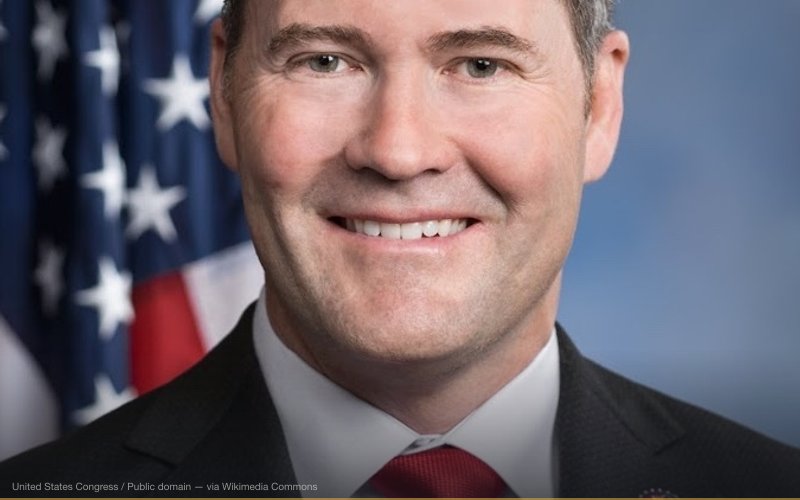
Frequently Asked Questions
What was the Signalgate scandal?
Did anyone face consequences for the Signalgate leak?
What classified information was shared in the Signal group chat?

Infographic
Share this visual summary. Right-click to save.