Skull and Bones Geronimo Skull Theft
Overview
In the annals of American conspiracy theories, few are as specific, as bizarre, and as stubbornly persistent as this one: In 1918, a group of young Army officers stationed at Fort Sill, Oklahoma — all members of Yale’s Skull and Bones secret society — dug up the grave of the legendary Apache leader Geronimo and spirited his skull, femurs, and riding gear back to New Haven, Connecticut. There, the story goes, Geronimo’s skull was installed in a glass case inside The Tomb, the windowless Skull and Bones headquarters on Yale’s campus, where it has remained for over a century as a trophy and ritual object.
The tale reads like Gothic fiction, but it refuses to go away. A letter from 1918 describes the grave robbery. Bonesmen have whispered about the skull for generations. Geronimo’s descendants have sued for its return. And the question of whether one of America’s most elite institutions is literally sitting on stolen Indigenous remains has become a microcosm of much larger questions about power, desecration, and the casual arrogance of American aristocracy.
Origins & History
Geronimo: From Warrior to Prisoner
Geronimo — born Goyahkla around 1829 — was an Apache medicine man and war leader who spent decades fighting Mexican and American forces across the Southwest. His resistance made him the most famous Native American of his era, a figure who appeared on the front pages of newspapers from New York to London. He surrendered for the final time in 1886 and was held as a prisoner of war for the remaining 23 years of his life.
By the early 1900s, Geronimo had become something of a celebrity prisoner — he appeared at the 1904 World’s Fair in St. Louis and rode in Theodore Roosevelt’s 1905 inaugural parade. He died on February 17, 1909, at Fort Sill, Oklahoma, after falling from his horse while drunk and lying in the cold overnight. He was buried in the Apache prisoner of war cemetery at the fort, beside other members of his band who had died in captivity.
The Alleged Theft
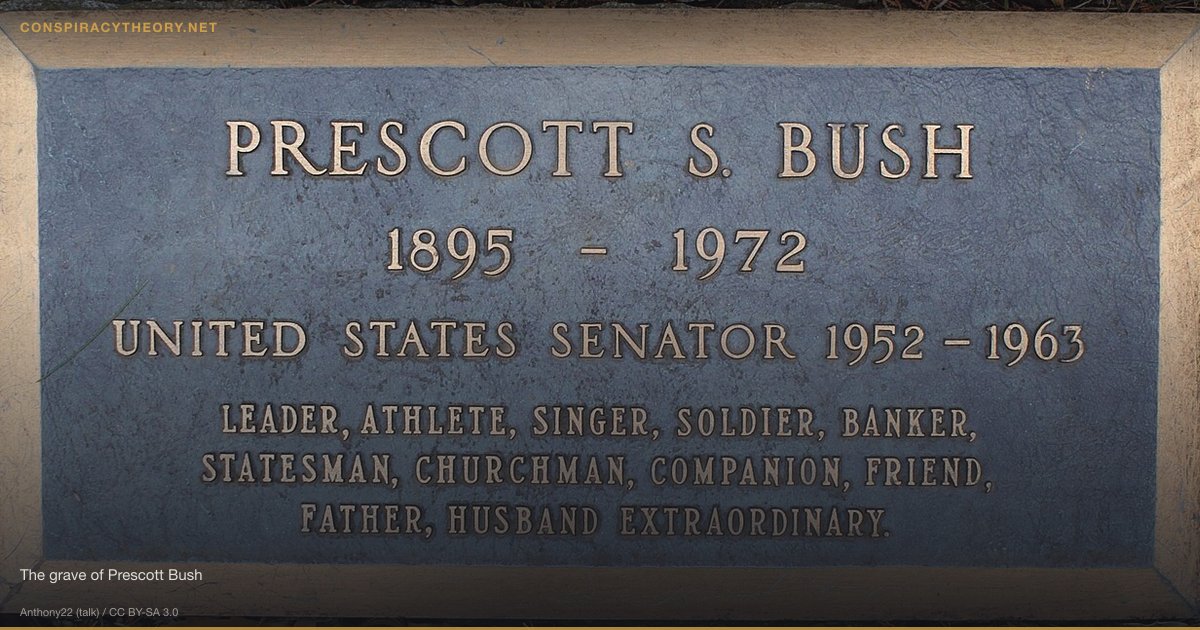
The grave robbery supposedly occurred in 1918, during World War I, when young men from privileged families were stationed at Fort Sill for artillery training before deployment to France. Among them, according to the theory, was Prescott Sheldon Bush — future U.S. Senator, father of President George H.W. Bush, and grandfather of President George W. Bush. Bush was a member of the Skull and Bones class of 1917.
The story goes that Bush and several fellow Bonesmen knew of Geronimo’s grave at Fort Sill and decided to acquire his remains as a prize for their society. Secret societies thrive on dramatic relics and initiation rituals, and what could be more dramatic than the skull of America’s most famous Native warrior?
The Letter
The key piece of documentary evidence is a letter from 1918, written by Winter Mead, a Bonesman stationed at Fort Sill. The letter, discovered by Yale historian Marc Wortman while researching in Skull and Bones archives, describes members of the society opening a grave and removing a skull, some bones, and horse tack. “The skull of the worthy Geronimo the Terrible, exhumed from its tomb at Fort Sill by your club,” the letter reportedly states, before describing the items displayed in The Tomb.
The letter’s existence was reported by Wortman and later confirmed by other researchers. Its authenticity as a document has not been seriously challenged. What is contested is whether the letter accurately describes the exhumation of Geronimo specifically, or whether the Bonesmen dug up someone else’s remains and attributed them to Geronimo for bragging rights — which, in its own way, would be almost worse.
The Internal Skull and Bones Account
According to Alexandra Robbins, who conducted extensive interviews with Bones members for her 2002 book Secrets of the Tomb, the story of Geronimo’s skull is well known within the society. Multiple members told her the skull was displayed in The Tomb, and it figured in certain rituals. However, one former member told Robbins that the skull was actually that of a young boy, not Geronimo.
In 2009, when Geronimo’s descendants filed a lawsuit, an internal investigation was reportedly conducted. According to leaks from that investigation, the society determined that whatever skull was in their possession was not actually Geronimo’s. This finding satisfied no one outside the society, since independent verification was not permitted.
Key Claims
- Prescott Bush and fellow Bonesmen robbed Geronimo’s grave at Fort Sill in 1918, removing the skull, femur bones, and personal effects
- Geronimo’s skull has been kept in The Tomb at Yale ever since, used as a ritual object during initiation ceremonies and displayed as a trophy
- The theft represents the broader pattern of powerful white institutions treating Indigenous peoples and their remains as collectible curiosities
- Skull and Bones has stonewalled all attempts to verify or return the remains, hiding behind institutional secrecy and legal maneuvers
- The Bush family’s connection to the theft adds a layer of dynastic power to the story, linking one of America’s most powerful political families to grave robbery
- An alternate version holds that the Bonesmen dug up a different grave entirely and merely claimed the skull was Geronimo’s, making the story about privileged dishonesty rather than successful desecration
Evidence
The Mead Letter
The 1918 letter from Winter Mead is the strongest single piece of evidence. It describes a grave being opened at Fort Sill and items being taken to The Tomb. The letter specifically names Geronimo. However, the letter could reflect genuine events, embellished events, or complete fabrication for internal society bragging. Secret societies are cultures of myth-making, and members regularly manufacture dramatic histories for their own rituals and traditions.
Oral Tradition Within Skull and Bones
Multiple former members have confirmed to journalists that a skull purported to be Geronimo’s exists in The Tomb. Former member Ron Rosenbaum wrote about Bones in a 2001 New York Observer piece and confirmed the skull story was common knowledge internally. The consistency of these accounts across decades of membership lends credibility.
The 2009 Lawsuit
In February 2009, Harlyn Geronimo — the Apache leader’s great-grandson — filed a federal lawsuit seeking the return of Geronimo’s remains. The suit named Skull and Bones, Yale University, the U.S. Army, the Department of the Interior, and President Barack Obama (as head of the federal government). The legal theory relied on the Native American Graves Protection and Repatriation Act (NAGPRA), which requires the return of Native remains held by institutions receiving federal funding.
Yale denied holding Geronimo’s remains. The case was ultimately dismissed on jurisdictional and procedural grounds without reaching the factual question. Fort Sill officials stated that they believed Geronimo’s remains were undisturbed in their original gravesite, but acknowledged that no forensic examination had been conducted to verify this.
The 2009 Bush Meeting
Before the lawsuit, in what has been described as an attempt at resolution, Skull and Bones representatives (including Neil Bush, Prescott Bush’s grandson) reportedly met with Harlyn Geronimo and offered to return a skull. Harlyn Geronimo rejected the offer, reportedly because the presented skull appeared to be that of a child rather than an adult male. This incident, widely reported at the time, deepened suspicion that whatever the society had in its possession was not what they claimed — and raised the question of where the child’s skull had come from.
What Remains Unknown
No independent party has been permitted to examine the contents of The Tomb. No forensic analysis has been conducted on the skull (or skulls) in Skull and Bones’ possession. No archaeological investigation of Geronimo’s Fort Sill gravesite has been undertaken to determine whether the remains are intact. Every avenue that could resolve the question definitively has been blocked by institutional secrecy, legal procedure, or military bureaucracy.
Cultural Impact
The Geronimo skull theft story has resonated far beyond the conspiracy theory community because it encapsulates several themes that run deep in American culture.
Colonial power dynamics: The image of privileged white Ivy Leaguers digging up a Native American leader’s remains for use as a party prop is so grotesque that it functions as a parable about American power relations regardless of whether it literally happened. That the alleged perpetrators went on to produce presidents of the United States only sharpens the point.
Repatriation politics: The case became a touchstone in the broader movement for Native American repatriation of remains and cultural artifacts. NAGPRA, passed in 1990, was designed precisely to address situations like this one, but the Geronimo case demonstrated the law’s limitations when confronting well-connected private institutions.
Bush dynasty scrutiny: The story has followed the Bush family through three generations of political life. During both George H.W. Bush’s and George W. Bush’s presidencies, the Geronimo skull story surfaced regularly in critical media coverage.
The name “Geronimo” in military culture: When Navy SEALs used “Geronimo” as the code name for Osama bin Laden during the 2011 raid that killed him, Native American groups protested the association of a revered Indigenous leader’s name with America’s most wanted terrorist. Some commentators linked this to the broader pattern of appropriation exemplified by the skull theft allegation.
In Popular Culture
- “Secrets of the Tomb” by Alexandra Robbins (2002) — Includes detailed reporting on the skull story based on interviews with Bones members
- “The Good Shepherd” (2006) — Robert De Niro’s film about the Yale-CIA connection includes Skull and Bones rituals that reference the collection of relics
- “America’s Secret Establishment” by Antony Sutton (1983) — Early treatment of the skull theft in the context of broader Bones conspiracy theories
- The 2009 lawsuit generated extensive media coverage in the New York Times, Washington Post, and Apache media outlets
- “Geronimo: His Own Story” (1906/1970) — While predating the skull controversy, S.M. Barrett’s autobiography of Geronimo provides essential context for understanding the Apache leader’s significance
Key Figures
- Geronimo (Goyahkla) (c. 1829-1909) — Apache medicine man and war leader whose remains are at the center of the controversy
- Prescott Bush (Bones 1917) — Alleged participant in the 1918 grave robbery; later U.S. Senator from Connecticut
- Winter Mead — Bonesman whose 1918 letter describes the grave robbery
- Harlyn Geronimo — Great-grandson of Geronimo who filed the 2009 lawsuit seeking return of the remains
- Marc Wortman — Yale historian who discovered the Mead letter in Skull and Bones archives
- Alexandra Robbins — Journalist whose book Secrets of the Tomb brought the story to a wide audience
- Neil Bush — Prescott Bush’s grandson who reportedly participated in the unsuccessful 2009 attempt to return a skull to the Geronimo family
Timeline
| Date | Event |
|---|---|
| c. 1829 | Geronimo (Goyahkla) born in present-day Arizona/New Mexico |
| 1886 | Geronimo surrenders for the last time; held as prisoner of war |
| February 17, 1909 | Geronimo dies at Fort Sill, Oklahoma; buried in Apache POW cemetery |
| 1917 | Prescott Bush initiated into Skull and Bones at Yale |
| 1918 | Bonesmen stationed at Fort Sill allegedly rob Geronimo’s grave; Winter Mead letter describes the event |
| 1983 | Antony Sutton discusses the skull theft in America’s Secret Establishment |
| 1986 | Apache tribal chairman Ned Anderson attempts to recover the skull; Skull and Bones allegedly shows him a skull and then denies the incident |
| 2002 | Alexandra Robbins publishes Secrets of the Tomb with detailed reporting on the skull story |
| 2006 | Marc Wortman discovers the 1918 Mead letter in Bones archives |
| 2009 | Harlyn Geronimo files federal lawsuit seeking return of remains |
| 2009 | Skull and Bones representatives meet with Geronimo family; offered skull rejected as belonging to a child |
| 2010 | Lawsuit dismissed on procedural grounds |
| 2011 | ”Geronimo” used as code name for Osama bin Laden in SEAL Team Six raid; Native American groups protest |
Sources & Further Reading
- Robbins, Alexandra. Secrets of the Tomb: Skull and Bones, the Ivy League, and the Hidden Paths of Power. Back Bay Books, 2002.
- Wortman, Marc. “The Skull and Bones Connection.” Yale Alumni Magazine, 2006.
- Sutton, Antony. America’s Secret Establishment. Trine Day, 1983.
- Geronimo v. Obama et al., No. 1:09-cv-00303 (D.D.C. 2009).
- Barrett, S.M. Geronimo: His Own Story. E.P. Dutton, 1906 (republished 1970).
- Rosenbaum, Ron. “At Skull and Bones, Bush’s Secret Club Initiates Ream Gore.” New York Observer, April 23, 2001.
- “Geronimo’s Heirs Sue Secret Yale Society Over His Skull.” The New York Times, February 19, 2009.
Related Theories
- Skull and Bones — CIA Domination — The broader theory of Bones influence over American intelligence
- Bohemian Grove — Another elite institution accused of maintaining dark rituals and outsized influence

Frequently Asked Questions
Did Prescott Bush really steal Geronimo's skull?
Where is Geronimo buried?
Have Geronimo's descendants tried to get the skull back?
What evidence exists for the skull theft?
Infographic
Share this visual summary. Right-click to save.
