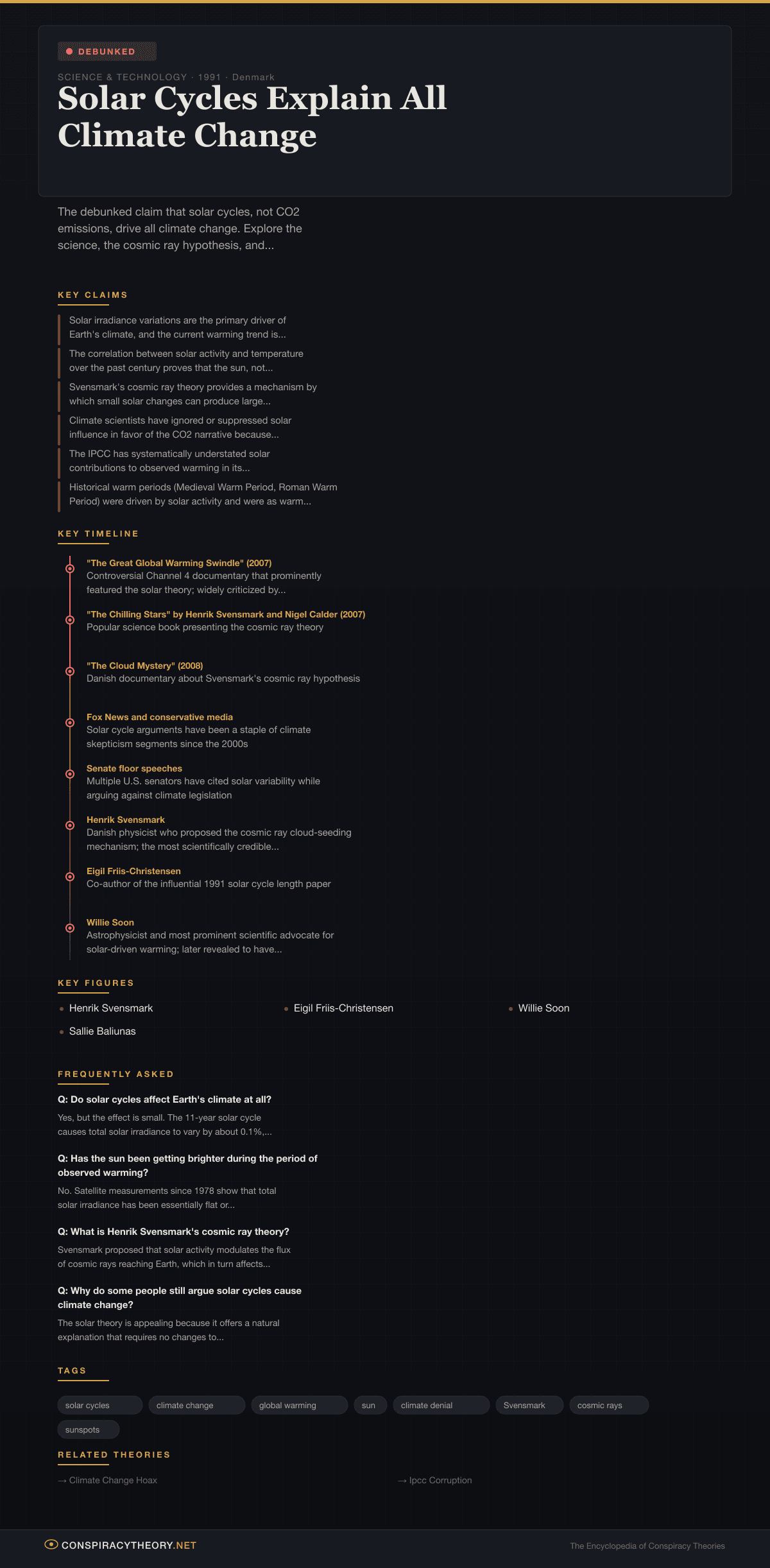
Solar Cycles Explain All Climate Change
Overview
The sun is a nuclear furnace that holds the entire solar system in its gravitational grip, drives weather patterns, and makes life on Earth possible. So it is not unreasonable — at first glance — to wonder whether changes in the sun’s energy output might explain the warming that climate scientists have been documenting for decades. The sun, after all, is the original climate driver. Maybe the recent warming is just the sun doing what it has always done.
This is the essence of the solar cycle theory of climate change: the claim that natural variations in solar activity — sunspot cycles, solar flares, changes in irradiance — are the primary driver of Earth’s warming, and that human CO2 emissions are either irrelevant or play a minor role. It is one of the most persistent arguments in climate change denial, in part because it sounds scientific and in part because it offers a narrative in which no one needs to change anything.
The problem is that the data comprehensively refute it. Since 1978, satellites have measured the sun’s energy output with extraordinary precision, and that output has been flat or slightly declining during the same period that global temperatures have risen sharply. The sun cannot be driving a warming trend it is not participating in.
Origins & History
The Real Science of Solar Influence
Scientists have studied the relationship between solar activity and Earth’s climate for centuries. The correlation between the Maunder Minimum — a period of very low sunspot activity from roughly 1645 to 1715 — and the coldest phase of the Little Ice Age in Europe has been noted since the 19th century. This real (if debated) historical correlation provides the kernel of truth from which the solar cycle theory grows.
Solar activity follows an approximately 11-year cycle, during which the number of sunspots increases and decreases. At solar maximum, the sun emits slightly more energy (about 0.1% more than at solar minimum). Longer-term “grand cycles” may produce larger variations over centuries. These variations do affect Earth’s climate — the question is how much.
Friis-Christensen and the 1991 Paper
The modern solar cycle argument took shape in 1991, when Danish physicists Eigil Friis-Christensen and Knud Lassen published a paper in Science showing a striking correlation between solar cycle length and Northern Hemisphere temperature over the period 1860-1990. The paper appeared to demonstrate that solar activity could explain most observed warming without invoking greenhouse gases.
The paper was influential but quickly challenged. Critics demonstrated that the correlation relied on selective data processing and that it broke down entirely when extended beyond 1990. As solar activity leveled off and then declined in the 2000s, temperatures continued to rise — destroying the correlation that had been the paper’s centerpiece.
Svensmark and Cosmic Rays
Danish physicist Henrik Svensmark proposed a more sophisticated mechanism in 1997. His theory: solar activity modulates the flux of galactic cosmic rays reaching Earth’s atmosphere. When the sun is active, its magnetic field deflects more cosmic rays; when it is quiet, more cosmic rays penetrate the atmosphere. Svensmark hypothesized that cosmic rays seed cloud formation — more cosmic rays mean more clouds, which reflect sunlight and cool the planet. Less solar activity, more clouds, more cooling. More solar activity, fewer clouds, more warming.
The theory was elegant and generated genuine scientific interest. It was testable, it proposed a physical mechanism (unlike the simple correlation papers), and it could potentially explain amplification of small solar irradiance changes into larger climate effects.
CERN’s CLOUD (Cosmics Leaving Outdoor Droplets) experiment, which ran from 2009 onward, was designed in part to test Svensmark’s hypothesis. The results were nuanced: cosmic rays do appear to enhance nucleation of aerosol particles in the atmosphere, but the effect is far too small to significantly influence cloud cover or climate at the scales Svensmark proposed. The CLOUD experiment confirmed the basic physics while refuting the climate significance.
The Fossil Fuel Connection
The solar cycle theory found enthusiastic promotion from organizations funded by the fossil fuel industry. Willie Soon, an astrophysicist at the Harvard-Smithsonian Center for Astrophysics, became the most prominent scientific advocate, publishing papers arguing that solar variability was the dominant climate driver. In 2015, investigative reporting revealed that Soon had received over $1.2 million from fossil fuel interests — including ExxonMobil, the Charles G. Koch Foundation, and Southern Company — and had failed to disclose these funding sources in his academic publications.
This did not technically invalidate Soon’s research, but it illustrated a pattern: the solar cycle theory was being amplified not because of its scientific merits but because of its utility to industries threatened by emissions regulation.
Key Claims
- Solar irradiance variations are the primary driver of Earth’s climate, and the current warming trend is a natural consequence of solar activity changes
- The correlation between solar activity and temperature over the past century proves that the sun, not CO2, controls climate
- Svensmark’s cosmic ray theory provides a mechanism by which small solar changes can produce large climate effects through cloud modulation
- Climate scientists have ignored or suppressed solar influence in favor of the CO2 narrative because greenhouse gas theories attract more research funding and political attention
- The IPCC has systematically understated solar contributions to observed warming in its assessment reports
- Historical warm periods (Medieval Warm Period, Roman Warm Period) were driven by solar activity and were as warm as or warmer than the present, meaning current temperatures are not unusual
Evidence
What the Solar Data Actually Show
The evidence against the solar explanation is overwhelming and comes primarily from direct measurement:
Satellite irradiance data (1978-present): NASA and ESA satellites have continuously measured total solar irradiance (TSI) for over four decades. The data show that TSI varies by approximately 1 watt per square meter over the 11-year solar cycle (out of a total of about 1,361 W/m2). Since the early 1980s, there has been no upward trend in TSI. The sun has not gotten brighter.
Temperature-solar divergence: From approximately 1980 onward, global temperatures and solar activity have moved in opposite directions. Temperatures have risen sharply while solar activity has remained flat or slightly declined. This divergence is the single most devastating piece of evidence against the solar theory. You cannot blame the sun for a warming trend that the sun is not producing.
Solar cycle 24 (2008-2019): This was the weakest solar cycle in a century. If the solar theory were correct, temperatures should have dropped significantly. Instead, the 2010s were the warmest decade in the instrumental record.
Stratospheric cooling: Greenhouse gas warming predicts that the troposphere (lower atmosphere) should warm while the stratosphere (upper atmosphere) should cool, because greenhouse gases trap heat below. Solar warming would warm both layers. Observations show tropospheric warming and stratospheric cooling — exactly what greenhouse theory predicts and exactly what solar theory does not.
What the Solar Theory Gets Right
Solar activity is not climatically irrelevant. The science does support modest solar influence:
- The 11-year solar cycle produces a measurable ~0.1 degrees C temperature oscillation
- Grand solar minima (like the Maunder Minimum) may contribute to regional cooling on the order of 0.1-0.3 degrees C
- UV variations associated with the solar cycle affect stratospheric ozone, which can influence atmospheric circulation patterns
These are real effects, documented by mainstream climate science. They are also small — an order of magnitude smaller than the warming attributed to greenhouse gases.
The Attribution Evidence
Modern climate science does not ignore solar influence — it quantifies it. The IPCC’s attribution analyses consistently find that solar forcing accounts for a small fraction of observed warming (roughly 0.1 degrees C out of 1.1+ degrees C total since pre-industrial times). The rest is overwhelmingly explained by greenhouse gas increases, with smaller contributions from aerosols, land use changes, and volcanic activity.
Cultural Impact
The solar cycle theory has served as one of the most effective tools in the climate denial arsenal because it has the appearance of scientific sophistication. Unlike cruder denial arguments (“the climate has always changed” or “scientists are making it up”), the solar theory invokes real physics, cites real data, and is promoted by credentialed scientists. It gives people who want to reject climate action an intellectual permission structure to do so.
The theory has been particularly effective in political contexts. U.S. Senator James Inhofe, who famously called climate change “the greatest hoax ever perpetrated on the American people,” cited solar variability as an alternative explanation. Republican policy platforms have referenced solar theories when arguing against emissions regulations.
The Svensmark version — with its testable mechanism and genuine (if ultimately insufficient) scientific interest — also illustrates how legitimate scientific inquiry can be appropriated by political movements. Svensmark himself has complained that his work was weaponized by denialists and that his actual scientific claims were more modest than what advocates made of them.
In Popular Culture
- “The Great Global Warming Swindle” (2007) — Controversial Channel 4 documentary that prominently featured the solar theory; widely criticized by scientists for misrepresenting data
- “The Chilling Stars” by Henrik Svensmark and Nigel Calder (2007) — Popular science book presenting the cosmic ray theory
- “The Cloud Mystery” (2008) — Danish documentary about Svensmark’s cosmic ray hypothesis
- Fox News and conservative media — Solar cycle arguments have been a staple of climate skepticism segments since the 2000s
- Senate floor speeches — Multiple U.S. senators have cited solar variability while arguing against climate legislation
Key Figures
- Henrik Svensmark — Danish physicist who proposed the cosmic ray cloud-seeding mechanism; the most scientifically credible figure associated with the solar theory
- Eigil Friis-Christensen — Co-author of the influential 1991 solar cycle length paper
- Willie Soon — Astrophysicist and most prominent scientific advocate for solar-driven warming; later revealed to have received extensive fossil fuel industry funding
- Sallie Baliunas — Harvard-Smithsonian astrophysicist who co-authored controversial papers with Soon arguing for solar dominance
- Nigel Calder — British science writer and former New Scientist editor who co-authored “The Chilling Stars” with Svensmark
Timeline
| Date | Event |
|---|---|
| 1801 | William Herschel suggests sunspot activity correlates with wheat prices |
| 1893 | E.W. Maunder identifies the period of low sunspot activity (1645-1715) now called the Maunder Minimum |
| 1978 | Satellite measurements of total solar irradiance begin |
| 1991 | Friis-Christensen and Lassen publish solar cycle length correlation paper in Science |
| 1997 | Henrik Svensmark publishes cosmic ray cloud-seeding hypothesis |
| 2003 | Soon and Baliunas publish controversial paper claiming Medieval Warm Period was warmer than present |
| 2007 | ”The Great Global Warming Swindle” documentary features solar theory prominently |
| 2009 | CERN CLOUD experiment begins testing cosmic ray nucleation hypothesis |
| 2011 | CLOUD results published; cosmic ray effect is real but climatically insignificant |
| 2015 | Investigation reveals Willie Soon received $1.2 million from fossil fuel interests |
| 2019 | Solar cycle 24 ends as weakest in a century; decade is warmest on record regardless |
| 2020s | Solar theory continues circulating on social media despite scientific refutation |
Sources & Further Reading
- Friis-Christensen, E. and K. Lassen. “Length of the Solar Cycle: An Indicator of Solar Activity Closely Associated with Climate.” Science 254 (1991): 698-700.
- Svensmark, Henrik and Eigil Friis-Christensen. “Variation of Cosmic Ray Flux and Global Cloud Coverage.” Journal of Atmospheric and Solar-Terrestrial Physics 59 (1997): 1225-1232.
- IPCC. Climate Change 2021: The Physical Science Basis. Chapter 7: The Earth’s Energy Budget, Climate Feedbacks and Climate Sensitivity.
- Lockwood, Mike and Claus Froehlich. “Recent Oppositely Directed Trends in Solar Climate Forcings and the Global Mean Surface Air Temperature.” Proceedings of the Royal Society A 463 (2007): 2447-2460.
- Kirkby, Jasper et al. “Role of Sulphuric Acid, Ammonia and Galactic Cosmic Rays in Atmospheric Aerosol Nucleation.” Nature 476 (2011): 429-433.
- Goldenberg, Suzanne. “Work of Prominent Climate Skeptic Was Funded by Energy Industry.” The Guardian, February 21, 2015.
- NASA Goddard Institute for Space Studies. Total Solar Irradiance Data.
Related Theories
- Climate Change Hoax — The broader conspiracy theory that climate change is fabricated
- IPCC Corruption — Claims that the IPCC manipulates science for political purposes
Frequently Asked Questions
Do solar cycles affect Earth's climate at all?
Has the sun been getting brighter during the period of observed warming?
What is Henrik Svensmark's cosmic ray theory?
Why do some people still argue solar cycles cause climate change?

Infographic
Share this visual summary. Right-click to save.