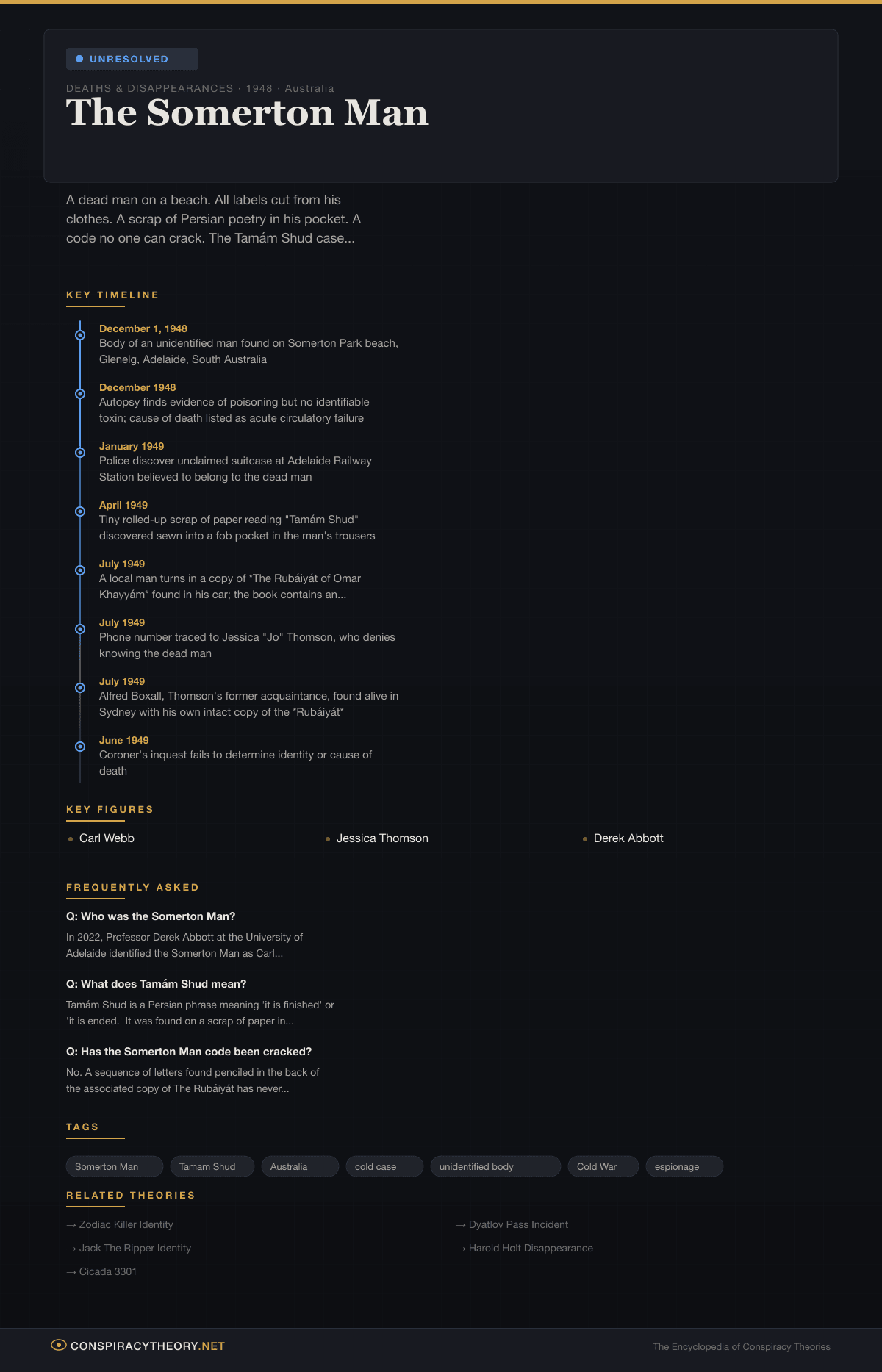
The Somerton Man
Overview
There’s a particular kind of mystery that refuses to die — not because it’s the most violent, or the most politically explosive, but because every single detail seems engineered to resist resolution. The death of the Somerton Man is that kind of mystery. A well-dressed, well-fed man of about forty shows up dead on an Adelaide beach on December 1, 1948, and in the seventy-eight years since, almost nothing about the case has gone the way you’d expect.
No identification. No cause of death. Every clothing label methodically removed. A scrap of paper in his fob pocket bearing two words in Persian — Tamám Shud, “it is finished” — torn from the final page of a twelfth-century poetry collection. A phone number that led to a woman who claimed she didn’t know him but nearly fainted when shown a plaster cast of his face. And a sequence of penciled letters in the back of a book that remains, to this day, one of the most stubbornly unsolvable codes in the history of cryptography.
In 2022, after decades of work, a University of Adelaide professor announced that DNA analysis had finally identified the dead man as Carl “Charles” Webb, a Melbourne electrical engineer. The announcement was a genuine breakthrough — and it solved almost nothing. Because the Somerton Man case was never really about who he was. It was about everything else: the removed labels, the untraceable poison, the code, the woman, and the eerie, theatrical precision of the whole affair, which has always carried the unmistakable scent of professional tradecraft.
The Body on the Beach
At around 6:30 on the morning of December 1, 1948, a pair of horseback riders noticed a man slumped against the seawall at Somerton Park beach, a quiet stretch of sand in the Adelaide suburb of Glenelg. They assumed he was a vagrant sleeping it off. An hour later, another couple spotted him. The man was lying with his head resting against the wall, his legs extended and crossed at the ankles, with an unlit cigarette resting on his collar — as if he’d been in the act of reaching for a match when something stopped him. His right arm was draped across his body. He looked, by all accounts, like a man who’d fallen asleep watching the sunrise.
He was dead.
Police arrived and found a man aged approximately forty to forty-five years old, of athletic build, roughly five feet eleven inches tall. He was clean-shaven, with ginger-brown hair and hazel eyes. His hands were soft — not the hands of a laborer — and his calf muscles were high-set and well-defined, a feature sometimes associated with dancers or runners. He was wearing a fashionable double-breasted suit, a knitted pullover, a white shirt, a red-and-blue tie, brown trousers, and polished brown shoes. All of his clothing was in good condition. He appeared well-nourished and well-cared-for.
And he was carrying absolutely no identification. Not a wallet. Not a driver’s license. Not a letter, a receipt, a ticket stub — nothing that any ordinary person in 1948 would have been carrying. His pockets contained a bus ticket from the city to Glenelg, an unused second-class rail ticket from Adelaide to the nearby town of Henley Beach, an aluminum American comb, a packet of Juicy Fruit chewing gum, a packet of Army Club cigarettes (which, oddly, contained seven Kensitas cigarettes — a different brand), and a half-empty box of Bryant & May matches.
Then there was the matter of the labels. Every single one had been removed from every piece of clothing on his body — cut out with what appeared to be deliberate care. Not torn. Not worn away. Removed. Shirt, trousers, pullover, jacket, tie, underwear, hat — all stripped of any identifying marks. In 1948, before the age of ubiquitous CCTV and digital records, clothing labels were one of the primary tools investigators used to trace a person’s identity. Someone had systematically eliminated that avenue.
This was not, in other words, a man who had wandered onto a beach and died of natural causes.
The Autopsy That Explained Nothing
The post-mortem examination was conducted by Dr. John Barkley Dwyer, a government pathologist, and what he found was perhaps the most maddening element of the entire case. The man’s organs showed clear signs of poisoning: his spleen was enlarged to roughly three times its normal size, his liver was congested and distended, blood had pooled in his stomach, and there was evidence of acute gastric hemorrhage. His heart was in normal condition. The small blood vessels in his brain were congested.
All of this pointed emphatically toward poisoning. But when toxicological tests were run, they found nothing. No known poison. No drug. No alcohol. No substance that would explain the pathology they were seeing.
Dr. Dwyer’s official finding was that the man had died from “acute circulatory failure,” which is a medical way of saying his heart stopped and they couldn’t determine why. In his personal assessment, Dwyer believed the man had been poisoned by a barbiturate or a soluble hypnotic — a drug that would have metabolized and disappeared from the body before analysis could detect it. Some researchers have since pointed to digitalis, a heart medication derived from foxglove that, in 1948, would have been virtually undetectable in an autopsy. Others have suggested a rare organophosphate compound, the kind of thing that intelligence agencies were very much experimenting with in the early Cold War.
The coroner’s inquest was equally inconclusive. “I am unable to say who the deceased was,” the coroner stated. “I am unable to say how he died or what was the cause of death.” This remains one of the only cases in modern Australian legal history where neither the identity nor the cause of death of a deceased person could be established.
Tamám Shud: The Scrap in the Pocket
The body was embalmed and held for months as police attempted to establish an identity. They tried everything: fingerprint databases across Australia and internationally, dental records, missing persons reports, port and immigration records, military service files. Nothing matched. Nobody, anywhere, was looking for this man.
It wasn’t until April 1949, during a more thorough examination of the body’s clothing, that a tiny rolled-up scrap of paper was discovered sewn into a fob pocket in the man’s trousers — a pocket within a pocket that had been overlooked during the initial search. On the paper, printed in an ornate font, were two words: Tamám Shud.
The phrase is Persian. It translates roughly as “it is finished” or “it is ended.” It appears as the last two words in the Rubáiyát of Omar Khayyám, a collection of medieval Persian quatrains about mortality, fate, the fleeting nature of existence, and the wisdom of seizing pleasure while you can. In Edward FitzGerald’s famous English translation — the most widely circulated version in the English-speaking world — the final verse reads:
And when Thyself with shining Foot shall pass Among the Guests Star-scatter’d on the Grass, And in thy joyous Errand reach the Spot Where I made one — turn down an empty Glass!
It is, unmistakably, a poem about death. And someone had torn the final words from the final page and placed them in the dead man’s clothing.
The paper was identified by experts as having been torn — not cut — from a specific edition of the Rubáiyát, a small hardcover published by Whitcombe & Tombs, a New Zealand publisher. This was a relatively uncommon edition, and police launched a public appeal to find the book it had been torn from.
The Code That Nobody Can Read
In July 1949, a man came forward. He reported that several months earlier — around the time of the Somerton Man’s death — he had found a copy of the Rubáiyát of Omar Khayyám on the back seat of his unlocked car, which had been parked on Jetty Road in Glenelg, just a few hundred meters from where the body was found. He had tossed it in his glove compartment and forgotten about it. When the police appeal jogged his memory, he turned it in.
The book was the correct edition — Whitcombe & Tombs — and the final page had been torn. The scrap in the dead man’s pocket matched perfectly.
But the book held something else. On the inside back cover, detectives found faint pencil markings — a sequence of capital letters arranged in five lines, apparently written and partially erased:
WRGOABABD
MLIAOI
WTBIMPANETP
MLIABOAIAQC
ITTMTSAMSTGAB
The second line appeared to have been crossed out. Some letters remain ambiguous to this day — the handwriting was faint, and experts have disagreed on whether certain characters are Q’s or O’s, M’s or W’s.
Police sent the code to the Australian military’s cipher bureau, to naval intelligence, and eventually to the British Government Code and Cipher School (the successors to the Bletchley Park codebreakers who had cracked Enigma). None of them could make sense of it. The sequence was too short for statistical analysis, and without a key — or any context — it could be virtually anything: a cipher, a mnemonic, the first letters of a memorized poem, a one-time pad encryption, or something else entirely.
In the decades since, the code has been analyzed by professional cryptographers, computer scientists, linguists, and hundreds of amateur enthusiasts. Nobody has cracked it. The Australian Broadcasting Corporation once ran a nationwide challenge. Various academics have proposed partial solutions. None have been accepted by the broader research community.
There was also a phone number. Written in pencil on the back of the book was a local Adelaide telephone number. When police traced it, it led them to a young nurse living at a house on Moseley Street in Glenelg — less than four hundred meters from where the body was found.
Her name was Jessica Ellen Thomson.
The Woman Who Knew Nothing
Thomson — known as “Jestyn” in early police reports, a pseudonym derived from an inscription in the book — was twenty-seven years old, recently married, and appeared to be living a perfectly ordinary life in suburban Adelaide. When police knocked on her door and showed her a plaster bust of the dead man’s face, she became, according to the detective present, visibly distressed. She seemed on the verge of fainting.
And then she said she had no idea who he was.
Thomson told police she had once owned a copy of the Rubáiyát of Omar Khayyám — the same Whitcombe & Tombs edition — and that she had given it to a man named Alfred Boxall, a former army lieutenant she’d met during the Second World War. She’d inscribed it with the name “Jestyn,” which was a private pet name. The implication was obvious: the dead man was Boxall.
Except he wasn’t. Police tracked down Alfred Boxall, and he was alive, well, and living in Sydney. He still had his copy of the Rubáiyát. It was intact — no torn pages.
So there were two copies of this relatively uncommon book. One given by Thomson to Boxall. Another — found in a car near the beach where a dead man was found with the torn final page in his pocket and Thomson’s phone number penciled inside.
Thomson maintained for the rest of her life that she did not know the Somerton Man. She asked police to keep her identity confidential, and they honored her request for decades. She refused all media interviews. When her daughter Kate Thomson was asked years later about the case, she reported that her mother had, on one occasion, told her the dead man’s identity — and then made her swear never to reveal it.
“She said it on her deathbed,” Kate told a television interviewer. “And she said, ‘He’s known to a level higher than the police.’”
Jessica Thomson died in 2007. She took whatever she knew with her.
Robin Thomson and the Genetic Ghost
Then there’s the matter of Robin Thomson, Jessica’s son, born in July 1947 — about a year and a half before the Somerton Man turned up dead.
Robin Thomson had two extremely rare physical traits. His upper lateral incisors were congenitally absent — meaning he was born missing a pair of teeth that most humans have. And he had a condition called cymba, a particular shape of the ear canal where the upper hollow is larger than the lower, which occurs in only about one to two percent of the Caucasian population. When a photograph of the Somerton Man’s ear was analyzed, he appeared to have the same feature. And his teeth, photographed during autopsy, showed the same congenital absence of the upper lateral incisors.
The probability of two unrelated individuals sharing both of these rare traits is exceptionally low. The implication was hard to ignore: the Somerton Man might have been Robin Thomson’s biological father.
Robin Thomson grew up to become a ballet dancer — which some have noted could explain the dead man’s distinctive high-set calf muscles. He died in 2009, at the age of sixty-three, of no publicly disclosed cause. His wife found him dead in a hallway.
Professor Derek Abbott, the University of Adelaide researcher who would eventually identify the Somerton Man, actually married Rachel Egan — Robin Thomson’s daughter. Abbott had been investigating the case since 2009, and his relationship with Egan began through the research. The connection has been noted by skeptics, but Abbott has been transparent about it, and his scientific methodology has been reviewed by independent experts.
Carl Webb: A Name After Seventy-Four Years
In 2021, South Australian police exhumed the Somerton Man’s body from West Terrace Cemetery in Adelaide. The remains were in poor condition — the original 1948 embalming had preserved some tissues, but decades underground had taken their toll. DNA was extracted from hairs found attached to the death mask and from material recovered during the exhumation.
Professor Abbott, working with American genealogist Colleen Fitzpatrick — a pioneer in forensic genealogy who had helped identify victims of 9/11 — used the DNA to build a family tree through public genealogical databases. In July 2022, Abbott announced that the Somerton Man was almost certainly Carl “Charles” Webb, born in 1905 in Footscray, a suburb of Melbourne.
Webb was an electrical engineer and instrument maker. He had married a woman named Dorothy Robertson in 1941; the marriage appears to have dissolved by the mid-1940s, though no formal divorce record has been found. He had no known children. He vanished from public records sometime in the mid-1940s — no employment records, no tax filings, no electoral roll appearances, nothing. He simply stopped existing on paper several years before his body appeared on that Adelaide beach.
The identification, if correct, raises as many questions as it answers. Why would an electrical engineer from Melbourne travel to Adelaide, strip all the labels from his clothing, and die on a beach with a scrap of Persian poetry in his pocket? How did he know Jessica Thomson, whose phone number was in the book found in the nearby car? What was his relationship to her — and was he really Robin’s father? And how, exactly, did he die?
Abbott has noted that Webb’s occupation — electrical engineer and instrument maker — would have been a potentially useful cover for intelligence work in the early Cold War period. But that’s speculation, and Abbott is careful to label it as such.
The Espionage Theory
The intelligence angle has haunted the Somerton Man case from the beginning, and it’s easy to see why. In December 1948, Australia was deep in the early Cold War. Soviet espionage networks were actively operating on Australian soil, and they would be spectacularly exposed the following year when the Venona decryptions — a top-secret Allied program to decode Soviet diplomatic cables — began yielding names.
Several elements of the case map neatly onto intelligence tradecraft:
The removed labels. Stripping identifying markers from clothing is a classic technique for making a body harder to trace. It’s taught in espionage training programs. Ordinary people do not do this.
The undetectable poison. Intelligence agencies in the late 1940s were actively developing poisons that would be difficult or impossible to detect in an autopsy. The CIA’s Technical Services Division and its Soviet counterpart were both working on exactly this problem. The symptoms described by the pathologist — acute circulatory failure with evidence of poisoning but no identifiable toxin — are consistent with the kind of sophisticated compound a state actor might employ.
The code. One-time pads and first-letter encryption systems were standard tools of Cold War espionage. The letter sequence in the book, if it is a one-time pad cipher, would be essentially unbreakable without the corresponding pad — which is exactly the point.
Jessica Thomson. Gwendolyn Dorothy “Jo” Thomson’s background has been the subject of intense speculation. Some researchers have pointed out that she was studying Russian at the University of Adelaide at a time when almost nobody in Australia studied Russian, and that she had connections to several individuals who were later identified as having links to Soviet intelligence networks in Australia. Thomson’s first husband, Prosper Thomson, had served in Army Intelligence during the war.
The Rubáiyát. Some intelligence historians have noted that copies of the Rubáiyát were used by at least one known espionage network as a key for encoding messages. The existence of two copies of the same rare edition — one given to Boxall, another found near the body — could indicate a spy ring using the book as a shared cipher key.
The suitcase. Police eventually traced an unclaimed suitcase at the Adelaide Railway Station that appeared to belong to the dead man. Inside were clothes — also with labels removed — a screwdriver, a stenciling brush (used for applying identification marks to equipment), and a knife. The stenciling brush is a particularly odd item for a civilian to carry, but a natural one for someone involved in covert logistics.
None of this constitutes proof. But the constellation of details — the removed labels, the untraceable poison, the unbreakable code, the connections to a woman with possible intelligence ties, the deliberate anonymization of the body — forms a pattern that is deeply suggestive of professional covert operations.
The Love Triangle
Not everyone buys the spy theory. A simpler, more human explanation has always existed alongside it: Carl Webb traveled to Adelaide, went to the home of a woman he had some relationship with — possibly the mother of his child — was rejected, and killed himself.
The Rubáiyát is, after all, a poem about the transience of life and love. Tamám Shud — “it is finished” — reads like a suicide note. The positioning of the body, calm and composed against the seawall, suggests a man who sat down and waited to die, not one who was attacked. The crossed legs, the unlit cigarette — there’s an almost theatrical peacefulness to the scene that speaks more to a deliberate exit than a murder.
Under this theory, Webb was a man whose marriage had failed, who had traveled to Adelaide to see a woman (Thomson) who wanted nothing to do with him, and who chose to end his life on the beach near her home. He removed his own clothing labels — either because he wanted to make identification difficult, or because he was a man with a theatrical streak who wanted to die as a mystery.
The problem with this theory is the poison. If Webb killed himself, he did so with a substance that was completely undetectable in 1948 forensic analysis. Ordinary suicides don’t have access to that kind of pharmacology. You might argue that an electrical engineer with chemical knowledge could have synthesized something exotic, but that’s a stretch, and it pushes the theory back toward the intelligence angle — because the people who do have access to undetectable poisons tend to work for governments.
The Code Endures
Since the 1940s, the code has been subjected to every form of analysis that cryptography, linguistics, and computing can bring to bear. Some findings of note:
Professor Abbott’s team at the University of Adelaide performed statistical analysis on the letter frequencies and found patterns inconsistent with random selection but also inconsistent with any known cipher system. The letters appear to be deliberately chosen, but the principle of their selection remains opaque.
In 2014, a retired Australian police detective named Gerry Feltus — who had spent years investigating the case — suggested the letters might be the initials of an English-language text, possibly a poem or prayer that held personal significance to the dead man. Under this theory, each letter represents the first letter of a word in a memorized passage. If so, the code is effectively uncrackable without knowing the original text.
Others have suggested the sequence is a one-time pad cipher, which by design is mathematically unbreakable without the key. If the key was destroyed — or was written on another page of the Rubáiyát that was torn out and discarded — then the code is lost forever.
A 2023 machine-learning analysis by researchers at Flinders University found statistical evidence that the letter sequence may encode a message in English, but could not recover the plaintext without additional information. The authors noted that the sequence’s brevity makes definitive analysis virtually impossible.
The code remains, in the assessment of most serious cryptographers, effectively insoluble without new physical evidence.
The 2021 Exhumation and Its Aftermath
The decision to exhume the Somerton Man in May 2021 was the culmination of years of lobbying by Professor Abbott and others who believed that modern forensic technology — specifically DNA analysis and forensic genealogy — could finally establish the man’s identity.
The exhumation was authorized by South Australia’s Attorney General and conducted under strict forensic protocols. The body, buried in 1949 in an unmarked grave at West Terrace Cemetery, was recovered along with soil samples and material from the coffin. The original embalming — a formaldehyde-based process — had preserved some biological material, though the quality was variable.
Abbott’s team extracted usable DNA and, working with Fitzpatrick’s genealogical expertise, built a family tree using public databases including Ancestry.com and GEDmatch. The trail led to the Webb family of Footscray. Carl Webb’s marriage record, physical description, and timeline all matched the known facts about the Somerton Man.
South Australia Police have been circumspect about the identification. As of early 2026, they have not officially confirmed or denied Abbott’s finding, stating only that the investigation remains open. The reluctance likely reflects the fact that DNA-based genealogical identification, while powerful, requires independent corroboration to meet legal standards — and many of the records that might corroborate Webb’s identity have been lost or destroyed in the intervening decades.
Why It Still Matters
The Somerton Man case has inspired novels, documentaries, academic papers, university courses, a ballet, and at least one marriage (Abbott and Egan). It is, by any measure, one of the great unsolved mysteries of the twentieth century — not because of its body count (one) or its political significance (uncertain), but because of its sheer, perverse elegance.
Every element of the case seems designed to tantalize. The torn page. The code. The beautiful nurse. The rare genetic anomaly linking the dead man to her son. The second copy of the same obscure book. The poison that leaves no trace. It reads less like a real crime and more like a puzzle constructed by someone who wanted it to be insoluble — who wanted to die as a question mark, a permanent gap in the record.
If Webb was a spy, the case is a window into the invisible war that was being fought across the Pacific in the earliest days of the Cold War — a war whose casualties were designed to be unidentifiable, whose methods were designed to be undetectable, and whose secrets were designed to outlast everyone involved.
If he was a heartbroken man who killed himself on a beach near the home of a woman who didn’t want him, the case is something else entirely — a monument to the human capacity for theatrical despair, for turning death itself into a performance.
Either way, the Somerton Man got what he seems to have wanted. Nearly eight decades later, the words in his pocket still echo: Tamám Shud. It is finished.
Except, of course, it isn’t.
Timeline
- December 1, 1948 — Body of an unidentified man found on Somerton Park beach, Glenelg, Adelaide, South Australia
- December 1948 — Autopsy finds evidence of poisoning but no identifiable toxin; cause of death listed as acute circulatory failure
- January 1949 — Police discover unclaimed suitcase at Adelaide Railway Station believed to belong to the dead man
- April 1949 — Tiny rolled-up scrap of paper reading “Tamám Shud” discovered sewn into a fob pocket in the man’s trousers
- July 1949 — A local man turns in a copy of The Rubáiyát of Omar Khayyám found in his car; the book contains an uncracked code and a phone number
- July 1949 — Phone number traced to Jessica “Jo” Thomson, who denies knowing the dead man
- July 1949 — Alfred Boxall, Thomson’s former acquaintance, found alive in Sydney with his own intact copy of the Rubáiyát
- June 1949 — Coroner’s inquest fails to determine identity or cause of death
- June 14, 1949 — The Somerton Man is buried in an unmarked grave at West Terrace Cemetery, Adelaide
- 1978 — Case reopened briefly by South Australian police; no new findings
- 1995 — Retired detective Gerry Feltus begins his decades-long investigation of the case
- 2009 — Professor Derek Abbott at the University of Adelaide begins formal academic research into the case
- 2009 — Robin Thomson, Jessica’s son, dies at age 63
- 2013 — Abbott’s team identifies the rare ear and dental anomalies shared by the Somerton Man and Robin Thomson
- May 2021 — The Somerton Man’s body is exhumed from West Terrace Cemetery for DNA analysis
- July 2022 — Abbott and genealogist Colleen Fitzpatrick announce the Somerton Man has been identified as Carl “Charles” Webb, an electrical engineer from Melbourne
- 2023 — Machine-learning analysis at Flinders University finds statistical evidence the code may encode an English message but cannot crack it
- Present — South Australia Police have not officially confirmed the identification; cause of death remains undetermined
Sources & Further Reading
- Feltus, G.M. The Unknown Man: A Suspicious Death at Somerton Beach. Melbourne Books, 2010.
- Abbott, Derek. “The Somerton Man Mystery.” University of Adelaide research page.
- Dash, Mike. “The Body on Somerton Beach.” Smithsonian Magazine, August 2011.
- “The Somerton Man: DNA may have finally identified the ‘most mysterious man in the world.’” The Guardian, July 2022.
- Fitzpatrick, Colleen and Derek Abbott. “Forensic genealogy identifies the Somerton Man.” Forensic Science International: Genetics, 2023.
- Australian Broadcasting Corporation. “The Somerton Man.” Australian Story, 2014.
- Norman, Paul. Rebáiyát of Omar Khayyám: The Connection to the Somerton Man Case. Self-published, 2018.
- Cramer, John. “The Taman Shud Case.” Journal of the Royal Australian Historical Society, 1985.
- South Australia Police Cold Case Unit. Case File 1/48 (restricted access).
Related Theories
The Somerton Man case shares DNA — sometimes literally — with other mysteries built on unidentified individuals, uncrackable codes, and deaths that refuse to be explained. For more cases where the identity or circumstances of death remain contested, see the Zodiac Killer investigation, the Dyatlov Pass Incident, and Jack the Ripper. For another famous Australian disappearance that has attracted espionage theories, see the case of Prime Minister Harold Holt. And for another famously unsolvable code that has consumed the internet, see Cicada 3301.
Frequently Asked Questions
Who was the Somerton Man?
What does Tamám Shud mean?
Has the Somerton Man code been cracked?
Infographic
Share this visual summary. Right-click to save.