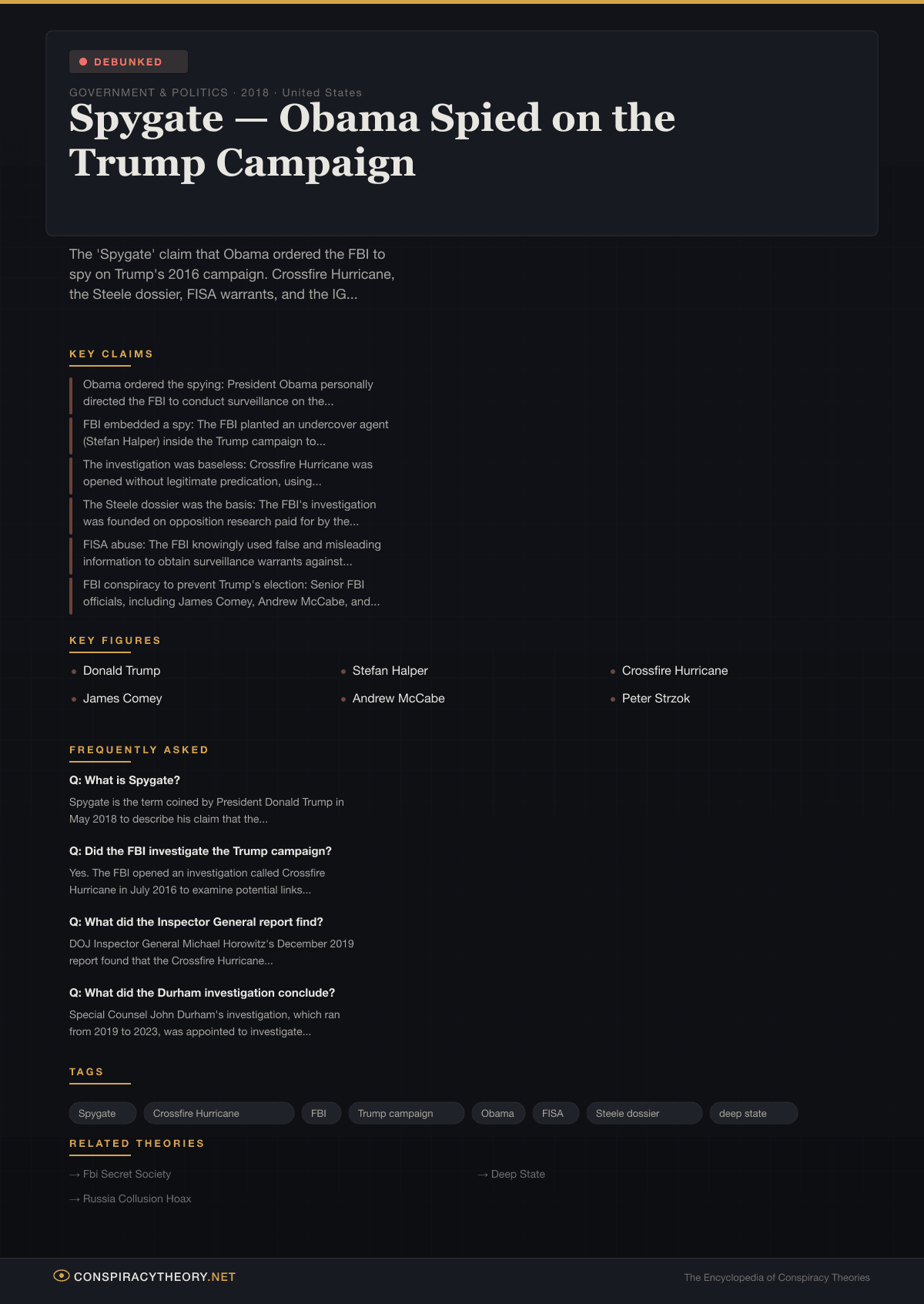
Spygate — Obama Spied on the Trump Campaign
Overview
On May 23, 2018, President Donald Trump fired off a tweet that coined a term: “SPYGATE could be one of the biggest political scandals in history!” The claim was simple and explosive: President Barack Obama had ordered the FBI to embed a spy inside Trump’s 2016 presidential campaign, using the fabricated pretext of Russian collusion to conduct political surveillance on behalf of the Democratic Party. The investigation — known internally as Crossfire Hurricane — was not a legitimate national security inquiry but a politically motivated “witch hunt” designed to prevent, and then undermine, Trump’s presidency.
The allegation electrified Trump’s base and consumed American politics for years. It spawned congressional investigations, a Special Counsel appointment, a 434-page Inspector General report, and a separate three-year investigation by Special Counsel John Durham. The total cost of investigating the investigation ran into tens of millions of dollars.
The results were consistent across every investigation: the FBI’s inquiry into Trump campaign contacts with Russia was properly predicated, no political bias influenced the decision to open it, and no evidence supported the claim that Obama ordered political spying. At the same time, the investigations revealed genuine problems — 17 significant errors in FISA warrant applications, an FBI lawyer who altered a document, and institutional failures that compromised the investigation’s integrity. The truth, as it often does, fell between the conspiracy theory and the official narrative.
This article is classified as debunked because the central claim — that Obama personally ordered political espionage against the Trump campaign — was investigated by Trump’s own Justice Department and found to be unsupported by evidence. The FBI’s investigation had legitimate predication, and no spy was “planted” in the campaign. However, the FBI’s serious procedural failures are documented facts, not conspiracy.
Origins & History
Crossfire Hurricane
The FBI investigation that became the Spygate controversy began on July 31, 2016, when the Bureau opened a counterintelligence investigation designated Crossfire Hurricane. The trigger was specific and documented: on May 10, 2016, George Papadopoulos, a foreign policy advisor to the Trump campaign, told Alexander Downer, the Australian High Commissioner to the United Kingdom, at a London bar that Russia had “dirt” on Hillary Clinton in the form of thousands of emails. When WikiLeaks began releasing stolen Democratic National Committee emails in July 2016, the Australian government relayed Downer’s account to the FBI through official intelligence channels.
The Inspector General’s report later confirmed that this information — not the Steele dossier, not political direction from the Obama White House — was the basis for opening Crossfire Hurricane. The investigation initially focused on four individuals associated with the Trump campaign: Papadopoulos, Carter Page, Paul Manafort, and Michael Flynn.
Stefan Halper and the “Spy” Question
The individual at the center of the Spygate allegation was Stefan Halper, a Cambridge University academic with a decades-long history as an asset for US intelligence agencies. In the summer and fall of 2016, Halper had several meetings and conversations with Carter Page and George Papadopoulos, during which he asked questions about the campaign’s connections to Russia.
Halper was what the intelligence community calls a “confidential human source” (CHS) — an individual who provides information to intelligence agencies, often by cultivating relationships with targets. The use of CHSs is a standard and legally authorized intelligence-gathering technique.
The Spygate narrative characterized Halper as a “spy planted inside the Trump campaign.” This framing was misleading in several respects. Halper was not embedded within the campaign; he met with campaign associates in academic and social settings outside campaign operations. He was not a new asset deployed specifically for Crossfire Hurricane; he had been an intelligence source for years. And his deployment was not ordered by Obama; it was an operational decision made within the FBI’s counterintelligence division.
The distinction between “the FBI used a longtime intelligence source to assess potential foreign intelligence threats to a presidential campaign” and “Obama planted a spy inside Trump’s campaign” is the gap between investigative fact and conspiracy theory.
The Steele Dossier
The role of the Steele dossier in the investigation became another major node of the Spygate narrative. The dossier was a series of intelligence reports compiled by Christopher Steele, a former MI6 officer, commissioned by the opposition research firm Fusion GPS, which was in turn retained by the law firm Perkins Coie on behalf of the Hillary Clinton campaign and the Democratic National Committee.
The dossier alleged extensive connections between the Trump campaign and the Russian government, including the most sensational claim — an alleged compromising video of Trump in a Moscow hotel. Many of the dossier’s specific claims were never verified, and some were subsequently debunked.
The dossier’s significance to the Spygate narrative was twofold. First, Spygate proponents argued that the dossier was the real basis for the FBI investigation, meaning the probe was founded on opposition research funded by the Clinton campaign. The Inspector General’s report found this was not the case — Crossfire Hurricane was opened based on the Australian intelligence, not the dossier. However, the dossier did play a significant role in the FBI’s applications for FISA surveillance warrants against Carter Page.
Second, the FBI’s reliance on the dossier in its FISA applications — without fully disclosing the dossier’s political provenance or the limitations of its sourcing — became the investigation’s most legitimate scandal. The Inspector General found 17 significant errors and omissions in the FISA applications, including failures to disclose information that undermined the dossier’s reliability. This was not a conspiracy but an institutional failure — and a serious one.
The Nunes Memo and the Page FISA Warrants
In February 2018, the House Intelligence Committee, then chaired by Republican Devin Nunes, released a memo alleging that the FBI’s FISA warrant application against Carter Page was based primarily on the Steele dossier and that the FBI had failed to disclose the dossier’s political origins to the FISA court. Democrats on the committee released a counter-memo arguing that the Nunes memo was misleading and that the FBI had provided adequate context to the court.
The Inspector General’s subsequent investigation largely vindicated elements of both memos while finding that the full picture was worse than either side had described. The FISA applications did rely significantly on the dossier, the FBI did fail to disclose important information about the dossier’s limitations, and the 17 errors and omissions identified by the IG represented a systemic failure that went beyond any single individual or political motivation.
The Strzok-Page Texts
Another pillar of the Spygate narrative was the discovery of text messages between FBI agent Peter Strzok and FBI lawyer Lisa Page (no relation to Carter Page), who were having an affair. The texts included messages critical of Trump, including one in which Strzok wrote, “We’ll stop it” in apparent reference to Trump’s election. Strzok was a senior agent on both the Clinton email investigation and Crossfire Hurricane, making his apparent political bias a legitimate concern.
The Inspector General investigated whether Strzok’s bias affected his investigative decisions and found that while the texts were “deeply concerning,” there was no evidence that his political views influenced specific investigative steps. Strzok was removed from the Mueller investigation when the texts were discovered and was subsequently fired from the FBI.
The Durham Investigation
In May 2019, Attorney General William Barr appointed US Attorney John Durham as Special Counsel to investigate the origins of Crossfire Hurricane. The investigation was widely expected, by Trump and his allies, to produce indictments against senior FBI and Obama administration officials.
After four years, Durham’s investigation produced one guilty plea (FBI lawyer Kevin Clinesmith, who altered an email used in a FISA warrant application), two acquittals at trial (Steele source Igor Danchenko and Clinton campaign lawyer Michael Sussmann), and a final report released in May 2023. The report criticized the FBI’s handling of Crossfire Hurricane, arguing that the investigation should never have been opened as a full investigation and that the Bureau applied a lower threshold of evidence than it would have for other subjects. However, the report did not find evidence that the investigation was opened at Obama’s direction, that it was politically motivated at its inception, or that a spy was planted in the Trump campaign.
The Durham investigation’s outcome was, for Spygate believers, deeply anticlimactic. The headline-grabbing indictments of senior officials never materialized. The two cases brought to trial resulted in acquittals. The final report’s criticisms of the FBI, while significant, fell far short of the conspiracy Trump had described.
Key Claims
- Obama ordered the spying: President Obama personally directed the FBI to conduct surveillance on the Trump campaign for political purposes
- FBI embedded a spy: The FBI planted an undercover agent (Stefan Halper) inside the Trump campaign to gather political intelligence
- The investigation was baseless: Crossfire Hurricane was opened without legitimate predication, using fabricated intelligence as a pretext
- The Steele dossier was the basis: The FBI’s investigation was founded on opposition research paid for by the Clinton campaign
- FISA abuse: The FBI knowingly used false and misleading information to obtain surveillance warrants against Carter Page
- FBI conspiracy to prevent Trump’s election: Senior FBI officials, including James Comey, Andrew McCabe, and Peter Strzok, conspired to prevent Trump from winning the 2016 election and, failing that, to remove him from office
Evidence & Debunking
What Was Debunked
Obama ordered the spying: No evidence supports this claim. Neither the Inspector General, nor the Durham investigation, nor congressional investigations found evidence that Obama personally directed the FBI to investigate the Trump campaign. The investigation was opened by FBI counterintelligence officials based on intelligence from Australia.
FBI planted a spy inside the campaign: Stefan Halper was not embedded within the campaign. He met with campaign associates in external settings. The Inspector General found that his deployment was consistent with standard FBI investigative practices for counterintelligence cases.
The investigation was baseless: The Inspector General explicitly found that the investigation was properly predicated. The Australian intelligence regarding Papadopoulos provided a legitimate basis for a counterintelligence inquiry.
FBI conspiracy to prevent Trump’s election: The Inspector General found no evidence of a coordinated conspiracy among FBI leadership to prevent Trump’s election. While individual officials expressed political opinions, no evidence linked those opinions to specific investigative decisions.
What Was Confirmed
FISA warrant problems were real: The 17 errors and omissions in the FISA applications against Carter Page were genuine and serious. An FBI lawyer did alter a document. The FBI did fail to disclose information that undermined the Steele dossier’s reliability. The FISA court subsequently found that at least two of the four warrants against Page lacked sufficient basis.
The Steele dossier was unreliable: The dossier’s most significant claims were never verified, and some were contradicted by subsequent investigation. The FBI’s continued reliance on the dossier despite growing doubts about its sourcing was a legitimate failure.
Individual bias existed: Peter Strzok’s text messages demonstrated political bias that was incompatible with his role in a sensitive investigation, even if that bias did not demonstrably affect specific decisions.
The FBI’s investigation had institutional problems: Both the IG report and the Durham report identified genuine failures in how the FBI handled Crossfire Hurricane, including insufficient rigor in evaluating evidence, failure to share exculpatory information with the FISA court, and an institutional culture that permitted serious procedural lapses.
Cultural Impact
Spygate became one of the defining political narratives of the Trump era, shaping public perception of the FBI, the intelligence community, and the relationship between law enforcement and political power. It contributed to a historically unprecedented level of partisan division over the legitimacy of federal law enforcement.
For Trump supporters, Spygate confirmed a pre-existing belief that the “deep state” — a permanent bureaucratic establishment hostile to outsider politicians — would use its institutional power to undermine a democratically elected president. The theory reinforced the narrative that Trump was a victim of coordinated persecution rather than a subject of legitimate investigation.
For Trump critics, Spygate represented a disinformation campaign designed to discredit a legitimate investigation into Russian interference in the 2016 election. The theory, in their view, successfully shifted public attention from the substance of the Russia investigation to the process by which it was conducted.
The lasting institutional impact may be the most significant. The FBI’s credibility suffered damage from both the substantiated procedural failures and the unsubstantiated conspiracy allegations. Public confidence in the FBI’s political neutrality — already declining — fell further along partisan lines. The FISA court, previously an obscure institution, became a subject of public debate, with reforms enacted in response to the documented warrant application failures.
Timeline
| Date | Event |
|---|---|
| May 2016 | George Papadopoulos tells Australian diplomat Alexander Downer that Russia has “dirt” on Clinton |
| July 2016 | WikiLeaks releases stolen DNC emails; FBI opens Crossfire Hurricane investigation |
| Summer-Fall 2016 | Stefan Halper meets with Carter Page and George Papadopoulos |
| October 2016 | FBI obtains first FISA warrant against Carter Page |
| January 2017 | Intelligence community assessment concludes Russia interfered in 2016 election |
| May 2017 | Robert Mueller appointed Special Counsel to investigate Russian interference |
| December 2017 | Strzok-Page text messages revealed; Strzok removed from Mueller investigation |
| February 2018 | Nunes memo alleging FISA abuse released |
| May 2018 | Trump tweets “SPYGATE” for the first time; Stefan Halper publicly identified |
| March 2019 | Mueller investigation concludes; report does not establish conspiracy between Trump campaign and Russia |
| May 2019 | Attorney General Barr appoints John Durham to investigate Crossfire Hurricane origins |
| December 2019 | DOJ Inspector General Michael Horowitz releases 434-page report finding investigation was properly predicated but identifying 17 FISA errors |
| January 2020 | FISA court finds two of four Carter Page warrants lacked sufficient basis |
| August 2020 | FBI lawyer Kevin Clinesmith pleads guilty to altering document in FISA application |
| 2021-2022 | Durham brings cases against Igor Danchenko and Michael Sussmann; both acquitted at trial |
| May 2023 | Durham releases final report; criticizes FBI but finds no evidence of political conspiracy to open investigation |
Sources & Further Reading
- Horowitz, Michael E. “Review of Four FISA Applications and Other Aspects of the FBI’s Crossfire Hurricane Investigation.” Office of the Inspector General, US Department of Justice, December 2019
- Durham, John H. “Report on Matters Related to Intelligence Activities and Investigations Arising Out of the 2016 Presidential Campaigns.” Office of the Special Counsel, May 2023
- Mueller, Robert S., III. “Report on the Investigation into Russian Interference in the 2016 Presidential Election.” US Department of Justice, March 2019
- Nunes, Devin. “Foreign Intelligence Surveillance Act Abuses at the Department of Justice and the Federal Bureau of Investigation.” House Permanent Select Committee on Intelligence, February 2, 2018
- Schiff, Adam. “Correcting the Record — The Russia Investigation.” House Permanent Select Committee on Intelligence, February 24, 2018
- Isikoff, Michael, and David Corn. Russian Roulette: The Inside Story of Putin’s War on America and the Election of Donald Trump. Twelve, 2018
- Graff, Garrett M. “The Inside Story of the Mueller Investigation’s Mistakes.” Wired, September 2019
- Savage, Charlie. “Barr Assigns US Attorney in Connecticut to Review Origins of Russia Inquiry.” The New York Times, May 13, 2019
- FISA Court. “Order Regarding Compliance.” December 17, 2019
- Goldman, Adam, and Michael S. Schmidt. “F.B.I. Sent Investigator Posing as Assistant to Meet with Trump Aide in 2016.” The New York Times, May 2, 2019
Related Theories
- FBI Secret Society — The claim that a “secret society” within the FBI conspired against Trump
- Deep State — The broader theory of a permanent bureaucratic apparatus working to undermine elected officials
- Russia Collusion Hoax — The counter-narrative that the entire Russia investigation was a fabrication
Frequently Asked Questions
What is Spygate?
Did the FBI investigate the Trump campaign?
What did the Inspector General report find?
What did the Durham investigation conclude?

Infographic
Share this visual summary. Right-click to save.