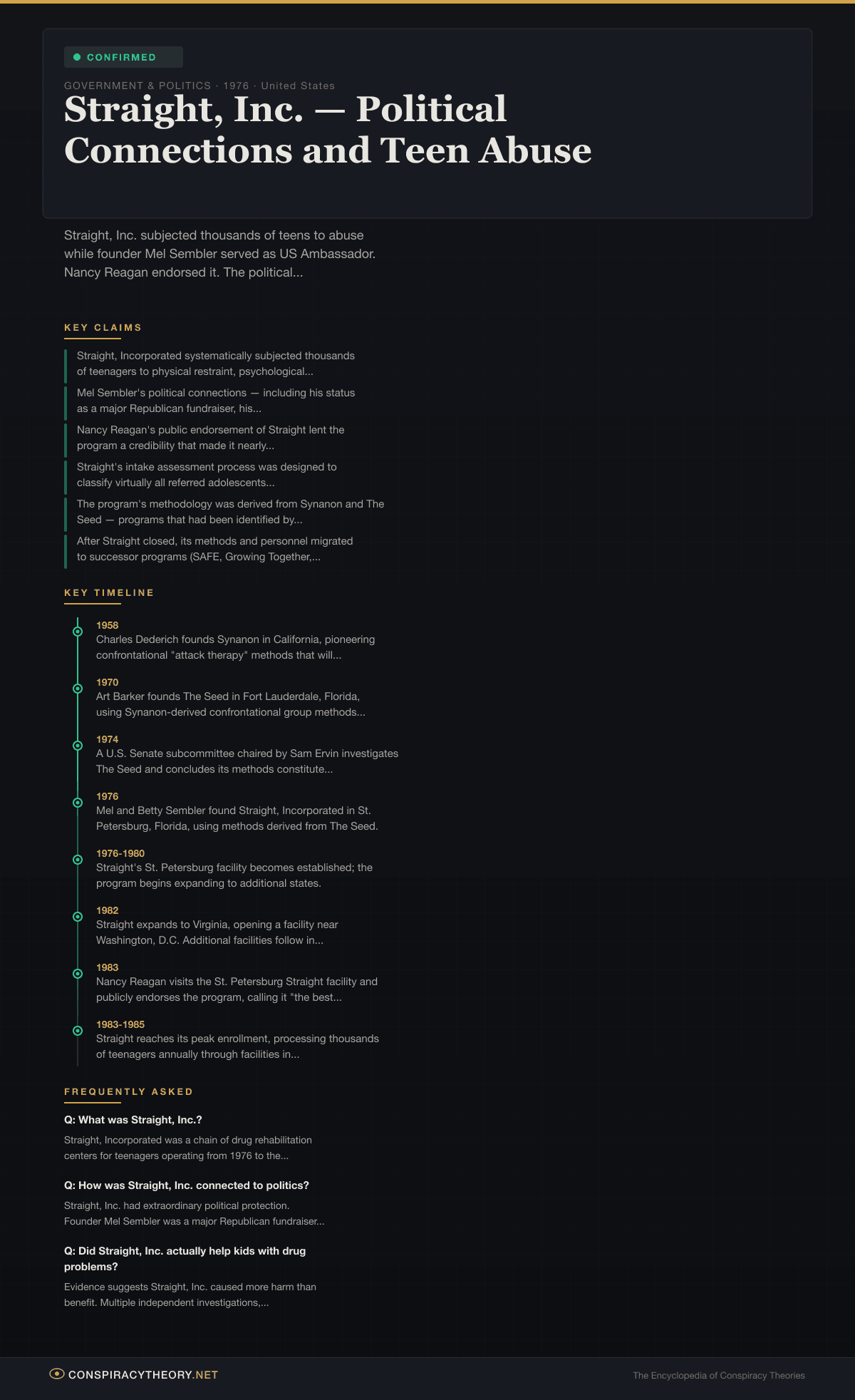
Straight, Inc. — Political Connections and Teen Abuse
Overview
On a spring day in 1983, First Lady Nancy Reagan walked through the front doors of a Straight, Incorporated facility in St. Petersburg, Florida, smiled for the cameras, and declared the program “the best drug rehabilitation program I’ve seen.” Behind those doors, teenagers were being held against their will, physically restrained by other adolescents, denied food and sleep, forced to sit in rigid positions for twelve or more hours a day, psychologically broken through confrontational group sessions that combined elements of attack therapy and cult indoctrination, and — in many documented cases — beaten, sexually humiliated, and driven to the brink of suicide. Some had never used drugs at all.
Straight, Incorporated operated from 1976 to the early 1990s, processing an estimated 50,000 teenagers through its facilities in Florida, Virginia, Ohio, Texas, Georgia, Maryland, Massachusetts, Michigan, New Jersey, and California. It was, by volume, one of the largest adolescent drug treatment operations in American history. It was also, by the weight of evidence compiled through state investigations, civil lawsuits, criminal proceedings, and the testimony of thousands of survivors, one of the most systematically abusive institutions for children ever to operate on American soil.
But the Straight, Inc. story is not simply a story of institutional abuse. It is a story about the intersection of private cruelty and public power — about how political connections at the highest levels of American government protected an organization that was torturing children, how the War on Drugs created a moral panic that allowed the abuse to be reframed as tough love, and how the people responsible not only escaped accountability but were rewarded with ambassadorships, foundation chairmanships, and continued influence over drug policy.
Mel Sembler, Straight’s co-founder, was not some fringe operator running a fly-by-night program. He was one of the most prolific Republican fundraisers in Florida, a member of the inner circles of two Bush presidencies, and a man who parlayed his involvement in “drug rehabilitation” into a political career that took him from St. Petersburg to Canberra to Rome. After Straight, Inc. finally closed under the weight of lawsuits and state investigations, Sembler became the chairman of the Drug Free America Foundation — continuing to shape national drug policy from the wreckage of an organization that had systematically tortured children in the name of keeping them drug-free.
This is a confirmed conspiracy. The abuse is documented beyond reasonable dispute. The political protection is a matter of public record. The only remaining question is whether the term “conspiracy” is strong enough for what actually happened.
Origins & History
The Seed: Where It All Began
To understand Straight, Inc., you have to go back to The Seed, an adolescent drug program founded in Fort Lauderdale, Florida in 1970 by Art Barker, a recovering alcoholic with no formal therapeutic training. The Seed used techniques borrowed from Synanon — the California-based organization founded by Charles Dederich that pioneered confrontational “attack therapy” and eventually devolved into an acknowledged cult — including marathon group sessions, aggressive confrontation, peer-enforced conformity, and the systematic breaking down of individual identity.
The Seed attracted attention from the U.S. Senate in 1974, when a subcommittee chaired by Senator Sam Ervin investigated the program and concluded that its methods constituted “an unfair and unconscionable intrusion on the right of privacy of thousands of young people” and compared its techniques to the brainwashing methods used on American prisoners of war in North Korea. The Senate report used the term “thought reform” — the clinical language for what is colloquially called brainwashing. The Seed’s federal funding was cut, and it was forced to modify some of its practices.
Mel and Betty Sembler were familiar with The Seed. Their involvement with adolescent drug treatment grew from personal experience — their own son had struggled with drug use — and from the networks of concerned parents that had formed around The Seed and similar programs. When The Seed began facing regulatory pressure in the mid-1970s, the Semblers saw an opportunity to create a new organization using the same essential methodology but with better political insulation.
The Founding of Straight, Inc.
Straight, Incorporated was founded in 1976 in St. Petersburg, Florida. The organizational structure was nominally nonprofit, governed by a board of directors drawn largely from the Semblers’ social and business networks. The program’s stated mission was to rehabilitate drug-addicted teenagers through an intensive treatment model that kept adolescents in the program for twelve to eighteen months or longer.
The methodology was The Seed’s, refined and systematized. New enrollees — called “newcomers” or “first phasers” — entered a program that controlled every aspect of their existence. The daily regimen followed a rigid pattern: wake at 7 AM, sit in a group room on hard plastic chairs arranged in dense rows, participate in confrontational “rap sessions” that lasted for most of the day, eat monitored meals, and sleep at the homes of “oldcomer” families — veteran Straight families who hosted newer enrollees. For the first weeks or months, newcomers had no contact with their own families except under strictly supervised conditions.
The rap sessions were the core of the program and the primary site of abuse. Groups of thirty to eighty teenagers sat facing a moderator — usually a staff member with no clinical credentials. The moderator would call on students to share their drug histories, confess to rule violations, and participate in confrontational exchanges with peers. The atmosphere was deliberately intense: students were expected to “motivate” — raising their hands frantically, waving their arms, sitting on the edge of their chairs — to demonstrate their eagerness to participate. Failure to motivate was treated as evidence of resistance and could result in punishment.
The confrontation was not therapeutic dialogue. It was organized verbal assault. Teenagers were screamed at, inches from their faces, by staff and peers. They were called every degrading name available. They were told they were worthless, that their families hated them, that they would die on the streets. These sessions lasted eight to twelve hours a day, five to seven days a week. The purpose was not insight — it was psychological demolition.
Expansion and Political Ascent
Straight expanded rapidly through the late 1970s and 1980s, opening facilities across the country. By the mid-1980s, Straight operated programs in at least ten states and was processing thousands of teenagers annually. The expansion coincided with — and was fueled by — the escalation of the War on Drugs under the Reagan administration.
Mel Sembler was a shrewd political operator. He recognized that the War on Drugs was creating a political environment in which anyone who could claim to be “saving kids from drugs” would receive not just funding but immunity from scrutiny. He cultivated relationships with Florida Republicans, became a major fundraiser, and positioned Straight, Inc. as a model program that demonstrated the kind of tough, no-nonsense approach to drug abuse that conservative politicians championed.
The political connections were extraordinary. Nancy Reagan’s 1983 visit to the St. Petersburg facility was a publicity coup that gave Straight the First Lady’s imprimatur. Reagan’s “Just Say No” campaign dovetailed perfectly with Straight’s messaging, and the endorsement provided a shield of legitimacy that deflected criticism for years. Mel Sembler became one of the most prolific Republican fundraisers in Florida. He was a personal friend of both George H.W. Bush and George W. Bush. He served on the boards of Republican organizations and raised millions of dollars for GOP candidates and causes.
In 1989, President George H.W. Bush appointed Mel Sembler as U.S. Ambassador to Australia and Nauru. It was a remarkable appointment: a man whose primary public claim to fame was running an organization that was already the subject of multiple lawsuits alleging systematic child abuse was sent to represent the United States abroad. Sembler served as ambassador until 1993. In 2001, President George W. Bush appointed him Ambassador to Italy, where he served until 2005.
Virgil Miller Newton and the Clinical Facade
A key figure in Straight’s operations was Virgil Miller Newton III, who served as the organization’s national clinical director. Newton had a background that included work at The Seed, and he was instrumental in designing and implementing Straight’s treatment protocols. Under Newton’s direction, the program maintained a veneer of clinical legitimacy while employing methods that had no basis in evidence-based treatment.
Newton and his staff developed the intake assessment process that critics would later identify as the mechanism by which Straight misdiagnosed teenagers. The assessment was designed to identify drug involvement, but it operated on a definitional framework so broad that virtually any adolescent behavior — experimentation with alcohol, attendance at parties where drugs might be present, friendships with peers who used drugs, defiance of parental authority, declining grades — could be classified as evidence of drug dependency or “pre-addiction.” Former staff members have testified that the assessments were essentially predetermined: the goal was enrollment, not diagnosis.
The clinical facade served another purpose: it insulated the program from legal challenges. When lawsuits alleged abuse, Straight’s lawyers argued that the confrontational methods were legitimate therapeutic techniques conducted under clinical supervision. The fact that most direct-contact staff had no professional credentials — many were recent program graduates themselves, teenagers or young adults with no training beyond their own experience as Straight clients — was obscured by the presence of Newton and a handful of credentialed professionals at the organizational level.
Key Claims
-
Straight, Incorporated systematically subjected thousands of teenagers to physical restraint, psychological torture, food and sleep deprivation, and conditions constituting false imprisonment, under the guise of drug rehabilitation.
-
Mel Sembler’s political connections — including his status as a major Republican fundraiser, his personal relationships with two presidents, and his ambassadorial appointments — provided Straight with political protection that delayed effective regulatory action for years, even as lawsuits and state investigations documented abuse.
-
Nancy Reagan’s public endorsement of Straight lent the program a credibility that made it nearly untouchable during the height of the War on Drugs, when questioning any “anti-drug” program was politically dangerous.
-
Straight’s intake assessment process was designed to classify virtually all referred adolescents as drug-dependent, regardless of actual drug use history, in order to maximize enrollment and revenue.
-
The program’s methodology was derived from Synanon and The Seed — programs that had been identified by government investigations as using brainwashing techniques — and these methods were implemented by untrained staff, many of them former program participants.
-
After Straight closed, its methods and personnel migrated to successor programs (SAFE, Growing Together, Pathway Family Center), perpetuating the same abusive practices under new names.
-
Mel Sembler’s post-Straight career as chairman of the Drug Free America Foundation allowed him to continue influencing national drug policy despite his role in an organization that systematically abused children.
Evidence
State Investigations and Regulatory Actions
Multiple state agencies investigated Straight facilities and documented abuse. These were not activist organizations or disgruntled parents — they were state departments of health, child welfare agencies, and licensing boards conducting official reviews.
Florida: The Florida Department of Health and Rehabilitative Services (HRS) investigated the St. Petersburg facility multiple times. Investigations documented instances of physical abuse, improper restraint, and conditions that violated state licensing standards. However, the political connections of Straight’s leadership complicated enforcement. The program received warnings and was required to implement corrective actions but continued operating for years after initial findings of violations.
Virginia: The Virginia facility faced investigation by the Virginia Department of Mental Health, Mental Retardation, and Substance Abuse Services. Investigators documented violations of patient rights, physical abuse, and inadequate clinical supervision. The Virginia program was eventually forced to close.
Ohio: Ohio state investigators documented similar conditions at the Cincinnati-area Straight facility. The program faced licensing challenges and regulatory sanctions.
Maryland, New Jersey, and other states: Straight facilities in multiple additional states faced regulatory scrutiny. The pattern was consistent: investigations found violations, the program made minimal changes or relocated, and the abuse continued.
Lawsuits and Legal Findings
The legal record against Straight is extensive. Dozens of civil lawsuits were filed by former clients and their families, and several resulted in significant judgments or settlements.
Fred Collins Jr. v. Straight, Inc.: In one of the most significant cases, a jury awarded $220,000 to Fred Collins Jr. after finding that Straight had falsely imprisoned him. Collins, who had been referred to Straight at age 16, testified that he had been physically restrained, denied food, and held against his will for months. The jury found that his confinement constituted false imprisonment — not “treatment.”
Richard Bradbury case: Richard Bradbury was awarded $721,000 after suing Straight for abuse he suffered in the program. The case documented systematic mistreatment including physical restraint, psychological abuse, and deprivation of basic necessities.
Multiple additional cases: The cumulative legal record includes dozens of additional lawsuits, many resulting in settlements. As with WWASPS cases, many settlements included confidentiality provisions that prevented the full scope of the legal record from becoming public.
The legal significance of these cases extends beyond the individual verdicts. The false imprisonment findings were particularly damaging because they established that Straight’s confinement of teenagers — which the program characterized as voluntary treatment — constituted, in the eyes of juries presented with the evidence, illegal detention.
Survivor Testimony
Thousands of former Straight clients have shared their experiences through legal depositions, media interviews, documentary appearances, advocacy organizations, and online platforms. The accounts span facilities in multiple states and cover the full period of Straight’s operation from the late 1970s through the early 1990s.
Common elements of survivor accounts include:
“Motivating”: Students were required to sit on the edge of their chairs in group sessions, waving their arms frantically to be called on. Failure to “motivate” with sufficient energy was treated as noncompliance. Students who failed to motivate could be physically restrained by peers — a practice in which multiple students would grab the offender, force them to the floor, and hold them down, sometimes sitting on them.
Physical restraint by peers: One of Straight’s most distinctive and dangerous practices was the use of other teenagers — not trained staff — to physically restrain noncompliant clients. This “motivating” restraint, and the more severe restraints used as punishment, involved groups of adolescents tackling, pinning, and sitting on other adolescents. The practice led to documented injuries and created an environment in which violence between teenagers was institutionally sanctioned.
“Host home” system: Rather than housing clients in a residential facility, Straight placed newcomers in the homes of families whose own children were further along in the program. This system was presented as therapeutic — integrating newcomers into stable family environments — but it functioned as an outsourcing of supervision and confinement. Host families were responsible for ensuring that the newcomer could not leave, which effectively made private citizens into jailers. The system also created opportunities for abuse in private homes, away from any institutional oversight.
Belt-looping: Newcomers were literally attached to an “oldcomer” by a belt loop — required to hold onto the belt or belt loop of a more senior client at all times. This practice was ostensibly for supervision and safety but functioned as a constant physical reminder of the newcomer’s lack of autonomy and as a mechanism for immediate physical control.
Food and sleep deprivation: Survivors consistently report inadequate food — small portions, monotonous menus, food withheld as punishment — and disrupted sleep. The long hours of group sessions, combined with the host home system’s lack of privacy, meant that many clients were chronically exhausted, a condition that increased their psychological vulnerability to the confrontational sessions.
Confession and informing: Clients were required to write detailed “moral inventories” confessing to drug use, sexual activity, and other behaviors — real or invented. The pressure to produce ever-more-dramatic confessions created an environment in which teenagers fabricated drug histories to satisfy the program’s expectations. Clients were also incentivized to inform on each other, creating an atmosphere of constant surveillance and mutual suspicion.
Suicidal ideation and attempts: Multiple former clients have reported that Straight drove them to suicidal states. Some attempted suicide during the program or immediately after leaving. The program’s response to suicidal ideation was typically increased confrontation and restraint rather than mental health intervention.
The Seed Connection
The continuity between The Seed and Straight is documented through personnel, methodology, and the 1974 Senate investigation. Senator Sam Ervin’s subcommittee identified The Seed’s methods as constituting “thought reform” — a finding that directly implicates the same methods used by Straight, since Straight was founded by individuals connected to The Seed and employed identical techniques. The Senate committee’s report noted that The Seed’s practices bore “a striking resemblance” to brainwashing techniques identified in studies of Chinese Communist programs for political re-education.
This lineage — from Synanon to The Seed to Straight — establishes that the methods used at Straight were not novel therapeutic innovations but repackaged coercive techniques that had already been identified and condemned by federal investigators. The Semblers and their associates were aware of The Seed’s history, including its investigation by the Senate, when they established Straight using the same fundamental methodology.
Debunking / Verification
This is a confirmed case of systematic institutional abuse protected by political connections. The evidentiary record is overwhelming.
What is beyond dispute: State investigations in multiple jurisdictions found that Straight facilities violated licensing standards, patient rights, and child protection requirements. Juries in civil trials found that Straight falsely imprisoned clients. Thousands of survivors have provided consistent testimony documenting physical restraint, psychological abuse, food and sleep deprivation, and conditions constituting false imprisonment. The U.S. Senate identified the methods used by Straight’s predecessor program as “thought reform” techniques resembling brainwashing. Nancy Reagan publicly endorsed the program. Mel Sembler served as U.S. Ambassador under two administrations while lawsuits documenting his organization’s abuse of children were being litigated.
What defenders have argued: Straight’s defenders — including some parents and a minority of former clients — maintained that the program saved teenagers from drug addiction, criminal behavior, and death. They argue that the confrontational methods, while intense, were necessary to break through the denial and manipulation that characterize adolescent substance abuse. Some parents who enrolled their children have continued to express gratitude for the program, believing it turned their child’s life around. Mel Sembler has consistently denied that abuse occurred and has characterized critics as a small group of disgruntled former clients and anti-drug-war activists.
Why these defenses fail: The defenses fail for three reasons. First, the abuse is documented not by critics but by state regulatory agencies, courts of law, and the U.S. Senate — institutions with no anti-drug-war agenda. Second, many of Straight’s clients were not drug addicts. They were teenagers referred by worried parents for behavior that did not constitute substance dependency, subjected to an intake process designed to classify them as drug-dependent regardless of actual use. A program that tortures non-drug-users in the name of drug treatment cannot credibly claim therapeutic purpose. Third, even if some clients benefited (as may be the case with any intervention, however harmful, applied to a large enough population), the systematic nature of the abuse — consistent across facilities, years, and thousands of accounts — demonstrates organizational policy, not isolated incidents.
The political protection question: The most conspiratorial dimension of the Straight story is the relationship between the Semblers’ political activities and the program’s ability to operate despite documented abuse. This is not speculative. Mel Sembler was one of the most prolific Republican fundraisers in Florida. He had personal relationships with Presidents George H.W. Bush and George W. Bush. Nancy Reagan endorsed the program. These relationships provided Straight with a political shield that made it extremely difficult for state regulators to take decisive action. When state investigators documented violations, the political cost of shutting down a program endorsed by the First Lady and run by a major party donor was significant. This is not to suggest a specific quid pro quo — it is to observe that political power distorts regulatory environments, and in Straight’s case, that distortion allowed children to be tortured for years after the abuse was documented.
The successor programs: Straight’s closure in the early 1990s did not end the methods. Programs including SAFE (Straight Adolescent Family Education), Growing Together, and Pathway Family Center were founded by former Straight personnel and used substantially similar methods. Pathway Family Center was eventually investigated and shut down in Michigan after documented abuse. The persistence of Straight’s methodology through successor programs demonstrates that the closure of the original organization did not constitute meaningful accountability.
Cultural Impact
Straight, Inc. occupies a central position in the history of the troubled teen industry and in the broader story of how the War on Drugs enabled institutional abuse.
The program’s political connections make it a uniquely powerful case study in the corruption of regulatory oversight by political influence. Other troubled teen programs abused children — the industry’s history is littered with documented cases from coast to coast. But no other program had its founder appointed as U.S. Ambassador while lawsuits documenting the organization’s abuse of children were pending. No other program received a personal endorsement from the First Lady. Straight demonstrates, with exceptional clarity, how political power can render children invisible — how the prestige of a cause (fighting drugs) and the connections of its advocates can make the suffering of thousands of teenagers simply disappear from political consciousness.
The Straight story has been told through multiple documentaries, books, and journalistic investigations. Maia Szalavitz, a journalist who has devoted much of her career to covering the troubled teen industry, has documented Straight extensively in her books Help at Any Cost (2006) and in numerous articles. The documentary The Last Stop (2012) examined Straight’s legacy. Online survivor communities, including websites and forums maintained by former clients, have preserved an extensive archive of testimony and documentation.
Straight’s influence on the troubled teen industry extends beyond its own operations. The program demonstrated that adolescent behavioral modification could be enormously profitable, that confrontational methods derived from discredited sources could be repackaged as legitimate treatment, that political connections could substitute for clinical evidence, and that parents’ desperation could be monetized at scale. These lessons were absorbed by the entrepreneurs who built the next generation of troubled teen programs — including WWASPS, which took the concept global.
The Drug Free America Foundation, which Mel Sembler chaired after Straight’s closure, continued to advocate against marijuana legalization, harm reduction approaches, and drug policy reform — positions that critics argue perpetuated the same punitive framework that had enabled Straight’s abuse. The foundation’s role in opposing evidence-based drug policy reform represented a continuation of Straight’s institutional legacy by different means: the same people, the same ideology, the same conviction that the ends justified the means.
The broader cultural impact of the Straight story is inseparable from the reckoning with the War on Drugs that has gathered force in the 2010s and 2020s. As public opinion has shifted toward decriminalization, harm reduction, and evidence-based treatment, programs like Straight have come to represent the cruelty and irrationality of the punitive approach. The fact that a program endorsed by the First Lady of the United States was simultaneously torturing children encapsulates, for many critics, the moral bankruptcy of the War on Drugs itself.
Key Figures
Mel Sembler — Co-founder of Straight, Inc. and its most powerful political asset. A real estate developer and one of the most prolific Republican fundraisers in Florida, Sembler served as U.S. Ambassador to Australia and Nauru (1989-1993) under George H.W. Bush and U.S. Ambassador to Italy (2001-2005) under George W. Bush. After Straight’s closure, he became chairman of the Drug Free America Foundation. He has consistently denied that systematic abuse occurred at Straight facilities.
Betty Sembler — Co-founder of Straight, Inc. alongside her husband Mel. Betty was actively involved in the organization’s operations and public advocacy. She served as the first president of the Drug Free America Foundation.
Nancy Reagan — First Lady of the United States (1981-1989), whose “Just Say No” campaign aligned with Straight’s anti-drug messaging. Reagan personally visited Straight’s St. Petersburg facility in 1983 and publicly endorsed the program, providing it with a political and public relations shield that complicated regulatory enforcement for years.
Virgil Miller Newton III — Straight’s national clinical director, who designed and oversaw the program’s treatment protocols. Newton had connections to The Seed and was instrumental in adapting its confrontational methods for Straight. He provided the clinical imprimatur that the program used to defend its methods as legitimate therapeutic techniques.
Art Barker — Founder of The Seed, the Fort Lauderdale-based program whose methods were investigated by the U.S. Senate in 1974 and identified as resembling brainwashing. The Seed’s techniques were directly adopted by Straight’s founders.
Senator Sam Ervin — Chairman of the Senate subcommittee that investigated The Seed in 1974 and concluded that its methods constituted “thought reform.” The subcommittee’s findings established that the fundamental methodology later used by Straight had been identified by the U.S. Congress as coercive and brainwashing-like before Straight was even founded.
Fred Collins Jr. — A former Straight client whose false imprisonment lawsuit against the organization resulted in a $220,000 jury verdict, establishing a legal precedent that Straight’s confinement of teenagers could constitute illegal detention rather than voluntary treatment.
Timeline
- 1958 — Charles Dederich founds Synanon in California, pioneering confrontational “attack therapy” methods that will later influence The Seed and Straight.
- 1970 — Art Barker founds The Seed in Fort Lauderdale, Florida, using Synanon-derived confrontational group methods on adolescents.
- 1974 — A U.S. Senate subcommittee chaired by Sam Ervin investigates The Seed and concludes its methods constitute “thought reform” resembling brainwashing. Federal funding is cut.
- 1976 — Mel and Betty Sembler found Straight, Incorporated in St. Petersburg, Florida, using methods derived from The Seed.
- 1976-1980 — Straight’s St. Petersburg facility becomes established; the program begins expanding to additional states.
- 1982 — Straight expands to Virginia, opening a facility near Washington, D.C. Additional facilities follow in Ohio, Texas, Georgia, and other states.
- 1983 — Nancy Reagan visits the St. Petersburg Straight facility and publicly endorses the program, calling it “the best drug rehabilitation program I’ve seen.”
- 1983-1985 — Straight reaches its peak enrollment, processing thousands of teenagers annually through facilities in approximately ten states. The program receives federal endorsement and funding connections through the War on Drugs apparatus.
- 1983 — First major lawsuits are filed against Straight by former clients alleging false imprisonment, abuse, and emotional distress.
- 1985 — Florida Department of Health and Rehabilitative Services investigates St. Petersburg facility, documenting violations of licensing standards and patient rights.
- 1986 — Fred Collins Jr. wins a $220,000 jury verdict against Straight for false imprisonment.
- 1987 — Virginia state investigators document abuse and regulatory violations at the Virginia Straight facility. The Virginia program faces licensing challenges.
- 1988 — Richard Bradbury is awarded $721,000 in a lawsuit against Straight for abuse suffered in the program.
- 1989 — President George H.W. Bush appoints Mel Sembler as U.S. Ambassador to Australia and Nauru, despite ongoing litigation against Straight.
- 1990-1993 — Under mounting legal pressure and state regulatory action, Straight facilities begin closing across the country. Sembler serves as ambassador while lawsuits against his organization proceed.
- 1993 — The last Straight, Inc. facilities close. The organization officially ceases operations. Successor programs — SAFE, Growing Together — are established by former Straight personnel.
- 1995 — Mel Sembler co-founds the Drug Free America Foundation, continuing advocacy against drug legalization and harm reduction approaches.
- Late 1990s-2000s — Pathway Family Center, a Straight successor program in Michigan founded by former Straight personnel, operates using similar methods before being investigated and shut down.
- 2001 — President George W. Bush appoints Mel Sembler as U.S. Ambassador to Italy. He serves until 2005.
- 2006 — Maia Szalavitz publishes Help at Any Cost, documenting Straight’s history and the broader troubled teen industry.
- 2012 — Documentary The Last Stop examines Straight’s legacy and survivor experiences.
- 2020s — Survivor advocacy organizations continue to campaign for regulation of the troubled teen industry and for accountability for Straight’s leadership. The broader reckoning with the troubled teen industry, catalyzed by Paris Hilton and others, brings renewed attention to Straight’s history as a foundational case.
Sources & Further Reading
- Szalavitz, Maia. Help at Any Cost: How the Troubled-Teen Industry Cons Parents and Hurts Kids. New York: Riverhead Books, 2006.
- U.S. Senate, Committee on the Judiciary, Subcommittee on Constitutional Rights. “Individual Rights and the Federal Role in Behavior Modification.” 93rd Congress, 2nd Session, 1974.
- Miller, Richard Lawrence. Drug Warriors and Their Prey: From Police Power to Police State. Westport, CT: Praeger, 1996.
- Rekers, George, and Mark Kilgus. “Studies of the Clinical Effectiveness of Straight, Incorporated.” Unpublished reports cited in litigation (note: these studies were funded by Straight and have been criticized for methodological deficiencies).
- Fred Collins Jr. v. Straight, Inc. — Circuit Court, Pinellas County, Florida.
- Richard Bradbury v. Straight, Inc. — Civil proceedings documenting abuse.
- Labi, Nadya. “Tough Love Hits Home.” Time, December 9, 2002.
- Szalavitz, Maia. “The Trouble with Tough Love.” The Washington Post, January 29, 2006.
- Investigative reports by the St. Petersburg Times (now Tampa Bay Times) documenting Straight operations and political connections.
- Drug Free America Foundation records and public advocacy positions.
- Florida Department of Health and Rehabilitative Services investigation records.
- Virginia Department of Mental Health, Mental Retardation, and Substance Abuse Services investigation records.
- Hilton, Paris. This Is Paris (documentary). YouTube Originals, 2020. (Background on troubled teen industry.)
- Breaking Code Silence. Advocacy organization and survivor testimony platform.
Related Theories
- WWASPS — World Wide Association of Specialty Programs — A later network of troubled teen programs that took the model global, operating abusive facilities in Jamaica, Mexico, Samoa, Costa Rica, and the Czech Republic. WWASPS founder Robert Lichfield built on the business model pioneered by programs like Straight.
- Prison-Industrial Complex — The broader theory that the American incarceration system is driven by private profit and political incentives, of which the troubled teen industry represents a parallel phenomenon targeting minors.
- CIA Drug Trafficking — Allegations that intelligence agencies facilitated the very drug crisis that programs like Straight claimed to be fighting, raising questions about the War on Drugs’ true purposes.
Frequently Asked Questions
What was Straight, Inc.?
How was Straight, Inc. connected to politics?
Did Straight, Inc. actually help kids with drug problems?

Infographic
Share this visual summary. Right-click to save.