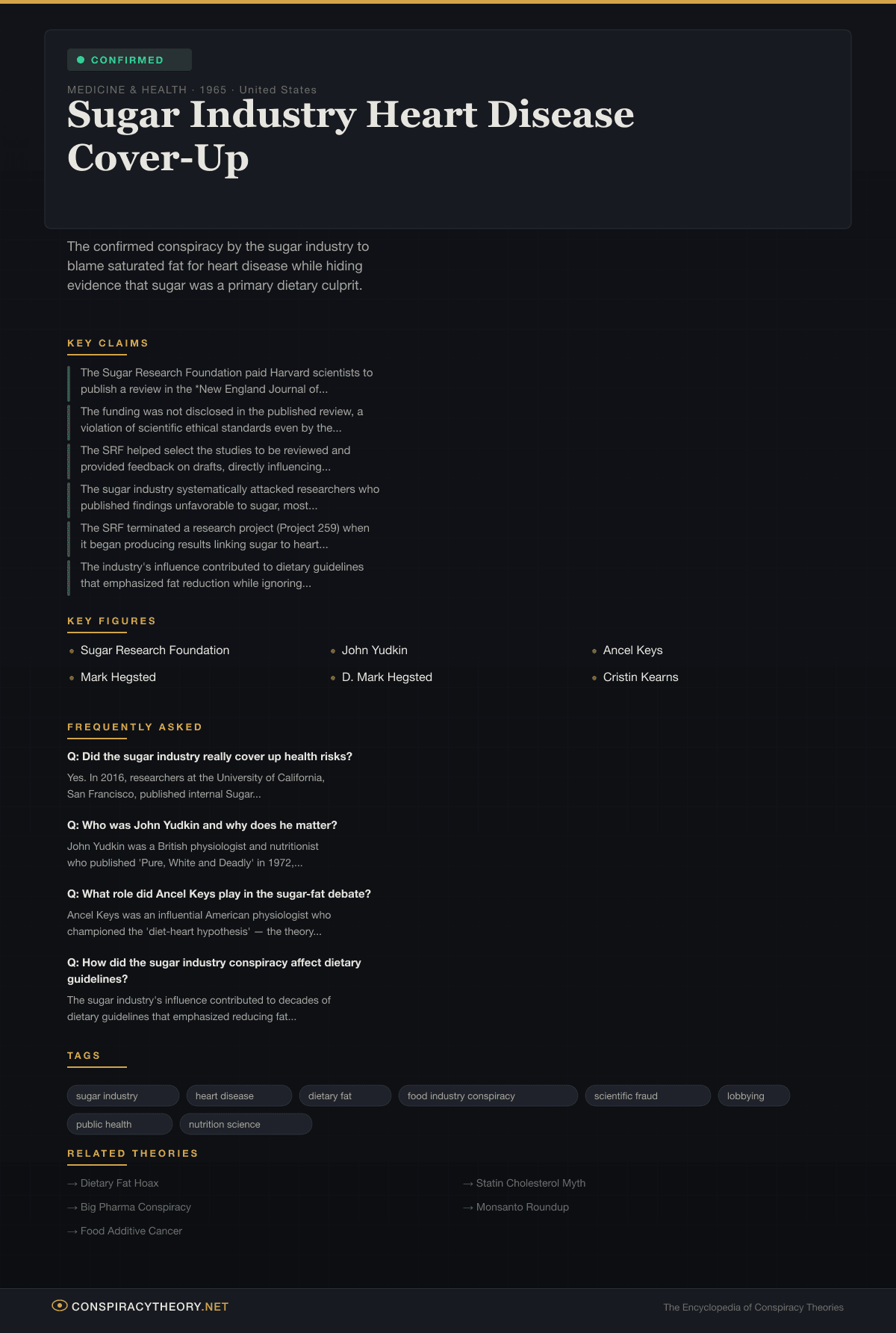
Sugar Industry Heart Disease Cover-Up

Overview
In 1972, a British physiologist named John Yudkin published a book called Pure, White and Deadly. Its central argument was that sugar, not fat, was the primary dietary driver of heart disease, obesity, and a constellation of other chronic conditions that were beginning to reshape the health landscape of the industrialized world. The book was meticulously researched, carefully argued, and based on decades of clinical and epidemiological work. It was also, in a very real sense, a death sentence for its author’s career. Within a few years, Yudkin had been marginalized, ridiculed, and effectively erased from mainstream nutrition science. His laboratory lost funding. His research was dismissed. He died in 1995, largely forgotten by the field he had spent his life trying to serve.
The story of how this happened — and of who made it happen — is one of the most consequential confirmed conspiracies in the history of public health. In 2016, researchers at the University of California, San Francisco, led by dental researcher Cristin Kearns, published a landmark paper in JAMA Internal Medicine revealing that the Sugar Research Foundation, the trade association of the American sugar industry, had secretly funded a 1967 literature review by Harvard scientists that was designed to exonerate sugar and blame saturated fat for heart disease. The review, published in the New England Journal of Medicine — one of the most prestigious medical journals in the world — did not disclose the sugar industry’s funding or its role in selecting the studies to be reviewed.
The consequences of this conspiracy extend far beyond one fraudulent paper. The sugar industry’s campaign to redirect scientific attention from sugar to fat helped shape fifty years of dietary guidelines, food industry practices, and public health policy. It contributed to the “low-fat” food movement that flooded supermarkets with products stripped of fat but loaded with sugar. And it may have helped fuel the very epidemics of obesity, diabetes, and heart disease it claimed to be addressing.
Origins & History
The Post-War Nutrition Wars
The story begins in the 1950s and 1960s, when heart disease was emerging as the leading cause of death in the United States and scientists were fiercely debating its dietary causes. Two competing hypotheses dominated the field:
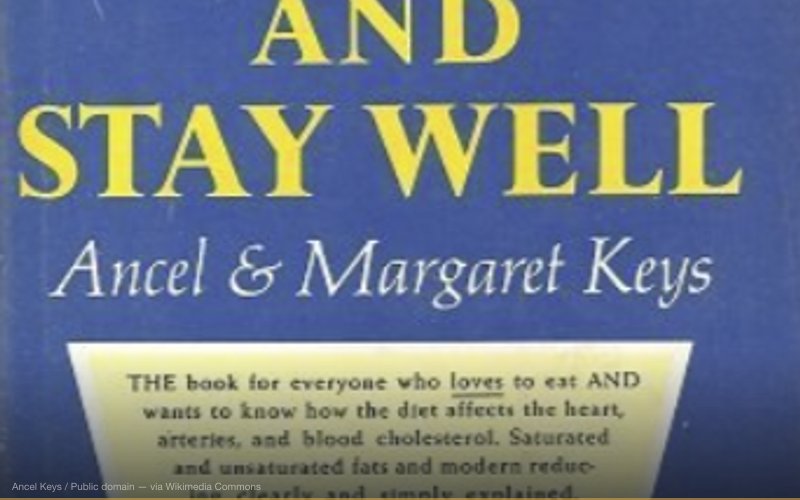
The diet-heart hypothesis, championed by American physiologist Ancel Keys, held that dietary saturated fat and cholesterol were the primary culprits. Keys’s research, including the influential Seven Countries Study, appeared to show a correlation between saturated fat consumption and heart disease rates across different populations. Keys was a charismatic, aggressive advocate for his theory, and he wielded his influence with a combativeness that brooked little dissent.
The sugar hypothesis, advanced by Yudkin and a smaller cohort of researchers, argued that the dramatic increase in sugar consumption — particularly refined sucrose — was a more significant driver of heart disease than fat. Yudkin’s research showed that sugar consumption correlated more strongly with heart disease rates than fat consumption did, and his clinical work demonstrated that high sugar intake raised triglycerides and other markers of cardiovascular risk.
These hypotheses were not mutually exclusive — it was entirely possible that both fat and sugar contributed to heart disease — but the scientific and political dynamics of the era forced them into competition. Research funding, journal space, government advisory positions, and media attention were finite resources, and the fight over which hypothesis would dominate became intensely personal.
The Sugar Research Foundation Intervenes
By the mid-1960s, the sugar industry was alarmed. A growing body of research was linking sugar to heart disease, and if the sugar hypothesis gained traction, the commercial consequences would be devastating. The Sugar Research Foundation (SRF), later renamed the Sugar Association, decided to take action.
Internal documents uncovered by Kearns and her colleagues show that in 1964, SRF vice president and director of research John Hickson proposed a strategy to counter the anti-sugar research. “We can and should do something about the claims that sugar is dangerous,” Hickson wrote. The solution was to fund research that would shift blame from sugar to fat.
In 1965, the SRF paid three Harvard researchers — Mark Hegsted, Robert McGandy, and Frederick Stare — to conduct a review of the scientific literature on the relationship between diet and heart disease. The SRF paid the researchers approximately $6,500 — equivalent to roughly $50,000 in modern currency. The foundation did not merely fund the review; it helped select the studies to be included. Hickson reviewed drafts of the article and provided feedback that influenced its conclusions.
The resulting review, “Dietary Fats, Carbohydrates and Atherosclerotic Vascular Disease,” was published in the New England Journal of Medicine in 1967. It concluded that there was “no doubt” that reducing cholesterol and saturated fat was the only dietary intervention needed to prevent heart disease. Sugar’s role was minimized. The review did not disclose the SRF’s funding.
The Destruction of John Yudkin
The sugar industry’s campaign was not limited to funding favorable research. It also targeted scientists who challenged the industry’s preferred narrative, and its most prominent victim was John Yudkin.
Yudkin, a professor at Queen Elizabeth College, University of London, was one of the world’s leading nutrition scientists. His research demonstrating sugar’s role in heart disease was methodologically sound and clinically significant. But after the publication of Pure, White and Deadly in 1972, the sugar industry and its allies launched a coordinated campaign to discredit him.
Ancel Keys, whose fat hypothesis aligned with the sugar industry’s interests (though the extent of any direct coordination between Keys and the SRF remains unclear), was particularly brutal. Keys called Yudkin’s work “a mountain of nonsense” and attacked his methodology in personal and professional terms. The World Sugar Research Organisation, an international industry group, described Yudkin’s work as “emotional assertions” and worked to prevent him from publishing and presenting.
The campaign worked. Yudkin’s funding dried up. He was excluded from major conferences. His research was ignored in dietary guidelines. When he retired in 1971, his successor at Queen Elizabeth College — reportedly under industry pressure — dismantled his laboratory. By the time of his death in 1995, Yudkin was largely forgotten, and the fat hypothesis reigned supreme.
The Low-Fat Revolution and Its Consequences
The triumph of the fat hypothesis — aided by the sugar industry’s intervention — had enormous practical consequences. The 1977 McGovern Committee report, Dietary Goals for the United States, recommended that Americans reduce their fat intake. The first Dietary Guidelines for Americans, published in 1980, echoed this recommendation. The food industry responded with a flood of “low-fat” and “fat-free” products.
There was a problem, however. When you remove fat from processed food, the food tastes terrible. The solution the food industry found was to replace fat with sugar. Low-fat yogurt, low-fat cookies, low-fat salad dressing — virtually all of them compensated for reduced fat with added sugar. Americans dutifully reduced their fat intake as instructed, and their sugar consumption soared.
The results were catastrophic. Obesity rates in the United States, which had been relatively stable through the 1970s, began climbing sharply in the 1980s and have continued rising ever since. Type 2 diabetes followed the same trajectory. Heart disease, the very condition the low-fat guidelines were supposed to address, remained the leading cause of death. The dietary guidance that was supposed to make Americans healthier may have made them sicker — and the sugar industry’s manipulation of science was a contributing factor.
The Documents Surface
The full extent of the sugar industry’s campaign remained hidden for decades. It was only in 2016 that Cristin Kearns, a postdoctoral researcher at UCSF who had stumbled on the SRF’s internal documents in a university archive, published her findings in JAMA Internal Medicine. The paper, co-authored with prominent nutrition researchers Laura Schmidt and Stanton Glantz, documented the SRF’s funding of the Harvard review, its role in shaping the review’s conclusions, and its failure to disclose the industry relationship.
The discovery received worldwide media coverage and prompted comparisons to the tobacco industry’s decades-long campaign to conceal the health risks of smoking. The Sugar Association responded with a statement acknowledging that its funding practices in the 1960s “should have exercised greater transparency” but denying that its funding had influenced the Harvard researchers’ conclusions — a claim contradicted by the internal documents showing that the SRF had reviewed and influenced drafts of the paper.
Further Revelations
Kearns and her colleagues subsequently uncovered additional evidence of sugar industry manipulation:
In 2017, they published evidence that the SRF had funded a research project called “Project 259” at the University of Birmingham in England, which had begun producing results linking sugar to heart disease and bladder cancer. When the preliminary results came in, the SRF terminated the project’s funding before the research could be completed or published. The internal documents showed that the decision was made because the findings were unfavorable to the sugar industry.
Research published in 2019 revealed that the sugar industry had also influenced the National Institute of Dental Research’s 1971 National Caries Program, steering it away from recommending sugar reduction and toward interventions such as vaccines and enzymes that would allow continued sugar consumption.
Key Claims
The confirmed claims about the sugar industry conspiracy include:
- The Sugar Research Foundation paid Harvard scientists to publish a review in the New England Journal of Medicine that minimized sugar’s role in heart disease and blamed saturated fat
- The funding was not disclosed in the published review, a violation of scientific ethical standards even by the less rigorous norms of the 1960s
- The SRF helped select the studies to be reviewed and provided feedback on drafts, directly influencing the paper’s conclusions
- The sugar industry systematically attacked researchers who published findings unfavorable to sugar, most prominently John Yudkin
- The SRF terminated a research project (Project 259) when it began producing results linking sugar to heart disease and cancer
- The industry’s influence contributed to dietary guidelines that emphasized fat reduction while ignoring sugar, contributing to the low-fat food revolution that increased sugar consumption
- Industry manipulation paralleled tobacco industry tactics, using funded research, attacks on dissenting scientists, and regulatory capture to protect commercial interests at the expense of public health
Evidence
The evidence for the sugar industry conspiracy is comprehensive and largely undisputed:
Internal documents: The SRF’s internal correspondence, preserved in university archives, provides primary-source evidence of the industry’s strategy, including letters discussing funding, research direction, and the need to counter anti-sugar findings.
Financial records: Payment records confirm the transfer of funds from the SRF to the Harvard researchers, including the specific amounts and conditions of funding.
Published research: The 1967 New England Journal of Medicine review is a matter of public record, and its failure to disclose industry funding is verifiable.
Subsequent investigations: Peer-reviewed publications in JAMA Internal Medicine, PLOS Biology, and other journals have documented multiple instances of sugar industry interference in science, each supported by archival evidence.
Industry admissions: The Sugar Association’s own statement acknowledged that its 1960s-era funding practices lacked transparency, effectively conceding the factual basis of the allegations while disputing their significance.
Cultural Impact
Scientific Integrity Reforms
The sugar industry revelations contributed to a broader reckoning with industry influence on scientific research. Medical journals, including the New England Journal of Medicine, tightened their conflict-of-interest disclosure requirements. The National Institutes of Health strengthened its policies on industry-funded research. And the concept of “industry capture” of scientific advisory processes entered mainstream public health discourse.
The Sugar Tax Movement
The growing awareness of sugar’s health effects — and of the industry’s efforts to conceal them — has fueled a global movement to tax sugary beverages. Mexico introduced a sugar tax in 2014. The UK implemented its Soft Drinks Industry Levy in 2018. Several U.S. cities, including Philadelphia, San Francisco, and Seattle, have enacted local sugar taxes. The sugar industry has opposed these measures with campaigns that echo its historical tactics, though with significantly less success in an era of greater public skepticism.
Yudkin’s Rehabilitation
John Yudkin’s posthumous rehabilitation has become one of the most notable narratives in modern nutrition science. Pure, White and Deadly was republished in 2012 with an introduction by pediatric endocrinologist Robert Lustig, whose own work on sugar and metabolic disease — including his viral 2009 UCSF lecture “Sugar: The Bitter Truth,” viewed over 20 million times on YouTube — drew directly on Yudkin’s research. The republication introduced Yudkin’s work to a new generation and transformed him from a forgotten crank into a prophetic figure.
The Nutrition Science Trust Crisis
Perhaps the most damaging legacy of the sugar industry conspiracy is the erosion of public trust in nutrition science itself. The revelation that foundational dietary guidance was influenced by industry manipulation has contributed to widespread skepticism about nutritional recommendations, making it harder for legitimate public health messaging to gain traction. This skepticism has, in turn, created fertile ground for nutrition-related conspiracy theories and pseudoscientific dietary movements.
In Popular Culture
The sugar industry conspiracy has been examined in numerous documentaries and books. Fed Up (2014), produced by Laurie David and narrated by Katie Couric, focused on the sugar industry’s role in the obesity epidemic. That Sugar Film (2014), an Australian documentary, explored the health effects of sugar consumption. Gary Taubes’s The Case Against Sugar (2016) provided a comprehensive history of the sugar industry’s influence on nutrition science. Michael Moss’s Salt Sugar Fat: How the Food Giants Hooked Us (2013) examined the broader food industry’s manipulation of dietary research and consumer behavior.
Timeline
| Date | Event |
|---|---|
| 1950s-1960s | Diet-heart hypothesis (fat) and sugar hypothesis compete for scientific dominance |
| 1964 | SRF vice president John Hickson proposes strategy to counter anti-sugar research |
| 1965 | SRF pays Harvard scientists approximately $6,500 to conduct favorable literature review |
| 1967 | Funded review published in New England Journal of Medicine without disclosure of sugar industry funding |
| 1971 | Sugar industry influence shapes National Institute of Dental Research caries program |
| 1972 | John Yudkin publishes Pure, White and Deadly; faces industry-coordinated attacks |
| 1977 | McGovern Committee’s Dietary Goals for the United States recommends reducing fat intake |
| 1980 | First Dietary Guidelines for Americans emphasize fat reduction |
| 1980s-2000s | Low-fat food revolution replaces fat with sugar; obesity and diabetes rates soar |
| 1995 | John Yudkin dies, largely marginalized from mainstream nutrition science |
| 2009 | Robert Lustig’s lecture “Sugar: The Bitter Truth” goes viral, reigniting the sugar debate |
| 2012 | Pure, White and Deadly republished with introduction by Lustig |
| September 2016 | Kearns, Schmidt, and Glantz publish sugar industry documents in JAMA Internal Medicine |
| 2017 | Further documents reveal SRF terminated “Project 259” when results linked sugar to heart disease |
| 2019 | Research reveals sugar industry influence on federal dental research program |
| 2020s | Sugar taxes enacted in dozens of jurisdictions worldwide |
Sources & Further Reading
- Kearns, Cristin E., Laura A. Schmidt, and Stanton A. Glantz. “Sugar Industry and Coronary Heart Disease Research: A Historical Analysis of Internal Industry Documents.” JAMA Internal Medicine, 176(11), 2016
- Yudkin, John. Pure, White and Deadly. Davis-Poynter, 1972 (republished Penguin, 2012)
- Taubes, Gary. The Case Against Sugar. Alfred A. Knopf, 2016
- Lustig, Robert H. Fat Chance: Beating the Odds Against Sugar, Processed Food, Obesity, and Disease. Hudson Street Press, 2012
- Moss, Michael. Salt Sugar Fat: How the Food Giants Hooked Us. Random House, 2013
- O’Connor, Anahad. “How the Sugar Industry Shifted Blame to Fat.” New York Times, September 12, 2016
- Kearns, Cristin E., Stanton A. Glantz, and Laura A. Schmidt. “Sugar Industry Sponsorship of Germ-Free Rodent Studies.” PLOS Biology, 2017
- Hegsted, D. Mark, Robert B. McGandy, and Frederick J. Stare. “Dietary Fats, Carbohydrates and Atherosclerotic Vascular Disease.” New England Journal of Medicine, 1967
- Keys, Ancel. Seven Countries: A Multivariate Analysis of Death and Coronary Heart Disease. Harvard University Press, 1980
- McGovern, George. Dietary Goals for the United States. U.S. Senate Select Committee on Nutrition and Human Needs, 1977
Related Theories
- Dietary Fat Hoax — The broader theory that the anti-fat consensus was manufactured
- Statin Cholesterol Myth — Related claims about the pharmaceutical industry’s role in cholesterol science
- Big Pharma Conspiracy — The general theory of pharmaceutical industry influence on medical research
- Monsanto Roundup — Another documented case of corporate interference with health science
Frequently Asked Questions
Did the sugar industry really cover up health risks?
Who was John Yudkin and why does he matter?
What role did Ancel Keys play in the sugar-fat debate?
How did the sugar industry conspiracy affect dietary guidelines?
Infographic
Share this visual summary. Right-click to save.