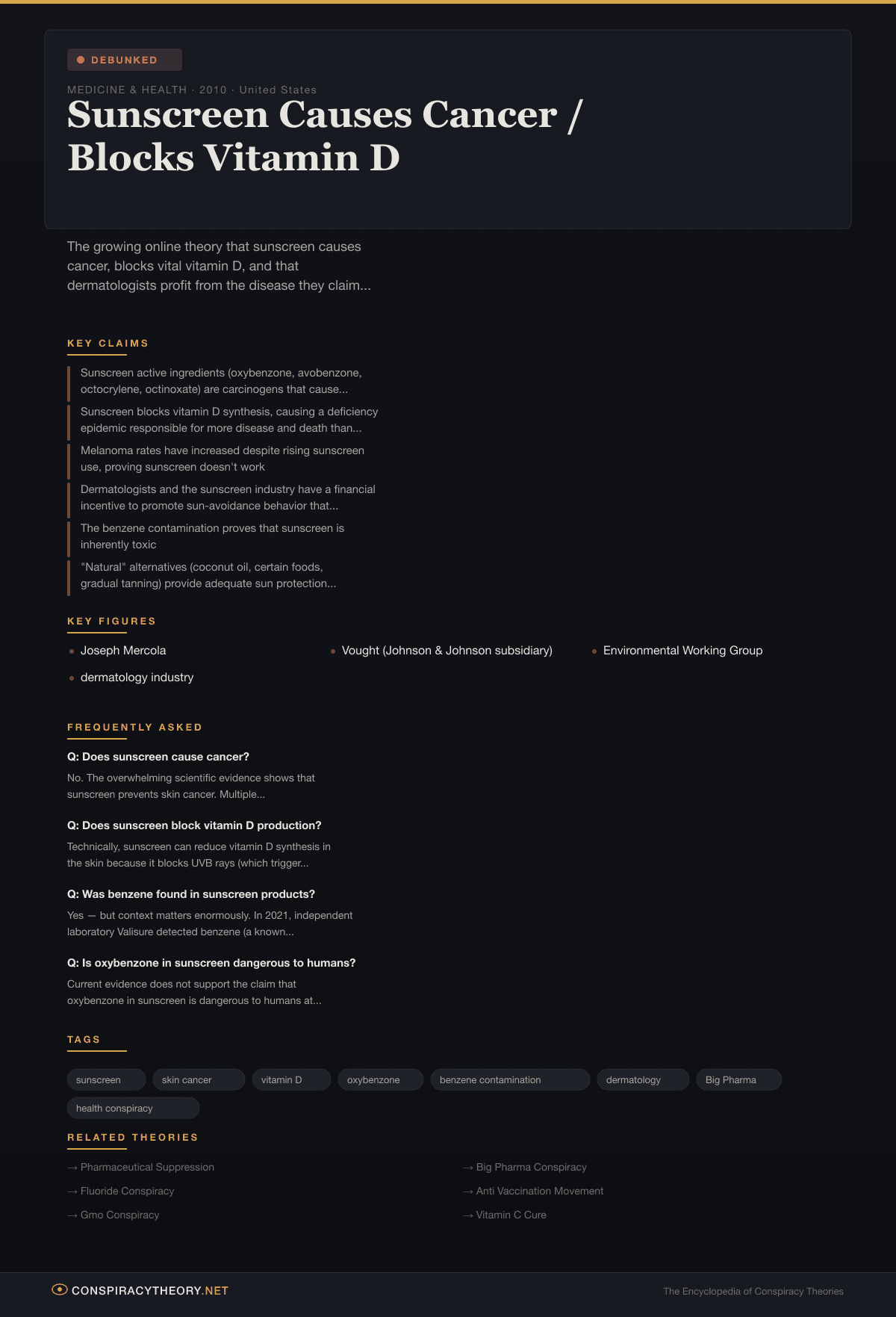
Sunscreen Causes Cancer / Blocks Vitamin D
Overview
Somewhere around 2019, the internet decided that sunscreen was trying to kill you.
The theory goes something like this: sunscreen doesn’t prevent skin cancer — it causes it. The chemicals in sunscreen (oxybenzone, avobenzone, octocrylene, and others) are absorbed through the skin, disrupt hormones, and trigger the very cancers they claim to prevent. Meanwhile, by blocking ultraviolet radiation, sunscreen prevents your body from producing vitamin D, the deficiency of which causes a cascade of other health problems — depression, immune dysfunction, and, yes, cancer. The entire sunscreen industry, in this telling, is a circular scam: dermatologists frighten you into using a product that makes you sick, then treat the resulting illness for profit.
Then, in 2021, independent testing found actual benzene — an unambiguous carcinogen — in dozens of sunscreen products. The theory seemed vindicated. “We tried to tell you,” went the social media posts, shared hundreds of thousands of times.
The reality is, as usual, more complicated than the conspiracy and more interesting than the marketing. Sunscreen’s safety profile is robust. The benzene finding was real but misunderstood. The vitamin D concern has a kernel of truth but has been inflated far beyond the evidence. And the idea that dermatologists promote sunscreen to generate melanoma patients is not just wrong — it inverts the actual economics of skin cancer treatment.
This is a theory worth examining carefully because, unlike many health conspiracies, it takes real data points and real regulatory ambiguities and welds them into a narrative that could genuinely get people killed.
Origins & History
The Vitamin D Counterrevolution
The roots of sunscreen skepticism predate social media, beginning with legitimate scientific research into vitamin D’s health effects. In the early 2000s, a series of studies linked vitamin D deficiency to increased risks of various cancers, cardiovascular disease, autoimmune disorders, and depression. Vitamin D is primarily synthesized in the skin through UVB exposure — the same radiation that sunscreen is designed to block.
From this research, a reasonable question emerged: Could aggressive sun avoidance and sunscreen use contribute to a vitamin D deficiency epidemic? Some researchers — most notably endocrinologist Michael Holick of Boston University — began arguing that the dermatological establishment’s “sun is the enemy” messaging had gone too far, and that moderate, unprotected sun exposure was beneficial.
Holick’s position was (and remains) within the bounds of legitimate medical debate, though the dermatological mainstream disagrees with his framing. But the nuanced scientific discussion about optimal sun exposure was quickly stripped of its nuance by the internet’s content machine.
Joseph Mercola and the Alternative Health Pipeline
The transformation from scientific debate to conspiracy theory happened largely through the alternative health media ecosystem. Joseph Mercola — an osteopathic physician whose website mercola.com became one of the internet’s largest sources of health misinformation — began aggressively promoting the narrative that sunscreen was dangerous and sun exposure was beneficial as early as 2008.
Mercola’s framing was not subtle: sunscreen was a Big Pharma product designed to create lifelong customers. Dermatologists who recommended it were either dupes or profiteers. The real cancer risk came from avoiding the sun, not from UV exposure. He sold vitamin D supplements on the same website — a financial incentive he rarely disclosed.
By the mid-2010s, the anti-sunscreen narrative had become standard content in the alternative health and wellness space. It fit perfectly into existing frameworks: natural is good (sunlight), synthetic is bad (chemicals), mainstream medicine is corrupt (pharmaceutical suppression), and the establishment’s advice is designed to keep you sick and dependent.
The TikTok Explosion
The theory achieved mass reach around 2020-2022 through TikTok and Instagram, where wellness influencers — many of them young, attractive, and entirely without medical credentials — began posting content about “what dermatologists won’t tell you.” Common claims included:
- Sunscreen ingredients are “toxic chemicals” that cause cancer
- Ancient civilizations didn’t use sunscreen and had no skin cancer (a historically unfalsifiable claim)
- Melanoma rates have risen even as sunscreen use has increased (true, but explained by other factors — see Debunking section)
- Your body “needs” unprotected sun exposure for vitamin D and you should “eat your sunscreen” through antioxidant-rich foods
The format — short, confident, visually appealing, delivered by someone who looks healthy and lives a photogenic life — was devastating. These videos accumulated tens of millions of views. A 2022 survey by the Orlando Health Cancer Institute found that one in seven adults under 35 believed that daily sunscreen use was more harmful than direct sun exposure.
The Benzene Bombshell
In May 2021, independent pharmaceutical testing laboratory Valisure submitted a citizen petition to the FDA reporting that it had detected benzene — a known human carcinogen — in 78 out of 294 sunscreen and after-sun products tested. Some products contained benzene at levels more than three times the FDA’s emergency limit.
This was real. It was alarming. And it was immediately weaponized by the anti-sunscreen movement as proof that “we were right all along.”
What got lost in the social media firestorm: benzene was not a sunscreen ingredient. It was a manufacturing contaminant introduced during the aerosol production process — specifically through the propellant used in spray-on sunscreen cans. Non-aerosol sunscreens (lotions, creams, sticks) were largely unaffected. Johnson & Johnson voluntarily recalled affected Neutrogena and Aveeno spray products. The problem was an industrial quality control failure, not evidence that sunscreen chemistry causes cancer.
But “specific aerosol products contaminated by manufacturing defect” doesn’t travel as fast on social media as “THEY PUT CANCER CHEMICALS IN YOUR SUNSCREEN.”
The FDA’s Unfortunate Timing
In 2019, the FDA proposed a rule that would update sunscreen regulations, requesting additional safety data for 12 of 16 active sunscreen ingredients, including oxybenzone and avobenzone. The FDA classified only two ingredients — zinc oxide and titanium dioxide — as “generally recognized as safe and effective” (GRASE).
This regulatory action, which was standard bureaucratic procedure to update decades-old monographs, was immediately and widely misinterpreted as the FDA declaring that chemical sunscreens were unsafe. In reality, the FDA’s position was that newer studies had shown these chemicals could be absorbed through the skin into the bloodstream at levels that exceeded their original safety thresholds — and that more data was needed to determine whether this absorption posed any actual health risk.
“We need more data” and “this is dangerous” are very different statements. Social media conflated them instantaneously.
Key Claims
The sunscreen conspiracy theory makes several claims of varying sophistication:
- Sunscreen active ingredients (oxybenzone, avobenzone, octocrylene, octinoxate) are carcinogens that cause the cancers they purport to prevent
- Sunscreen blocks vitamin D synthesis, causing a deficiency epidemic responsible for more disease and death than skin cancer
- Melanoma rates have increased despite rising sunscreen use, proving sunscreen doesn’t work
- Dermatologists and the sunscreen industry have a financial incentive to promote sun-avoidance behavior that generates skin cancer patients and sunscreen customers
- The benzene contamination proves that sunscreen is inherently toxic
- “Natural” alternatives (coconut oil, certain foods, gradual tanning) provide adequate sun protection without the chemical risks
- Big Pharma and the dermatology industry suppress evidence of sunscreen’s harms, similar to how they suppress other natural cures
- Historical and indigenous populations that didn’t use sunscreen had no skin cancer, proving it’s unnecessary
Evidence
What the Theory Gets Right (Sort Of)
It would be intellectually dishonest to dismiss every element of sunscreen skepticism. Several of the movement’s data points are real, even if the conclusions drawn from them are not:
Chemical sunscreen absorption is real. A 2019 FDA-funded study published in JAMA demonstrated that four chemical sunscreen active ingredients (avobenzone, oxybenzone, octocrylene, and ecamsule) were absorbed into the bloodstream at levels exceeding the FDA’s 0.5 ng/mL threshold after maximal-use application. A 2020 follow-up confirmed absorption for six chemicals. This is a real finding that merited further study. What it does not demonstrate is that these blood levels cause harm — that is a separate question that remains under investigation.
Oxybenzone has documented environmental effects. Research has shown that oxybenzone contributes to coral bleaching, which led Hawaii to ban oxybenzone-containing sunscreens in 2021. Environmental harm is real but distinct from human health harm.
Vitamin D deficiency is widespread. Vitamin D insufficiency affects an estimated 1 billion people worldwide. Sunscreen does reduce UVB-mediated vitamin D synthesis. These are real public health data points.
The benzene contamination was real. Valisure’s testing was methodologically sound and led to legitimate recalls.
Melanoma rates have risen. Age-adjusted melanoma incidence has increased in the U.S. and other developed nations over recent decades despite increased sunscreen promotion.
What the Science Actually Shows
Sunscreen prevents skin cancer — the evidence is overwhelming. The most robust evidence comes from a randomized controlled trial conducted in Nambour, Australia, published in the Journal of Clinical Oncology in 2011. Over 1,621 adults were randomly assigned to daily sunscreen application or discretionary use and followed for 15 years. The daily sunscreen group had a 50% reduction in melanoma incidence and a 73% reduction in invasive melanomas. This is the gold standard of medical evidence — a randomized, controlled, long-term trial.
Additional large-scale studies have confirmed the protective effect. A 2022 meta-analysis in the British Journal of Dermatology found consistent evidence that regular sunscreen use reduces the risk of both melanoma and non-melanoma skin cancers.
The melanoma paradox has conventional explanations. Rising melanoma rates despite increased sunscreen use is frequently cited as proof of sunscreen failure. The actual explanations:
- Better detection. Melanoma screening has become more common and more sensitive. We’re finding cancers that went undiagnosed in previous decades.
- Thinning ozone layer increased ground-level UV exposure from the 1970s through the early 2000s.
- Changing recreation patterns. Outdoor leisure time and travel to sunny destinations increased dramatically in the late 20th century.
- Sunburn, not chronic exposure, is the primary melanoma risk factor, and many sunscreen users apply it inadequately or use it as permission to spend longer in the sun than they otherwise would (a phenomenon called “risk compensation”).
- Sunscreen use increased primarily after 1990; melanoma has a latency period of decades, meaning today’s diagnoses often reflect UV damage sustained in the 1960s-1980s, before widespread sunscreen use.
Sunscreen does not cause clinically significant vitamin D deficiency. A 2019 systematic review in the British Journal of Dermatology examined 75 studies and concluded that “in practice, sunscreen use does not appear to decrease vitamin D levels.” This seems paradoxical — sunscreen blocks UVB, and UVB triggers vitamin D synthesis. But in real-world conditions, people don’t apply sunscreen thickly enough, uniformly enough, or on enough body surface to achieve the UVB-blocking efficiency measured in laboratory settings. Incidental exposure through daily activities provides sufficient vitamin D for most people. For those at risk of deficiency, oral vitamin D supplements (which are cheap, safe, and effective) are the recommended solution — not unprotected UV exposure.
Chemical sunscreen ingredients have not been shown to cause cancer in humans. Despite decades of use by billions of people, no epidemiological study has linked chemical sunscreen use to increased cancer incidence. The absorption studies prompted appropriate calls for more research, but absorption through the skin does not equal toxicity — many medications (nicotine patches, hormone patches, topical antibiotics) are designed to be absorbed through the skin.
Debunking / Verification
The sunscreen conspiracy theory is debunked because its central claim — that sunscreen causes cancer — is contradicted by the strongest available evidence, including randomized controlled trials. It takes real but limited concerns (chemical absorption, manufacturing contamination, vitamin D) and inflates them beyond what the evidence supports, while ignoring or misrepresenting the extensive evidence for sunscreen’s protective effects.
The economic argument inverts reality. The claim that dermatologists promote sunscreen to generate skin cancer revenue misunderstands the economics of medicine. A tube of sunscreen costs $10-15. A course of melanoma treatment can cost $100,000-$500,000. Dermatologists who prevent skin cancer reduce their potential revenue. The economic incentive, if anything, runs in the opposite direction from what the conspiracy claims.
The “ancestral” argument is ahistorical. Claims that pre-industrial or indigenous peoples didn’t get skin cancer because they didn’t use sunscreen ignore several realities: skin cancer was less documented because dermatology as a field barely existed; people in equatorial regions have darker skin (which provides natural UV protection); traditional clothing and behavioral sun avoidance (working during cooler hours, seeking shade) provided protection; and life expectancy was shorter, meaning fewer people survived long enough for the decades-long latency of UV-related cancers to manifest.
“Natural” sunscreen alternatives don’t work. Coconut oil provides an SPF of approximately 1. Eating antioxidant-rich foods does not create a physical or chemical UV barrier in the skin. “Building a base tan” provides an SPF of approximately 3-4 — minimal protection that comes at the cost of the UV damage required to produce the tan in the first place.
Medical Disclaimer: This article is an informational reference, not medical advice. The scientific consensus from the FDA, WHO, American Academy of Dermatology, and equivalent international organizations is that regular sunscreen use is safe and reduces skin cancer risk. Individuals with concerns about specific sunscreen ingredients should consult a board-certified dermatologist.
Cultural Impact
The Wellness-to-Conspiracy Pipeline
The sunscreen conspiracy illustrates a broader pattern in contemporary health misinformation: the wellness-to-conspiracy pipeline. It begins with legitimate health-adjacent content (eat well, exercise, get vitamin D) and progressively escalates to conspiratorial claims (doctors are trying to make you sick, natural is always better, Big Pharma is suppressing cures).
This pipeline is particularly effective because its early stages are genuinely appealing and often contain good advice. Nobody disagrees that eating vegetables is healthy. The problem is when “eat vegetables” slides into “vegetables cure cancer” and then into “oncologists suppress vegetable cures to protect chemotherapy profits.” The sunscreen conspiracy follows this trajectory precisely: “vitamin D is important” becomes “sunscreen causes vitamin D deficiency” becomes “the sunscreen industry is a cancer-causing cartel.”
The Anti-Vaccination Overlap
Research has documented significant overlap between sunscreen skepticism and vaccine hesitancy. Both share a common narrative structure: a medical intervention promoted by mainstream medicine is secretly harmful, the medical establishment knows but suppresses the truth for profit, and “natural” alternatives (immunity, sunlight) are superior to synthetic interventions (vaccines, sunscreen).
This overlap is not coincidental. It reflects a coherent alternative worldview in which the human body is naturally perfect and all interventions are corrupting. It’s a modern secular version of the Garden of Eden — the body in its natural state is healthy, and it’s the chemicals that cause the fall.
Real-World Harm
Unlike some conspiracy theories, sunscreen skepticism has measurable public health consequences. The Orlando Health survey finding that one in seven young adults believed sunscreen was more harmful than direct sun exposure represents a significant shift in behavior-relevant beliefs. Dermatologists have reported seeing patients — particularly young women influenced by social media wellness culture — who have stopped using sunscreen entirely.
Skin cancer is the most common cancer in the United States. Melanoma kills approximately 8,000 Americans annually. An increase in unprotected UV exposure among young adults today will manifest as increased skin cancer rates in 20-30 years.
In Popular Culture
- TikTok hashtags like #sunscreendebate and #naturalsuncare have accumulated hundreds of millions of views
- Joseph Mercola’s website mercola.com was identified by the Center for Countering Digital Hate as one of the “Disinformation Dozen” — twelve accounts responsible for a majority of anti-vaccine and health misinformation shared on social media
- Gwyneth Paltrow’s Goop brand has promoted “clean” sunscreen alternatives, contributing to chemical-free marketing that implies conventional sunscreens are “dirty” or harmful
- The 1999 Baz Luhrmann spoken-word hit “Everybody’s Free (To Wear Sunscreen)” now reads as an ironic cultural artifact
- Documentary The Human Element (2018) covers dermatological science including UV damage
- Wellness influencers with millions of followers regularly post anti-sunscreen content, typically while selling competing products (mineral sunscreens, vitamin D supplements, antioxidant serums)
Key Figures
Joseph Mercola — Osteopathic physician whose website became a primary vector for anti-sunscreen messaging and broader health misinformation. Named by the New York Times as “the most influential spreader of coronavirus misinformation online” in 2021. Sells vitamin D supplements and alternative health products.
Michael Holick — Boston University endocrinologist who has argued for more moderate sun exposure recommendations. His position — that some unprotected sun exposure is beneficial for vitamin D synthesis — is within legitimate medical debate, though it has been co-opted and distorted by the anti-sunscreen conspiracy movement. He has received funding from the indoor tanning industry, which complicates his positioning.
Environmental Working Group (EWG) — A consumer advocacy organization whose annual sunscreen guide rates products and flags chemical ingredients it considers concerning. While not a conspiracy source, EWG’s alarming language about chemical sunscreens has been extensively cited by anti-sunscreen content creators. Many dermatologists consider EWG’s risk assessments overcautious and misleading.
David Light / Valisure — CEO and founder of the independent laboratory that detected benzene contamination in sunscreen products. Valisure’s testing was legitimate and prompted real regulatory action. Light has been careful to distinguish between manufacturing contamination and inherent sunscreen safety, though this distinction has been lost in popular media.
Timeline
| Date | Event |
|---|---|
| 1978 | FDA first regulates sunscreen as an over-the-counter drug |
| 2000s | Research links vitamin D deficiency to various diseases; debate about optimal sun exposure begins |
| 2008 | Joseph Mercola begins aggressively promoting anti-sunscreen content |
| 2011 | Australian randomized controlled trial shows 50-73% melanoma reduction with daily sunscreen use |
| 2015 | Hawaii begins considering oxybenzone ban to protect coral reefs |
| 2019 | FDA proposes updated sunscreen monograph; requests additional safety data for chemical UV filters |
| 2019 | JAMA study shows chemical sunscreen absorption into bloodstream above FDA threshold |
| 2020-2022 | TikTok and Instagram anti-sunscreen content goes viral |
| May 2021 | Valisure detects benzene contamination in 78 sunscreen products |
| Jul 2021 | Johnson & Johnson recalls Neutrogena and Aveeno aerosol sunscreens |
| 2021 | Hawaii’s oxybenzone ban takes effect |
| 2022 | Orlando Health survey finds 1 in 7 young adults believe sunscreen is more harmful than sun exposure |
| 2023-2025 | Anti-sunscreen content continues spreading on social media despite scientific consensus |
Sources & Further Reading
- Green, Adele C., et al. “Reduced Melanoma After Regular Sunscreen Use: Randomized Trial Follow-up.” Journal of Clinical Oncology, 2011.
- Matta, Murali K., et al. “Effect of Sunscreen Application on Plasma Concentration of Sunscreen Active Ingredients.” JAMA, 2019.
- Neale, Rachel E., et al. “The Effect of Sunscreen on Vitamin D: A Review.” British Journal of Dermatology, 2019.
- Valisure. “Citizen Petition on Benzene in Sunscreen and After-Sun Products.” FDA Submission, May 2021.
- Holick, Michael F. “Vitamin D Deficiency.” New England Journal of Medicine, 2007.
- Linos, Eleni, et al. “Sunscreen Use and Risk of Melanoma.” Journal of Clinical Oncology, 2011.
- U.S. Food and Drug Administration. “Proposed Rule: Sunscreen Drug Products for Over-the-Counter Human Use.” Federal Register, 2019.
- Orlando Health Cancer Institute. “Sun Safety Survey.” 2022.
- Danovaro, Roberto, et al. “Sunscreens Cause Coral Bleaching by Promoting Viral Infections.” Environmental Health Perspectives, 2008.
- American Academy of Dermatology. “Sunscreen FAQs.” aad.org. (Accessed 2026.)
Related Theories
- Big Pharma Conspiracy — The broader framework claiming pharmaceutical companies profit from keeping people sick
- Pharmaceutical Suppression — The theory that effective natural cures are suppressed by the medical industry
- Anti-Vaccination Movement — Shares the narrative structure of a medical intervention secretly causing the harm it claims to prevent
- Fluoride Conspiracy — Another theory about a supposedly health-promoting substance actually being a toxic plot
- Vitamin C Cure Suppression — Related claims about suppressed vitamin-based treatments
- GMO Conspiracy — Similar “unnatural substances cause disease” framing
- Statin/Cholesterol Myth — Another theory claiming a widely prescribed medical intervention causes more harm than it prevents
- Depopulation Agenda — Some extreme versions frame sunscreen as part of a deliberate population-reduction scheme
Frequently Asked Questions
Does sunscreen cause cancer?
Does sunscreen block vitamin D production?
Was benzene found in sunscreen products?
Is oxybenzone in sunscreen dangerous to humans?
Infographic
Share this visual summary. Right-click to save.