Tartarian Empire — The Hidden World Civilization
Overview
The Tartarian Empire conspiracy theory claims that a vast, technologically advanced civilization called Tartaria dominated much of the world until it was destroyed in a catastrophic “reset” event during the 18th or 19th century. Proponents allege that the grand architecture of the 19th century — ornate government buildings, cathedrals, exhibition halls, and infrastructure — was not built by the societies credited in historical records but was instead inherited from this erased civilization. A subsequent cover-up by world governments purportedly rewrote history to conceal Tartaria’s existence.
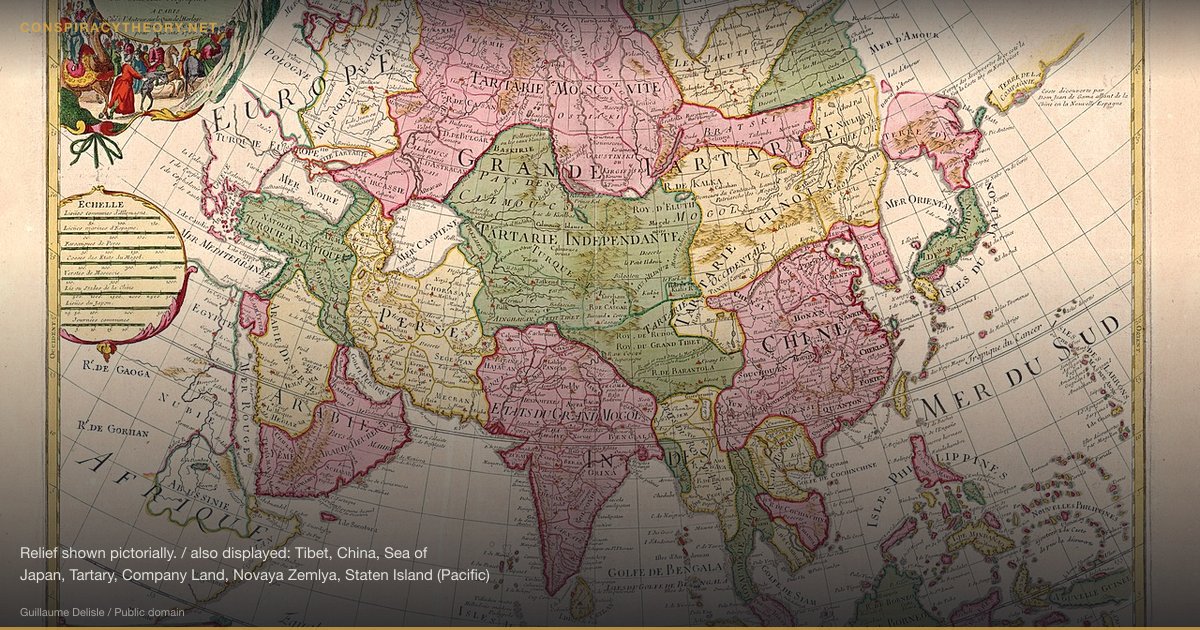
The theory emerged from internet forums around 2016-2018, primarily on YouTube channels and Reddit communities, and has grown into one of the most distinctive conspiracy movements of the social media era. It draws on misinterpretations of historical maps (which do label Central Asia as “Grand Tartary”), observations about architectural anomalies, and a general distrust of academic history.
The theory is classified as debunked. “Grand Tartary” was a genuine European cartographic term for the interior of Asia, but it described a geographic region, not a unified empire. The architectural evidence cited by proponents has mundane explanations rooted in well-documented construction practices. And the alleged “reset” events correspond to real historical disasters (fires, wars, pandemics) that are thoroughly recorded in primary sources.
Origins & History
Grand Tartary on Historical Maps
The kernel of truth that the theory exploits is real: European maps from the 16th through 19th centuries do show a vast region labeled “Tartaria Magna” or “Grand Tartary.” This territory roughly encompassed modern Siberia, Mongolia, Central Asia, and parts of China — the lands of the Mongol Empire’s successor states and various Turkic peoples. European cartographers used “Tartary” as a blanket term for territories they understood poorly, similar to how “Terra Incognita” was used for unexplored regions.
The name derives from “Tatar,” the European term for the Mongol and Turkic peoples who invaded Eastern Europe in the 13th century. Medieval Europeans often spelled it “Tartar,” associating it with Tartarus, the underworld of Greek mythology — reflecting their fear of the Mongol invasions. As geographic knowledge improved, the label gradually disappeared from maps by the mid-19th century, replaced by more specific national and regional names.
The Internet Theory Takes Shape
The modern Tartaria conspiracy theory bears no meaningful relationship to the actual historical region. It originated on Russian-language internet forums around 2016, where users began questioning the official narrative of how ornate 19th-century buildings were constructed. Key early promoters included Russian YouTuber Philipp Druzhinin and his channel “AISPIK,” which presented elaborate theories about a pre-existing civilization.
The theory migrated to English-language platforms around 2017-2018, gaining traction on Reddit’s r/Tartaria and r/CulturalLayer subreddits, as well as YouTube channels run by Jon Levi, Martin Liedtke, and Sylvie Ivanowa (whose “New Earth” channel focused on architectural anomalies). TikTok accelerated the theory’s spread dramatically from 2020 onward, with short-form videos showcasing “impossible” architecture reaching millions of views.
The Mud Flood Connection
Central to the theory is the claim of a “mud flood” — a catastrophic event that allegedly buried Tartarian civilization under layers of sediment. Proponents point to buildings with partially buried ground floors, below-grade windows, and excavated basements as evidence. This sub-theory gave rise to the broader “reset” narrative: the idea that a cataclysmic event wiped out the previous civilization, and the current world order was built atop its ruins while its history was erased.
Key Claims
- A technologically advanced global civilization: Tartaria was allegedly a worldwide empire with technology surpassing our own, including free energy systems, advanced acoustics, and atmospheric electricity harvesting
- The mud flood reset: A catastrophic event (sometimes attributed to a directed energy weapon, nuclear war, or natural disaster) buried the Tartarian civilization under mud in the 18th or 19th century
- Inherited architecture: Grand buildings of the 19th century — world’s fair pavilions, government buildings, cathedrals, railroad stations — were built by Tartarians, not by the societies that claim them. The 1893 Chicago World’s Fair is a favorite example
- Star forts as energy devices: Star-shaped military fortifications found worldwide were actually energy harvesting or distribution facilities, not defensive structures
- Free energy suppression: Tartarian buildings were designed to harness atmospheric energy through their spires, domes, and metal ornamentation, a technology subsequently suppressed by modern power companies
- Orphan trains as population replacement: The 19th-century orphan train movement in America was actually the redistribution of Tartarian children after the civilization’s adult population was eliminated
- History is fabricated: Academic history is a deliberate fabrication maintained by governments, universities, and religious institutions to conceal the truth about human civilization
Evidence & Debunking
The Maps Explained
Historical maps showing “Tartaria” or “Grand Tartary” are well understood by cartographic historians. The term was a European designation for poorly known Asian territories, similar to labels like “Cathay” for China or “Hindustan” for India. As European geographic knowledge improved through exploration and colonialism, these imprecise labels were replaced by specific names. This process is thoroughly documented in cartographic scholarship. The disappearance of “Tartary” from maps reflects improved knowledge, not a deliberate erasure.
Buried Buildings Have Mundane Explanations
The “buried first floors” that proponents cite as mud flood evidence result from several well-documented processes:
- Street grade elevation: Cities routinely raised street levels for drainage improvement, especially after flooding or as sewage systems were installed. Seattle, Portland, and dozens of other cities have documented histories of raising street grades by 5-15 feet
- Deliberate basement construction: Many 19th-century buildings were designed with below-grade service floors for storage, kitchens, and servant quarters
- Urban infill: Centuries of accumulated debris, construction fill, and deliberate land raising naturally bury lower portions of older structures
- Foundation settling: Buildings constructed on soft ground gradually sink as their foundations compress underlying soil
The Architecture Is Well-Documented
The construction of 19th-century buildings cited by Tartaria proponents is exhaustively documented. The 1893 Chicago World’s Columbian Exposition — perhaps the theory’s favorite example — left behind thousands of photographs showing construction in progress, architectural blueprints, contractor records, worker payroll documents, newspaper coverage, and personal correspondence. The buildings were designed by Daniel Burnham, Frederick Law Olmsted, and other architects whose careers, training, and other projects are fully documented.
Similarly, the spread of Neoclassical, Beaux-Arts, and Renaissance Revival architecture worldwide is explained by colonialism, architectural pattern books (widely published and distributed), international architectural education (particularly the École des Beaux-Arts in Paris), and the deliberate adoption of Western styles by modernizing nations.
Star Forts Are Military Architecture
Star-shaped fortifications (trace italienne) are a well-documented evolution in military architecture that emerged in 15th-century Italy in response to cannon warfare. The angled bastions allowed defending forces to provide covering fire along the fort’s walls, eliminating the dead zones created by traditional round or square towers. The design spread across Europe and to colonial territories through military engineers like Sébastien Le Prestre de Vauban. Thousands of military engineering treatises, construction records, and battle reports document their purpose and construction.
The Free Energy Claim
The claim that old buildings with spires and domes were energy harvesting devices has no basis in physics. Architectural ornamentation serves documented aesthetic, structural, and symbolic purposes. The buildings cited were heated by coal furnaces, lit by gas lamps (later electricity), and their construction and utility records survive in municipal archives.
Cultural Impact
A New Kind of Conspiracy
Tartaria represents a distinctively 21st-century conspiracy theory — one that emerged and spread almost entirely through social media rather than through books or talk radio. Its visual nature (photographs of grand buildings, old maps, buried facades) makes it particularly well-suited to platforms like YouTube, TikTok, and Instagram, where striking images drive engagement.
Architecture Tourism
Ironically, the Tartaria community has created a new form of architectural appreciation, with adherents visiting and documenting ornate 19th-century buildings that might otherwise be overlooked. Some architectural preservationists have noted, with ambivalence, that Tartaria enthusiasts are among the most passionate advocates for preserving historical buildings — even if their reasons for doing so are based on false premises.
Academic and Historical Response
Historians have responded to the Tartaria phenomenon with a mix of bemusement and concern. The theory fundamentally rejects the methodology of academic history — primary source analysis, archaeological evidence, peer review — in favor of visual pattern matching and intuitive reasoning. It represents a broader trend of “alternative epistemology” in which personal observation and online community consensus replace expert analysis.
Intersection with Other Conspiracies
Tartaria theory frequently intersects with other conspiracy movements, including flat earth, free energy suppression, anti-institutional narratives, and New World Order theories. The idea that all of recorded history is a fabrication maintained by a ruling elite resonates with broader conspiratorial worldviews. Some adherents incorporate elements of Great Reset theories, arguing that the Tartarian civilization was destroyed to implement the current global order.
Timeline
- 1500s-1800s — European maps label Central and Northern Asia as “Tartaria Magna” or “Grand Tartary”
- Mid-1800s — “Tartary” gradually disappears from maps as geographic knowledge improves
- 2016 — Early Tartaria theories emerge on Russian-language internet forums
- 2017 — r/CulturalLayer subreddit created, becoming an early English-language hub for the theory
- 2018 — r/Tartaria subreddit created; theory spreads to English-speaking YouTube channels
- 2018 — Jon Levi’s YouTube channel begins regular Tartaria content, gaining hundreds of thousands of subscribers
- 2019 — “Mud flood” becomes a trending search term; New Earth channel launches with architectural analysis
- 2020 — COVID-19 lockdowns accelerate online engagement with Tartaria content
- 2020-2021 — TikTok becomes a major distribution platform for Tartaria content, reaching mainstream audiences
- 2022 — Vice, The Atlantic, and other major outlets publish features on the Tartaria phenomenon
- 2023 — Tartaria content continues to grow across platforms; some content moderation begins
- 2024-2025 — Theory remains active, with new adherents discovering it through short-form video recommendations
Sources & Further Reading
- Newitz, Annalee. “The Bizarre History of Tartaria, the Conspiracy Theory That Says We’re Living in an Invented World.” Slate, 2021.
- Radford, Benjamin. “Tartaria and the Mud Flood: An Internet Conspiracy Theory Examined.” Skeptical Inquirer, 2022.
- Harries, John. “Grand Tartary: The History Behind the Map Label.” Imago Mundi, 2003.
- Pollard, Justin. “Trace Italienne: The Military Revolution in Fortification.” History Today, 2009.
- Graham, David A. “The Conspiracy Theory That Explains Everything.” The Atlantic, 2022.
- Hatherley, Owen. “What Is ‘Tartaria’ and Why Does It Claim All Architecture?” Dezeen, 2022.
- McLaughlin, Timothy. “The Rise of the ‘Tartaria’ Conspiracy Theory.” Vice, 2021.
- Harrison, P. “Mapping the Unknown: European Cartographic Representations of Central Asia.” Journal of Historical Geography, 2009.
Frequently Asked Questions
Was Tartaria a real empire?
What is the mud flood theory?
Why do old buildings look similar around the world?

Infographic
Share this visual summary. Right-click to save.
