Templar Treasure at Rosslyn Chapel

Overview
Rosslyn Chapel is a small, unfinished medieval church perched on a hill above Roslin Glen in Midlothian, Scotland. It measures roughly 69 feet long by 35 feet wide. It has no tower, no nave (the planned extension was never built), and for much of its history, its roof leaked so badly that the carvings inside were dissolving. It is, by any objective measure, a modest building.
It is also, according to a theory that has generated millions of dollars in book sales, a blockbuster Hollywood film, and an international tourist industry, the hiding place of the Holy Grail. Or the Ark of the Covenant. Or ancient scrolls from the Temple of Solomon. Or the lost treasure of the Knights Templar. Or the mummified head of Jesus Christ. The specifics depend on which book you’ve read.
The Rosslyn Chapel treasure theory is one of the most commercially successful conspiracy narratives ever constructed. Popularized by a sequence of pseudo-historical books in the 1980s and 1990s, then detonated into the global mainstream by Dan Brown’s The Da Vinci Code in 2003, it transformed a crumbling rural chapel into one of Scotland’s most visited tourist attractions and lodged the idea of Templar treasure at Rosslyn permanently in popular culture. The theory has been debunked by historians, archaeologists, and even the chapel’s own custodians — but its romantic appeal has proved far more durable than its evidence.
Origins & History
The Building of Rosslyn Chapel
The historical facts about Rosslyn Chapel are well-documented, if less exciting than the legends. Construction began in 1446 under William Sinclair, 1st Earl of Caithness (sometimes spelled “St. Clair”), a Scottish nobleman with significant wealth and political connections. William’s intention was to build a large collegiate church — a church staffed by a college of canons who would say prayers for his family’s souls. The elaborate choir section was completed by the time of William’s death around 1484, but the planned nave, tower, and transepts were never built. What stands today is essentially the east end of a much larger church that was never finished.
The chapel’s interior is extraordinary. Almost every surface is covered with carved stone decoration — a density of ornament virtually unmatched in Scottish architecture. The carvings include biblical scenes (the expulsion from Eden, the crucifixion, angels with instruments), botanical motifs (flowers, leaves, vines), animal figures, and numerous “Green Men” — foliate heads common in medieval European art. The most famous single feature is the Apprentice Pillar, an elaborately carved column with an attached legend about a master mason and his apprentice.
For centuries, none of this was considered particularly mysterious. The chapel was understood to be a lavish example of late Gothic ecclesiastical architecture, remarkable for the quality and quantity of its carvings but not for any hidden content. It fell into disuse after the Scottish Reformation, served as a horse stable during Oliver Cromwell’s occupation, and gradually deteriorated until restoration efforts began in the 19th century.
The Templar Connection Is Invented
The association between Rosslyn Chapel and the Knights Templar is a relatively modern construction. Its roots lie in 18th-century Freemasonry, not medieval history.
Scottish Freemasonry developed elaborate origin myths claiming descent from the Knights Templar, the builders of Solomon’s Temple, and ancient mystery traditions. The Sinclair family became central to these myths because William Sinclair of Rosslyn held the hereditary title of Grand Master Mason of Scotland — a title that Freemasons later reinterpreted as “Grand Master of the Freemasons,” an entirely different claim. The chapel, with its dense carvings that could be interpreted as symbolic or coded, became a natural focus for Masonic-Templar mythology.
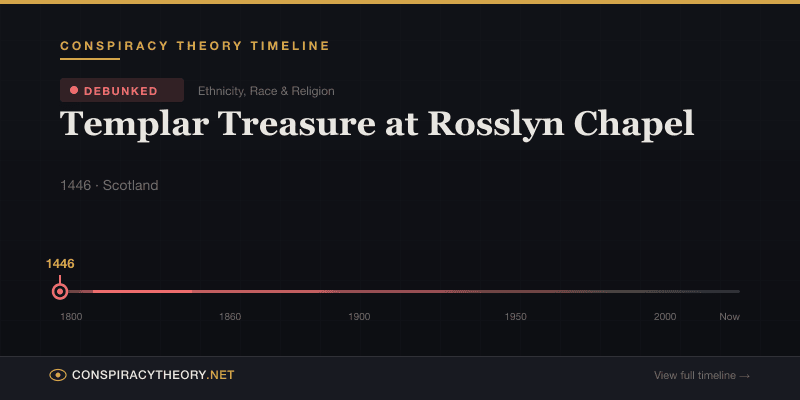
The critical fact that undermines the entire Templar-Rosslyn connection is chronology: the Knights Templar were dissolved in 1312. Rosslyn Chapel was begun in 1446 — 134 years later. William Sinclair was not a Templar. He could not have been a Templar. The order had ceased to exist more than a century before he laid the first stone.
Proponents address this gap by arguing that Templar knowledge and traditions survived in secret, passing through the Sinclair family across generations. This is asserted without documentary evidence.
The Book That Started Everything
The modern Rosslyn treasure theory owes its existence primarily to two books. The first was The Holy Blood and the Holy Grail (1982) by Michael Baigent, Richard Leigh, and Henry Lincoln, which wove together the Priory of Sion hoax, Templar mythology, and the claim that Jesus and Mary Magdalene had descendants whose bloodline survived into European nobility. While the book focused primarily on France, it established the broader narrative framework — secret societies, hidden treasure, suppressed religious truths — that would later be applied to Rosslyn.
The second and more Rosslyn-specific foundation was laid by Christopher Knight and Robert Lomas in The Hiram Key (1996), which argued that Rosslyn Chapel was built as a replica of the Temple of Solomon and that its vaults contained scrolls hidden by the Templars after they excavated beneath the Temple Mount in Jerusalem. Andrew Sinclair’s The Sword and the Grail (1992) pushed the Sinclair-Templar connection, linking Rosslyn to the alleged Templar expedition to America.
The Da Vinci Code Explosion
Then came Dan Brown.
The Da Vinci Code, published in 2003, sold over 80 million copies worldwide and was adapted into a 2006 film starring Tom Hanks. The novel’s climax takes place at Rosslyn Chapel, which Brown depicts as the final resting place of the Holy Grail — revealed in his narrative to be not a cup but the remains of Mary Magdalene and documents proving Jesus’s bloodline.
Brown’s novel was fiction, and he said so. But it was written in a style that blurred the line between thriller and pseudo-history, opening with a page headed “FACT” that listed the Priory of Sion and Opus Dei as real organizations. Millions of readers came away believing that the novel’s historical claims were essentially true, or at least plausible. The effect on Rosslyn Chapel was immediate and transformative: annual visitor numbers exploded from around 30,000 to over 175,000, generating enough revenue to fund a comprehensive restoration of the building.
The irony is considerable. A theory about hidden treasure literally saved the chapel — not because the treasure was real, but because the story was profitable.
Key Claims
-
Rosslyn Chapel is a coded Templar structure. The chapel’s elaborate carvings are not decorative but symbolic, encoding Templar secrets, Masonic knowledge, or the location of hidden treasure.
-
Vaults beneath the chapel contain Templar treasure. Sealed crypts beneath the chapel floor hold the accumulated wealth of the Knights Templar, hidden there after the order’s suppression.
-
The Holy Grail is at Rosslyn. Depending on the version, the Grail is a physical chalice, the bones of Mary Magdalene, or documents about the Jesus bloodline, stored in the chapel’s vaults.
-
The Ark of the Covenant is at Rosslyn. Some versions claim the Templars recovered the Ark from beneath Solomon’s Temple and transported it to Scotland via the Sinclair family.
-
Scrolls from Solomon’s Temple are hidden there. The Templars allegedly excavated beneath the Temple Mount during the Crusades and recovered ancient documents, which were brought to Rosslyn for safekeeping.
-
The chapel is a replica of Solomon’s Temple. The chapel’s dimensions and design supposedly mirror the biblical Temple of Solomon, indicating its builders had access to Templar knowledge of the original structure.
-
Carvings depict New World plants. Certain botanical carvings in the chapel allegedly depict maize (corn) and aloe, plants native to the Americas — proving the Sinclairs had contact with the New World before Columbus, connecting to the Templar New World discovery theory.
-
The Apprentice Pillar contains the Grail. The most dramatic claim holds that the Holy Grail is physically encased inside the Apprentice Pillar, hidden within the stone column itself.
Evidence
The Carvings
The carvings at Rosslyn are genuinely remarkable, and their sheer density has invited interpretive overreach for decades.
The “Corn” Carvings. Several arched carvings in the chapel feature what some observers have identified as ears of maize (corn), a New World crop that should not appear in a building constructed before Columbus’s voyage. If genuine, this would be significant evidence of pre-Columbian transatlantic contact.
However, art historians who have examined the carvings closely identify them as stylized depictions of wheat, lilies, or strawberry plants — all common motifs in medieval European decorative carving. The “corn” identification requires seeing the carvings in a specific way; they do not unambiguously depict maize. Botanist Adrian Dyer, who studied the carvings in 2010, concluded they were consistent with European botanical motifs and showed no definitive New World species.
The Green Men. Over 100 Green Men — foliate heads with vegetation sprouting from mouths, ears, or eyes — appear throughout the chapel. These are sometimes cited as pagan or Templar symbols. In reality, Green Men are among the most common decorative motifs in medieval European churches, appearing in hundreds of buildings across the continent. They are part of a widespread artistic tradition, not a unique coded message.
Templar Symbols. Proponents identify various carvings as Templar crosses, Masonic symbols, or alchemical diagrams. Professional art historians note that the same motifs appear in churches throughout medieval Europe that have no Templar connection. The carvings are consistent with the standard decorative repertoire of 15th-century Scottish ecclesiastical architecture.
The Vaults
Rosslyn Chapel does have vaults beneath its floor. This has been confirmed by ground-penetrating radar (GPR) surveys conducted in 2010 by the Rosslyn Chapel Trust in partnership with archaeologists.
What was found: The GPR survey revealed several underground chambers beneath the chapel floor, consistent in size and configuration with burial vaults. Medieval collegiate churches routinely included crypts for the burial of the founding family and the canons who served the church. The Sinclair family is known to have been buried in the vaults for generations.
What was not found: No evidence of treasure, unusual artifacts, or chambers inconsistent with normal burial use. The vaults have not been excavated — the chapel trust has declined to open them, partly out of respect for the burials and partly because the chapel’s structural integrity could be compromised. This refusal to dig has, predictably, been cited by conspiracy theorists as evidence of a cover-up.
The Temple of Solomon Claim
Knight and Lomas argued that Rosslyn Chapel’s floor plan mirrors that of Herod’s Temple (the Second Temple) in Jerusalem. This claim has been rejected by architectural historians. The chapel’s dimensions and layout are consistent with a standard medieval collegiate church choir, and its proportions differ significantly from biblical and archaeological descriptions of the Temple. The comparison requires selective measurement and ignores the chapel’s obvious relationship to contemporary Scottish church design.
The Sinclair-Templar Link
The evidentiary chain connecting the Sinclair family to the Knights Templar is remarkably thin:
- The Sinclairs held land in Scotland during the Templar era, but no documentary evidence connects them to the order itself.
- The hereditary title of “Grand Master Mason” held by the Sinclairs related to guild masonry (regulating the stonemasons’ trade), not speculative Freemasonry or the Templars.
- The Masonic-Templar connection that later accrued to the Sinclair family was constructed in the 18th century, not the medieval period.
- No contemporary document from the 14th or 15th century mentions the Sinclairs in connection with the Templars, their treasure, or their secrets.
Debunking / Verification
-
The chronology is fatal. The Templars were dissolved in 1312. The chapel was built starting in 1446. No documentary evidence connects the two. Every claim that bridges this 134-year gap relies on speculation about secret transmissions of knowledge through the Sinclair family — speculation for which no evidence exists.
-
The Priory of Sion is a proven hoax. A significant portion of the Rosslyn-Grail narrative descends from The Holy Blood and the Holy Grail, which relied heavily on documents planted in the Bibliotheque nationale by Pierre Plantard, a French fantasist who later admitted the fraud under oath. The Priory of Sion never existed as described, and claims built on its “evidence” are built on sand.
-
The carvings have conventional explanations. Every motif cited as Templar symbolism, New World botany, or encoded treasure maps has been identified by professional art historians as standard elements of 15th-century European ecclesiastical decoration. The interpretations offered by conspiracy authors require no specialized knowledge of medieval art — and it shows.
-
The vaults are consistent with burial crypts. The underground chambers revealed by GPR are exactly what you would expect beneath a medieval collegiate church: family burial vaults. Their presence is not evidence of hidden treasure.
-
The chapel’s own custodians reject the theory. The Rosslyn Chapel Trust, which manages and conserves the building, has consistently stated that the chapel is a medieval church, not a Templar structure or treasure vault. While the trust has benefited financially from the Da Vinci Code tourism boom, it has made no claims supporting the conspiracy theory.
-
Dan Brown wrote a novel. The Da Vinci Code is fiction. Brown said so. The fact that millions of readers treated it as history says something interesting about the relationship between narrative and belief, but it does not constitute evidence.
Cultural Impact
The Da Vinci Code Tourism Phenomenon
The impact of The Da Vinci Code on Rosslyn Chapel cannot be overstated. Before the novel, the chapel was a modestly visited historic site struggling to fund its conservation. After the novel, it became an international destination. Visitor numbers increased roughly sixfold. Revenue from admissions, gift shop sales, and guided tours funded a comprehensive conservation program that stabilized the building and restored its carvings.
This created a paradox that the chapel’s custodians have navigated with visible discomfort: the institution responsible for the chapel’s care is financially dependent on a narrative it officially denies. The visitor center presents the chapel’s actual history, but the gift shop sells books about Templars and the Grail.
Broader Impact on Templar Mythology
Rosslyn Chapel became the anchor point for a network of interconnected Templar conspiracies. The chapel connected the dots between the Priory of Sion, the Holy Grail bloodline theory, the Templar voyage to America, Oak Island, and Freemasonry. It served as the physical location that made an otherwise abstract web of speculation feel tangible. You could go there. You could touch the carvings. You could stand above the vaults and imagine what might be below.
Academic and Architectural Response
The Rosslyn phenomenon provoked a significant response from professional historians. Mark Oxbrow and Ian Robertson published Rosslyn and the Grail (2005), a methodical debunking that examined each conspiracy claim against documentary evidence. The Rosslyn Chapel Trust commissioned its own academic history. Medieval art historians published analyses demonstrating that the chapel’s carvings were conventional for their period and region.
These correctives have been widely cited but have not significantly dented the popular narrative. The conspiracy version is simply a better story, and stories are what people remember.
In Popular Culture
- The Da Vinci Code (2003) by Dan Brown — the novel that made Rosslyn Chapel globally famous; adapted into a 2006 film directed by Ron Howard with Tom Hanks filming at the actual chapel
- The Holy Blood and the Holy Grail (1982) by Baigent, Leigh, and Lincoln — the pseudo-historical foundation for the Rosslyn-Grail connection
- The Hiram Key (1996) by Knight and Lomas — claimed Rosslyn as a replica of Solomon’s Temple
- The Sword and the Grail (1992) by Andrew Sinclair — connected the Sinclair family, Templars, and the Grail
- Rosslyn Chapel: The Music of the Cubes (2007) — Thomas and Stuart Mitchell’s claim that the carvings encode a medieval musical composition
- The chapel has appeared in numerous documentaries on the History Channel, National Geographic, and BBC
- Video game Assassin’s Creed franchise features Templar-related storylines inspired by the broader mythology
Key Figures
- William Sinclair, 1st Earl of Caithness (c. 1410-1484) — Founder and builder of Rosslyn Chapel
- Dan Brown (b. 1964) — Author of The Da Vinci Code, which made Rosslyn Chapel a global phenomenon
- Michael Baigent (1948-2013) — Co-author of The Holy Blood and the Holy Grail, foundational pseudo-historical text
- Henry Lincoln (b. 1930) — Co-author of The Holy Blood and the Holy Grail and BBC documentary filmmaker
- Andrew Sinclair (1935-2019) — Sinclair family member, historian, and author who promoted the Templar-Sinclair connection
- Christopher Knight and Robert Lomas — Authors of The Hiram Key, claiming Rosslyn replicates Solomon’s Temple
- Pierre Plantard (1920-2000) — French fantasist who fabricated the Priory of Sion documents that underpin part of the narrative
Timeline
| Date | Event |
|---|---|
| 1119 | Knights Templar founded |
| 1312 | Templar order dissolved by Pope Clement V |
| 1446 | Construction of Rosslyn Chapel begins under William Sinclair |
| c. 1484 | Chapel construction halts upon William Sinclair’s death; planned nave never built |
| 1560s | Scottish Reformation; chapel falls into disuse |
| 1650s | Cromwellian forces use chapel as stables |
| 1736 | Sinclair family connection to Scottish Freemasonry formalized |
| 1800s | Restoration efforts begin; Romantic-era visitors begin noting the chapel’s mystery |
| 1982 | The Holy Blood and the Holy Grail published, establishing Templar-Grail pseudo-history |
| 1992 | Andrew Sinclair publishes The Sword and the Grail |
| 1996 | Knight and Lomas publish The Hiram Key |
| 2003 | Dan Brown publishes The Da Vinci Code; Rosslyn becomes a global phenomenon |
| 2005 | Mark Oxbrow and Ian Robertson publish Rosslyn and the Grail (debunking) |
| 2006 | The Da Vinci Code film released; chapel visitor numbers surge |
| 2010 | Ground-penetrating radar survey reveals burial vaults beneath the chapel |
| 2011 | Major conservation project completed, funded in part by Da Vinci Code tourism revenue |
Sources & Further Reading
- Oxbrow, Mark, and Ian Robertson. Rosslyn and the Grail. Mainstream Publishing, 2005.
- Baigent, Michael, Richard Leigh, and Henry Lincoln. The Holy Blood and the Holy Grail. Jonathan Cape, 1982.
- Knight, Christopher, and Robert Lomas. The Hiram Key. Century, 1996.
- Sinclair, Andrew. The Sword and the Grail. Crown, 1992.
- Brown, Dan. The Da Vinci Code. Doubleday, 2003.
- Barber, Malcolm. The New Knighthood: A History of the Order of the Temple. Cambridge University Press, 1994.
- Thompson, Robert L.D. Rosslyn Chapel Decoded. 2013.
- Butler, Alan, and John Ritchie. Rosslyn Revealed: A Library in Stone. O Books, 2006.
- Rosslyn Chapel Trust — official history and conservation reports, rosslynchapel.com.
Related Theories
- Knights Templar Discovered America — the theory that Templar-connected explorers reached the New World, often linked to the Sinclair family
- Priory of Sion — the fabricated secret society central to the Holy Blood and the Holy Grail narrative
- Holy Grail Bloodline — the theory that Jesus had descendants, which intersects with Rosslyn through the Da Vinci Code
- Holy Grail Chalice Theories — competing theories about what the Grail actually is
- Freemasonry Conspiracy — Masonic claims to Templar heritage that connect to the Sinclair family
- Oak Island Money Pit — another alleged Templar treasure site, sometimes linked to Rosslyn in the same narrative chain
Frequently Asked Questions
Is there really treasure hidden under Rosslyn Chapel?
Was Rosslyn Chapel built by the Knights Templar?
What did 'The Da Vinci Code' claim about Rosslyn Chapel?
What are the carvings in Rosslyn Chapel and what do they mean?
Infographic
Share this visual summary. Right-click to save.
