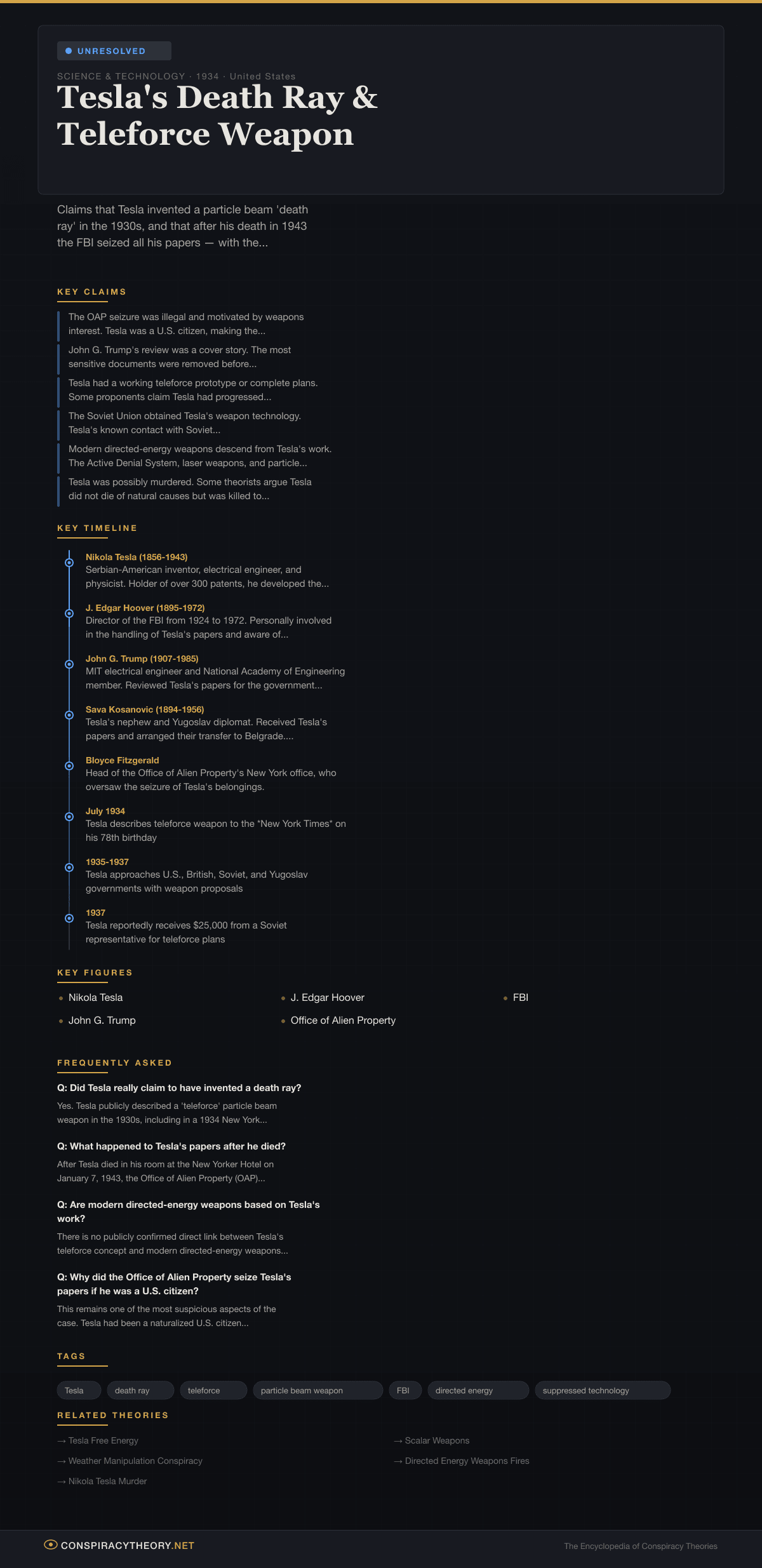
Tesla's Death Ray & Teleforce Weapon
Overview
Nikola Tesla, the Serbian-American inventor whose contributions to alternating current electricity, radio, and numerous other technologies transformed the modern world, spent the final decade of his life claiming to have developed a revolutionary weapon. He called it “teleforce” — a device that would project a concentrated beam of particles at enormous velocity, capable of destroying aircraft and armies at distances of hundreds of miles. The press dubbed it a “death ray,” a label Tesla disliked but that has persisted in popular imagination.
Tesla died alone in Room 3327 of the New Yorker Hotel on January 7, 1943, at the age of 86. Within hours, despite his status as a naturalized American citizen, the Office of Alien Property seized his belongings — an estimated 80 trunks of papers, models, and personal effects. The FBI became involved, and MIT electrical engineer John G. Trump was brought in to evaluate the materials. Trump’s official conclusion was that Tesla’s papers contained “nothing which would constitute a hazard in unfriendly hands.”
The conspiracy theory holds that this assessment was either a deliberate cover story or that the most sensitive documents — including workable plans for the teleforce weapon — were separated from the collection before Trump’s review. Proponents argue that the U.S. government (or possibly the Soviet Union, which Tesla had also approached) successfully developed Tesla’s weapon technology in secret, and that modern directed-energy weapons are the descendants of his work. The theory sits at the intersection of documented historical facts — Tesla’s genuine claims, the real seizure of his papers, and the actual development of directed-energy weapons decades later — and speculative connections that remain unproven.
Origins & History
Tesla’s Weapon Claims
Tesla first publicly described his teleforce concept on his 78th birthday in July 1934, in an interview with the New York Times. He described a weapon that would send concentrated beams of particles through the air, using a new type of vacuum seal and an open-ended vacuum tube. He claimed the device could bring down a fleet of 10,000 enemy airplanes at a distance of 250 miles and could make any nation impregnable against attack.
Tesla characterized the weapon not as an offensive tool but as a defensive one, calling it a “peace ray” that would make war impossible by rendering attack futile. This framing was consistent with his lifelong interest in technologies that could end warfare — he had previously proposed similar ideas using electromagnetic means.
Throughout the mid-to-late 1930s, Tesla approached multiple governments with his concept. He is documented to have contacted the United States War Department, the United Kingdom, the Soviet Union, and Yugoslavia. According to various accounts, the Soviet Union may have paid Tesla $25,000 for preliminary plans, though the details of this transaction remain murky. The U.S. and British governments showed interest but did not fund the project.
Tesla claimed the weapon required four separate inventions working in concert: a new method for producing very high voltages, a new apparatus for producing immense electrical force, a method of amplifying this force, and a new method for producing a tremendous electrical repelling force. He described the beam as consisting of microscopic particles of matter projected at enormous velocities.
The Death and Seizure
Tesla was found dead in his hotel room on January 7, 1943, by hotel maid Alice Monaghan. The New York City medical examiner ruled the cause of death as coronary thrombosis. His body was discovered several hours after death, though some accounts suggest it may have been longer.
What followed has been the primary fuel for conspiracy theories. The Office of Alien Property (OAP), a wartime agency responsible for seizing assets of foreign nationals in the United States, took custody of Tesla’s belongings. This was legally anomalous: Tesla had been a U.S. citizen since 1891, which should have placed his estate outside the OAP’s jurisdiction. The FBI was also involved, with Director J. Edgar Hoover taking a personal interest in the case.
The government brought in John G. Trump, a respected MIT electrical engineer and physicist who would later become known as the uncle of Donald Trump, to evaluate the technical papers. After a three-day review, Trump produced a report stating that Tesla’s papers contained “speculative, philosophical, and somewhat promotional” material but nothing of practical military significance. His evaluation specifically addressed the death ray concept, concluding that Tesla’s ideas, “did not include new, sound, workable principles or methods for realizing such results.”
Tesla’s belongings were eventually released to his nephew, Sava Kosanovic, the Yugoslav ambassador to the United States, who arranged for their transfer to the Nikola Tesla Museum in Belgrade in 1952. However, the question of whether all materials were returned has never been definitively settled.
The Cold War Context
The seizure of Tesla’s papers took place during World War II, a period when the U.S. government routinely classified and seized scientific materials related to weapons development. The Manhattan Project was underway, radar technology was a closely guarded secret, and the military was actively pursuing any potential advantage.
During the Cold War, both the United States and Soviet Union invested heavily in directed-energy weapons research. The U.S. pursued particle beam weapons as part of the Strategic Defense Initiative (SDI, popularly known as “Star Wars”) in the 1980s. The Soviet Union conducted its own parallel research. Whether any of this research drew on Tesla’s ideas — either directly through his papers or indirectly through his published concepts — remains a matter of speculation.
Key Claims
-
The OAP seizure was illegal and motivated by weapons interest. Tesla was a U.S. citizen, making the OAP’s jurisdiction questionable. The seizure’s true purpose was to secure teleforce weapon plans for government use, not routine alien property management.
-
John G. Trump’s review was a cover story. The most sensitive documents were removed before Trump’s evaluation, or his official report deliberately downplayed their significance on government orders.
-
Tesla had a working teleforce prototype or complete plans. Some proponents claim Tesla had progressed beyond theoretical descriptions to practical designs or even a working model, which was seized and developed in secret.
-
The Soviet Union obtained Tesla’s weapon technology. Tesla’s known contact with Soviet representatives, combined with the $25,000 payment, may have given the USSR access to teleforce principles, motivating the U.S. seizure as a damage-limitation exercise.
-
Modern directed-energy weapons descend from Tesla’s work. The Active Denial System, laser weapons, and particle beam research programs are argued to be the classified descendants of Tesla’s seized technology.
-
Tesla was possibly murdered. Some theorists argue Tesla did not die of natural causes but was killed to facilitate the seizure of his work, though no credible evidence supports this claim.
-
Tesla’s broader technological legacy has been deliberately suppressed. The death ray theory is part of a larger narrative that Tesla’s inventions — including free energy devices and earthquake machines — have been systematically suppressed by governments and corporate interests.
Evidence
Documented Facts Supporting the Theory’s Framework
Several aspects of the case are matters of historical record, not speculation:
Tesla genuinely claimed to have developed the teleforce concept and described it in multiple public statements and private communications over nearly a decade. These were not vague hints but detailed (if incomplete) technical descriptions published in major newspapers.
The OAP seizure of a U.S. citizen’s property was legally irregular. While wartime powers gave the government broad authority, the specific use of the OAP for a naturalized citizen was unusual and has never been fully explained.
The FBI maintained a file on Tesla. Documents released through the Freedom of Information Act (FOIA) confirm that the Bureau monitored Tesla, was aware of his weapons claims, and took an active interest in his papers after his death. Hoover personally corresponded about the case.
John G. Trump’s three-day review of decades of accumulated papers, models, and notebooks was remarkably brief. Critics question whether any evaluator could meaningfully assess Tesla’s extensive body of work in such a short time.
The U.S. government subsequently invested billions in directed-energy weapons research during the Cold War, including particle beam weapons that bear conceptual similarity to Tesla’s descriptions.
Evidence Against the Theory
Trump’s assessment was not conducted casually. He was a highly qualified electrical engineer who specialized in high-voltage phenomena — precisely the domain of Tesla’s claimed weapon. His evaluation was consistent with the assessments of other scientists who had reviewed Tesla’s later claims during his lifetime.
Tesla’s financial situation in his final years suggests he was not in possession of a working prototype. He lived in modest hotel rooms, relied on support from the Yugoslav government and Westinghouse Corporation, and was known to make grandiose claims that he could not substantiate. His later career was marked by a pattern of announcing revolutionary inventions that never materialized.
No physical evidence of a teleforce device — no prototype, component, or workable blueprint — has ever surfaced from Tesla’s papers, either those held in Belgrade or those released through FOIA requests.
The particle beam weapons researched during the Cold War were developed from independent physics principles, primarily drawing on post-World War II particle accelerator technology. Scientists involved in these programs have not credited Tesla’s work as a foundation.
FOIA Releases
The FBI released approximately 250 pages of Tesla-related documents through FOIA requests over the decades. These documents confirm government interest in Tesla’s weapons claims and the involvement of multiple agencies in handling his estate. However, they do not contain evidence of a cover-up or suppressed weapon technology. Conspiracy theorists argue this absence itself is evidence that the most sensitive documents remain classified.
Debunking / Verification
The Tesla death ray theory is classified as unresolved because it combines documented facts with unverifiable speculation in ways that resist definitive conclusion.
The core historical facts — Tesla’s claims, the irregular seizure, FBI interest, and subsequent directed-energy weapons research — are all verified. What remains unproven is the conspiratorial link between these facts: that Tesla had workable weapon technology, that it was deliberately seized and suppressed (or developed in secret), and that modern weapons systems derive from it.
Physicists have noted that Tesla’s published descriptions of the teleforce concept, while imaginative, contain fundamental problems. His proposed method for accelerating particles required an open-ended vacuum tube — a concept that contradicts the basic physics of maintaining a vacuum. His claimed range of 250 miles would require solving particle beam dispersion problems that remain challenging even with modern technology.
However, Tesla was known for describing his inventions in deliberately vague or misleading terms to protect intellectual property, which means his public descriptions may not reflect his actual designs. This makes it impossible to definitively evaluate his claims based solely on published material.
The question of what, if anything, was removed from Tesla’s collection before or after Trump’s review may never be answerable. The passage of time, the wartime context, and the involvement of multiple government agencies with classified operations mean that a complete accounting of Tesla’s papers is probably impossible.
Cultural Impact
Tesla’s death ray has become one of the most enduring symbols in the broader cultural mythology surrounding Nikola Tesla. Beginning in the 1990s, Tesla experienced a dramatic posthumous rehabilitation in popular culture. Once overshadowed by Thomas Edison in public memory, Tesla became an icon — the misunderstood genius whose revolutionary ideas were stolen, suppressed, or ignored by a lesser world.
The death ray narrative fits perfectly into this rehabilitation. It combines the elements that make Tesla’s story compelling: genuine brilliance, institutional opposition, government intrigue, and the tantalizing possibility that transformative technology remains hidden. The theory has been amplified by the internet, where Tesla appreciation communities grew rapidly in the 2000s and 2010s.
The story has also influenced real-world policy discussions about directed-energy weapons, which have moved from science fiction to military reality. The U.S. Navy’s deployment of laser weapons on warships, the development of the Active Denial System (a millimeter-wave crowd control device), and various missile defense concepts all invite comparisons to Tesla’s vision, regardless of whether any direct connection exists.
The association of John G. Trump with Donald Trump has added a layer of political interest to the story in recent years, generating social media speculation about whether the Trump family possesses secret Tesla technology — claims that are entirely without evidence but that demonstrate how conspiracy theories can evolve and attach to contemporary figures.
In Popular Culture
- Film: The Prestige (2006) features a fictionalized Tesla (played by David Bowie) who creates a matter transportation device; The Current War (2017) depicts the Edison-Tesla rivalry
- Television: Warehouse 13 features Tesla’s inventions as powerful artifacts; Sanctuary includes Tesla as a recurring character; Murdoch Mysteries depicts Tesla and his inventions
- Video Games: Command & Conquer: Red Alert series features Tesla coils as weapons; BioShock Infinite includes Teslapunk aesthetics and weapons
- Literature: Tesla appears as a character in numerous science fiction and alternative history novels; W. Bernard Carlson’s Tesla: Inventor of the Electrical Age (2013) provides a scholarly biography
- Music: Tesla (the band), numerous references in industrial and electronic music
- Comics: Tesla appears frequently in steampunk and alternative history comics, often wielding death ray-like devices
Key Figures
- Nikola Tesla (1856-1943) — Serbian-American inventor, electrical engineer, and physicist. Holder of over 300 patents, he developed the AC motor, the Tesla coil, and contributed fundamental advances in radio, X-ray technology, and remote control. His teleforce weapon claims dominated his final decade.
- J. Edgar Hoover (1895-1972) — Director of the FBI from 1924 to 1972. Personally involved in the handling of Tesla’s papers and aware of the inventor’s weapons claims through FBI surveillance.
- John G. Trump (1907-1985) — MIT electrical engineer and National Academy of Engineering member. Reviewed Tesla’s papers for the government and concluded they contained nothing of military significance. Uncle of Donald Trump.
- Sava Kosanovic (1894-1956) — Tesla’s nephew and Yugoslav diplomat. Received Tesla’s papers and arranged their transfer to Belgrade. His diplomatic status added Cold War intrigue to the story.
- Bloyce Fitzgerald — Head of the Office of Alien Property’s New York office, who oversaw the seizure of Tesla’s belongings.
Timeline
- July 1934 — Tesla describes teleforce weapon to the New York Times on his 78th birthday
- 1935-1937 — Tesla approaches U.S., British, Soviet, and Yugoslav governments with weapon proposals
- 1937 — Tesla reportedly receives $25,000 from a Soviet representative for teleforce plans
- January 5, 1943 — Tesla’s last known meeting, with Yugoslav diplomats at the New Yorker Hotel
- January 7, 1943 — Tesla found dead in his hotel room; cause of death ruled coronary thrombosis
- January 8-9, 1943 — FBI notified; Office of Alien Property seizes Tesla’s belongings (approximately 80 trunks)
- January 26-28, 1943 — John G. Trump reviews Tesla’s papers over three days
- January 30, 1943 — Trump submits report concluding papers contain nothing of military value
- 1943-1952 — Tesla’s papers held in government storage amid legal disputes over his estate
- 1952 — Most papers shipped to the Nikola Tesla Museum in Belgrade, Yugoslavia
- 1980s — Strategic Defense Initiative (Star Wars) pursues particle beam weapons research
- 2016 — FBI releases additional Tesla-related FOIA documents, fueling renewed interest
- 2020s — U.S. military deploys operational directed-energy weapons on naval vessels
Sources & Further Reading
- Carlson, W. Bernard. Tesla: Inventor of the Electrical Age. Princeton University Press, 2013.
- Cheney, Margaret. Tesla: Man Out of Time. Simon & Schuster, 1981.
- Seifer, Marc. Wizard: The Life and Times of Nikola Tesla. Citadel Press, 1996.
- Tesla, Nikola. “A Machine to End War.” Liberty magazine, February 1937.
- “Tesla, at 78, Bares New ‘Death Beam.’” New York Times, July 11, 1934.
- FBI Records: The Vault — Nikola Tesla. Federal Bureau of Investigation FOIA releases.
- Trump, John G. Report on Tesla papers to the Office of Alien Property, January 30, 1943.
- O’Neill, John J. Prodigal Genius: The Life of Nikola Tesla. Ives Washburn, 1944.
- Harnessing the Particle Beam: The Strategic Defense Initiative. U.S. Department of Defense archives.
Related Theories
- Tesla Free Energy Suppression — Claims that Tesla discovered methods of wireless energy transmission that were suppressed by industrial interests
- Scalar Weapons — The theory that scalar electromagnetic waves can be weaponized, often attributed to Tesla’s research
- HAARP — Weather and mind control claims about the High-frequency Active Auroral Research Program, sometimes linked to Tesla technology
- Government Technology Suppression — The broader theory that governments suppress revolutionary technologies

Frequently Asked Questions
Did Tesla really claim to have invented a death ray?
What happened to Tesla's papers after he died?
Are modern directed-energy weapons based on Tesla's work?
Why did the Office of Alien Property seize Tesla's papers if he was a U.S. citizen?
Infographic
Share this visual summary. Right-click to save.