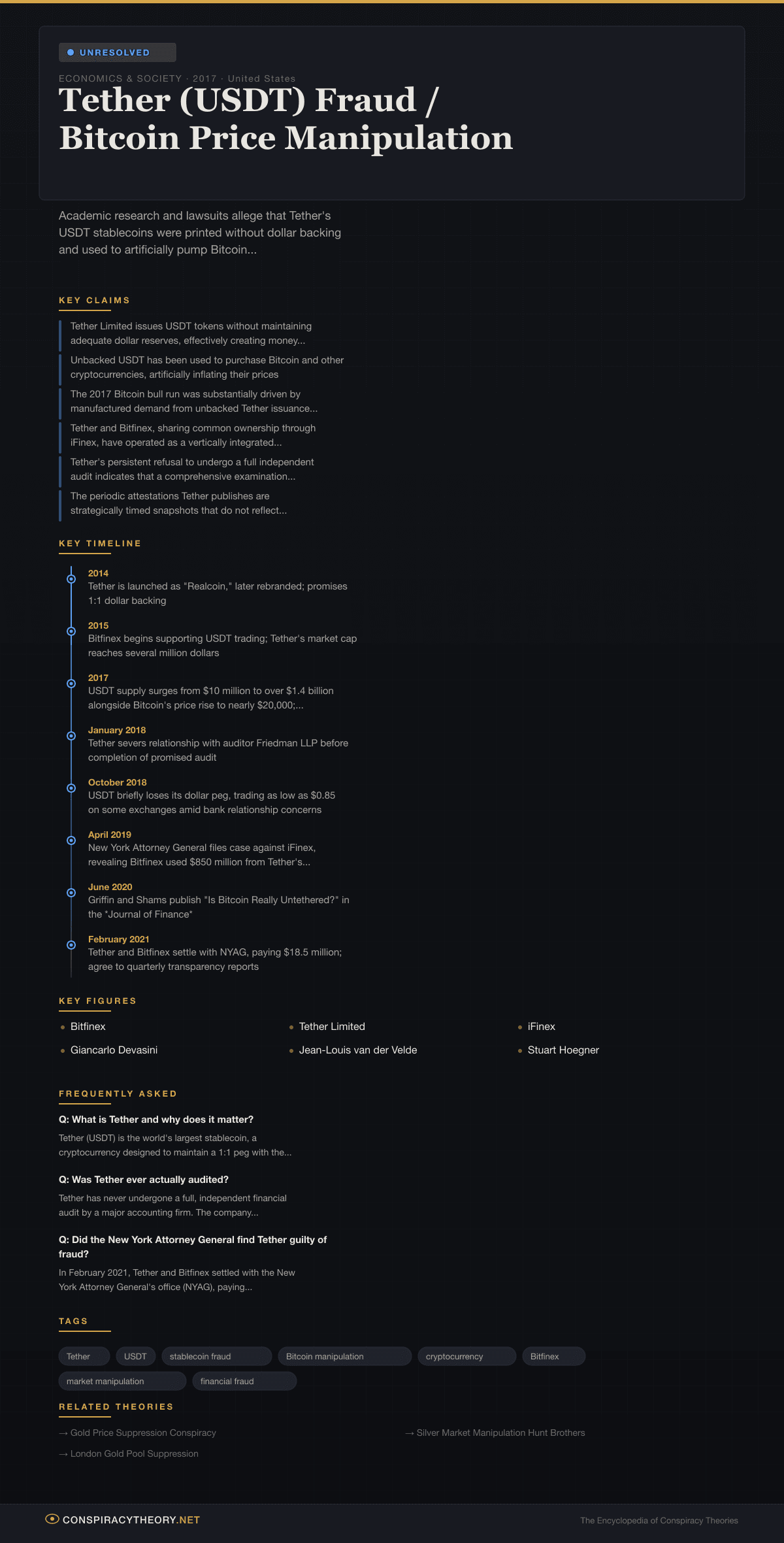
Tether (USDT) Fraud / Bitcoin Price Manipulation
Overview
The Tether conspiracy theory alleges that Tether Limited, the company behind the USDT stablecoin, has engaged in systematic fraud by issuing billions of dollars worth of USDT tokens without adequate dollar reserves, and that these unbacked tokens have been used to artificially inflate the price of Bitcoin and other cryptocurrencies, creating a market built substantially on fictitious value. The theory gained academic credibility through a peer-reviewed paper by finance professors John Griffin and Amin Shams, published in the Journal of Finance in 2020, which found statistical evidence that Tether issuance was associated with Bitcoin price increases in patterns inconsistent with legitimate market demand.
Unlike many conspiracy theories, the Tether allegations rest on a substantial foundation of documented evidence, including findings by the New York Attorney General, the Commodity Futures Trading Commission, and academic researchers. Tether’s refusal to submit to a full independent audit, its acknowledged commingling of funds with the affiliated Bitfinex exchange, and its settlement with the NYAG after findings of material misrepresentation have lent credibility to concerns about its operations. At the same time, USDT has maintained its dollar peg through multiple market crises, and Tether has continued to operate and expand, leading defenders to argue that its reserves are now adequate even if past practices were questionable.
The theory remains classified as unresolved because, while significant evidence of past misconduct exists, the full scope of Tether’s reserves and the extent to which USDT issuance has influenced cryptocurrency prices remain matters of active legal and academic investigation.
Origins & History
Tether was launched in 2014 as “Realcoin” before being rebranded as Tether and issued on the Bitcoin blockchain using the Omni Layer protocol. The company was founded by Brock Pierce, Reeve Collins, and Craig Sellars, with the core proposition that each USDT token would be backed by one US dollar held in reserve. This seemingly simple concept addressed a genuine need in the cryptocurrency ecosystem: traders wanted a dollar-equivalent digital asset that could move between exchanges without the delays and regulatory friction of traditional banking.
From the beginning, Tether’s relationship with the Bitfinex cryptocurrency exchange was unusually close. Both were controlled by iFinex Inc., a company registered in the British Virgin Islands and operated by CEO Jean-Louis van der Velde and Chief Financial Officer Giancarlo Devasini. This shared ownership structure raised concerns about conflicts of interest, as Bitfinex was both the primary platform for USDT trading and the entity most directly benefiting from increased USDT issuance.
Skepticism about Tether’s reserves began growing in 2017 as USDT issuance surged dramatically alongside Bitcoin’s price rise from approximately $1,000 in January to nearly $20,000 in December. The supply of USDT increased from roughly $10 million at the start of 2017 to over $1.4 billion by year’s end. Critics, including anonymous blogger “Bitfinex’ed” who began investigating Tether’s operations in 2017, argued that the pace of issuance was inconsistent with organic demand and suggested that new USDT was being printed to purchase Bitcoin, artificially inflating its price.
In January 2018, Tether severed its relationship with its auditor, Friedman LLP, before a promised full audit was completed. The company never secured another major accounting firm to conduct a comprehensive audit, instead relying on periodic attestations that provided snapshots of reserves at specific moments without examining the broader pattern of financial activity.
The situation escalated in October 2018 when a report by Bloomberg revealed that Tether’s banking relationship had shifted to Deltec Bank & Trust in the Bahamas, and questions about the quality and accessibility of Tether’s reserves intensified. In April 2019, the New York Attorney General filed a case against iFinex, alleging that Bitfinex had lost $850 million through its payment processor Crypto Capital Corp. and had secretly covered the shortfall by accessing Tether’s reserves. The filing revealed that, at the time of the loss, Tether did not hold sufficient reserves to back all USDT in circulation.
In June 2020, Griffin and Shams published their peer-reviewed paper “Is Bitcoin Really Untethered?” in the Journal of Finance, one of the discipline’s most prestigious publications. Their analysis of blockchain data found that large purchases of Bitcoin tended to follow new issuances of USDT, particularly during periods of declining Bitcoin prices, in a pattern consistent with price support operations rather than legitimate trading demand. They concluded that a single large account on Bitfinex was responsible for much of this activity.
Tether and Bitfinex settled with the NYAG in February 2021, paying $18.5 million and agreeing to quarterly transparency reports. The settlement found that Tether had misrepresented its reserves, had at times held no cash reserves at all, and had commingled funds with Bitfinex. In October 2021, the Commodity Futures Trading Commission (CFTC) separately fined Tether $41 million for making untrue statements about its reserves, finding that USDT was fully backed on only about 27.6% of the days during a 26-month sample period from 2016 to 2018.
Key Claims
- Tether Limited issues USDT tokens without maintaining adequate dollar reserves, effectively creating money from nothing
- Unbacked USDT has been used to purchase Bitcoin and other cryptocurrencies, artificially inflating their prices
- The 2017 Bitcoin bull run was substantially driven by manufactured demand from unbacked Tether issuance rather than genuine market interest
- Tether and Bitfinex, sharing common ownership through iFinex, have operated as a vertically integrated market manipulation vehicle
- Tether’s persistent refusal to undergo a full independent audit indicates that a comprehensive examination would reveal insufficient reserves
- The periodic attestations Tether publishes are strategically timed snapshots that do not reflect the actual state of reserves during normal operations
- If Tether were to fail or be forced to prove its reserves, the resulting loss of confidence would trigger a catastrophic crash across the entire cryptocurrency market
- Tether’s reserves include high-risk commercial paper and other non-liquid assets that could not be redeemed at par in a crisis
Evidence
The evidentiary basis for Tether-related concerns is stronger than for most conspiracy theories, resting on government investigations, academic peer-reviewed research, and Tether’s own admissions.
The NYAG investigation (2019-2021) produced court filings documenting that Bitfinex had secretly accessed Tether’s reserves to cover an $850 million loss, that Tether had at times held no cash reserves, and that company officials had made misleading public statements about the state of reserves. These are findings of fact from a government investigation, not speculation.
The CFTC’s October 2021 enforcement action found that Tether had held sufficient fiat reserves to back USDT on only 27.6% of the days during a 26-month sample period. This finding was based on the CFTC’s own analysis of Tether’s financial records.
The Griffin and Shams paper, published in the Journal of Finance after rigorous peer review, provided statistical evidence that Tether issuance was correlated with Bitcoin price movements in patterns consistent with price manipulation. While the paper’s methodology has been debated, its publication in a top-tier finance journal reflects the seriousness with which the academic community has treated the allegations.
Tether’s own attestation reports have revealed that its reserves include not only cash and Treasury bonds but also commercial paper, secured loans, corporate bonds, and other assets whose liquidity and valuation during a crisis could be questionable. The composition of reserves has improved since the NYAG settlement, with Tether reporting increased holdings of US Treasury securities, but the company continues to resist a full audit.
Against these concerns, several factors support Tether’s continued viability. USDT has maintained its dollar peg through multiple severe market downturns, including the Terra/Luna collapse in May 2022, which saw competitors like UST lose their peg entirely. Tether has processed billions of dollars in redemptions without failing to honor the peg. The company reported substantial profits in recent years, suggesting improving financial health. However, defenders of Tether acknowledge that maintaining the peg during normal market conditions does not prove that reserves are adequate for a truly systemic crisis.
Debunking / Verification
The Tether controversy resists clean categorization because some claims have been verified while the full picture remains unclear.
Verified claims include: Tether misrepresented its reserves (confirmed by NYAG and CFTC); Tether was not fully backed for extended periods (confirmed by CFTC); Bitfinex accessed Tether’s reserves to cover losses (confirmed by NYAG); Tether has never undergone a full independent audit (acknowledged by Tether); and there is a statistical correlation between Tether issuance and Bitcoin price movements (documented by peer-reviewed academic research).
Unresolved questions include: the current adequacy of Tether’s reserves; whether Tether issuance was the primary driver of Bitcoin price increases or merely correlated with them; whether the improvements in reserves and transparency since the 2021 settlement are sufficient; and whether a severe redemption crisis would expose remaining inadequacies.
Some critics have argued that the Tether concerns are overblown, noting that the company has survived every market crash since 2017 and that its market cap has grown substantially, suggesting genuine market demand. The cryptocurrency community remains divided, with institutional investors and regulators expressing ongoing concern while active traders continue to rely on USDT as the market’s primary liquidity vehicle.
Cultural Impact
The Tether controversy has had significant impact on cryptocurrency regulation, market structure, and public perception. It played a central role in catalyzing regulatory attention to stablecoins broadly, contributing to proposed legislation in the United States and regulatory frameworks in the European Union (the Markets in Crypto-Assets Regulation, or MiCA) and other jurisdictions.
The possibility that the world’s largest cryptocurrency market is substantially built on a potentially unbacked stablecoin has become a key argument for skeptics who view cryptocurrency as a speculative bubble. If Tether were to collapse, the cascading effects on cryptocurrency prices and the broader digital asset ecosystem would be severe, given USDT’s role as the primary trading pair on most exchanges.
Within the cryptocurrency community, “Tether FUD” (fear, uncertainty, and doubt) has become a recognized category of market commentary, with defenders dismissing concerns and critics maintaining that a reckoning is inevitable. The debate reflects broader tensions within cryptocurrency between the industry’s libertarian, anti-regulation origins and the growing recognition that consumer protection and market integrity require some form of oversight.
The Tether case has also served as a cautionary example in discussions about financial transparency and the risks of self-regulation. It demonstrates how a critical piece of financial infrastructure can operate for years with minimal oversight, making representations about its reserves that are later found to be materially false, without systemic consequences — at least so far.
Timeline
- 2014 — Tether is launched as “Realcoin,” later rebranded; promises 1:1 dollar backing
- 2015 — Bitfinex begins supporting USDT trading; Tether’s market cap reaches several million dollars
- 2017 — USDT supply surges from $10 million to over $1.4 billion alongside Bitcoin’s price rise to nearly $20,000; blogger “Bitfinex’ed” begins investigating
- January 2018 — Tether severs relationship with auditor Friedman LLP before completion of promised audit
- October 2018 — USDT briefly loses its dollar peg, trading as low as $0.85 on some exchanges amid bank relationship concerns
- April 2019 — New York Attorney General files case against iFinex, revealing Bitfinex used $850 million from Tether’s reserves to cover losses through Crypto Capital Corp.
- June 2020 — Griffin and Shams publish “Is Bitcoin Really Untethered?” in the Journal of Finance
- February 2021 — Tether and Bitfinex settle with NYAG, paying $18.5 million; agree to quarterly transparency reports
- October 2021 — CFTC fines Tether $41 million for making untrue statements about reserves; finds USDT was fully backed on only 27.6% of sampled days
- May 2022 — Terra/Luna collapse destroys algorithmic stablecoin UST; Tether processes billions in redemptions and maintains its peg
- 2023-2025 — Tether reports record profits and increased Treasury holdings; regulatory scrutiny continues; company’s market cap exceeds $90 billion
Sources & Further Reading
- Griffin, John M. and Amin Shams. “Is Bitcoin Really Untethered?” Journal of Finance, vol. 75, no. 4, August 2020.
- New York State Office of the Attorney General. “Attorney General James Ends Virtual Currency Trading Platform Bitfinex’s Illegal Activities in New York.” Press release, February 23, 2021.
- Commodity Futures Trading Commission. “CFTC Orders Tether and Bitfinex to Pay Fines Totaling $42.5 Million.” Press release, October 15, 2021.
- Castor, Amy. “The Bit Short: Inside Crypto’s Doomsday Machine.” Blog post series, amycastor.com, 2021-present.
- Protos. “Tether Papers: This Is Exactly Who Acquired 70% of All USDT Ever Issued.” Protos.com, November 2021.
- Bloomberg. Various investigative reports on Tether’s banking relationships and reserves, 2018-2023.
Frequently Asked Questions
What is Tether and why does it matter?
Was Tether ever actually audited?
Did the New York Attorney General find Tether guilty of fraud?
Infographic
Share this visual summary. Right-click to save.