The Fellowship (The Family)
Overview
The Fellowship, more commonly known as The Family, is a secretive Christian organization that has operated at the intersection of American religion and political power since 1935. It is not a church. It has no official membership rolls, no public website, no congregations, and no statement of faith available for inspection. What it does have is extraordinary access: to the White House, to the United States Congress, and to heads of state around the world, including some of the most brutal authoritarian regimes of the twentieth and twenty-first centuries.
The organization is best known for two things visible to the public. The first is the National Prayer Breakfast, a Washington institution held annually since 1953 and attended by every sitting president from Dwight Eisenhower onward. The second is the C Street Center, a Capitol Hill townhouse at 133 C Street SE, registered as a church for tax purposes, where members of Congress have lived under the spiritual mentorship of Fellowship leaders. Both of these are real. Both are documented. And both are merely the surface of a network that extends far deeper into American and international politics than most voters have ever been told.
The Fellowship’s status is classified as confirmed. This is not a theory built on speculation or inference. The organization exists. Its leaders have been identified. Its activities have been documented by journalists, most notably Jeff Sharlet, whose 2008 book The Family: The Secret Fundamentalism at the Heart of American Power drew on years of research and firsthand access. Congressional records, tax filings, leaked internal documents, and the testimony of former insiders corroborate the essential claims: that The Fellowship operates a private influence network connecting American politicians to foreign leaders under a theological framework that holds the powerful to be God’s chosen instruments, regardless of their moral conduct.
Abraham Vereide and the Origins
The Fellowship was founded by Abraham Vereide, a Norwegian-born Methodist minister who had immigrated to the United States in 1905. Vereide spent years working in urban ministry in Seattle before arriving at an insight that would shape the rest of his career and, arguably, the trajectory of American political religion: rather than ministering to the poor and working class, he would minister to the powerful. His reasoning was straightforward. If you convert the man at the top, the benefits cascade downward. If a factory owner finds God, the workers benefit. If a senator finds God, the nation benefits. If a dictator finds God, a country is saved.
In 1935, Vereide organized his first prayer breakfast for civic and business leaders in Seattle. The concept spread. By the early 1940s, Vereide had established prayer groups for members of Congress in Washington, DC. His model was disarmingly simple: small groups of powerful men meeting privately to pray, study scripture, and build personal relationships grounded in shared Christian faith. No formal organization. No bylaws. No publicity.
The approach worked precisely because of its informality. Politicians who might never join a visible religious organization were comfortable attending a private breakfast where they could network with colleagues across party lines under the cover of spiritual fellowship. By the late 1940s, Vereide’s network had penetrated both chambers of Congress and had begun reaching into the executive branch.
Vereide died in 1969. Leadership of the organization passed to Douglas Coe, a soft-spoken Illinois native who would run The Fellowship for the next four decades and transform it from a Washington prayer network into a global operation.
The National Prayer Breakfast
The National Prayer Breakfast is The Fellowship’s most visible creation and its single greatest source of legitimacy. First held in 1953 at the suggestion of Billy Graham and organized by Vereide’s congressional prayer groups, the event brings together the president of the United States, members of Congress, foreign dignitaries, and thousands of attendees for a morning of prayer, speeches, and networking at the Washington Hilton.
Every president since Eisenhower has attended. The event is bipartisan by design. It is covered by the press as a routine expression of American civic religion, a feel-good affair where Democrats and Republicans set aside their differences for a morning of shared faith. What receives far less coverage is the organization behind it.
The Fellowship uses the breakfast as the centerpiece of a week of private meetings, dinners, and receptions that bring together American lawmakers and foreign officials. These side events, largely invisible to the media, are where the real networking occurs. Foreign leaders seeking access to the American political establishment attend the breakfast and its satellite events as guests of The Fellowship, bypassing normal diplomatic channels. The breakfast functions, in effect, as an annual diplomatic trade show run by a private religious organization with no public accountability.
In 2023, the National Prayer Breakfast was formally reorganized and renamed the National Prayer Gathering, with Congress distancing the event from The Fellowship following years of criticism. The rebranding reflected growing discomfort with the organization’s role, though The Fellowship’s broader network remained intact.
C Street Center
The C Street Center at 133 C Street SE, Washington, DC, is a brick townhouse on Capitol Hill that serves as both a residence and a meeting place for members of Congress affiliated with The Fellowship. It is classified as a church for tax-exemption purposes, a designation that has drawn persistent criticism, since the building functions primarily as a subsidized boarding house for sitting legislators.
Residents have included senators and representatives from both parties, though the house has skewed Republican in recent decades. The arrangement is not merely logistical. Members who live at C Street participate in regular prayer meetings, Bible study sessions, and what The Fellowship calls “accountability” relationships with one another and with Fellowship leaders. The model is deliberate: by living together under spiritual guidance, legislators form bonds of personal loyalty and mutual obligation that transcend party affiliation, committee assignments, or policy disagreements.
C Street entered the national consciousness in 2009 when two of its most prominent residents became embroiled in sex scandals within weeks of each other. Senator John Ensign of Nevada admitted to an extramarital affair with the wife of his close friend and legislative aide, Doug Hampton. The fallout revealed that Ensign’s parents had paid the Hamptons $96,000, that Fellowship members had attempted to mediate the situation privately, and that the organization had prioritized containing the scandal over any form of accountability. Ensign resigned from the Senate in 2011, one day before the Senate Ethics Committee was expected to recommend his expulsion.
Governor Mark Sanford of South Carolina, another C Street affiliate, disappeared from public view in June 2009. His staff told reporters he was “hiking the Appalachian Trail.” He was actually in Buenos Aires visiting his Argentine mistress, Maria Belen Chapur. When the truth emerged, it was reported that Sanford had confided in his C Street housemates about the affair and that they had counseled him to end it but had not disclosed the information to anyone outside the group. The episode illustrated both the intensity of C Street’s internal bonds and the way those bonds could be used to manage, rather than correct, the behavior of powerful men.
A third C Street resident, Representative Chip Pickering of Mississippi, was sued by his ex-wife in 2009 for allegedly conducting an extramarital affair at the C Street house itself.
The clustering of these scandals around a single address raised unavoidable questions about what, exactly, C Street was for. Critics argued that the house functioned less as a spiritual community and more as a mutual protection society for politicians, a place where powerful men could confess transgressions to one another with the confidence that the information would be managed internally rather than reported.
The Dictator Network
The most consequential allegations about The Fellowship concern its international operations. Under Doug Coe’s leadership, the organization built relationships with heads of state around the world, including a significant number of authoritarian rulers, military strongmen, and dictators.
Coe’s philosophy, as described by Jeff Sharlet and corroborated by former insiders, held that God works through powerful men. The nature of their power, or how they obtained it, was secondary. What mattered was the relationship: if you could build a personal bond with a leader and introduce him to a Fellowship-style understanding of Jesus, you could influence the direction of an entire country. The theological term within The Fellowship for this approach was “Jesus plus nothing” — a stripped-down Christianity that dispensed with doctrine, denominational affiliation, and institutional church structures in favor of a direct, personal commitment to Jesus as a model of leadership.
In practice, this meant that Fellowship-affiliated congressmen and operatives cultivated personal relationships with figures including:
- Yoweri Museveni, president of Uganda, who has ruled since 1986 and has been a longtime participant in Fellowship-organized events
- Suharto, the Indonesian military dictator who ruled from 1967 to 1998 and was responsible for mass killings estimated in the hundreds of thousands
- Siad Barre, the Somali dictator whose regime collapsed into civil war and famine
- Teodoro Obiang Nguema Mbasogo, president of Equatorial Guinea, one of the most corrupt and repressive regimes in Africa
- Various Latin American military figures during the Cold War era
These relationships were not conducted through the State Department or any publicly accountable channel. They were private, personal, and mediated by a religious organization that operated outside the normal structures of foreign policy. Fellowship members would visit foreign leaders, pray with them, and serve as informal back-channel contacts between those leaders and the American government. In some cases, Fellowship-connected congressmen intervened directly in foreign affairs, meeting with dictators and conveying messages that carried implicit American endorsement without any democratic oversight.
Doug Coe himself was known to invoke authoritarian leaders as models of the kind of total commitment he sought from Fellowship members. In speeches captured on tape, Coe praised the organizational dedication of Hitler, Lenin, and Mao — not their ideologies, he clarified, but their ability to inspire absolute loyalty in their followers. He held these up as examples of the kind of devotion that should characterize a follower of Jesus. The comparison alarmed critics but made internal sense within an organization that viewed power itself as divinely ordained.
Uganda and Anti-Gay Legislation
The Fellowship’s most internationally controversial entanglement involved Uganda’s Anti-Homosexuality Act, first introduced in 2009. The original version of the bill proposed the death penalty for certain homosexual acts. It was authored by Ugandan Member of Parliament David Bahati, a participant in Fellowship-organized activities.
Jeff Sharlet’s reporting established that Fellowship members had spent years cultivating relationships with Ugandan political and religious leaders. American Fellowship associates had traveled to Uganda, participated in events organized around Ugandan prayer breakfasts modeled on the Washington event, and built personal bonds with figures in President Museveni’s inner circle. The relational infrastructure that The Fellowship created became a conduit through which American evangelical ideas about homosexuality — specifically, the framing of homosexuality as a fundamental social and spiritual threat — flowed into Ugandan political discourse.
When the bill was introduced, the international outcry was immediate. Human rights organizations identified the connections between the bill’s sponsors and American evangelical networks, including The Fellowship. The organization issued a rare public statement distancing itself from the legislation, saying it did not support the bill and that its work in Uganda focused on reconciliation and prayer, not policy.
Critics found this disavowal unconvincing. The Fellowship had built the relationships. It had created the framework. It had provided the access. The fact that it did not draft the specific legislative language was, in the view of its critics, a distinction without a meaningful difference. The relational model that The Fellowship relied upon — build personal bonds, trust God to work through the powerful — meant that the organization disclaimed responsibility for the downstream consequences of those relationships.
The Anti-Homosexuality Act was signed into law by Museveni in 2014 (with the death penalty provision removed, though long prison sentences remained). It was briefly struck down by Uganda’s Constitutional Court on procedural grounds, then reintroduced and signed again in 2023 in a version that restored the death penalty for “aggravated homosexuality.”
Jeff Sharlet’s Expose
The Fellowship operated in near-total obscurity for decades. Its existence was not a secret — the National Prayer Breakfast was public, and occasional newspaper articles mentioned the organization — but its internal workings, its theology, its international operations, and its scope were virtually unknown to the American public.
That changed with Jeff Sharlet. A journalist and academic, Sharlet lived at Ivanwald, a Fellowship-run house for young men in Arlington, Virginia, in 2002. The house functioned as a kind of training facility for future Fellowship operatives: young men lived communally, performed manual labor at the homes of Fellowship leaders, studied scripture, and absorbed the organization’s theology of power. Sharlet’s firsthand experience inside the organization formed the basis of a 2003 article in Harper’s Magazine and, eventually, his 2008 book The Family: The Secret Fundamentalism at the Heart of American Power.
Sharlet’s reporting revealed several key aspects of The Fellowship that had not previously been understood:
-
The “Jesus plus nothing” theology: The Fellowship taught that Jesus was not primarily a moral teacher or a savior of individual souls but a model of powerful leadership. The organization’s Jesus was a figure of strength, authority, and strategic acumen, not meekness or charity.
-
The “covenant” model: Fellowship relationships were structured around covenants — binding personal commitments between members that created networks of mutual loyalty and obligation. These covenants were described in explicitly biblical terms and were understood to supersede other loyalties, including partisan political allegiances.
-
The “key man” strategy: The Fellowship focused its efforts on what it called “key men” — leaders in positions of power who could influence the direction of institutions, governments, and nations. Ordinary believers were largely irrelevant to this strategy. The organization’s resources were directed upward, toward the powerful, not downward, toward the masses.
-
The deliberate avoidance of publicity: The Fellowship’s operating principle was invisibility. Coe repeatedly told associates that the organization’s power depended on its ability to operate without public scrutiny. He compared The Fellowship to the Mafia in its organizational discipline, though he framed the comparison as aspirational rather than criminal.
Sharlet’s book was followed by a 2019 Netflix documentary series, also titled The Family, which brought the story to a mass audience. The series drew on Sharlet’s research and featured interviews with former Fellowship insiders, journalists, and politicians.
How It Works
The Fellowship does not operate like a conventional organization. There is no formal membership. There are no dues. There is no public leadership structure, no board of directors accessible to outside scrutiny, and no annual report. The organization functions through a web of personal relationships, small prayer groups, and informal networks that are deliberately designed to resist institutional accountability.
At the center of this web, for over forty years, was Doug Coe. Coe did not seek public office, did not give press interviews, and did not appear on television. He operated entirely behind the scenes, cultivating personal relationships with presidents, senators, foreign leaders, and business executives. His influence was relational, not institutional. He had no title that captured his actual authority. He was simply the man who knew everyone and whom everyone trusted.
Coe died in 2017. The organization’s subsequent leadership structure has been even less transparent than it was during his tenure.
The Fellowship’s domestic operations revolve around prayer groups: small, private gatherings of politicians, military officers, and business leaders who meet weekly to pray, study scripture, and build personal bonds. These groups exist in the House, in the Senate, in the Pentagon, and in state capitals around the country. They are voluntary, private, and invisible to the public. Members do not publicly identify themselves as Fellowship affiliates.
The international operations follow the same model, scaled globally. Fellowship-connected figures organize prayer breakfasts and leadership events in countries around the world, building personal relationships with foreign leaders and creating informal diplomatic channels that operate parallel to official state-to-state relations. The National Prayer Breakfast serves as the annual nexus of this global network, bringing foreign officials to Washington for a week of private meetings under the banner of shared Christian faith.
The result is an influence network that is difficult to map, nearly impossible to hold accountable, and invisible to the vast majority of Americans whose elected representatives participate in it. Whether this constitutes a deep state operation, a benign religious fellowship, or something in between depends on one’s tolerance for powerful private networks that operate beyond democratic oversight.
Unlike comparable elite gatherings such as Bohemian Grove, which draws scrutiny for its secrecy and rituals but remains primarily a social retreat, The Fellowship is distinguished by its explicit goal of shaping political outcomes through personal relationships with sitting officeholders and foreign heads of state.
Timeline
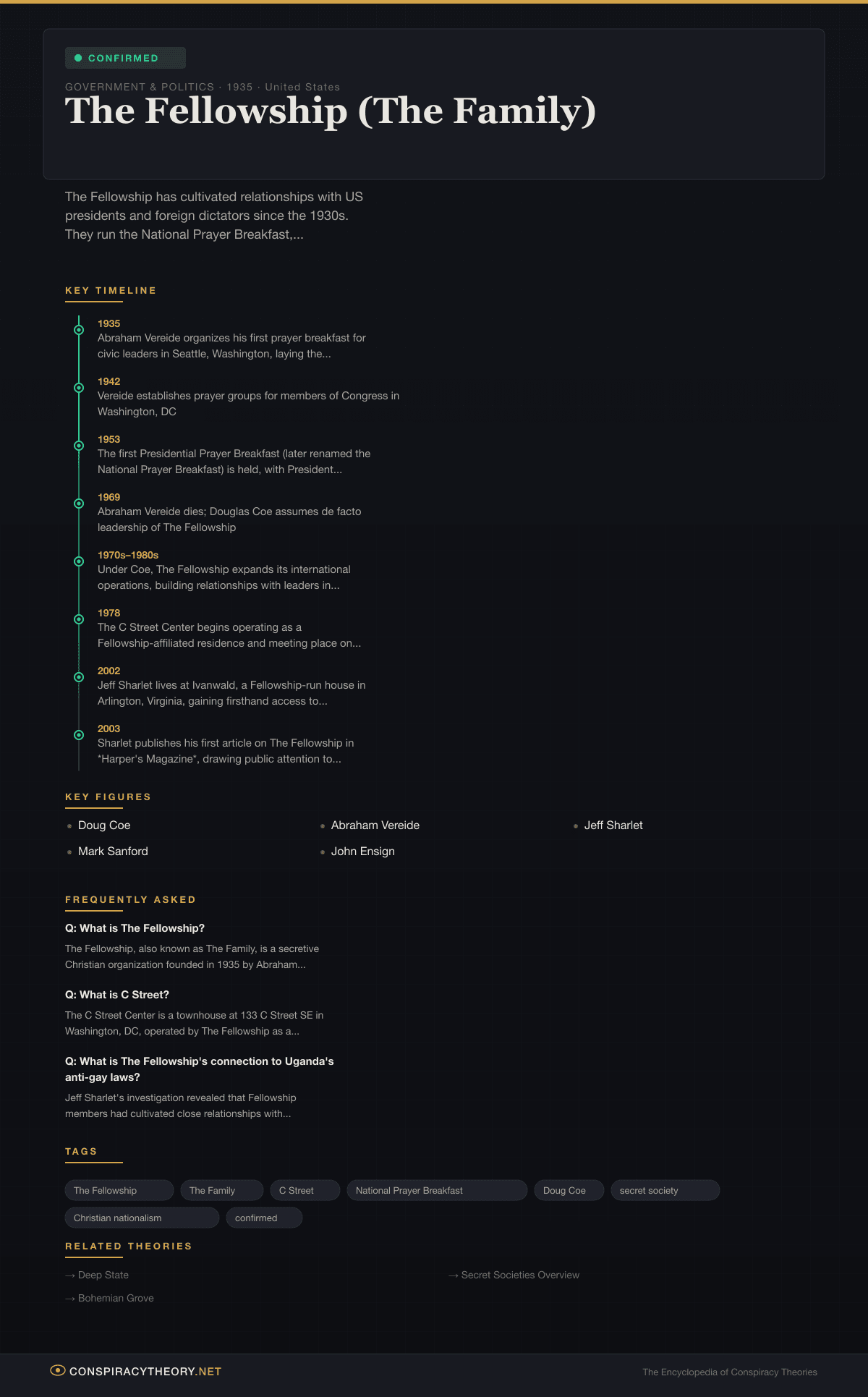
- 1935 — Abraham Vereide organizes his first prayer breakfast for civic leaders in Seattle, Washington, laying the foundation for what becomes The Fellowship
- 1942 — Vereide establishes prayer groups for members of Congress in Washington, DC
- 1953 — The first Presidential Prayer Breakfast (later renamed the National Prayer Breakfast) is held, with President Dwight Eisenhower in attendance
- 1969 — Abraham Vereide dies; Douglas Coe assumes de facto leadership of The Fellowship
- 1970s–1980s — Under Coe, The Fellowship expands its international operations, building relationships with leaders in Africa, Asia, Latin America, and Europe, including authoritarian regimes
- 1978 — The C Street Center begins operating as a Fellowship-affiliated residence and meeting place on Capitol Hill
- 2002 — Jeff Sharlet lives at Ivanwald, a Fellowship-run house in Arlington, Virginia, gaining firsthand access to the organization’s inner workings
- 2003 — Sharlet publishes his first article on The Fellowship in Harper’s Magazine, drawing public attention to the organization
- 2008 — Sharlet publishes The Family: The Secret Fundamentalism at the Heart of American Power
- 2009 — Senator John Ensign admits to an extramarital affair; Governor Mark Sanford’s disappearance and affair are revealed; both are C Street residents, bringing intense media scrutiny to the house and The Fellowship
- 2009 — Uganda’s Anti-Homosexuality Bill is introduced by David Bahati, a participant in Fellowship-organized activities; international outcry follows
- 2010 — Sharlet publishes C Street: The Fundamentalist Threat to American Democracy, expanding his reporting on the organization
- 2011 — Senator John Ensign resigns from the Senate ahead of expected Ethics Committee action
- 2014 — Uganda’s Anti-Homosexuality Act is signed into law by President Museveni
- 2017 — Doug Coe dies at age 88; leadership of The Fellowship becomes even less transparent
- 2019 — Netflix releases The Family, a five-part documentary series based on Sharlet’s research
- 2023 — The National Prayer Breakfast is reorganized and renamed the National Prayer Gathering, with Congress formally distancing the event from The Fellowship; Uganda passes a new Anti-Homosexuality Act restoring the death penalty for “aggravated homosexuality”
Sources & Further Reading
- Sharlet, Jeff. The Family: The Secret Fundamentalism at the Heart of American Power. Harper Perennial, 2008. (The definitive investigation into The Fellowship, based on years of research and firsthand access to the organization.)
- Sharlet, Jeff. C Street: The Fundamentalist Threat to American Democracy. Little, Brown and Company, 2010. (A follow-up focusing on the C Street Center, the Ensign and Sanford scandals, and The Fellowship’s domestic political operations.)
- Sharlet, Jeff. “Jesus Plus Nothing: Undercover Among America’s Secret Theocrats.” Harper’s Magazine, March 2003. (Sharlet’s original article on his experience living at Ivanwald.)
- The Family. Directed by Jesse Moss. Netflix, 2019. (A five-part documentary series drawing on Sharlet’s research and featuring interviews with former insiders.)
- Bumiller, Elisabeth. “An Invisible Leader, and a Prayer Breakfast.” The New York Times, December 2009. (Reporting on Doug Coe and The Fellowship’s role behind the National Prayer Breakfast.)
- Scahill, Jeremy. “The Fellowship: A Look at the Powerful Christian Group.” The Nation, 2009. (Investigative reporting on The Fellowship’s domestic and international operations.)
- Senate Ethics Committee. “Report on Senator John Ensign.” United States Senate, 2011. (Official findings on the Ensign affair and the involvement of Fellowship associates in managing the scandal.)
- Kaplan, Esther. “Follow the Money: Investigating the Fellowship.” The Nation, 2010. (Analysis of The Fellowship’s financial structures and tax-exempt status.)
- Vereide, Abraham. Papers held at the Billy Graham Center Archives, Wheaton College, Wheaton, Illinois. (Primary source material on the founding and early operations of The Fellowship.)
Related Theories
- Deep State — The Fellowship’s invisible influence network operating parallel to official government channels echoes broader concerns about unelected power structures shaping American policy.
- Bohemian Grove — Another elite gathering that operates in secrecy, though Bohemian Grove functions primarily as a social retreat rather than a network with explicit political and diplomatic objectives.
Frequently Asked Questions
What is The Fellowship?
What is C Street?
What is The Fellowship's connection to Uganda's anti-gay laws?

Infographic
Share this visual summary. Right-click to save.