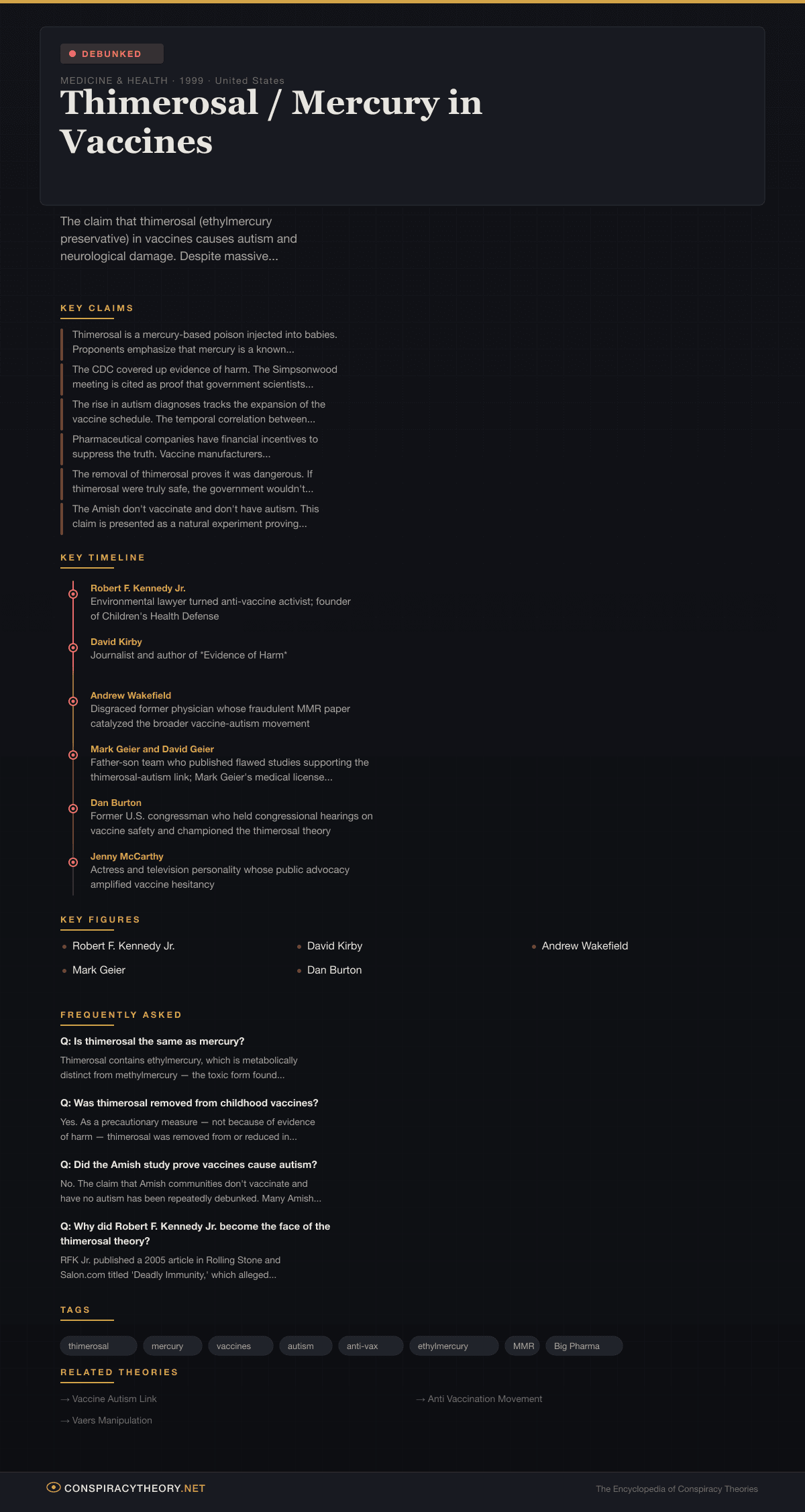
Thimerosal / Mercury in Vaccines
Overview
In the late 1990s, a preservative called thimerosal became the center of one of the most consequential public health conspiracy theories in modern history. Thimerosal — an organomercury compound used since the 1930s to prevent bacterial and fungal contamination in multi-dose vaccine vials — was accused of causing autism in children. The theory leveraged a genuine-sounding scientific concern (mercury is toxic, and mercury is in vaccines) into a juggernaut of fear that altered vaccination policy, spawned a multimillion-dollar anti-vaccine industry, and continues to erode public trust in immunization programs worldwide.
The problem is that thimerosal contains ethylmercury, not the neurotoxic methylmercury found in contaminated fish. The body processes these two compounds very differently. And the definitive test of the theory — removing thimerosal from childhood vaccines, which the United States did by 2001 — produced no change whatsoever in autism rates. Every major epidemiological study, involving millions of children across multiple countries, has found no connection between thimerosal and autism. The theory is, by any scientific standard, conclusively debunked.
Yet it refuses to die. Fueled by celebrity advocacy, political opportunism, and the very human need to find explanations for a condition that remains poorly understood, the thimerosal conspiracy has become a foundational text of the modern anti-vaccination movement — a movement with body counts measured in preventable deaths from measles, whooping cough, and other once-controlled diseases.
Origins & History
The Precautionary Removal
The thimerosal controversy began not with rogue scientists or internet conspiracists but with the U.S. government itself. In 1997, Congress passed the FDA Modernization Act, which included a provision requiring the FDA to review mercury-containing food and drugs. When the FDA tallied the cumulative mercury exposure from the childhood vaccine schedule, it found that infants might receive up to 187.5 micrograms of ethylmercury by six months of age — a number that exceeded EPA guidelines for methylmercury exposure.
The distinction between ethylmercury and methylmercury is critical. The EPA guidelines were written for methylmercury, a different compound with different pharmacokinetics. But the FDA, the American Academy of Pediatrics, and the Public Health Service jointly recommended in 1999 that thimerosal be removed from childhood vaccines as a “precautionary measure” — even while stating that no evidence of harm existed.
This precautionary removal was intended to maintain public confidence. It had the opposite effect. For many parents, the removal was proof that thimerosal had been dangerous all along. If it was safe, why remove it?
The Autism Epidemic Narrative
The thimerosal theory gained traction because it appeared to explain a real phenomenon: the dramatic increase in autism diagnoses during the 1990s. Autism spectrum disorder diagnoses rose sharply during this period — from roughly 1 in 2,500 children in the 1980s to 1 in 150 by 2000.
Epidemiologists attribute most of this increase to expanded diagnostic criteria (the DSM-IV broadened the autism spectrum in 1994), increased awareness, diagnostic substitution (children previously classified as intellectually disabled were reclassified as autistic), and better screening. But to parents watching the numbers climb, the explanation felt inadequate. Something in the environment must be causing it, and vaccines — administered on a schedule that coincided with the age at which autism symptoms typically become apparent — made an intuitive culprit.
David Kirby and Evidence of Harm
The thimerosal theory received its most influential popular treatment in David Kirby’s 2005 book Evidence of Harm: Mercury in Vaccines and the Autism Epidemic: A Medical Controversy. Kirby presented the story primarily through the eyes of parent-activists who believed their children had been harmed by thimerosal. The book was nominated for a National Book Award finalist slot and lent mainstream credibility to the theory.
Kirby himself was careful to frame the book as journalism rather than advocacy, but its impact was decidedly one-directional. It provided an emotionally compelling narrative that scientific papers — with their cautious language and statistical abstractions — could not easily counter.
RFK Jr.’s Crusade
Robert F. Kennedy Jr. entered the thimerosal debate in 2005 with “Deadly Immunity,” an article simultaneously published in Rolling Stone and Salon.com. The piece alleged that a 2000 CDC meeting at the Simpsonwood Conference Center in Georgia had uncovered evidence linking thimerosal to autism, and that government officials had conspired to bury the findings.
The article was explosive — and deeply flawed. Salon appended multiple corrections before ultimately retracting the piece entirely in 2011. Rolling Stone also removed it. Independent analysis of the Simpsonwood transcripts showed that Kennedy had selectively quoted participants and misrepresented preliminary statistical findings that were later refined to show no association.
Undeterred, Kennedy founded the World Mercury Project (later renamed Children’s Health Defense), which became one of the largest and most well-funded anti-vaccine organizations in the world, generating millions of dollars annually through donation campaigns built around the thimerosal narrative.
Key Claims
- Thimerosal is a mercury-based poison injected into babies. Proponents emphasize that mercury is a known neurotoxin and that injecting any form of it into infants is inherently dangerous.
- The CDC covered up evidence of harm. The Simpsonwood meeting is cited as proof that government scientists knew about the thimerosal-autism connection and suppressed it.
- The rise in autism diagnoses tracks the expansion of the vaccine schedule. The temporal correlation between more vaccines and more autism diagnoses is presented as evidence of causation.
- Pharmaceutical companies have financial incentives to suppress the truth. Vaccine manufacturers allegedly lobbied for liability protections (the National Childhood Vaccine Injury Act of 1986) because they knew their products were harmful.
- The removal of thimerosal proves it was dangerous. If thimerosal were truly safe, the government wouldn’t have recommended removing it.
- The Amish don’t vaccinate and don’t have autism. This claim is presented as a natural experiment proving the vaccine-autism link.
Evidence
The Scientific Record
The thimerosal-autism hypothesis has been tested more rigorously than almost any other question in modern epidemiology. The results are unambiguous:
- A 2003 Danish study of over 500,000 children found no association between thimerosal-containing vaccines and autism (JAMA, Madsen et al.).
- A 2004 Institute of Medicine report reviewed all available evidence and concluded that the evidence “favors rejection of a causal relationship” between thimerosal and autism.
- A 2010 study in Pediatrics examined over 1,000 children and found no connection between thimerosal exposure and autism spectrum disorder (Price et al.).
- A 2014 meta-analysis of over 1.2 million children, published in Vaccine, found no link between vaccines, thimerosal, or mercury and autism (Taylor et al.).
- Most decisively, autism rates continued to rise after thimerosal was removed from childhood vaccines — the opposite of what the theory predicts.
The Simpsonwood Transcripts
The full Simpsonwood transcripts have been publicly available for years. They show scientists discussing preliminary data, expressing appropriate caution, and noting that the initial statistical signal weakened with better methodology — a routine part of epidemiological research, not evidence of a cover-up.
The Amish Claim
The “Amish don’t vaccinate and don’t have autism” claim originated with journalist Dan Olmsted in 2005. Subsequent research has demonstrated that many Amish communities do vaccinate (at variable rates), and that autism exists in Amish populations. A 2023 study published in JAMA Pediatrics confirmed the presence of autism spectrum disorder in Amish communities.
Debunking / Verification
The thimerosal-autism theory fails on multiple fronts:
-
Chemical distinction. Ethylmercury and methylmercury are different compounds. The EPA guidelines cited by anti-vaccine activists apply to methylmercury. Ethylmercury has a half-life of about 7 days in the blood and is rapidly excreted; methylmercury has a half-life of about 45 days and bioaccumulates.
-
The natural experiment. Thimerosal was removed from childhood vaccines by 2001. If it caused autism, rates should have declined. They didn’t. They continued to rise, consistent with expanded diagnosis rather than environmental exposure.
-
Epidemiological consensus. Studies encompassing millions of children across the United States, Denmark, the United Kingdom, Japan, and other countries have found no association.
-
The Wakefield factor. Much of the broader vaccine-autism panic originated with Andrew Wakefield’s fraudulent 1998 Lancet paper (which concerned the MMR vaccine, not thimerosal). Wakefield was stripped of his medical license and the paper was retracted. The thimerosal theory partially piggybacked on the momentum Wakefield created.
-
Expert consensus. The CDC, WHO, FDA, American Academy of Pediatrics, Institute of Medicine, European Medicines Agency, and virtually every major medical organization worldwide have concluded that thimerosal in vaccines does not cause autism.
Cultural Impact
The thimerosal theory has had enormous real-world consequences. Vaccination rates declined in communities influenced by anti-vaccine messaging, contributing to outbreaks of measles, whooping cough, and other preventable diseases. The 2019 measles outbreak in New York, largely concentrated in under-vaccinated communities, was one of the largest in the United States in decades.
The theory also reshaped American politics. Robert F. Kennedy Jr.’s anti-vaccine activism made him a prominent figure in health freedom movements and influenced his 2024 presidential campaign. The broader anti-vaccine infrastructure built around the thimerosal narrative — websites, nonprofits, documentary films, social media networks — became the distribution system for COVID-19 vaccine misinformation during the 2020-2021 pandemic.
Perhaps most perniciously, the theory has directed attention and resources away from genuine autism research. Billions of dollars and countless research hours have been spent re-testing a debunked hypothesis instead of investigating the actual genetic and environmental factors that contribute to autism spectrum disorder.
In Popular Culture
- Evidence of Harm (2005) by David Kirby — bestselling book that mainstreamed the thimerosal narrative
- Trace Amounts (2014) — documentary film promoting the thimerosal-autism link
- Vaxxed: From Cover-Up to Catastrophe (2016) — Andrew Wakefield-directed documentary (focuses on MMR but reinforced the broader vaccine-autism narrative)
- Jenny McCarthy’s advocacy on The Oprah Winfrey Show (2007) — celebrity endorsement that massively amplified vaccine fears
- Robert De Niro’s attempted screening of Vaxxed at the Tribeca Film Festival (2016) — became a major media controversy
Key Figures
- Robert F. Kennedy Jr. — Environmental lawyer turned anti-vaccine activist; founder of Children’s Health Defense
- David Kirby — Journalist and author of Evidence of Harm
- Andrew Wakefield — Disgraced former physician whose fraudulent MMR paper catalyzed the broader vaccine-autism movement
- Mark Geier and David Geier — Father-son team who published flawed studies supporting the thimerosal-autism link; Mark Geier’s medical license was revoked
- Dan Burton — Former U.S. congressman who held congressional hearings on vaccine safety and championed the thimerosal theory
- Jenny McCarthy — Actress and television personality whose public advocacy amplified vaccine hesitancy
Timeline
| Date | Event |
|---|---|
| 1930s | Thimerosal first used as a preservative in vaccines |
| 1997 | FDA Modernization Act requires review of mercury in drugs |
| 1999 | FDA, AAP, and PHS recommend precautionary removal of thimerosal from childhood vaccines |
| 2000 | Simpsonwood Conference Center meeting discusses preliminary thimerosal data |
| 2001 | Thimerosal removed or reduced in all routinely recommended childhood vaccines in the U.S. |
| 2003 | Danish study of 500,000+ children finds no thimerosal-autism link |
| 2004 | Institute of Medicine report rejects thimerosal-autism association |
| 2005 | David Kirby publishes Evidence of Harm; RFK Jr. publishes “Deadly Immunity” |
| 2007 | Jenny McCarthy appears on Oprah, amplifying vaccine fears |
| 2010 | Pediatrics study finds no connection between thimerosal exposure and ASD |
| 2011 | Salon retracts RFK Jr.’s “Deadly Immunity” article |
| 2014 | Meta-analysis of 1.2 million children finds no vaccine-autism link |
| 2016 | Vaxxed documentary released; Tribeca Film Festival controversy |
| 2020-2021 | Anti-vaccine infrastructure built around thimerosal narrative repurposed for COVID-19 vaccine opposition |
| 2023 | RFK Jr. launches presidential campaign with anti-vaccine platform |
Sources & Further Reading
- Madsen et al., “Thimerosal and the Occurrence of Autism,” JAMA 290, no. 13 (2003)
- Institute of Medicine, Immunization Safety Review: Vaccines and Autism (2004)
- Price et al., “Prenatal and Infant Exposure to Thimerosal from Vaccines and Immunoglobulins and Risk of Autism,” Pediatrics 126, no. 4 (2010)
- Taylor et al., “Vaccines Are Not Associated with Autism: An Evidence-Based Meta-Analysis,” Vaccine 32, no. 29 (2014)
- Paul Offit, Autism’s False Prophets: Bad Science, Risky Medicine, and the Search for a Cure (2008)
- Seth Mnookin, The Panic Virus: The True Story Behind the Vaccine-Autism Controversy (2011)
- “Deadly Immunity” retraction history — Salon.com editorial note (2011)
Related Theories
- Vaccine-Autism Link — the broader theory that vaccines cause autism, of which thimerosal is one variant
- Anti-Vaccination Movement — the larger social movement built on vaccine safety fears
- VAERS Data Manipulation — misuse of the vaccine adverse event reporting system to manufacture evidence of harm
Frequently Asked Questions
Is thimerosal the same as mercury?
Was thimerosal removed from childhood vaccines?
Did the Amish study prove vaccines cause autism?
Why did Robert F. Kennedy Jr. become the face of the thimerosal theory?
Infographic
Share this visual summary. Right-click to save.