Titanic–Olympic Switch Theory
Overview
On the night of April 14, 1912, the RMS Titanic struck an iceberg in the North Atlantic and sank in under three hours, killing more than 1,500 people in the deadliest peacetime maritime disaster in history. The sinking produced an immediate storm of inquiry, regulation, and grief — and within decades, an entire mythology. But among the many conspiracy theories that have attached themselves to the Titanic disaster, one stands out for its sheer audacity: the claim that the ship at the bottom of the Atlantic is not the Titanic at all.
According to this theory, the White Star Line secretly swapped the Titanic with her older, damaged sister ship, the RMS Olympic, then deliberately sank the disguised vessel in the middle of the ocean to collect a massive insurance payout. The real Titanic, according to this narrative, sailed on as the “Olympic” for another twenty-three years, and nobody noticed.
It is a theory that requires you to believe that one of the largest corporations in the Edwardian world orchestrated a switch of two 882-foot ocean liners under the noses of thousands of shipyard workers, government inspectors, and crew members — then murdered 1,500 people for money. And in some versions, the whole thing was masterminded by J.P. Morgan to eliminate wealthy rivals who opposed the creation of the Federal Reserve.
The theory is debunked. Thoroughly, repeatedly, and from every conceivable angle. But it refuses to die, because the Titanic is not just a ship — it is the Western world’s founding disaster myth of the twentieth century, and myths attract stories that are larger than the truth.
The Ships: Olympic and Titanic
To understand the switch theory, you need to understand the ships.
The RMS Olympic and RMS Titanic were the first two vessels of the White Star Line’s Olympic-class trio (the third was HMHS Britannic, originally named Gigantic). They were designed by Thomas Andrews and built by Harland & Wolff at their Belfast shipyard. Olympic was laid down first, in December 1908, and launched in October 1910. Titanic was laid down in March 1909 and launched in May 1911. A third ship, Britannic, would follow.
The two ships were built to the same general specifications — 882.5 feet long, roughly 46,000 gross tons, triple-screw propulsion — and at a glance, they looked almost identical. This visual similarity is the entire foundation of the switch theory. If they looked the same, the argument goes, then switching one for the other would have been feasible.
But “looked the same at a glance” is doing an enormous amount of heavy lifting. The ships were not identical. Olympic was hull number 400; Titanic was hull 401. Every major structural component — hull plates, keel sections, frames — was stamped with the yard number. The ships’ propellers had different serial numbers. Titanic’s B-deck promenade was enclosed (Olympic’s was open), a visible difference that showed up in photographs. Titanic had a different window configuration on her forward superstructure. The two ships had different interior decorations: Titanic’s first-class dining saloon, for instance, had a different layout than Olympic’s.
These were not subtle differences. They were documented in photographs, in shipyard records, in Board of Trade inspection reports, and in the testimony of passengers and crew who had sailed on both vessels. Swapping the two ships would have required not merely changing the nameplates but physically altering thousands of components — all in a matter of weeks, without a single one of the 15,000 workers at Harland & Wolff breathing a word about it.
The Olympic’s Damage and the Insurance Motive
The switch theory’s origin story begins on September 20, 1911, when the RMS Olympic, under the command of Captain Edward Smith (who would later command Titanic on her maiden voyage), collided with the Royal Navy cruiser HMS Hawke in the Solent, the strait between the Isle of Wight and the English mainland.
The collision was serious. Hawke’s reinforced ram bow tore a large hole in Olympic’s hull below the waterline and bent her starboard propeller shaft. The ship limped back to Southampton and then returned to Harland & Wolff in Belfast for repairs that took about six weeks. A Royal Navy inquiry found Olympic at fault for the collision — the suction effect of her enormous hull had allegedly drawn the smaller warship into her side — which meant the White Star Line could not recover damages from the Royal Navy.
This is where the conspiracy theory plants its flag. The claim is that the Olympic’s damage was far worse than publicly acknowledged — that the keel was twisted, that the hull was structurally compromised, and that repairing her to a seaworthy standard would have been ruinously expensive. Rather than absorb the loss, the White Star Line allegedly hatched a scheme: switch Olympic’s identity with the nearly completed Titanic, send the damaged ship out to sea disguised as the new vessel, arrange a controlled “accident” in the middle of the Atlantic, and collect the insurance payout on the “Titanic.”
The financial logic, at first glance, is not completely absurd. The White Star Line was owned by J.P. Morgan’s International Mercantile Marine Company (IMM), which had been struggling financially since its formation in 1902. The Olympic class ships were enormously expensive — each cost roughly $7.5 million to build (about $230 million in 2025 dollars). If one of them was a write-off, the temptation to commit insurance fraud might theoretically exist.
But the financial logic collapses on examination. The Titanic was insured for $5 million — less than her construction cost. If the White Star Line sank the ship deliberately for the insurance money, they would have taken a loss, not made a profit. You don’t commit the largest maritime fraud in history to lose $2.5 million. Furthermore, the Olympic’s repairs after the Hawke collision cost approximately £125,000 — expensive, but a fraction of the ship’s value. She was repaired and returned to service, where she operated profitably for another twenty-four years. If the hull was truly so damaged that she was beyond economic repair, she would not have sailed until 1935 without catastrophic structural failure.
The Logistics of a Switch
Set aside the financial logic for a moment and consider the physical requirements of switching two 882-foot ocean liners.
Both ships were at Harland & Wolff simultaneously during the winter of 1911–1912. Olympic was in for her post-Hawke repairs; Titanic was being fitted out for her maiden voyage. In theory, this overlap provides the window. In practice, it provides nothing of the sort.
Swapping the ships would have required changing or disguising thousands of hull plate numbers stamped into the steel during construction. It would have required altering Titanic’s enclosed B-deck promenade to match Olympic’s open design — or vice versa. It would have required matching window configurations, interior layouts, carpet patterns, stateroom arrangements, and decorative fittings between two ships that, while similar in outline, differed in hundreds of documented particulars. The woodwork in the first-class accommodations alone would have taken weeks to replicate or swap.
And all of this would have needed to happen without any of the roughly 15,000 Harland & Wolff employees noticing — or, if they noticed, without a single one ever mentioning it, in any context, to anyone, for the rest of their lives. Belfast in 1912 was a tight-knit industrial city where shipyard workers lived in the same neighborhoods, drank in the same pubs, attended the same churches, and married each other’s siblings. The idea that a conspiracy of this magnitude could be maintained among a workforce of that size, in a community of that intimacy, for over a century, strains credulity past the breaking point.
Robin Gardiner and the Book That Launched a Thousand Theories
The Titanic–Olympic switch theory existed in fragmentary form for decades — vague murmurings among Titanic enthusiasts and maritime history buffs. But it became a fully developed conspiracy theory in 1998, when British author Robin Gardiner published Titanic: The Ship That Never Sank?
Gardiner’s book argued that the switch was carried out during the winter of 1911–1912, when both ships were simultaneously at Harland & Wolff — Olympic for her post-Hawke repairs, and Titanic for final fitting-out before her maiden voyage. The shipyard, Gardiner claimed, was effectively a “closed shop” where the White Star Line could control information. Workers would have been sworn to secrecy. Nameplates, lifeboats, and other identifying features would have been swapped. The damaged Olympic would sail as the Titanic, be deliberately sunk in a controlled collision with an iceberg, and the insurance money would flow.
Gardiner’s scenario required a rescue ship to be standing by. He identified the SS Californian, the vessel that notoriously failed to respond to Titanic’s distress rockets on the night of the sinking, as the designated rescue ship. In Gardiner’s telling, the Californian was positioned nearby to pick up the Titanic’s passengers after a gentle, controlled sinking — but the plan went catastrophically wrong when the iceberg tore open too many compartments and the ship sank far faster than anticipated.
The book was a bestseller. It was also, by the standards of serious maritime historians, a work of wild speculation dressed up as investigative journalism. Gardiner cherry-picked evidence, ignored contradictory facts, and constructed an elaborate narrative that required an implausibly large conspiracy maintained in perfect silence across decades by thousands of participants.
Subsequent editions and follow-up books — including Titanic: The Ship That Never Sank? (revised edition) and The Great Titanic Conspiracy (2010, co-written with Erik Van der Schelling) — expanded the theory but did not materially strengthen it.
The J.P. Morgan and Federal Reserve Connection
If the basic switch theory is implausible, the Federal Reserve variant is baroque.
This version holds that J.P. Morgan did not merely orchestrate the sinking for insurance money — he did it to murder three specific passengers: John Jacob Astor IV, Benjamin Guggenheim, and Isidor Straus. These three men, the theory claims, were powerful opponents of the creation of a central bank in the United States, and Morgan arranged for them to be on the Titanic so they could be eliminated, clearing the way for the passage of the Federal Reserve Act in December 1913.
The theory notes that Morgan himself cancelled his booking on the Titanic at the last minute, citing ill health. Several other wealthy and prominent individuals also cancelled — including Henry Clay Frick, Horace Harding, George Vanderbilt, and Robert Bacon. This pattern of last-minute cancellations, the theory argues, suggests foreknowledge of the ship’s fate.
It is a compelling narrative. It is also wrong on almost every level.
First, the claim that Astor, Guggenheim, and Straus opposed the Federal Reserve is not supported by any historical evidence. None of the three men left any significant record of opposition to central banking. Astor was a real estate magnate and inventor; Guggenheim was a mining and smelting heir; Straus was the co-owner of Macy’s department store. They were wealthy men, but they were not figures in the central banking debate. The Jekyll Island meeting that drafted the blueprint for the Federal Reserve had already taken place in November 1910 — a year and a half before the Titanic sank. The political machinery for the Fed was already in motion.
Second, the Federal Reserve Act passed Congress in December 1913 with relatively little opposition from the business community. The significant opposition came from populist politicians and agrarian interests, not from New York industrialists. If Morgan had needed to eliminate opposition to the Fed, he would have been targeting senators and congressmen, not fellow plutocrats.
Third, the cancellations prove nothing. Morgan was 74 years old and genuinely ill — he died in Rome on March 31, 1913, less than a year after the Titanic sank. Frick’s cancellation was due to his wife spraining her ankle. Vanderbilt’s mother-in-law persuaded him not to sail. These are mundane explanations for mundane decisions. Wealthy people in 1912 changed travel plans constantly. The maiden voyage of a new liner was exciting but not a once-in-a-lifetime event — there would be other crossings.
Fourth, and most damningly, Morgan’s own company lost people on the Titanic. Thomas Andrews, the ship’s chief designer and a Harland & Wolff managing director, went down with the ship. So did several IMM employees. If Morgan had foreknowledge of the sinking, he made no effort to warn his own people.
The Wreck Site Evidence
In 1985, a joint American–French expedition led by Robert Ballard discovered the wreck of the Titanic lying in two pieces on the ocean floor at a depth of approximately 12,500 feet. Subsequent expeditions have extensively photographed and documented the wreck. If the switch theory were true, the wreck should be that of the Olympic — hull 400 — rather than the Titanic — hull 401.
Multiple pieces of physical evidence from the wreck site confirm that the ship on the bottom is Titanic, not Olympic.
The most conclusive is the evidence of hull plate numbers. Harland & Wolff stamped every hull plate with the ship’s yard number during construction. Hull plates recovered from the wreck site and visible in high-resolution photographs of the hull bear the number 401 — Titanic’s yard number. The propellers visible at the wreck site also match Titanic’s specifications and serial numbers, not Olympic’s.
Furthermore, the wreck shows the enclosed B-deck promenade that distinguished Titanic from Olympic. If the ship on the bottom were Olympic, this section would show the open promenade that characterized Olympic’s design until she was refitted in 1913 — after the Titanic sank.
Artifacts recovered from the wreck — china, silverware, personal effects — all bear markings consistent with Titanic, not Olympic. The ship’s fittings, layout, and construction details match Titanic’s plans as documented in Harland & Wolff’s records.
Switch theorists have attempted to explain this evidence by arguing that the conspirators altered hull plate numbers before the switch, but this argument undermines itself: if you have to argue that every piece of physical evidence was faked, you are no longer arguing from evidence at all. You are arguing from faith.
In 2023, James Cameron — director of the 1997 film Titanic and a veteran deep-sea explorer who has made over thirty dives to the wreck — dismissed the switch theory in characteristically blunt terms, noting that the physical evidence at the wreck site is unambiguous. Cameron’s dives have produced some of the most detailed footage ever recorded of the wreck, and nothing in that footage is consistent with the ship being Olympic.
The Olympic’s Subsequent Career
Perhaps the most devastating evidence against the switch theory is the career of the ship that sailed as the Olympic after 1912.
If the switch theory is correct, the “real” Titanic was sailing under Olympic’s name from 1912 onward. This ship continued in service for another twenty-three years. She served as a troop transport in World War I — during which she earned the nickname “Old Reliable” and famously rammed and sank the German submarine U-103 in May 1918. She was refitted and modernized in the 1920s. She carried passengers across the Atlantic throughout the 1920s and into the 1930s. She was finally retired in 1935 and scrapped at Jarrow and Inverkeithing.
During those twenty-three years, the ship was drydocked multiple times for maintenance and refitting. Her hull was inspected, repaired, and repainted. Her engines were overhauled. She was surveyed by Board of Trade inspectors, Lloyd’s of London surveyors, and shipyard engineers. At no point did anyone report finding hull plate numbers, structural details, or construction features inconsistent with the ship being the Olympic — hull 400.
If the “Olympic” had actually been the Titanic, this would mean that thousands of inspectors, engineers, and dockyard workers across multiple countries and decades all either missed the evidence or participated in the cover-up. The conspiracy would have needed to encompass not just the White Star Line but the British government’s Board of Trade, Lloyd’s of London, the Royal Navy (which used Olympic as a troopship), and multiple shipyards.
This is not a conspiracy theory. It is a conspiracy religion.
Why the Theory Persists
The Titanic–Olympic switch theory endures for reasons that have nothing to do with evidence and everything to do with narrative.
The sinking of the Titanic is, at its core, a story about hubris — an “unsinkable” ship that sank on her maiden voyage. But for some, that narrative is not satisfying enough. An iceberg hitting a ship is random, meaningless, an act of indifferent nature. A conspiracy gives the disaster meaning. It transforms 1,500 deaths from a tragedy into a crime, which is paradoxically more comforting because it implies that someone was in control.
The theory also feeds on legitimate grievances about wealth, power, and accountability. J.P. Morgan really was one of the most powerful men in the world. The White Star Line really did cut corners on lifeboats. The British Board of Trade really did fail in its regulatory duties. The class dynamics of the sinking — steerage passengers locked below while first-class passengers were given priority access to lifeboats — really were grotesque. The switch theory takes these real injustices and weaves them into a grand narrative of deliberate evil that feels more satisfying than the messy, bureaucratic reality of negligence and bad luck.
Robin Gardiner’s book gave the theory a veneer of respectability that it has never entirely lost. The internet amplified it. YouTube documentaries, Reddit threads, and social media posts have introduced the switch theory to new generations who encounter it without the context or expertise to evaluate it critically. The OceanGate Titan disaster in 2023 renewed public interest in all things Titanic-related and gave the theory another round of oxygen.
There is also the problem of the Californian, which the switch theory drafts into service as the designated rescue ship. Captain Stanley Lord of the Californian was subjected to intense scrutiny during both the British and American inquiries into the disaster, and his failure to respond to Titanic’s distress rockets remains one of the most debated aspects of the sinking. But the theory’s claim that Lord was deliberately positioned nearby to pick up survivors presupposes that the conspirators planned a slow, controlled sinking — a scenario in which the Titanic would settle gently into the water while passengers were transferred to the Californian. This is not how ships sink. The conspirators, if they existed, would have needed to predict with precision how quickly an 882-foot vessel would founder after striking an iceberg — something that the ship’s own designer, Thomas Andrews, could not accurately predict in real time on the night of the sinking.
The switch theory, in the end, requires a conspiracy so vast, so perfectly executed, and so hermetically sealed that it makes the actual sinking of the Titanic look like a minor logistical challenge by comparison. It requires thousands of silent conspirators, faked physical evidence, a controlled sinking that went catastrophically wrong, and a century-long cover-up maintained across wars, corporate bankruptcies, government investigations, and the discovery of the wreck itself. At every point where the theory can be tested against evidence, it fails. What remains is not a theory but a story — and like all good stories about the Titanic, it is ultimately about the human need to find meaning in catastrophe.
Timeline
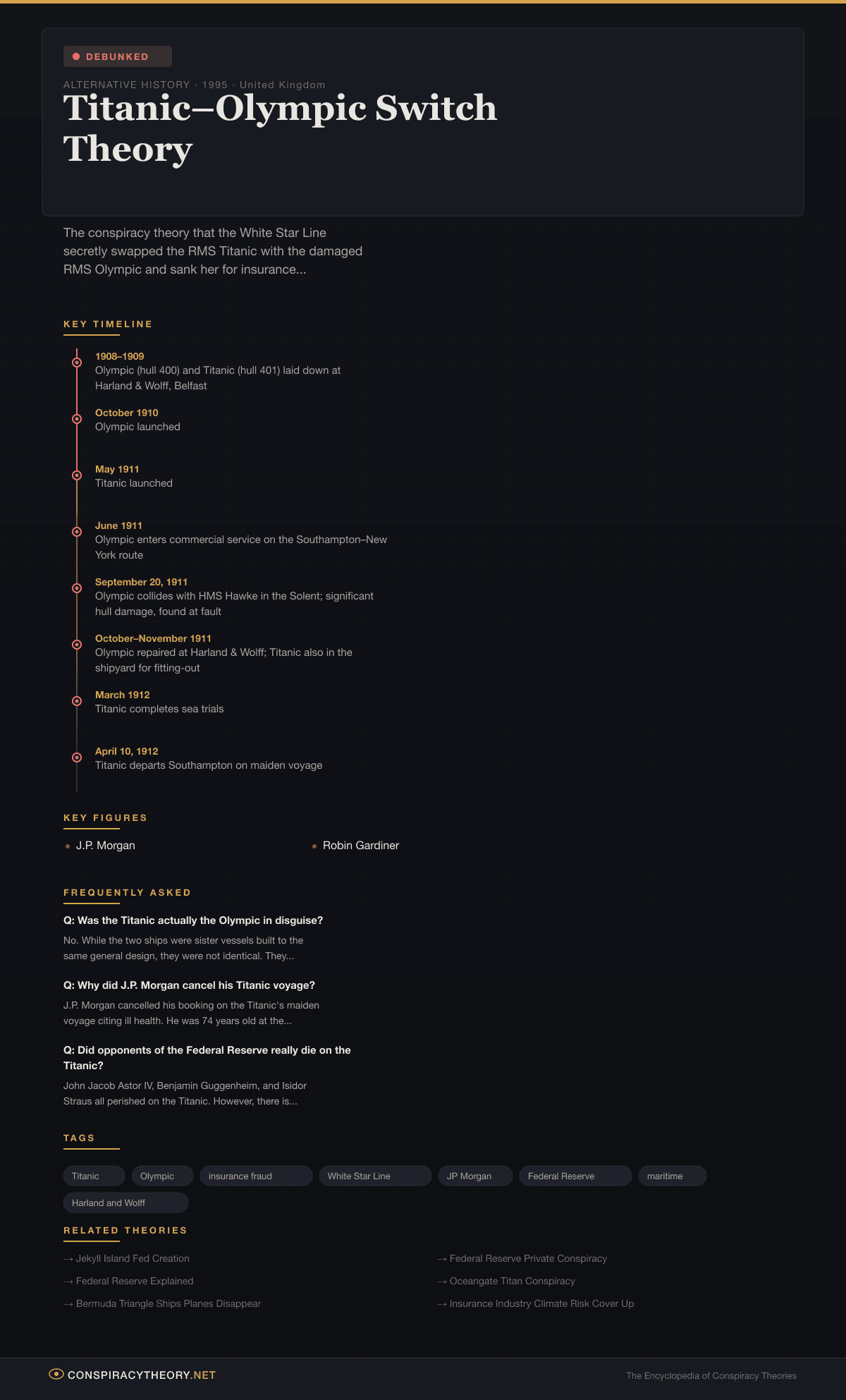
- 1908–1909 — Olympic (hull 400) and Titanic (hull 401) laid down at Harland & Wolff, Belfast
- October 1910 — Olympic launched
- May 1911 — Titanic launched
- June 1911 — Olympic enters commercial service on the Southampton–New York route
- September 20, 1911 — Olympic collides with HMS Hawke in the Solent; significant hull damage, found at fault
- October–November 1911 — Olympic repaired at Harland & Wolff; Titanic also in the shipyard for fitting-out
- March 1912 — Titanic completes sea trials
- April 10, 1912 — Titanic departs Southampton on maiden voyage
- April 14, 1912 — Titanic strikes iceberg at 11:40 PM; sinks at 2:20 AM on April 15
- April–May 1912 — British and American inquiries into the sinking
- 1913 — J.P. Morgan dies in Rome (March 31); Federal Reserve Act signed into law (December 23)
- 1914–1918 — Olympic serves as troopship in World War I; rams and sinks U-103 (1918)
- 1935 — Olympic retired from service and scrapped
- 1985 — Wreck of Titanic discovered by Robert Ballard expedition
- 1998 — Robin Gardiner publishes Titanic: The Ship That Never Sank?, popularizing the switch theory
- 2010 — Gardiner and Erik Van der Schelling publish The Great Titanic Conspiracy
- 2012 — 100th anniversary of the sinking renews public interest in all Titanic conspiracy theories
- 2023 — OceanGate Titan implosion near Titanic wreck site drives new wave of Titanic-related conspiracy content online
- 2024 — Switch theory continues to circulate on social media platforms, often tied to Federal Reserve conspiracy narratives
Sources & Further Reading
- Gardiner, Robin. Titanic: The Ship That Never Sank? Ian Allan Publishing, 1998.
- Gardiner, Robin, and Erik Van der Schelling. The Great Titanic Conspiracy. Ian Allan Publishing, 2010.
- Chirnside, Mark. The Olympic-Class Ships: Olympic, Titanic, Britannic. Tempus Publishing, 2004.
- Beveridge, Bruce, et al. Titanic: The Ship Magnificent. The History Press, 2008.
- Eaton, John P., and Charles A. Haas. Titanic: Triumph and Tragedy. W.W. Norton, 1994.
- British Wreck Commissioner’s Inquiry (Lord Mersey), 1912. Final Report.
- United States Senate Inquiry into the Titanic Disaster, 1912. Hearings and Final Report.
- Ballard, Robert D. The Discovery of the Titanic. Warner Books, 1987.
- Hall, Wayne. “The Titanic Switch Theory: A Critical Examination.” Encyclopedia Titanica, 2012.
Related Theories
- Jekyll Island Secret Meeting (Fed Creation) — the confirmed conspiracy behind the Federal Reserve’s origins
- Federal Reserve: Private Banking Conspiracy — ongoing debate about the Fed’s private ownership structure
- OceanGate Titan Conspiracy — modern Titanic-adjacent disaster and its conspiracy theories
- Bermuda Triangle — another debunked maritime mystery

Frequently Asked Questions
Was the Titanic actually the Olympic in disguise?
Why did J.P. Morgan cancel his Titanic voyage?
Did opponents of the Federal Reserve really die on the Titanic?
Infographic
Share this visual summary. Right-click to save.