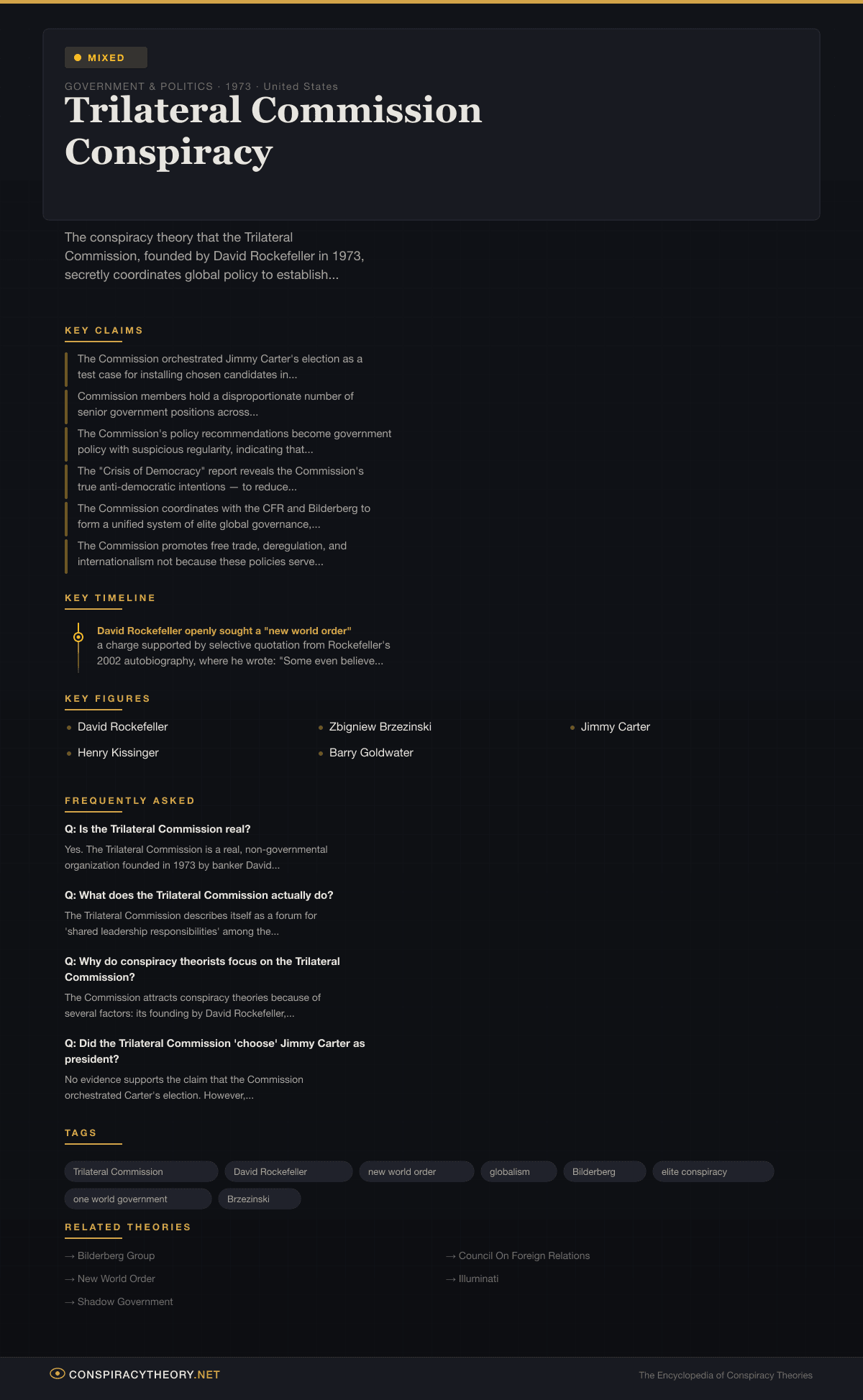
Trilateral Commission Conspiracy
Overview
In the landscape of elite conspiracy theories, the Trilateral Commission occupies a peculiar position. Unlike the Illuminati, which was either dissolved in 1785 or has been running the world ever since (depending on whom you ask), the Trilateral Commission is a real organization with a known address, a public member list, and a website. Unlike Bilderberg, which cloaks itself in secrecy, the Commission publishes its reports and announces its meetings. And unlike the Freemasons, whose rituals invite speculation precisely because they are hidden, the Commission’s rituals — such as they are — consist mainly of panel discussions about international trade policy, which are about as exciting as they sound.
And yet the Trilateral Commission has been a fixture of conspiracy theory for half a century. Founded in 1973 by banker David Rockefeller and political scientist Zbigniew Brzezinski, the Commission was intended to foster cooperation among the democratic industrialized nations of North America, Western Europe, and Japan. To its founders, it was a forum for responsible global leadership in an era of interdependence. To its critics, it was — and remains — a mechanism through which a transnational elite coordinates policy, manages democratic politics, and advances toward a one-world government that serves the interests of capital rather than citizens.
The truth, as is often the case with elite networking organizations, is more nuanced and more boring than either the official story or the conspiracy version suggests. The Trilateral Commission is neither a harmless discussion group nor a shadow world government. It is something in between: a network of powerful people who share a worldview, who influence policy through relationships rather than directives, and who operate with a degree of access and influence that is difficult to reconcile with democratic ideals even if it falls short of the conspiracy theorists’ most dramatic claims.
Origins & History
Rockefeller, Brzezinski, and the Crisis of Democracy
The Trilateral Commission was born from a specific historical moment: the early 1970s, when the postwar international order was fracturing under the pressure of the Vietnam War, the OPEC oil embargo, the collapse of the Bretton Woods monetary system, and rising trade tensions between the United States, Europe, and Japan. David Rockefeller, chairman of Chase Manhattan Bank and scion of America’s most prominent financial dynasty, believed that the existing institutions of international cooperation — the United Nations, NATO, the Organisation for Economic Co-operation and Development (OECD) — were inadequate to manage these challenges.
Rockefeller had been a member of the Council on Foreign Relations (CFR) since the 1940s and a regular attendee of Bilderberg Group meetings since the 1950s. But both organizations had limitations. The CFR was exclusively American. Bilderberg included Europeans but excluded the Japanese. Rockefeller wanted a forum that brought together leaders from all three centers of democratic capitalist power — what Brzezinski, then a professor at Columbia University, had termed the “trilateral” relationship.
Brzezinski provided the intellectual framework. His 1970 book Between Two Ages: America’s Role in the Technetronic Era argued that the industrialized democracies needed new institutions to manage the transition to a technology-driven global economy. Brzezinski envisioned a “community of the developed nations” that would coordinate economic and political policy across the Atlantic and Pacific. When Rockefeller approached him about creating such a body, Brzezinski became the Commission’s first director.
The Trilateral Commission was formally established in July 1973. Its initial membership of approximately 200 was drawn equally from North America, Western Europe, and Japan. Members included corporate CEOs, central bankers, academic economists, former government officials, and prominent journalists. The Commission’s membership was by invitation only, and its composition reflected the worldview of its founders: liberal internationalist, pro-free trade, skeptical of both left-wing populism and right-wing nationalism.
The Carter Connection
The event that transformed the Trilateral Commission from an obscure policy forum into a conspiracy theory touchstone was the election of Jimmy Carter as President of the United States in 1976. Carter’s connection to the Commission was not incidental — it was central to his political rise.
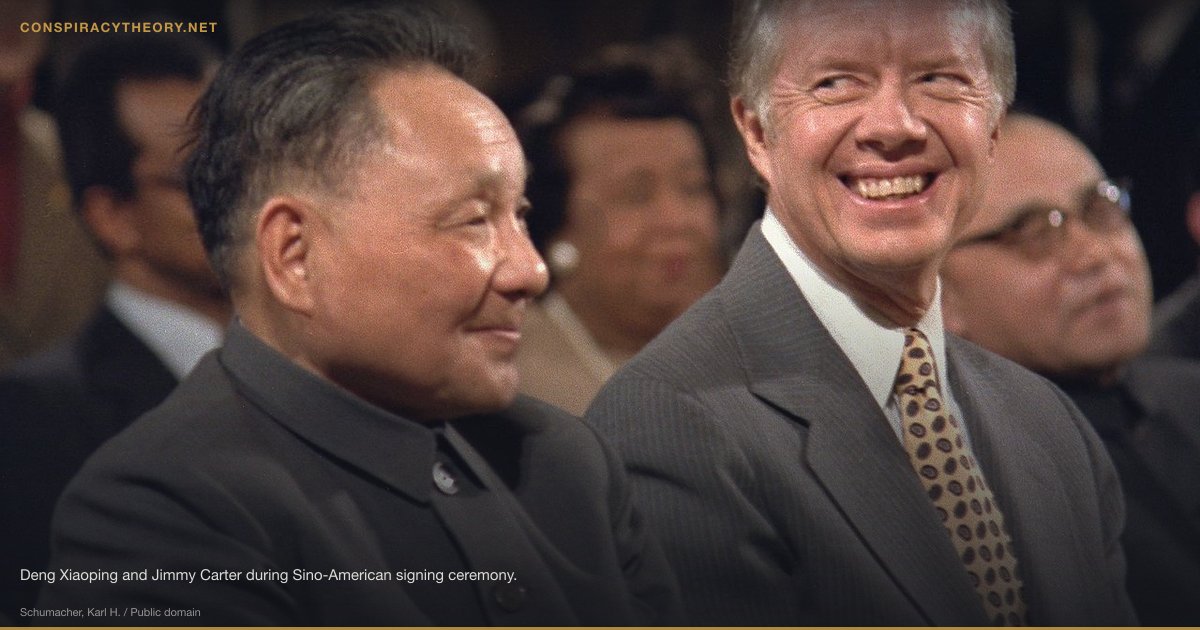
In 1973, Carter was a relatively obscure one-term governor of Georgia with no national profile and no obvious path to the presidency. Rockefeller, looking to recruit southern and younger members, invited Carter to join the Commission on the recommendation of a Coca-Cola executive. Carter accepted and became one of the Commission’s most active members, attending meetings, contributing to task force reports, and building relationships with the foreign policy establishment figures who constituted the Commission’s core membership.
When Carter ran for president in 1975-1976, he did so with a network of Trilateral contacts that gave him access to expertise, fundraising, and media attention far beyond what a governor from Georgia might normally command. Brzezinski became an informal advisor to the campaign and, after Carter’s victory, was appointed national security advisor. Carter’s cabinet and senior staff included at least twenty current or former Trilateral Commission members, including Vice President Walter Mondale, Secretary of State Cyrus Vance, Secretary of Defense Harold Brown, and Treasury Secretary W. Michael Blumenthal.
To conspiracy theorists, this was proof of puppetry — the Trilateral Commission had selected, groomed, and installed its chosen candidate. To political scientists, it was proof of networking — Carter had leveraged his Commission contacts to build the relationships and credentials needed for a national campaign, which is what networking organizations are designed to facilitate. The distinction between these interpretations — conspiracy versus networking — is the central tension of the entire Trilateral debate.
The Right-Wing Response
Opposition to the Trilateral Commission came initially and most forcefully from the political right. Senator Barry Goldwater, the 1964 Republican presidential nominee and patron saint of American conservatism, devoted a chapter of his 1979 book With No Apologies to the Commission, writing: “What the Trilaterals truly intend is the creation of a worldwide economic power superior to the political governments of the nation-states involved. As managers and creators of the system, they will rule the future.”
Goldwater’s critique reflected a broader conservative suspicion of internationalism that dated to the post-World War I debate over the League of Nations. The Commission’s explicit emphasis on international cooperation, its skepticism of economic nationalism, and its membership’s embrace of managed trade and coordinated monetary policy conflicted directly with the free-market, national sovereignty-focused ideology of the American right.
Conservative critics were joined by left-wing analysts who offered a different but complementary critique. Scholars like Noam Chomsky and Holly Sklar argued that the Commission represented not a conspiracy but a class project — the organized expression of transnational capital’s interests, pursued through open institutional channels rather than secret cabals. Sklar’s 1980 book Trilateralism: The Trilateral Commission and Elite Planning for World Management provided a detailed, sourced analysis of the Commission’s membership and policy recommendations that remains the most comprehensive academic treatment of the subject.
The “Crisis of Democracy” Report
No Trilateral Commission publication has generated more conspiracy theorizing than its 1975 report The Crisis of Democracy: On the Governability of Democracies, authored by Michel Crozier, Samuel Huntington, and Joji Watanuki. The report argued that Western democracies were experiencing a “crisis of governability” caused by an “excess of democracy” — that increased political participation, expanded social welfare expectations, and a decline in deference to authority were making democratic governments ungovernable.
Huntington, writing the American section, argued that the expansion of higher education, the civil rights movement, and the anti-war movement had produced a citizenry that made too many demands on government and too few concessions to authority. His prescription — a reduction in “the democratic surge” and the reinstitution of “a greater degree of moderation in democracy” — was inflammatory enough when published. In the context of conspiracy theory, it became proof that the Trilateral Commission sought to dismantle democracy itself.
Read in context, the report is a characteristic product of its era — a conservative academic’s alarm at social change, filtered through Cold War anxieties about institutional stability. Read as a statement of intent by a secretive elite organization, it becomes a confession of anti-democratic conspiracy. Both readings are defensible; neither is complete.
Key Claims
Conspiracy theories about the Trilateral Commission advance several specific claims:
- The Commission orchestrated Jimmy Carter’s election as a test case for installing chosen candidates in national leadership positions
- Commission members hold a disproportionate number of senior government positions across multiple administrations, regardless of party, demonstrating coordinated elite control
- The Commission’s policy recommendations become government policy with suspicious regularity, indicating that members implement pre-agreed agendas once they enter office
- The “Crisis of Democracy” report reveals the Commission’s true anti-democratic intentions — to reduce citizen participation and increase elite control
- The Commission coordinates with the CFR and Bilderberg to form a unified system of elite global governance, with each organization serving a specific function within the overall structure
- The Commission promotes free trade, deregulation, and internationalism not because these policies serve the public good but because they serve the financial interests of its corporate members
- David Rockefeller openly sought a “new world order” — a charge supported by selective quotation from Rockefeller’s 2002 autobiography, where he wrote: “Some even believe we are part of a secret cabal working against the best interests of the United States… If that’s the charge, I stand guilty, and I am proud of it”
Evidence
What Is Documented
Several facts about the Trilateral Commission are established beyond dispute:
Elite composition: The Commission’s membership has consistently included an extraordinary concentration of political and economic power. Multiple heads of state, central bank governors, major corporate CEOs, and senior media figures have been members. The overlap with government leadership positions is notable.
Carter administration saturation: The disproportionate presence of Trilateral members in the Carter administration is well-documented and was acknowledged by Carter himself, who joked about it during his presidency.
Policy influence: Commission task force reports have frequently anticipated or paralleled subsequent government policy initiatives, though whether this represents causation or simply the fact that Commission members and policymakers draw on the same intellectual frameworks is debated.
Rockefeller’s own statements: David Rockefeller’s autobiography and public statements confirm that he viewed international coordination among elites as both necessary and desirable, and that he was aware of and unbothered by conspiracy theories about his activities.
What Remains Speculative
Despite the documented facts, key conspiracy claims lack supporting evidence:
Central coordination: No evidence has emerged that the Commission issues binding directives to its members or that members’ government service is coordinated by the organization. The Commission’s meetings produce reports and recommendations, not orders.
Installation of leaders: The Carter connection, while suggestive, does not demonstrate that the Commission has the ability to determine election outcomes. Carter won a contested primary and general election through the normal democratic process, even if his Commission contacts aided his campaign.
Unified elite conspiracy: The assumption that the Commission, CFR, and Bilderberg function as components of a single conspiracy overstates the degree of coordination among these organizations, which have different memberships, different structures, and frequently disagree on policy questions.
Cultural Impact
The Template for Elite Conspiracy
The Trilateral Commission has served as a template for conspiracy theories about elite organizations for fifty years. Its structure — real organization, real powerful members, real but limited influence — has been mapped onto every subsequent elite gathering, from Davos to the Bohemian Grove. The Trilateral model established the pattern: identify a real organization, document its powerful membership, observe that members hold government positions, and conclude that the organization controls government.
Left-Right Convergence
The Commission is unusual in attracting conspiracy theories from both the political left and the political right. Right-wing critics see it as a vehicle for internationalist elites to undermine national sovereignty. Left-wing critics see it as a vehicle for corporate interests to capture democratic governance. This convergence — what scholars call “fusion paranoia” — has made the Trilateral Commission a rare common ground between otherwise opposed political movements.
The Rockefeller Brand
The Commission has permanently associated the Rockefeller name with conspiracy theory. David Rockefeller’s founding of the Commission, combined with his family’s earlier association with the CFR and Standard Oil, has made “Rockefeller” a metonym for elite conspiracy in a way that no amount of philanthropy has been able to overcome. The name functions as a shorthand for the argument that concentrated wealth translates into concentrated, undemocratic power.
Timeline
| Date | Event |
|---|---|
| 1970 | Zbigniew Brzezinski publishes Between Two Ages: America’s Role in the Technetronic Era |
| July 1973 | Trilateral Commission formally established by David Rockefeller and Zbigniew Brzezinski |
| 1973 | Jimmy Carter, then governor of Georgia, recruited to the Commission |
| 1975 | Commission publishes The Crisis of Democracy, arguing that Western democracies suffer from an “excess of democracy” |
| November 1976 | Carter elected president; subsequently appoints over 20 Trilateral Commission members to senior positions |
| 1977 | Brzezinski appointed as Carter’s national security advisor |
| 1979 | Barry Goldwater denounces the Commission in With No Apologies |
| 1980 | Holly Sklar publishes Trilateralism, the first comprehensive academic analysis of the Commission |
| 1980s | Commission expands focus to include newly industrialized countries |
| 1991 | Commission membership expanded from Japan-only Asian representation to include South Korea, Australia, and other Asia-Pacific nations |
| 2000 | Commission renamed its Asian group the “Pacific Asian Group” |
| 2002 | David Rockefeller publishes autobiography acknowledging and embracing his role in international elite coordination |
| 2009 | Commission expands to include members from China, India, Brazil, and Mexico |
| 2017 | David Rockefeller dies at age 101; Commission continues under new leadership |
| 2020s | Commission continues to hold annual meetings and publish reports; conspiracy theories persist |
Sources & Further Reading
- Sklar, Holly. Trilateralism: The Trilateral Commission and Elite Planning for World Management. South End Press, 1980
- Rockefeller, David. Memoirs. Random House, 2002
- Crozier, Michel, Samuel P. Huntington, and Joji Watanuki. The Crisis of Democracy: Report on the Governability of Democracies to the Trilateral Commission. New York University Press, 1975
- Goldwater, Barry. With No Apologies: The Personal and Political Memoirs of United States Senator Barry M. Goldwater. William Morrow, 1979
- Brzezinski, Zbigniew. Between Two Ages: America’s Role in the Technetronic Era. Viking Press, 1970
- Gill, Stephen. American Hegemony and the Trilateral Commission. Cambridge University Press, 1990
- Domhoff, G. William. Who Rules America? Challenges to Corporate and Class Dominance. McGraw-Hill, 2013
- Trilateral Commission. Official website and publications archive
- Dye, Thomas R. Who’s Running America? The Obama Years. Paradigm Publishers, 2014
- Shoup, Laurence H. Wall Street’s Think Tank: The Council on Foreign Relations and the Empire of Neoliberal Geopolitics. Monthly Review Press, 2015
Related Theories
- Bilderberg Group — The European-American elite meeting that parallels the Trilateral Commission
- Council on Foreign Relations — The American foreign policy establishment think tank with overlapping membership
- New World Order — The broader conspiracy theory of planned global governance
- Shadow Government — The related theory of hidden parallel governance structures
- Illuminati — The ur-conspiracy theory of elite secret control

Frequently Asked Questions
Is the Trilateral Commission real?
What does the Trilateral Commission actually do?
Why do conspiracy theorists focus on the Trilateral Commission?
Did the Trilateral Commission 'choose' Jimmy Carter as president?
Infographic
Share this visual summary. Right-click to save.