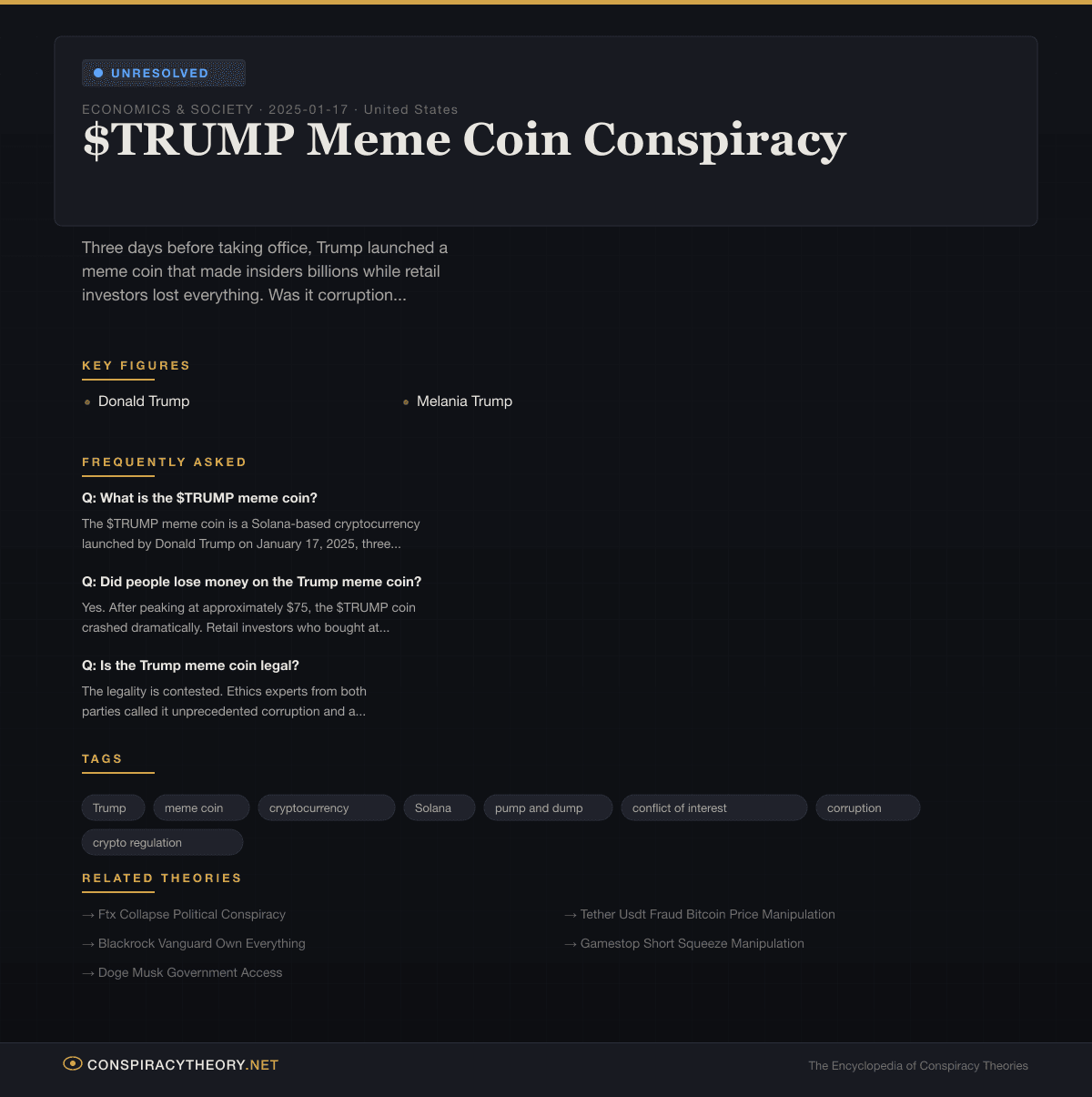
$TRUMP Meme Coin Conspiracy
Overview
On the evening of January 17, 2025 — a Friday, three days before Donald Trump would raise his right hand and take the oath of office for a second time — the incoming president posted to Truth Social. The post wasn’t about policy, or cabinet appointments, or the transfer of power. It was an advertisement. “My NEW Official Trump Meme is HERE!” the post read, with a link to purchase a Solana-based cryptocurrency token called $TRUMP.
Within hours, the token’s market capitalization exploded past $15 billion. By Saturday evening, a single $TRUMP coin was trading at roughly $75. The incoming president of the United States was, in real time, profiting from a speculative digital asset that people were buying specifically because of who he was and what he was about to become.
Then it collapsed. As quickly as it had rocketed upward, $TRUMP cratered — shedding billions in market value, wiping out retail investors who had bought at or near the peak, and leaving behind a trail of financial wreckage that ethics experts, legal scholars, and even some Republican lawmakers called the single most brazen conflict of interest in the history of the American presidency.
What made the whole thing worse — if it could get worse — was the tokenomics. Eighty percent of the total $TRUMP supply was held by two entities: CIC Digital LLC and Fight Fight Fight LLC, both affiliated with the Trump Organization. The public could buy the remaining 20%. The structure meant that Trump-linked insiders were positioned to profit on a scale that dwarfed any possible retail gain, while bearing almost none of the downside risk.
And then, just to make things truly surreal, Melania Trump launched her own meme coin, $MELANIA, the very next day.
The Launch: Three Days Before Power
The timing is the thing you can’t get past, no matter how hard defenders try to spin it.
If a random tech entrepreneur had launched a meme coin, nobody would have blinked. The crypto space in January 2025 was already saturated with joke tokens, celebrity shills, and outright scams. Meme coins are, by design, speculative instruments with no underlying value — their price is entirely a function of hype, community enthusiasm, and the greater fool theory. They are, in the most charitable interpretation, digital collectibles. In the least charitable interpretation, they are legalized gambling where the house always wins.
But this wasn’t a random tech entrepreneur. This was the president-elect of the United States, three days away from assuming control of the executive branch — including the Securities and Exchange Commission, the Commodity Futures Trading Commission, the Department of Justice, and every other federal agency with jurisdiction over financial markets and cryptocurrency regulation.
The $TRUMP token launched on the Solana blockchain on January 17, 2025, with an initial supply of 200 million tokens out of a planned total of 1 billion. The remaining 800 million tokens were scheduled to be released over a three-year vesting period — all controlled by Trump-affiliated entities. This meant that the insiders didn’t just hold 80% of the existing supply; they held the ability to flood the market with new tokens at any point over the next three years, diluting the value of tokens held by retail purchasers.
Within the first 24 hours, $TRUMP’s market capitalization surged past $15 billion. Trading volume was astronomical. Crypto exchanges that listed the token saw traffic spikes that crashed their servers. Social media exploded with screenshots of paper profits — people who had bought in early, who were suddenly sitting on five- and six-figure gains. The fear of missing out was overwhelming, and it drove a second wave of buyers into the market at precisely the worst time.
By January 20, inauguration day, $TRUMP had already begun its decline. By February, the coin had lost more than 80% of its peak value. By March, it was trading at a fraction of its high, and the discourse had shifted from euphoria to recrimination. Retail investors who had poured savings into the token — believing that the endorsement of an incoming president made it a safe bet — were posting their losses online.
The Tokenomics: Insiders Win, Everyone Else Loses
Understanding the $TRUMP coin conspiracy requires understanding the token’s structure, because the structure tells you everything about who was meant to benefit.
Of the 1 billion total $TRUMP tokens, 800 million — 80% — were allocated to CIC Digital LLC and Fight Fight Fight LLC. CIC Digital is a Trump Organization affiliate that manages Trump’s NFT and cryptocurrency ventures. Fight Fight Fight LLC was created specifically for the meme coin launch; its name references the words Trump shouted after the Butler, Pennsylvania assassination attempt in July 2024.
The remaining 200 million tokens were released to the public market. This is the pool that retail investors were buying and selling. This is the pool whose price action made headlines. And this is the pool whose collapse wiped out ordinary people’s money.
The 80/20 split is not, in itself, unusual for cryptocurrency projects. Many token launches reserve large allocations for founders, development teams, and treasury funds. But there is a critical difference between a startup founder holding a large stake in a project they built and plan to develop, and the incoming president of the United States holding a large stake in a speculative token whose value is entirely derived from his political identity and the power he’s about to assume.
The vesting schedule added another layer. The insider tokens were locked for various periods, but the schedule was controlled by the same entities that held the tokens. The practical effect was simple: Trump-affiliated entities could choose when to release additional supply to the market. If the price was high, they could sell. If the price was low, they could wait. Retail investors had no such luxury — they were price-takers in a market where the dominant holder could move the price at will.
This structure is, in its essentials, the architecture of a pump and dump. A small group controls the majority of the supply. Hype drives the price up. Retail investors pile in. The insiders sell. The price collapses. The insiders keep the money. The retail investors hold worthless tokens.
The only question is whether Donald Trump intended it to work this way, or whether it just happened to work this way, or whether the distinction matters.
$MELANIA: The Second Coin
On January 18, 2025 — the day after $TRUMP launched — Melania Trump posted to social media announcing her own meme coin, $MELANIA, also on the Solana blockchain.
The timing was remarkable. The $MELANIA launch came while $TRUMP was still in the middle of its initial price surge. The immediate effect was predictable and devastating: money that might have continued flowing into $TRUMP was diverted to $MELANIA, accelerating the sell-off in the first coin. $TRUMP’s price dropped roughly 40% in the hours following the $MELANIA announcement.
$MELANIA briefly achieved a market capitalization of approximately $13 billion before undergoing its own collapse. Like $TRUMP, the vast majority of the token supply was held by insiders.
The dual-coin launch produced one of the stranger conspiracy theories within the broader $TRUMP coin scandal. Some observers speculated that Melania’s team had launched $MELANIA deliberately to undermine $TRUMP — that it was a calculated act of financial sabotage, either motivated by personal grievances within the Trump marriage or by a separate group of insiders who wanted their own revenue stream regardless of the impact on the first coin. Others suggested the opposite: that the two launches were coordinated to maximize total extraction from the retail market, with $MELANIA serving as a second bite at the apple for insiders.
Neither interpretation has been confirmed. What is known is that the two launches collectively siphoned billions of dollars from retail investors into entities controlled by the Trump family, and that the $MELANIA launch materially harmed $TRUMP holders.
The Pay-to-Play Theory
The most serious conspiracy theory surrounding the $TRUMP coin isn’t about pump-and-dump mechanics — it’s about corruption.
The argument is straightforward: the $TRUMP meme coin created a legal mechanism for anyone in the world — including foreign governments, lobbyists, corporations, and individuals seeking presidential favor — to transfer money directly to Trump-affiliated entities. All they had to do was buy the coin. No disclosure required. No campaign finance laws to navigate. No gift restrictions. No bribery statutes to worry about. Just open your crypto wallet and purchase $TRUMP on a decentralized exchange.
Consider the implications. Under existing law, campaign donations are limited and disclosed. Gifts to the president are restricted and reported. Foreign contributions to campaigns are illegal. Lobbying expenditures are tracked. There is an entire architecture of ethics and transparency rules designed to prevent the president from being bought — rules that, whatever their imperfections, at least create a paper trail.
The $TRUMP coin sidestepped all of it. A Saudi prince could buy $50 million worth of $TRUMP and there would be no disclosure requirement, no campaign finance violation, no ethics filing. The money would flow directly to Trump-affiliated entities. The purchase would be recorded on the Solana blockchain, but the buyer’s identity would be pseudonymous. And the transaction would be perfectly legal, because buying a meme coin is not, under current law, a campaign contribution, a gift, or a bribe.
Ethics experts were unequivocal. Richard Painter, who served as the chief White House ethics lawyer under George W. Bush — a Republican — called the coin launch “the most corrupt act by a president-elect in American history.” Walter Shaub, the former director of the Office of Government Ethics, described it as “a vehicle for bribery.” Norm Eisen, who served as Obama’s ethics czar, called it “emoluments on steroids.”
The response from the Trump transition team was dismissive. They characterized the coin as no different from Trump-branded merchandise — hats, sneakers, trading cards, the gold sneakers that sold for $399. Just another product bearing the Trump name. The comparison was technically defensible and substantively absurd: a $15 hat does not create the same corruption risk as a pseudonymous digital asset with a multi-billion-dollar market cap.
The Crypto Deregulation Connection
To understand why the $TRUMP coin matters beyond the immediate financial damage, you have to zoom out to the broader regulatory landscape.
Throughout his 2024 campaign, Trump positioned himself as the most pro-crypto presidential candidate in American history. He spoke at the Bitcoin 2024 conference in Nashville. He promised to fire SEC Chair Gary Gensler (who had been aggressively pursuing enforcement actions against crypto companies). He pledged to establish a national Bitcoin reserve. He appointed crypto-friendly figures to key regulatory positions.
This wasn’t mere rhetoric. Within weeks of taking office, the Trump administration’s SEC — now under acting and then permanent pro-crypto leadership — began withdrawing enforcement actions against major crypto companies. The regulatory posture shifted from aggressive enforcement to what critics called abdication. Investigations were shelved. Lawsuits were dropped. The message to the crypto industry was clear: you’re safe now.
Here’s where the conspiracy theory gains its sharpest edge. The president of the United States was simultaneously:
- Personally profiting from a cryptocurrency (the $TRUMP meme coin)
- Appointing regulators who would determine the legal status of such tokens
- Directing policy that would determine whether crypto projects faced enforcement action
- Benefiting from crypto market growth that his own deregulatory agenda was designed to stimulate
The conflict of interest was not hidden. It was not subtle. It was not ambiguous. It was the single most direct financial conflict of interest in the history of the American presidency — a president enriching himself from an asset class over which he exercised regulatory control, in plain sight, while his supporters cheered.
The DOGE initiative under Elon Musk raised parallel concerns about the entanglement of private financial interests with government power, but the $TRUMP coin was more direct: the president himself was the financial beneficiary.
What We Know for Certain
Separating established fact from theory is essential here, because the confirmed facts are damning enough without embellishment.
Confirmed:
- Donald Trump launched a meme coin on January 17, 2025, three days before his inauguration
- The coin’s market cap briefly exceeded $15 billion
- 80% of the token supply was held by Trump-affiliated entities (CIC Digital LLC and Fight Fight Fight LLC)
- Melania Trump launched a competing meme coin on January 18, 2025
- The $MELANIA launch contributed to a 40% drop in $TRUMP’s price
- Both coins subsequently crashed, with retail investors losing billions
- The Trump administration’s SEC adopted a dramatically more permissive stance toward cryptocurrency regulation
- Ethics experts from both parties condemned the launch as unprecedented corruption
- No meaningful investigation into the coin’s legality has been initiated by any federal agency under the Trump administration
Contested:
- Whether foreign governments or lobbyists used the coin as a pay-to-play mechanism
- Whether the insider allocation was designed as an extraction scheme or a standard tokenomics structure
- Whether the $MELANIA launch was coordinated with or deliberately hostile to $TRUMP
- Whether the deregulatory agenda was influenced by Trump’s personal financial stake in crypto
- Whether existing law adequately addresses the corruption risks created by the coin
Unknown:
- The total amount of money extracted by Trump-affiliated entities from the coins
- The identities of the largest purchasers (blockchain transactions are pseudonymous)
- Whether any internal communications discussed the corruption implications before launch
- Whether foreign state actors purchased significant quantities of the tokens
The “It’s Just Merchandise” Defense
Defenders of the $TRUMP coin have consistently relied on a single argument: it’s no different from other Trump-branded products. Trump has sold hats, ties, steaks, vodka, NFTs, sneakers, and a Bible. The meme coin, in this framing, is simply the latest item in a long line of branded merchandise. If you don’t like it, don’t buy it.
This argument has a surface plausibility that evaporates on examination. The difference between a hat and a meme coin isn’t just the price point — it’s the structure. When you buy a Trump hat for $35, the transaction is simple: you give money, you get a hat. The hat doesn’t fluctuate in value. Nobody buys a Trump hat expecting it to appreciate by 1,000%. And critically, the hat transaction doesn’t create a mechanism for anonymous actors to transfer unlimited sums to the president’s business entities.
A meme coin is not merchandise. It is a speculative financial instrument. Its value is entirely derived from demand, which is entirely derived from the political identity and power of its creator. When the president of the United States issues a speculative financial instrument that enriches his entities by billions of dollars, that is not commerce. That is something for which we do not have a good word, because nothing like it has ever happened before.
The Broader Crypto-Politics Nexus
The $TRUMP meme coin didn’t emerge in a vacuum. It was the most visible node in a broader network connecting cryptocurrency markets to political power in ways that had no precedent in American governance.
The crypto industry spent heavily in the 2024 election cycle, with the Fairshake super PAC — funded by Coinbase, Ripple, and Andreessen Horowitz — spending more than $130 million to support crypto-friendly candidates in both parties. The industry’s bet paid off spectacularly: not only did Trump win, but Congress gained a substantial bloc of crypto-friendly legislators.
The FTX collapse in 2022 had demonstrated what happens when crypto money and political power become entangled — Sam Bankman-Fried’s $40 million in political donations, funded by fraud, became a cautionary tale. But the $TRUMP coin represented something different from the FTX debacle. SBF was a private actor using stolen money to buy political influence. Trump was a public official using his political identity to generate personal wealth. The money flowed in the opposite direction, and the corruption, if that’s what it was, was not hidden but advertised.
The relationship between Tether’s unaudited reserves and Bitcoin price manipulation had already demonstrated that the crypto ecosystem was vulnerable to structural manipulation by centralized actors. The $TRUMP coin wasn’t market manipulation in the traditional sense — it was something arguably worse. It was the president using the machinery of democratic legitimacy itself as a money-printing machine.
The Solana Connection
A detail that received less attention than it deserved: the $TRUMP coin was built on the Solana blockchain, not Ethereum or Bitcoin. This choice had implications.
Solana had been positioning itself as the preferred blockchain for meme coins and high-speed, low-cost trading. The $TRUMP coin launch generated enormous activity on the Solana network, driving up the price of SOL (Solana’s native token) and enriching Solana ecosystem participants. The question of whether anyone in Trump’s orbit held significant SOL positions before the launch — and thus profited from the network effects — has never been publicly addressed.
The Solana choice also meant that $TRUMP traded on decentralized exchanges where identity verification was minimal. Anyone with a crypto wallet could buy. No KYC (know your customer) checks. No anti-money-laundering screening. A Russian oligarch, a Chinese state entity, or a Mexican cartel could purchase $TRUMP tokens with no more identification than a pseudonymous wallet address.
This isn’t theoretical speculation — it’s the basic reality of how decentralized exchanges work, and it’s precisely why the pay-to-play theory resonates with ethics experts.
The International Dimension
The foreign corruption angle is the one that should keep you up at night.
Under the Foreign Corrupt Practices Act and longstanding American ethics norms, there are supposed to be walls between the president and foreign money. Those walls have always been imperfect — the emoluments lawsuits during Trump’s first term centered on foreign government spending at Trump hotels — but they existed. Foreign governments couldn’t just hand the president money.
The meme coin removed the wall entirely. Any foreign government, any sovereign wealth fund, any oligarch seeking to curry favor with the American president could purchase $TRUMP tokens in unlimited quantities, anonymously, on a decentralized exchange, and the money would ultimately flow to Trump-controlled entities. The transaction would be recorded on the blockchain, but without the buyer’s real-world identity attached.
Did this actually happen? We don’t know. Blockchain analytics firms have attempted to trace the largest $TRUMP purchases to identify patterns consistent with state-level buying, but pseudonymous wallets make definitive attribution nearly impossible. What we know is that the mechanism existed, that the incentive existed, and that there was no system in place to detect or prevent it.
For context, the entire architecture of American campaign finance law is built around the principle that we need to know who is giving money to politicians. The $TRUMP coin nullified that principle entirely — not by violating the law, but by existing in a space the law hadn’t contemplated.
Comparison to Historical Corruption
It’s worth placing the $TRUMP coin in historical context, because the scale of the potential corruption is difficult to grasp without reference points.
The Teapot Dome scandal — the gold standard of American presidential corruption for a century — involved Interior Secretary Albert Fall leasing federal oil reserves to private companies in exchange for approximately $400,000 in personal loans and gifts (roughly $7 million in today’s dollars). Fall went to prison. It was considered the most corrupt act of the Harding administration.
The $TRUMP meme coin generated billions of dollars for Trump-affiliated entities. Not millions. Billions. In three days.
Whether you consider it corruption depends on your definition. If corruption requires illegality, then the $TRUMP coin may not qualify — because the legal framework simply doesn’t address a scenario this audacious. If corruption means using public office for private enrichment in ways that undermine democratic governance, then the $TRUMP coin is corruption on a scale that makes Teapot Dome look like a parking ticket.
The BlackRock and Vanguard nexus of financial and political power is often cited as evidence of institutional corruption — the revolving door, the policy influence, the concentration of ownership. But even BlackRock doesn’t have the CEO of the United States actively shilling financial products to the public from the presidential podium.
The Regulatory Void
Perhaps the most disturbing aspect of the $TRUMP coin affair is the regulatory response, or rather its absence.
Under normal circumstances, a financial instrument that enriched insiders while retail investors lost billions would attract regulatory scrutiny. The SEC would investigate. The CFTC would ask questions. The DOJ would consider whether fraud occurred. Congressional committees would hold hearings.
None of that happened in any meaningful way. The SEC — now staffed with Trump appointees sympathetic to cryptocurrency — declined to investigate. The CFTC took no action. The DOJ, under a Trump-appointed attorney general, showed no interest. Congressional Republicans, who held majorities in both chambers, blocked Democratic attempts to hold hearings.
The fox was guarding the henhouse. Or more precisely, the fox had built the henhouse, stocked it with chickens, eaten most of them, and then appointed other foxes to investigate whether anything improper had occurred.
This regulatory void wasn’t accidental. It was the logical endpoint of decades of crypto industry lobbying and the specific pro-crypto appointments Trump made upon taking office. The same deregulatory agenda that enriched the broader crypto ecosystem also ensured that the president’s personal crypto ventures would face no scrutiny.
The Meme Coin as Mirror
There’s a way to read the $TRUMP meme coin not as an aberration but as a distillation — the purest expression of dynamics that have been building in American politics for decades.
The monetization of political identity. The erosion of ethics norms. The capture of regulatory agencies by the industries they regulate. The weaponization of financial complexity to render accountability impossible. The retreat of law from spaces where power operates. The normalization of conflicts of interest so extreme they would have ended careers in any previous era.
The $TRUMP coin is all of these things at once. It’s the place where celebrity politics, crypto speculation, regulatory capture, and presidential power converge into something that is either a historical scandal or the new normal, depending on which direction American governance goes from here.
Timeline
- 2024 (Campaign): Trump promises to be the most pro-crypto president, speaks at Bitcoin 2024, pledges to fire SEC Chair Gary Gensler and create a national Bitcoin reserve
- November 2024: Trump wins presidential election; crypto markets surge
- January 17, 2025: $TRUMP meme coin launches on Solana blockchain; price rapidly climbs
- January 18, 2025: $MELANIA meme coin launches; $TRUMP drops ~40%
- January 18-19, 2025: $TRUMP peaks at approximately $75; market cap exceeds $15 billion
- January 20, 2025: Trump inaugurated; decline in $TRUMP price accelerates
- Late January 2025: Ethics experts from both parties condemn the coin as unprecedented corruption
- February-March 2025: $TRUMP and $MELANIA crash; retail investors report massive losses
- Early 2025: Trump SEC begins withdrawing enforcement actions against crypto companies
- 2025 (ongoing): No federal investigation initiated; congressional oversight blocked by Republican majority
The Unanswered Questions
The $TRUMP meme coin story remains unresolved not because the facts are unclear, but because the system designed to answer the hard questions has been disabled by the person the questions are about.
Who were the largest buyers? Were any foreign governments involved? How much money has been extracted by Trump-affiliated entities? Were there internal discussions about the ethics and legality of the launch? Did anyone in Trump’s orbit purchase SOL or other related assets before the announcement? Was the $MELANIA launch coordinated with the $TRUMP team? Has any regulatory official been directed not to investigate?
These questions could be answered by a functioning system of oversight. Subpoena the records. Compel testimony. Trace the wallets. Audit the entities. The tools exist. The authority exists. The will does not — because the person who would need to be investigated controls the agencies that would do the investigating.
That, in the end, is the conspiracy. Not that the $TRUMP meme coin was a secret scheme hatched in back rooms. It wasn’t secret at all. It was announced on social media by the incoming president himself. The conspiracy, if you want to call it that, is that the system of checks and balances designed to prevent exactly this kind of self-dealing has proven entirely inadequate to the task — not because the rules failed, but because the rules were never written for a president willing to simply ignore them in plain sight.
Sources & Further Reading
- Financial Times: “Trump Meme Coin Raises Unprecedented Conflict of Interest Concerns” (January 2025)
- The New York Times: “Trump’s Meme Coin Makes Billions for Insiders as Regular Investors Lose” (February 2025)
- Bloomberg: “The $TRUMP Token’s 80/20 Split and What It Means” (January 2025)
- Reuters: “Ethics Experts Call Trump Meme Coin ‘Most Corrupt Act by a President-Elect’” (January 2025)
- CoinDesk: “$TRUMP Tokenomics: Who Owns What” (January 2025)
- Chainalysis: “On-Chain Analysis of $TRUMP Wallet Activity” (February 2025)
- The Atlantic: “The President is Selling You a Meme Coin” (January 2025)
- Wired: “How $TRUMP Broke American Ethics Law Without Technically Breaking Any Rules” (February 2025)
- Richard Painter, former White House ethics lawyer, public statements (January 2025)
- Walter Shaub, former Office of Government Ethics director, public statements (January-February 2025)
- Solana blockchain data, publicly accessible on-chain records
- SEC enforcement action withdrawal announcements (January-March 2025)
Related Theories
- FTX Collapse — Political Money Laundering Conspiracy — the previous collision of crypto money and political power
- Tether (USDT) Fraud / Bitcoin Price Manipulation — structural manipulation in crypto markets by centralized actors
- BlackRock & Vanguard Own Everything — institutional financial power and political influence
- GameStop Short Squeeze — when retail investors learned the market was rigged
- DOGE: Musk’s Government Access — private financial interests entangled with government power
- Trump Butler Assassination Attempt — the origin of “Fight Fight Fight,” which became the LLC name
- Cryptocurrency = NWO Digital Control — broader theories about crypto and centralized power
Frequently Asked Questions
What is the $TRUMP meme coin?
Did people lose money on the Trump meme coin?
Is the Trump meme coin legal?

Infographic
Share this visual summary. Right-click to save.