Tuskegee Syphilis Study
Overview
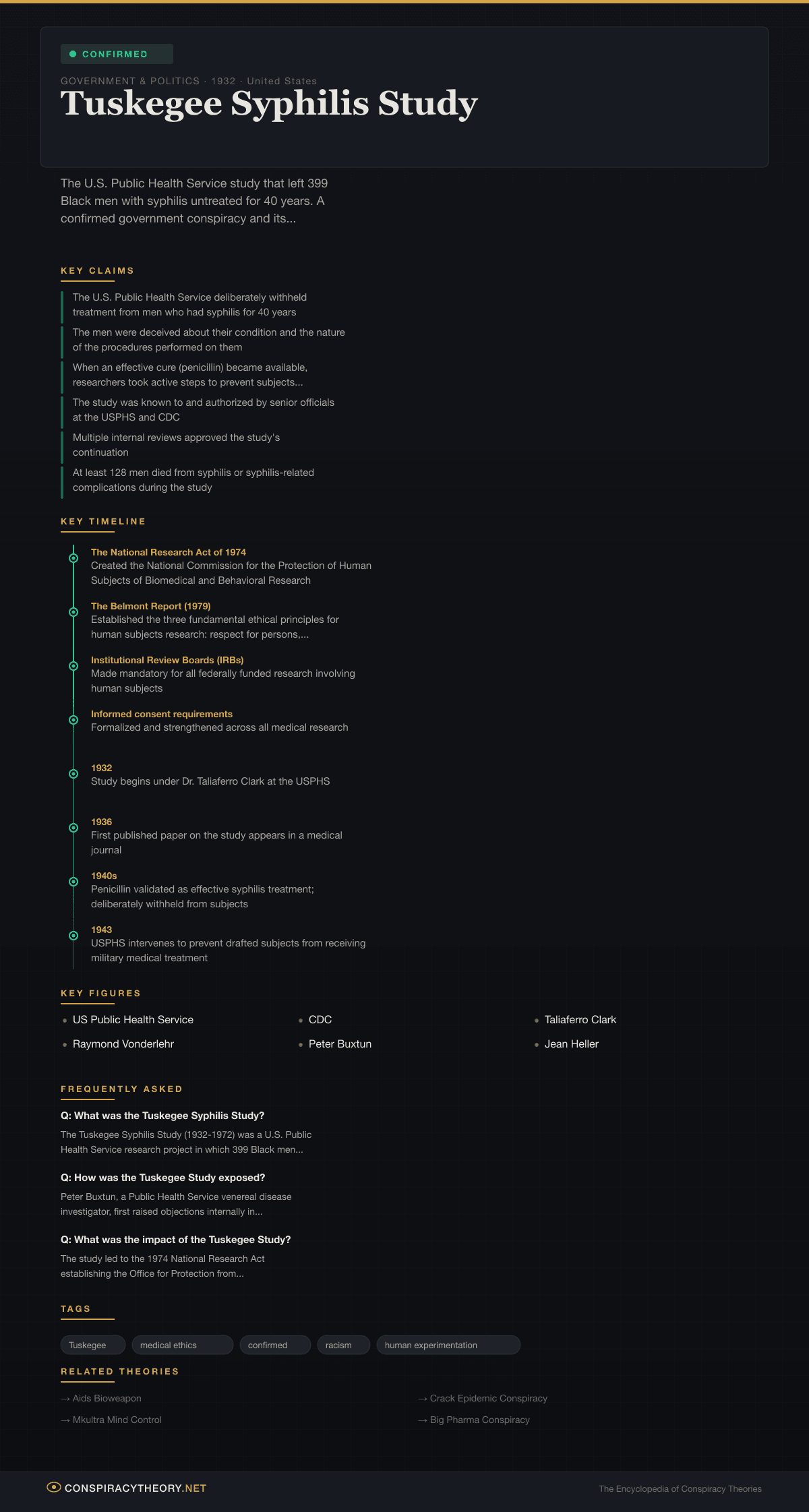
The Tuskegee Syphilis Study — formally known as the “Tuskegee Study of Untreated Syphilis in the Negro Male” — was a clinical study conducted by the United States Public Health Service (USPHS) and the Centers for Disease Control and Prevention (CDC) between 1932 and 1972. It stands as one of the most infamous examples of unethical medical experimentation in American history and one of the most thoroughly documented cases of a government conspiracy against its own citizens.
The study enrolled 399 Black men in Macon County, Alabama, who had syphilis, along with 201 uninfected men as controls. The infected men were told they were receiving free treatment for “bad blood” — a local term for a variety of ailments — but were in fact given placebos and diagnostic procedures disguised as treatment. When penicillin became the established standard of care for syphilis in the 1940s, the researchers deliberately withheld it from the study subjects to continue observing the natural progression of the disease.
The study continued for 40 years until it was exposed by journalist Jean Heller of the Associated Press in 1972, following a leak by Public Health Service employee Peter Buxtun, who had attempted to raise concerns internally for six years. By the time the study was terminated, at least 128 participants had died of syphilis or its complications, 40 wives had been infected, and 19 children had been born with congenital syphilis.
This entry is classified as confirmed — it is not a conspiracy theory but a documented conspiracy fact.
Origins & History
The Study’s Beginning (1932)
The study was initiated in 1932 by Dr. Taliaferro Clark of the USPHS, who proposed studying the effects of untreated syphilis in Black males. The study was based on a racist premise prevalent in the medical establishment of the era: that syphilis affected Black people differently than white people, with the disease supposedly causing more neurological damage in whites and more cardiovascular damage in Blacks.
Macon County, Alabama was chosen because it had one of the highest syphilis rates in the country — estimated at 35% among the Black population — and because the county’s extreme poverty meant most residents had never received medical treatment. The Tuskegee Institute (now Tuskegee University), a historically Black institution, was enlisted as a partner, lending credibility and facilitating access to the community. Nurse Eunice Rivers, a Black public health nurse, served as the primary liaison between researchers and subjects for the study’s entire duration.
The men were recruited with promises of free medical care, free meals on examination days, and burial stipends. They were not told they had syphilis; instead, they were told they were being treated for “bad blood.” The “treatment” they received consisted of aspirin, vitamins, and spinal taps (presented as “special free treatment”) that were actually diagnostic procedures.
Continuation Despite Penicillin (1940s-1972)
The most damning aspect of the study occurred after penicillin was validated as an effective cure for syphilis in the 1940s. Rather than treating the subjects, the USPHS researchers took active steps to ensure they did not receive treatment:
- Researchers prevented subjects from accessing syphilis treatment programs that became available in the community
- When World War II draft boards identified some subjects as having syphilis and ordered treatment, the USPHS intervened to exempt them
- Local physicians were given lists of study participants with instructions not to treat them
- The PHS sent letters to draft boards requesting that subjects be exempted from military service (and therefore military medical care)
The study was reviewed and reauthorized by CDC committees on multiple occasions throughout its duration. At no point did any reviewing body raise ethical objections. A 1969 review by the CDC concluded the study should continue.
The Whistleblower (1966-1972)
Peter Buxtun, a USPHS venereal disease investigator in San Francisco, first learned of the study in 1966 and was appalled. He filed formal protests with the USPHS in 1966 and again in 1968, arguing the study was immoral. Both times, a reviewing panel decided the study should continue until all subjects had died and could be autopsied.
Frustrated by the internal process, Buxtun leaked information about the study to Jean Heller, a reporter for the Associated Press. Her story, published on July 25, 1972, appeared on the front page of newspapers across the country. The public reaction was immediate and fierce. The study was terminated within days.
Key Claims
Unlike most entries in this wiki, the Tuskegee Study does not involve disputed claims. The following facts are fully documented through government records, congressional testimony, and subsequent investigations:
- The U.S. Public Health Service deliberately withheld treatment from men who had syphilis for 40 years
- The men were deceived about their condition and the nature of the procedures performed on them
- When an effective cure (penicillin) became available, researchers took active steps to prevent subjects from accessing it
- The study was known to and authorized by senior officials at the USPHS and CDC
- Multiple internal reviews approved the study’s continuation
- At least 128 men died from syphilis or syphilis-related complications during the study
- At least 40 wives were infected and 19 children were born with congenital syphilis
- The study was designed around explicitly racist assumptions about Black biology
Evidence
Government Records
The study is documented through extensive government records, including:
- USPHS internal correspondence and study protocols
- Published academic papers by study researchers, who openly described their methodology in medical journals throughout the study’s duration (over a dozen papers were published in peer-reviewed journals)
- CDC review committee minutes
- Congressional hearing transcripts from 1973
- The final report of the Ad Hoc Advisory Panel appointed by the Assistant Secretary for Health
The panel’s 1973 report concluded that the study was “ethically unjustified” and that “penicillin therapy should have been made available to the participants.”
Legal Proceedings
In 1973, civil rights attorney Fred Gray filed a class-action lawsuit on behalf of the study subjects. The case was settled out of court in 1974 for $10 million (approximately $60 million in 2024 dollars), with living syphilis subjects receiving $37,500 each, heirs of deceased subjects receiving $15,000, living controls receiving $16,000, and heirs of deceased controls receiving $5,000. The settlement also provided free lifetime medical care to surviving participants and their families.
Presidential Apology
On May 16, 1997, President Bill Clinton issued a formal apology on behalf of the United States government. With five surviving study participants present in the East Room of the White House, Clinton stated: “The United States government did something that was wrong — deeply, profoundly, morally wrong. It was an outrage to our commitment to integrity and equality for all our citizens… To the survivors, to the wives and family members, the children and the grandchildren, I say what you know: No power on Earth can give you back the lives lost, the pain suffered, the years of internal torment and anguish. What was done cannot be undone. But we can end the silence… We can look at you in the eye and finally say on behalf of the American people, what the United States government did was shameful, and I am sorry.”
Cultural Impact
Medical Ethics Reform
The Tuskegee Study’s exposure was the catalyst for the most significant reforms in research ethics in American history:
- The National Research Act of 1974 — Created the National Commission for the Protection of Human Subjects of Biomedical and Behavioral Research
- The Belmont Report (1979) — Established the three fundamental ethical principles for human subjects research: respect for persons, beneficence, and justice
- Institutional Review Boards (IRBs) — Made mandatory for all federally funded research involving human subjects
- Informed consent requirements — Formalized and strengthened across all medical research
Medical Distrust
The study’s legacy of medical distrust among Black Americans is well-documented and measurable. Research has consistently found that awareness of the Tuskegee Study correlates with:
- Lower willingness to participate in clinical trials
- Lower trust in physicians and healthcare institutions
- Lower rates of routine medical care utilization
- Higher rates of vaccine hesitancy
This distrust has had tangible public health consequences. During the COVID-19 pandemic, researchers and public health officials specifically cited the Tuskegee legacy as a factor in lower vaccination rates among Black Americans, though scholars have cautioned against oversimplifying complex attitudes toward healthcare into a single historical explanation.
A Template for Understanding Government Conspiracy
The Tuskegee Study occupies a critical position in conspiracy theory discourse because it is a verified government conspiracy of precisely the type that most conspiracy theories allege: a secret program, conducted by trusted authorities, that deliberately harmed citizens while maintaining a cover story. Its existence makes categorical dismissals of government conspiracy theories less credible and provides a factual foundation that conspiracy theorists frequently cite when defending more speculative claims.
The study is often invoked alongside MKUltra, COINTELPRO, Operation Mockingbird, and other confirmed government programs to argue that if these conspiracies were real, others may be as well.
Timeline
- 1932 — Study begins under Dr. Taliaferro Clark at the USPHS
- 1936 — First published paper on the study appears in a medical journal
- 1940s — Penicillin validated as effective syphilis treatment; deliberately withheld from subjects
- 1943 — USPHS intervenes to prevent drafted subjects from receiving military medical treatment
- 1966 — Peter Buxtun first raises ethical concerns internally
- 1968 — Buxtun files second formal protest; CDC review panel votes to continue the study
- 1969 — Another CDC committee review endorses continuation
- July 25, 1972 — Jean Heller’s AP story breaks nationally
- November 1972 — Study officially terminated
- 1973 — Congressional hearings held; Ad Hoc Advisory Panel finds study “ethically unjustified”
- 1973 — Fred Gray files class-action lawsuit
- 1974 — $10 million settlement; National Research Act passed
- 1979 — Belmont Report published
- May 16, 1997 — President Clinton issues formal apology
- 2004 — Last participant, Ernest Hendon, dies at age 96
- 2009 — Last widow receiving benefits from the settlement dies
Sources & Further Reading
- Jones, James H. Bad Blood: The Tuskegee Syphilis Experiment. Free Press, 1981 (expanded edition 1993)
- Reverby, Susan M. Examining Tuskegee: The Infamous Syphilis Study and Its Legacy. University of North Carolina Press, 2009
- Brandt, Allan M. “Racism and Research: The Case of the Tuskegee Syphilis Study.” Hastings Center Report 8, no. 6 (1978): 21-29
- Thomas, Stephen B. and Sandra Crouse Quinn. “The Tuskegee Syphilis Study, 1932 to 1972: Implications for HIV Education and AIDS Risk Education Programs in the Black Community.” American Journal of Public Health 81, no. 11 (1991): 1498-1505
- Centers for Disease Control and Prevention. “The Tuskegee Timeline.” CDC.gov
- National Commission for the Protection of Human Subjects. The Belmont Report. 1979
- Presidential Apology. “Remarks by the President in Apology for Study Done in Tuskegee.” May 16, 1997
Frequently Asked Questions
What was the Tuskegee Syphilis Study?
How was the Tuskegee Study exposed?
What was the impact of the Tuskegee Study?

Infographic
Share this visual summary. Right-click to save.