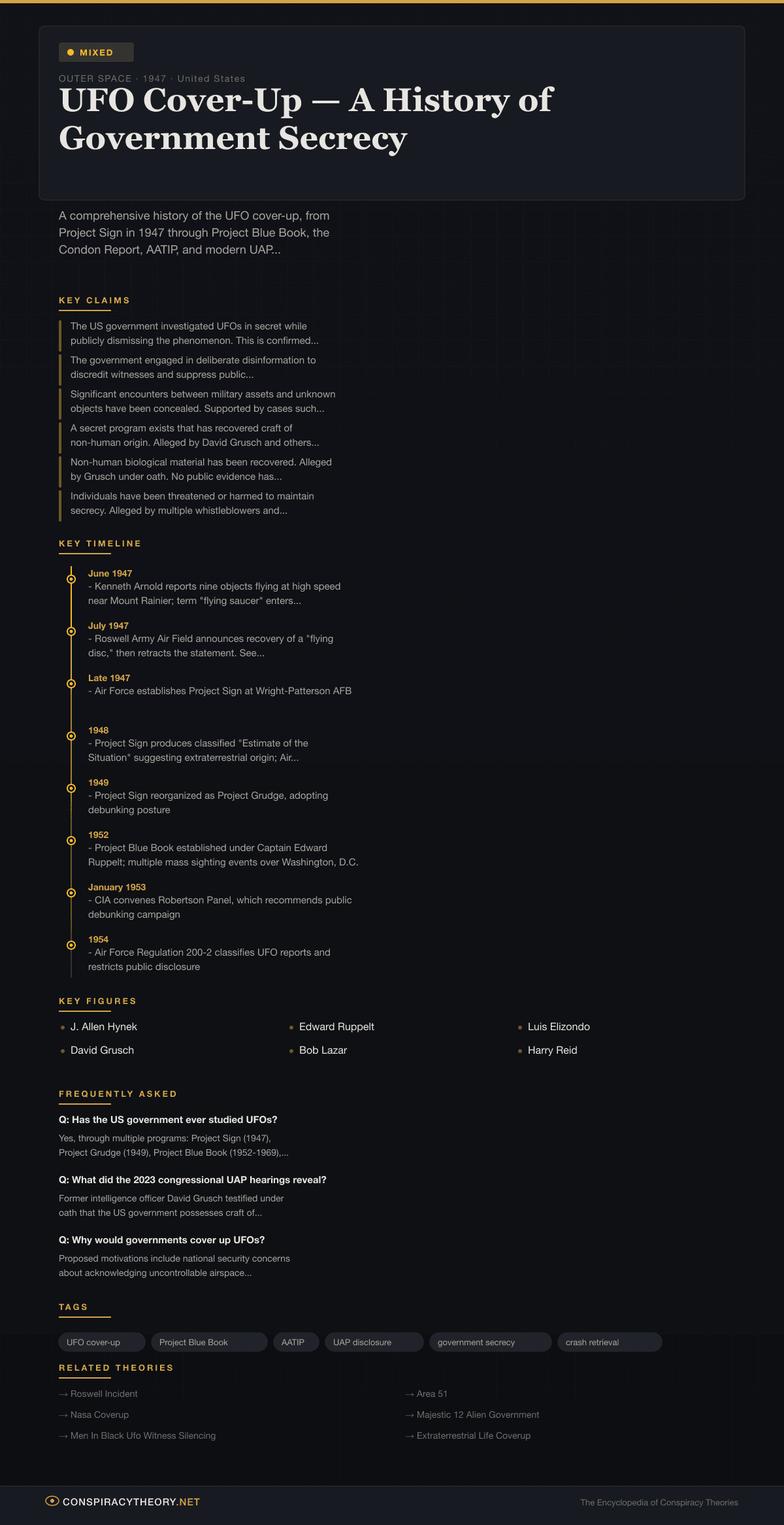
UFO Cover-Up — A History of Government Secrecy
Overview
The UFO cover-up conspiracy theory encompasses a broad and evolving set of claims alleging that the United States government, and to varying degrees other world governments, have systematically concealed evidence of unidentified flying objects and their origins from the public and from elected officials. The theory spans nearly eight decades, from the first wave of “flying saucer” sightings in 1947 through ongoing congressional hearings on what the government now officially terms unidentified anomalous phenomena (UAPs).
What distinguishes this theory from many other conspiracy narratives is the unusual degree to which elements of it have been substantiated over time. The US government did in fact operate secret UFO investigation programs, did withhold findings from the public, and did engage in deliberate efforts to debunk sightings and discredit witnesses. These facts are not in dispute; they are documented in declassified files and confirmed by former government officials. The contested questions are about the scope and motive of the secrecy: whether the government concealed mere bureaucratic embarrassment and Cold War anxiety, or whether it has hidden physical evidence of non-human technology, including recovered craft and biological materials.
The theory’s status is classified as mixed because the historical record confirms government secrecy and disinformation regarding UFOs while leaving the most extraordinary claims — possession of non-human craft and bodies — unverified by publicly available evidence. The tension between what has been confirmed and what remains alleged makes this one of the most complex and actively developing conspiracy narratives in existence.
Origins & History
1947: The Year Everything Started
The modern UFO era and the cover-up narrative both trace their origins to the summer of 1947. On June 24, private pilot Kenneth Arnold reported seeing nine objects flying in formation near Mount Rainier, Washington, at speeds he estimated at over 1,200 miles per hour, far beyond any known aircraft of the era. A reporter paraphrased Arnold’s description of their motion as “flying saucers,” and the term entered the American lexicon permanently.
Less than two weeks later, on or around July 7, the Roswell Army Air Field in New Mexico issued a press release stating that personnel had recovered a “flying disc” from a ranch near Roswell. Within hours, the statement was retracted and replaced with the explanation that the debris was a conventional weather balloon. Decades later, the Air Force acknowledged in its 1994 report The Roswell Report: Fact versus Fiction in the New Mexico Desert that the recovered material was actually from Project Mogul, a classified high-altitude balloon program designed to detect Soviet nuclear tests. For a detailed examination of the Roswell incident itself, see the dedicated Roswell Incident article.
The Roswell retraction established the template that would define the cover-up narrative for decades: an initial admission of something unusual, followed by a mundane explanation that many found unconvincing, fueling suspicion that the truth was being deliberately suppressed.
Project Sign, Project Grudge, and the Early Investigations (1947-1951)
The US military’s formal engagement with UFOs began in late 1947 with the establishment of Project Sign at Wright-Patterson Air Force Base. Sign’s investigators took the phenomenon seriously. In 1948, the project produced a top-secret “Estimate of the Situation” that reportedly concluded the most likely explanation for the best UFO cases was extraterrestrial origin. Air Force Chief of Staff General Hoyt Vandenberg rejected the estimate, and it was ordered destroyed. No copies are known to survive, though multiple former Air Force officers have confirmed its existence.
The rejection of the Estimate of the Situation marked a pivotal moment. Project Sign was reorganized as Project Grudge in 1949, and the new project adopted an explicitly skeptical posture. Grudge’s mandate was less to investigate UFO reports than to explain them away and reduce public concern. The project’s final report concluded that UFO sightings were the result of misidentification, mass hysteria, and hoaxes, and recommended that the Air Force reduce its investigative effort. Critics have characterized Grudge as the first institutionalized debunking program, the point at which the government shifted from investigating the phenomenon to managing public perception of it.
Project Blue Book (1952-1969)
Captain Edward Ruppelt revived serious investigation when he took command of the Air Force’s UFO program, now renamed Project Blue Book, in 1952. Ruppelt coined the term “unidentified flying object” as a neutral replacement for the sensationalized “flying saucer,” professionalized the reporting system, and investigated cases with genuine analytical rigor. His 1956 book The Report on Unidentified Flying Objects remains one of the most balanced early accounts of the phenomenon.
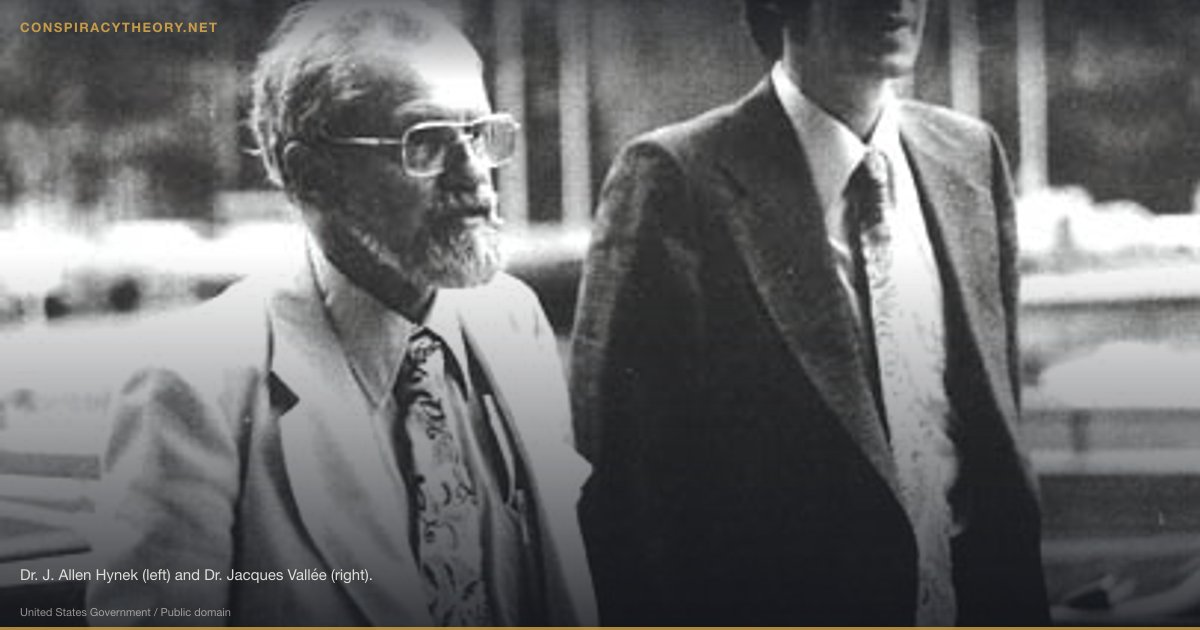
However, Ruppelt’s tenure was brief. After his departure, Blue Book devolved into what many of its own scientific consultants later described as a public relations operation designed to minimize the significance of sightings rather than investigate them. The project’s most prominent scientific advisor, astronomer J. Allen Hynek, initially served as a debunker, offering conventional explanations for sightings. Over time, Hynek grew increasingly dissatisfied with what he perceived as the project’s intellectual dishonesty. He later became one of the most credible advocates for serious UFO research, coining the “close encounter” classification system and founding the Center for UFO Studies in 1973.
Blue Book investigated 12,618 sightings over its seventeen-year existence. Of these, 701 — approximately 5.5% — were classified as “unidentified” even after investigation. The project was terminated in 1969 following the recommendations of the Condon Committee.
The Condon Report and the End of Official Investigation (1968-1969)
In 1966, the Air Force commissioned the University of Colorado to conduct an independent scientific study of UFOs, headed by physicist Edward Condon. The resulting 1968 Scientific Study of Unidentified Flying Objects, known as the Condon Report, concluded that further study of UFOs was unlikely to advance scientific knowledge and recommended ending Blue Book.
The Condon Report remains one of the most controversial documents in UFO history. Critics, including several members of Condon’s own research team, charged that the study’s conclusion was predetermined and did not reflect its own data. A leaked internal memo from project coordinator Robert Low, written before the study began, suggested the project’s real purpose was to provide a respectable basis for ending Air Force involvement: “The trick would be, I think, to describe the project so that, to the public, it would appear a totally objective study but, to the scientific community, would present the image of a group of nonbelievers trying their best to be objective.” Hynek and other scientists argued that approximately 30% of the cases examined in the report were left unexplained by its own investigators, contradicting Condon’s dismissive summary.
The closure of Blue Book in December 1969 ended the US government’s acknowledged UFO investigation program for nearly four decades. For cover-up proponents, the Condon Report represented the completion of a debunking strategy that had been in motion since Project Grudge: use scientific authority to dismiss the phenomenon and justify ending public investigation, while any genuine research continued in classified programs.
The Wilderness Years (1970-2006)
The period between Blue Book’s closure and the revelation of modern programs is marked by continued sightings, growing civilian research organizations, and periodic government actions that alternately fueled and dampened cover-up speculation.
The 1976 Tehran UFO incident, in which Iranian Air Force pilots reported instrument malfunctions while attempting to intercept an unknown object, generated a classified US Defense Intelligence Agency report that described the case as meeting “all the criteria necessary for a valid study of the UFO phenomenon.” The document’s existence, revealed through Freedom of Information Act requests, contradicted the government’s official position that UFOs warranted no further study.
In 1989, Robert Lazar claimed publicly that he had worked at a facility near Area 51 called S-4, where he had been hired to reverse-engineer propulsion systems from recovered extraterrestrial craft. Lazar’s claims have never been verified, his educational credentials have not been confirmed by the institutions he named, and no corroborating witness has come forward. However, his descriptions of the Area 51 complex were later confirmed in broad outline when the CIA officially acknowledged the base’s existence in 2013. Lazar remains one of the most polarizing figures in UFO history, viewed by some as a credible insider and by others as a fabricator.
The alleged Majestic 12 documents, which purported to be classified briefing papers describing a secret committee formed by President Truman to manage the recovery and investigation of alien spacecraft, surfaced in 1984. The FBI investigated the documents and concluded they were “bogus,” and most researchers — including several sympathetic to the UFO cover-up theory — have judged them to be forgeries. Nevertheless, MJ-12 became a foundational element of the cover-up mythos, providing a narrative framework for how a secret UFO management program might be organized.
AATIP and the Pentagon Videos (2007-2017)
The modern era of the UFO cover-up narrative was transformed by the December 2017 revelation that the Pentagon had operated the Advanced Aerospace Threat Identification Program (AATIP) from 2007 to at least 2012. The program was funded with $22 million in “black money” at the initiative of Senator Harry Reid of Nevada, with support from Senators Daniel Inouye and Ted Stevens. AATIP investigated reports of encounters between military personnel and unidentified aerial objects.
The New York Times broke the story simultaneously with the release of three Navy gun-camera videos — now known as “FLIR1,” “Gimbal,” and “GoFast” — showing encounters between Navy fighter pilots and objects displaying flight characteristics that appeared to defy known aerodynamics. The pilots described objects with no visible propulsion that accelerated instantaneously, performed hypersonic maneuvers without producing sonic booms, and transitioned between air and water. The Pentagon later confirmed the videos were authentic and had not been authorized for public release.
Luis Elizondo, who ran AATIP, resigned from the Pentagon in October 2017 in protest of what he described as excessive secrecy and bureaucratic resistance to taking the phenomenon seriously. Elizondo’s public statements, interviews, and subsequent congressional testimony made him the highest-ranking former defense official to allege systematic government concealment of UAP information.
Congressional Action and the Grusch Allegations (2020-Present)
The 2017 revelations triggered a cascade of institutional responses. In 2020, the Pentagon established the Unidentified Aerial Phenomena Task Force (UAPTF). In June 2021, the Office of the Director of National Intelligence released a preliminary assessment of UAPs that examined 144 reports from military personnel between 2004 and 2021. Of these, 143 remained unexplained. The report’s careful, non-committal language — neither confirming nor ruling out exotic explanations — was interpreted by both sides as supporting their position.
In July 2022, the Department of Defense established the All-domain Anomaly Resolution Office (AARO) to consolidate UAP investigation efforts. In 2023, AARO released a historical review concluding that it had found “no empirical evidence” of extraterrestrial activity or government reverse-engineering programs. Critics noted the review’s limited scope and questioned whether AARO had been granted access to the most sensitive programs.
The most dramatic development came in June 2023, when David Grusch, a former intelligence officer who had served on the UAPTF, filed a whistleblower complaint and gave public interviews alleging that the US government operates a secret program that has recovered craft of “non-human origin” and “biologics” — a term he used to indicate non-human biological material. Grusch testified under oath before the House Oversight Committee in July 2023 that this program had been illegally concealed from congressional oversight and that individuals who had attempted to disclose its existence had faced retaliation, including threats to their safety.
Grusch did not present physical evidence during his testimony but stated he had provided classified details and supporting documentation to the Inspector General of the Intelligence Community, who found his complaint “credible and urgent.” The Pentagon denied the existence of any such program. Multiple members of Congress from both parties stated they had received classified briefings that corroborated elements of Grusch’s claims, though the content of those briefings remains classified.
Subsequent legislative efforts, particularly provisions championed by Senate Majority Leader Chuck Schumer in the 2024 National Defense Authorization Act, sought to compel disclosure of government-held UAP records. The final legislation, while diluted from Schumer’s original proposal, established a framework for record collection and review that supporters described as the most significant government transparency measure on the topic since the Freedom of Information Act.
Key Claims
The UFO cover-up theory encompasses a hierarchy of claims, ranging from well-documented to speculative:
-
The US government investigated UFOs in secret while publicly dismissing the phenomenon. This is confirmed by the historical record. Projects Sign, Grudge, and Blue Book operated alongside public statements minimizing the significance of sightings. AATIP was secret until revealed in 2017.
-
The government engaged in deliberate disinformation to discredit witnesses and suppress public interest. Supported by declassified CIA documents, including a 1953 memo from the Robertson Panel recommending a program to “debunk” flying saucers through mass media, and by the documented experience of Hynek and other Blue Book scientists.
-
Significant encounters between military assets and unknown objects have been concealed. Supported by cases such as the 2004 USS Nimitz encounter, the Tehran incident, and multiple events described in the 2021 ODNI report.
-
A secret program exists that has recovered craft of non-human origin. Alleged by David Grusch and others but not confirmed by publicly available evidence. Denied by the Pentagon and AARO.
-
Non-human biological material has been recovered. Alleged by Grusch under oath. No public evidence has been presented, and independent verification has not occurred.
-
Individuals have been threatened or harmed to maintain secrecy. Alleged by multiple whistleblowers and witnesses over decades. Some cases of career retaliation against UFO researchers within the military are documented; more extreme claims remain unverified.
Evidence
Confirmed Government Secrecy
The factual basis for the cover-up narrative is substantial. Declassified documents confirm that the CIA convened the Robertson Panel in January 1953, which recommended a public education campaign designed to reduce public interest in UFOs through “debunking.” The panel recommended enlisting mass media, including the Walt Disney Company, in this effort. The CIA also monitored civilian UFO organizations and kept files on their members.
Air Force Regulation 200-2, issued in 1954, classified UFO reports and prohibited their public release without prior authorization. Military witnesses were instructed not to discuss sightings publicly. The regulation’s existence was not publicly acknowledged until revealed through FOIA requests.
The 2017 AATIP disclosure confirmed that UFO investigation had continued secretly after Blue Book’s closure, contradicting decades of official denials. The Navy’s formal acknowledgment of the gun-camera videos in 2020 confirmed that military encounters with unexplained objects were being tracked internally even as the Pentagon maintained publicly that it had no interest in UFOs.
The Pentagon Videos and Military Encounters
The three Navy videos released in 2017 and formally acknowledged in 2020 represent the strongest publicly available evidence that military forces have encountered objects exhibiting anomalous flight characteristics. The 2004 USS Nimitz incident is particularly well documented: Commander David Fravor and Lieutenant Commander Alex Dietrich both described encountering a “Tic Tac”-shaped object that outperformed their F/A-18F Super Hornets, moved without visible propulsion, and was tracked on multiple independent radar and infrared sensor systems.
What Remains Unproven
No publicly available physical evidence of non-human craft or biological material has been produced. Grusch’s allegations, while made under oath with legal protections, rely on secondhand testimony — he stated he was told about the programs by individuals with direct knowledge but did not claim personal firsthand access to recovered materials. AARO’s 2024 historical review found no evidence supporting the existence of crash retrieval or reverse-engineering programs, though critics argue the review was insufficiently thorough and may not have had access to the most compartmentalized programs.
The NASA cover-up theory, which alleges the space agency has concealed evidence of extraterrestrial life or artificial structures encountered during space missions, operates as a parallel narrative but rests on even thinner evidence.
Debunking / Verification
The UFO cover-up theory resists simple debunking because its core premise — that the government kept secrets about UFOs — is demonstrably true. The question is not whether secrecy occurred but what was being concealed and why.
Skeptics offer several alternative explanations for the documented secrecy that do not require non-human technology:
-
Cold War security concerns: UFO reports could reveal the capabilities and gaps of US radar and air defense systems. Acknowledging that unknown objects routinely penetrated restricted airspace would have been a national security embarrassment.
-
Classified aircraft: Some UFO sightings, particularly near military test facilities like Area 51, were likely observations of classified US aircraft programs, including the U-2, SR-71, and stealth aircraft. The government had strong incentives to let UFO explanations stand rather than acknowledge the existence of secret programs.
-
Institutional embarrassment: Admitting that the military could not identify or intercept objects in its own airspace was politically and institutionally costly. Debunking was simpler than acknowledging ignorance.
-
Sensor limitations: Some military encounters attributed to anomalous objects may reflect sensor artifacts, atmospheric phenomena, or the limitations of infrared and radar systems in certain conditions. Analysis of the “GoFast” video by skeptics, for example, has suggested the object’s apparent speed may be an artifact of parallax.
Proponents counter that these explanations, while plausible for individual cases, do not account for the full pattern of evidence: the destruction of the Estimate of the Situation, the Robertson Panel’s explicit debunking mandate, the concealment of AATIP, the corroborated military encounters involving multiple sensor systems, and the bipartisan congressional concern expressed since 2017.
Cultural Impact
The UFO cover-up narrative has profoundly shaped American culture and has influenced global attitudes toward government transparency, scientific inquiry, and the possibility of extraterrestrial life.
The narrative provided the foundation for some of the most successful entertainment properties of the late twentieth and early twenty-first centuries. The X-Files (1993-2002, 2016-2018) built its mythology directly on the cover-up framework, with its tagline “The Truth Is Out There” becoming a cultural catchphrase. Steven Spielberg’s Close Encounters of the Third Kind (1977) depicted government concealment of alien contact. Independence Day (1996) featured Area 51 as a secret alien research facility. The cover-up premise has remained a reliable narrative engine in film, television, literature, and video games for decades.
Beyond entertainment, the cover-up narrative has had measurable effects on public trust in government institutions. Surveys consistently show that a majority of Americans believe the government is not telling the public everything it knows about UFOs. A 2021 Gallup poll found that 41% of American adults believed some UFO sightings involved alien spacecraft, up from 33% in 2019. The shift in mainstream media treatment — from ridicule to serious reporting — following the 2017 AATIP revelations represented one of the most dramatic tonal changes in modern journalism.
The narrative has also influenced the scientific community, which has historically been reluctant to engage with UFO research. The 2023 NASA independent study team report on UAPs, and the appointment of a NASA director of UAP research, signaled a tentative institutional opening, though the stigma surrounding the topic in academic and scientific settings remains considerable.
Key Figures
-
J. Allen Hynek (1910-1986): Astronomer who served as scientific consultant to Projects Sign, Grudge, and Blue Book. Initially a skeptic, he became convinced the phenomenon warranted serious study and founded the Center for UFO Studies. His shift from debunker to advocate lends particular weight to his criticisms of the Air Force’s approach.
-
Edward Ruppelt (1923-1960): Air Force officer who directed Project Blue Book during its most rigorous period (1951-1953). Coined the term “UFO” and authored The Report on Unidentified Flying Objects. His account remains one of the most credible insider perspectives on early government UFO investigation.
-
Harry Reid (1939-2021): US Senator from Nevada who secured funding for AATIP. Reid described the program as one of his proudest achievements and stated publicly that he believed the government possessed evidence it had not disclosed.
-
Luis Elizondo: Former intelligence officer who directed AATIP. Resigned in protest over secrecy and became the most prominent government insider advocating for UFO transparency. His credibility has been both supported by the Inspector General’s office and questioned by Pentagon officials.
-
David Grusch: Former intelligence officer and UAPTF member who filed a whistleblower complaint and testified before Congress alleging government possession of non-human craft and biologics. His claims represent the most specific and dramatic allegations made under oath by a former government insider.
-
Bob Lazar: Claimed in 1989 to have worked on reverse-engineering alien craft near Area 51. His allegations have never been verified and his background claims remain unconfirmed, but his descriptions of the facility preceded its official acknowledgment. He remains a deeply divisive figure in UFO research.
Timeline
- June 1947 — Kenneth Arnold reports nine objects flying at high speed near Mount Rainier; term “flying saucer” enters popular vocabulary
- July 1947 — Roswell Army Air Field announces recovery of a “flying disc,” then retracts the statement. See Roswell Incident
- Late 1947 — Air Force establishes Project Sign at Wright-Patterson AFB
- 1948 — Project Sign produces classified “Estimate of the Situation” suggesting extraterrestrial origin; Air Force Chief of Staff rejects and orders it destroyed
- 1949 — Project Sign reorganized as Project Grudge, adopting debunking posture
- 1952 — Project Blue Book established under Captain Edward Ruppelt; multiple mass sighting events over Washington, D.C.
- January 1953 — CIA convenes Robertson Panel, which recommends public debunking campaign
- 1954 — Air Force Regulation 200-2 classifies UFO reports and restricts public disclosure
- 1966 — Air Force commissions University of Colorado study under Edward Condon
- 1968 — Condon Report concludes further UFO study is not warranted
- December 1969 — Project Blue Book officially terminated; Air Force states it will no longer investigate UFOs
- 1976 — Iranian Air Force pilots encounter unknown object over Tehran; classified DIA report describes the case in detail
- 1984 — Alleged Majestic 12 documents surface; FBI later concludes they are fabricated
- 1989 — Bob Lazar publicly claims to have worked on alien craft near Area 51
- 2004 — USS Nimitz carrier group encounters “Tic Tac” object off the coast of California; the encounter is recorded on multiple sensor systems
- 2007 — Senator Harry Reid secures funding for AATIP
- 2013 — CIA officially acknowledges the existence of Area 51
- December 2017 — New York Times reveals AATIP’s existence; three Navy UAP videos released publicly
- April 2020 — Pentagon formally acknowledges and releases the three Navy UAP videos
- June 2020 — Pentagon establishes Unidentified Aerial Phenomena Task Force
- June 2021 — Office of the Director of National Intelligence releases preliminary UAP assessment; 143 of 144 cases remain unexplained
- July 2022 — Department of Defense establishes All-domain Anomaly Resolution Office (AARO)
- June 2023 — David Grusch files whistleblower complaint alleging government possession of non-human craft
- July 2023 — Grusch, Commander Fravor, and Ryan Graves testify before House Oversight Committee
- 2024 — UAP disclosure provisions included in National Defense Authorization Act; AARO releases historical review finding no evidence of extraterrestrial programs
- 2025-2026 — Congressional oversight efforts continue; additional whistleblowers reportedly engage with Inspector General
Sources & Further Reading
- Ruppelt, Edward J. The Report on Unidentified Flying Objects. Doubleday, 1956
- Hynek, J. Allen. The UFO Experience: A Scientific Inquiry. Henry Regnery Company, 1972
- Kean, Leslie. UFOs: Generals, Pilots, and Government Officials Go on the Record. Harmony Books, 2010
- Blumenthal, Ralph, and Leslie Kean. “Glowing Auras and ‘Black Money’: The Pentagon’s Mysterious U.F.O. Program.” The New York Times, December 16, 2017
- Office of the Director of National Intelligence. “Preliminary Assessment: Unidentified Aerial Phenomena.” June 25, 2021
- United States House Committee on Oversight and Accountability. “Hearing on Unidentified Anomalous Phenomena: Implications on National Security, Public Safety, and Government Transparency.” July 26, 2023
- Condon, Edward U., and Daniel S. Gillmor, eds. Scientific Study of Unidentified Flying Objects. Bantam Books, 1969
- Central Intelligence Agency. “Report of the Scientific Advisory Panel on Unidentified Flying Objects” (Robertson Panel Report). January 1953. Declassified 1975
- Dolan, Richard M. UFOs and the National Security State: Chronology of a Cover-up, 1941-1973. Hampton Roads Publishing, 2002
- Department of Defense. “Report on the Historical Record of U.S. Government Involvement with Unidentified Anomalous Phenomena.” All-domain Anomaly Resolution Office, 2024
- Lacatski, James T., Colm A. Kelleher, and George Knapp. Skinwalkers at the Pentagon: An Insiders’ Account of the Secret Government UFO Program. RTMA, 2021
- NASA. “UAP Independent Study Team Report.” September 2023
Related Theories
- Roswell Incident — The foundational UFO crash retrieval case
- Area 51 — The military installation central to reverse-engineering allegations
- NASA Cover-Up — Allegations of space agency concealment of extraterrestrial evidence
- Majestic 12 — Alleged secret committee managing UFO crash retrievals
- Men in Black — Claims of government agents silencing UFO witnesses
- Extraterrestrial Life Cover-Up — Broader theory of concealed evidence for alien life
Frequently Asked Questions
Has the US government ever studied UFOs?
What did the 2023 congressional UAP hearings reveal?
Why would governments cover up UFOs?

Infographic
Share this visual summary. Right-click to save.