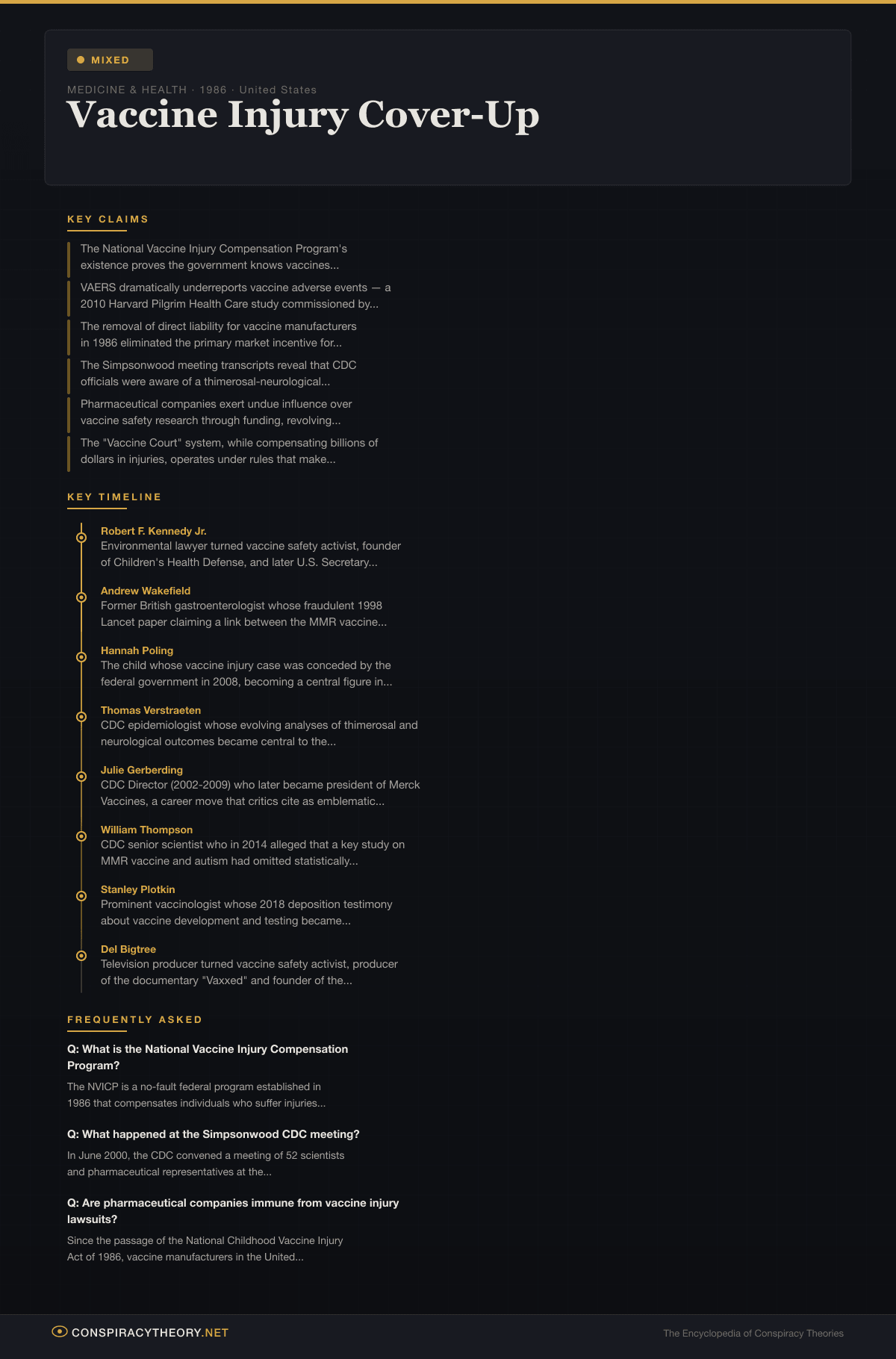
Vaccine Injury Cover-Up
Overview
The vaccine injury cover-up theory encompasses a broad set of allegations that governments, public health agencies, and pharmaceutical companies have systematically downplayed, concealed, or actively suppressed evidence that vaccines cause significant harm to a subset of recipients. Unlike the more specific — and widely debunked — claim that vaccines cause autism, this broader theory focuses on institutional mechanisms that critics argue are designed to minimize the appearance of vaccine-related injuries, shield manufacturers from accountability, and silence dissenting researchers and physicians.
Central to these allegations are several verifiable institutional features of the American vaccine system: the National Vaccine Injury Compensation Program (NVICP), which has paid billions in damages while maintaining that vaccines are safe; the Vaccine Adverse Event Reporting System (VAERS), which critics argue both underreports injuries and is simultaneously dismissed when its data suggests problems; and legal liability shields that prevent injured parties from directly suing vaccine manufacturers. The theory sits at the intersection of documented institutional practices and speculative claims about deliberate concealment, making it one of the more complex conspiracy theories to evaluate.
The status of this theory is classified as “mixed” because certain elements — such as the existence of liability protections, documented instances of specific vaccines being withdrawn due to safety concerns, and the reality that some individuals do experience serious adverse reactions — are factually established, while broader claims of a coordinated, systematic cover-up involving thousands of scientists and public health officials remain unproven and are disputed by mainstream medicine.
Origins & History
The modern vaccine injury cover-up narrative has roots stretching back to the earliest days of vaccination, but its contemporary form crystallized in the 1980s around a series of events that fundamentally altered the legal and institutional landscape of vaccine administration in the United States.
The Liability Crisis of the 1980s
In the early 1980s, a series of lawsuits alleging harm from the diphtheria-pertussis-tetanus (DPT) vaccine created what manufacturers described as a liability crisis. The 1982 documentary “DPT: Vaccine Roulette,” produced by WRC-TV reporter Lea Thompson, brought widespread public attention to allegations that the whole-cell pertussis vaccine was causing brain damage in children. The resulting wave of litigation led several vaccine manufacturers to exit the market entirely, raising concerns about potential vaccine shortages.
The National Childhood Vaccine Injury Act (1986)
In response to the liability crisis, Congress passed the National Childhood Vaccine Injury Act of 1986, signed into law by President Ronald Reagan. This legislation created two key institutions: the National Vaccine Injury Compensation Program (NVICP), a no-fault system for compensating vaccine injuries, and the Vaccine Adverse Event Reporting System (VAERS), a passive surveillance system for tracking adverse events following vaccination. Critically, the law also provided significant liability protections for vaccine manufacturers, requiring that injury claims be filed through the NVICP rather than through direct lawsuits.
For critics, the 1986 Act represents the original sin of the vaccine injury cover-up — the moment when the government effectively acknowledged that vaccines cause injuries while simultaneously removing the primary legal mechanism for holding manufacturers accountable. Supporters of the legislation argue it was a pragmatic response to a genuine crisis that threatened the nation’s vaccine supply while still providing a pathway for injured individuals to receive compensation.
The Thimerosal Controversy and Simpsonwood
In 1999, the FDA conducted a review of mercury-containing compounds in drugs and discovered that the cumulative amount of ethylmercury (in the form of thimerosal, a preservative) that infants received through the recommended vaccine schedule exceeded EPA guidelines for methylmercury exposure. Although ethylmercury and methylmercury have different toxicological profiles, the finding prompted the American Academy of Pediatrics and the U.S. Public Health Service to issue a joint statement calling for the removal of thimerosal from childhood vaccines as a precautionary measure.
In June 2000, the CDC convened a meeting at the Simpsonwood conference center in Norcross, Georgia. Fifty-two attendees — including CDC scientists, vaccine manufacturers, and academic researchers — reviewed an internal analysis by epidemiologist Thomas Verstraeten that had found a statistical association between thimerosal exposure and certain neurological outcomes, including attention deficit disorder. Transcripts of the meeting, later obtained through Freedom of Information Act requests, became a lightning rod for controversy. Critics, most prominently Robert F. Kennedy Jr. in his 2005 article “Deadly Immunity” published in Rolling Stone and Salon, alleged that the meeting was held to coordinate suppression of the findings. CDC officials maintained that the meeting was a standard scientific review and that Verstraeten’s preliminary findings were not replicated in subsequent, more rigorous analyses.
The Hannah Poling Case (2008)
In 2008, the federal government conceded the case of Hannah Poling in the Vaccine Court, acknowledging that vaccines had “significantly aggravated” an underlying mitochondrial disorder, leading to symptoms consistent with autism. The case attracted enormous attention because it appeared to validate, at least in a narrow sense, the claim that vaccines could trigger autistic regression in susceptible individuals. The government and medical establishment emphasized that the case was unique and did not establish a general link between vaccines and autism, but critics argued it demonstrated that such a link existed and was being systematically denied.
Key Claims
Proponents of the vaccine injury cover-up theory make several interconnected claims:
- The National Vaccine Injury Compensation Program’s existence proves the government knows vaccines cause serious harm, yet public messaging consistently describes vaccines as entirely safe
- VAERS dramatically underreports vaccine adverse events — a 2010 Harvard Pilgrim Health Care study commissioned by the Agency for Healthcare Research and Quality (AHRQ) estimated that fewer than 1% of adverse events are reported to VAERS
- The removal of direct liability for vaccine manufacturers in 1986 eliminated the primary market incentive for safety improvements
- The Simpsonwood meeting transcripts reveal that CDC officials were aware of a thimerosal-neurological disorder link and worked to suppress the evidence
- Pharmaceutical companies exert undue influence over vaccine safety research through funding, revolving door employment with regulatory agencies, and control of medical journals
- The “Vaccine Court” system, while compensating billions of dollars in injuries, operates under rules that make it systematically difficult for petitioners to prove their cases
- Whistleblowers and researchers who raise safety concerns face professional retaliation, loss of funding, and public vilification
- The CDC has conflicts of interest, as it both promotes vaccines and monitors their safety
- Post-licensure safety surveillance is inadequate, relying primarily on the passive VAERS system rather than active monitoring
Evidence
Documented Facts Supporting Elements of the Theory
Several elements cited by proponents are matters of public record. The NVICP has paid out over $5 billion in compensation since its inception, covering injuries ranging from anaphylaxis and Guillain-Barre syndrome to shoulder injury related to vaccine administration (SIRVA) and, in rare cases, death. This figure is used by both sides — critics cite it as evidence of widespread harm, while supporters note it represents a tiny fraction of the billions of vaccine doses administered.
The 2010 Harvard Pilgrim Health Care study, funded by AHRQ, did find that adverse events from drugs and vaccines are common but underreported. The study’s attempt to create an automated reporting system was reportedly discontinued when the CDC stopped responding to the researchers’ communications — a fact that critics cite as evidence of institutional resistance to improved safety monitoring.
The Simpsonwood transcripts are authentic documents obtained through FOIA. They show scientists discussing preliminary data suggesting statistical associations between thimerosal and neurological outcomes, with some participants expressing concern about the findings. However, the transcripts also show scientists raising legitimate methodological concerns about the analysis, and subsequent studies using different methodologies did not replicate the initial findings.
The revolving door between the CDC and pharmaceutical industry is documented. Most notably, Julie Gerberding, who served as CDC director from 2002 to 2009 during the height of the thimerosal controversy, subsequently became president of Merck’s vaccine division — a move that critics view as a clear conflict of interest.
The Verstraeten Studies
Thomas Verstraeten’s analysis went through several iterations. The initial “Generation Zero” dataset appeared to show a significant association between thimerosal exposure and neurological outcomes. Subsequent analyses, incorporating additional data from different HMOs, showed the association diminishing. Verstraeten published his final analysis in Pediatrics in 2003, concluding the results were “neutral” — neither confirming nor denying an association. Critics allege the data was manipulated through successive iterations to eliminate the signal; supporters argue the refinements reflected standard epidemiological methodology as more complete data became available.
Vaccine Court Proceedings
The “Omnibus Autism Proceeding” in Vaccine Court (2007-2010) examined thousands of claims alleging that vaccines caused autism. Special Masters ruled against the petitioners in all test cases, finding the scientific evidence did not support a causal link. Critics argue the proceedings were structurally biased, while mainstream scientists view them as a thorough review of the available evidence.
Debunking / Verification
What Is Established
It is established fact that vaccines can cause adverse reactions in some individuals, ranging from minor (soreness, fever) to serious (anaphylaxis, Guillain-Barre syndrome) and, in exceedingly rare cases, death. This is not disputed by the medical establishment, and it is the reason the NVICP exists. The Vaccine Information Statements (VIS) provided with every vaccination list known risks.
It is also established that institutional conflicts of interest exist within the vaccine regulatory framework, that the revolving door between government agencies and pharmaceutical companies is real, and that the 1986 Act did substantially reduce manufacturers’ liability exposure.
What Remains Disputed
The central question — whether these institutional features represent a coordinated cover-up or simply reflect the pragmatic challenges of managing a public health program that affects hundreds of millions of people — remains a matter of interpretation. The mainstream scientific and medical consensus holds that vaccines are overwhelmingly safe, that serious adverse events are rare and generally well-characterized, and that the benefits of vaccination far outweigh the risks at both individual and population levels.
Multiple large-scale epidemiological studies conducted in several countries have failed to find evidence that vaccines cause autism or other widespread neurological harm. The Institute of Medicine (now the National Academy of Medicine) has conducted several comprehensive reviews of vaccine safety evidence and has generally concluded that the evidence favors rejection of a causal relationship between vaccines and autism, while acknowledging that the evidence is inadequate to accept or reject causal relationships for some other outcomes.
The Underreporting Question
The claim that VAERS underreports adverse events is likely true in a general sense — passive surveillance systems always capture only a fraction of events. However, critics’ use of VAERS data to estimate total injuries by applying a multiplier to raw reports is methodologically problematic, as VAERS reports do not establish causation and include events that may be coincidental rather than vaccine-related.
Cultural Impact
The vaccine injury cover-up narrative has had profound effects on public health policy and public trust in medical institutions. It has been a driving force behind the modern anti-vaccination movement, contributing to declining vaccination rates in some communities and the resurgence of previously controlled diseases such as measles.
The narrative gained particular prominence during the COVID-19 pandemic, when the rapid development and deployment of mRNA vaccines under Emergency Use Authorization amplified existing concerns about safety surveillance and manufacturer liability. The PREP Act and other legal mechanisms that provided additional liability protections for COVID-19 vaccine manufacturers reinforced the narrative that the system is designed to protect corporations rather than individuals.
Robert F. Kennedy Jr.’s political career, culminating in his appointment as Secretary of Health and Human Services in the Trump administration in 2025, brought vaccine safety concerns from the margins to the center of American political discourse. His organization, Children’s Health Defense, became one of the most prominent voices questioning vaccine safety orthodoxy.
The theory has also influenced international policy, with vaccine hesitancy being named one of the top ten threats to global health by the World Health Organization in 2019.
Key Figures
- Robert F. Kennedy Jr. — Environmental lawyer turned vaccine safety activist, founder of Children’s Health Defense, and later U.S. Secretary of Health and Human Services. His 2005 article “Deadly Immunity” and 2014 book “Thimerosal: Let the Science Speak” were influential in popularizing the cover-up narrative.
- Andrew Wakefield — Former British gastroenterologist whose fraudulent 1998 Lancet paper claiming a link between the MMR vaccine and autism was retracted, and who was struck off the UK medical register. Despite his discrediting, he remains influential in anti-vaccine circles.
- Hannah Poling — The child whose vaccine injury case was conceded by the federal government in 2008, becoming a central figure in the debate over whether vaccines can trigger autism in susceptible individuals.
- Thomas Verstraeten — CDC epidemiologist whose evolving analyses of thimerosal and neurological outcomes became central to the Simpsonwood controversy.
- Julie Gerberding — CDC Director (2002-2009) who later became president of Merck Vaccines, a career move that critics cite as emblematic of regulatory capture.
- William Thompson — CDC senior scientist who in 2014 alleged that a key study on MMR vaccine and autism had omitted statistically significant data showing an association in African American boys, becoming known as the “CDC Whistleblower.”
- Stanley Plotkin — Prominent vaccinologist whose 2018 deposition testimony about vaccine development and testing became widely circulated in vaccine-skeptic communities.
- Del Bigtree — Television producer turned vaccine safety activist, producer of the documentary “Vaxxed” and founder of the Informed Consent Action Network (ICAN).
Timeline
- 1982 — “DPT: Vaccine Roulette” documentary airs, sparking public concern about pertussis vaccine safety
- 1986 — National Childhood Vaccine Injury Act signed into law, creating the NVICP and providing manufacturer liability shields
- 1988 — NVICP begins accepting claims; Vaccine Adverse Event Reporting System (VAERS) established
- 1998 — Andrew Wakefield publishes fraudulent MMR-autism study in The Lancet
- 1999 — FDA review reveals cumulative thimerosal exposure in infant vaccines exceeds EPA methylmercury guidelines; AAP and PHS call for thimerosal removal
- 2000 — Simpsonwood conference held to discuss Verstraeten’s thimerosal findings
- 2003 — Verstraeten publishes final thimerosal analysis in Pediatrics, reporting “neutral” findings
- 2004 — Institute of Medicine issues report rejecting causal relationship between MMR vaccine and autism
- 2005 — Robert F. Kennedy Jr. publishes “Deadly Immunity” in Rolling Stone and Salon
- 2008 — Government concedes Hannah Poling vaccine injury case; Wakefield’s Lancet paper partially retracted
- 2010 — Wakefield’s Lancet paper fully retracted; he is struck off UK medical register; Harvard Pilgrim VAERS study completed
- 2011 — Supreme Court rules in Bruesewitz v. Wyeth that vaccine manufacturers are protected from design defect claims
- 2014 — CDC senior scientist William Thompson alleges data omission in MMR-autism study
- 2016 — Documentary “Vaxxed: From Cover-Up to Catastrophe” released
- 2019 — WHO names vaccine hesitancy as top ten global health threat; measles cases surge worldwide
- 2020-2021 — COVID-19 vaccines developed under Operation Warp Speed; Emergency Use Authorizations issued; PREP Act provides additional liability protections
- 2025 — Robert F. Kennedy Jr. appointed as U.S. Secretary of Health and Human Services
Sources & Further Reading
- National Vaccine Injury Compensation Program. Health Resources and Services Administration. https://www.hrsa.gov/vaccine-compensation
- Verstraeten, T., et al. “Safety of Thimerosal-Containing Vaccines: A Two-Phased Study of Computerized Health Maintenance Organization Databases.” Pediatrics 112, no. 5 (2003): 1039-1048.
- Institute of Medicine. “Immunization Safety Review: Vaccines and Autism.” National Academies Press, 2004.
- Kennedy, Robert F. Jr. “Deadly Immunity.” Rolling Stone / Salon, 2005 (subsequently retracted by Salon).
- Bruesewitz v. Wyeth LLC, 562 U.S. 223 (2011).
- Lazarus, R., et al. “Electronic Support for Public Health — Vaccine Adverse Event Reporting System (ESP:VAERS).” Harvard Pilgrim Health Care, 2010.
- Holland, Mary, et al. “Unanswered Questions from the Vaccine Injury Compensation Program: A Review of Compensated Cases of Vaccine-Induced Brain Injury.” Pace Environmental Law Review 28, no. 2 (2011).
- Deer, Brian. “How the Case Against the MMR Vaccine Was Fixed.” BMJ 342 (2011): c5347.
- Poling, Jon S., et al. “Developmental Regression and Mitochondrial Dysfunction in a Child with Autism.” Journal of Child Neurology 21, no. 2 (2006): 170-172.
- Offit, Paul A. “Deadly Choices: How the Anti-Vaccine Movement Threatens Us All.” Basic Books, 2011.
Related Theories
- Vaccine-Autism Link — The specific claim that vaccines, particularly the MMR vaccine and thimerosal-containing vaccines, cause autism spectrum disorder
- Anti-Vaccination Movement — The broader social movement opposing mandatory vaccination and questioning vaccine safety
- Big Pharma Conspiracy — Allegations that pharmaceutical companies prioritize profits over patient safety across all drug categories
- COVID Vaccine Deaths — Claims that mRNA COVID-19 vaccines have caused widespread deaths and injuries that are being suppressed
Frequently Asked Questions
What is the National Vaccine Injury Compensation Program?
What happened at the Simpsonwood CDC meeting?
Are pharmaceutical companies immune from vaccine injury lawsuits?
Infographic
Share this visual summary. Right-click to save.