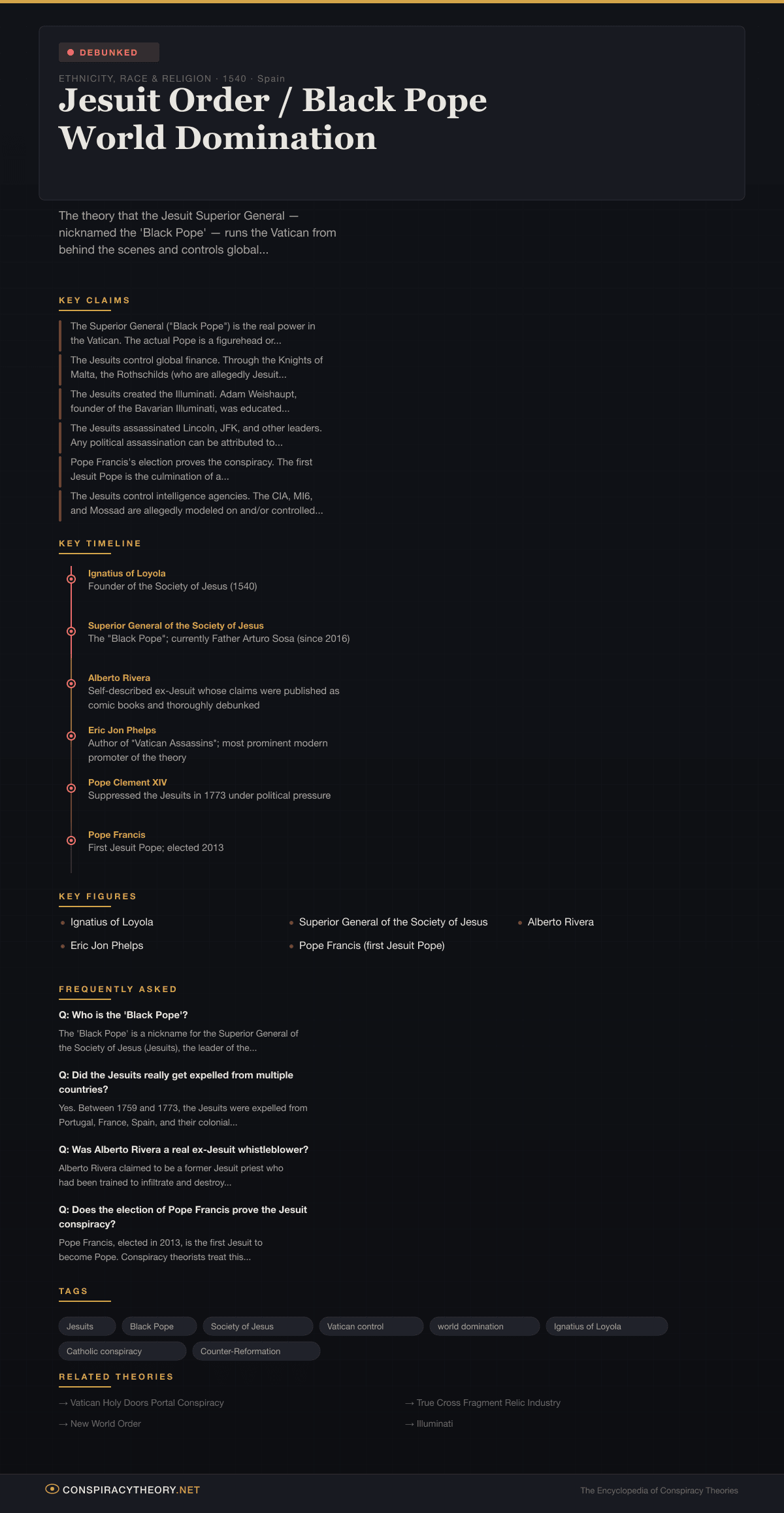
Jesuit Order / Black Pope World Domination
Overview
The Society of Jesus has been accused of a great many things over its nearly five-hundred-year history: assassinating kings, starting wars, manipulating empires, controlling banks, founding the Illuminati, infiltrating Protestant churches, creating Islam, orchestrating the Holocaust, and sinking the Titanic. If you spend enough time in certain corners of the internet, you’ll come to believe that a small religious order founded by a limping Basque soldier in 1540 is actually the hidden hand behind virtually every significant event in modern history — and that the Jesuit Superior General, the so-called “Black Pope,” is the real power in the Vatican, pulling the strings while the actual Pope serves as a white-robed figurehead.
The Jesuit conspiracy theory is one of the oldest and most durable in the Western canon. Unlike many conspiracy theories, it is grounded in a kernel of historical fact: the Jesuits genuinely were an enormously influential organization. They ran universities, advised monarchs, conducted espionage, engaged in geopolitics, and were so powerful that they were expelled from multiple countries and suppressed entirely by the Pope in 1773. That much is true. What is not true — what collapses under the slightest historical scrutiny — is the leap from “influential religious order” to “secret rulers of the world.”
The theory persists because it serves as a remarkably flexible template. Need someone to blame? The Jesuits did it. It doesn’t matter whether the accusation comes from Protestants, atheists, Freemasons, or competing Catholic factions — the Jesuits are capacious enough villains to accommodate everyone’s paranoia.
Origins & History
The Real Jesuits
The Society of Jesus was founded in 1540 by Ignatius of Loyola, a Spanish Basque nobleman who experienced a religious conversion while recovering from a cannonball wound sustained at the Battle of Pamplona in 1521. Loyola and six companions took vows of poverty, chastity, and obedience, and offered their services directly to the Pope, creating a religious order uniquely devoted to papal authority.
The Jesuits were different from existing religious orders in several important ways. They did not wear distinctive habits (they dressed as secular priests), they did not chant the Divine Office in common, and they emphasized intellectual rigor, education, and active engagement with the world. They became the Catholic Church’s intellectual elite — founding universities, conducting scientific research, and training the sons of European nobility.
Most significantly, the Jesuits became the spearhead of the Counter-Reformation. They established missions across the globe, from Japan to Paraguay, from China to Canada. They served as confessors and advisors to Catholic monarchs — a role that gave them genuine political influence and, inevitably, generated suspicion and enmity.
Early Anti-Jesuit Sentiment
Opposition to the Jesuits was nearly as old as the order itself. Protestant reformers viewed them as agents of papal tyranny. Competing Catholic orders — particularly the Dominicans — resented their rapid rise and special privileges. Secular rulers were wary of an order that answered directly to the Pope and whose members operated across national borders with what seemed like diplomatic immunity.
The most significant charge against the Jesuits in the early modern period was regicide. The assassination of Henry IV of France in 1610 by Francois Ravaillac — though Ravaillac was not a Jesuit — was widely blamed on Jesuit influence. The order had previously been expelled from France in 1594 after a failed assassination attempt on Henry IV by Jean Chatel, a former student at a Jesuit school.
The Jesuits were also accused of practicing “mental reservation” and “equivocation” — theological doctrines that allegedly allowed them to lie under oath if they believed a higher moral purpose was served. Pascal’s Provincial Letters (1656-1657) satirized Jesuit casuistry as moral corruption, and the critique stuck. To this day, the word “jesuitical” carries connotations of deviousness and sophistry.
Expulsions and Suppression
The wave of anti-Jesuit action in the eighteenth century was genuinely dramatic:
- 1759: Portugal expels the Jesuits from all Portuguese territories under the Marquis of Pombal.
- 1764: France suppresses the order.
- 1767: Spain expels the Jesuits under Charles III.
- 1773: Under intense political pressure from the Bourbon monarchies, Pope Clement XIV suppresses the entire Society of Jesus with the brief Dominus ac Redemptor.
The suppression lasted forty-one years. During this period, the Jesuits survived in Prussia and Russia, where Protestant and Orthodox rulers refused to enforce the papal brief — a delicious historical irony.
1814: Pope Pius VII restored the Society of Jesus. The order rebuilt gradually, eventually becoming the largest male religious order in the Catholic Church.
Modern Conspiracy Theory
The modern “Jesuits run everything” narrative synthesizes these historical episodes into a grand conspiracy. Key promoters include:
Alberto Rivera — A self-described ex-Jesuit priest who, in a series of comic books published by Jack Chick in the 1980s, claimed the Jesuits had created Islam, founded the Freemasons and the Illuminati, started both World Wars, created communism, controlled the Mafia, and orchestrated the Holocaust. Journalistic investigations found no evidence that Rivera had ever been a Jesuit, a Catholic priest, or indeed any of the things he claimed to be.
Eric Jon Phelps — Author of Vatican Assassins (2001), a sprawling text alleging that the Jesuit Superior General controls the world through the Knights of Malta, the CFR, the Bilderberg Group, and virtually every other organization that appears in conspiracy literature. The book is largely unsourced and contains numerous historical errors.
Various internet conspiracy communities — Since the early 2000s, the “Jesuit world domination” theory has circulated on conspiracy forums, YouTube channels, and social media, often merged with Illuminati, Freemason, and New World Order narratives.
Key Claims
- The Superior General (“Black Pope”) is the real power in the Vatican. The actual Pope is a figurehead or puppet controlled by the Jesuit leadership.
- The Jesuits control global finance. Through the Knights of Malta, the Rothschilds (who are allegedly Jesuit agents), and central banks, the order controls the global financial system.
- The Jesuits created the Illuminati. Adam Weishaupt, founder of the Bavarian Illuminati, was educated by Jesuits, which proves the Illuminati is a Jesuit front.
- The Jesuits assassinated Lincoln, JFK, and other leaders. Any political assassination can be attributed to Jesuit agents.
- Pope Francis’s election proves the conspiracy. The first Jesuit Pope is the culmination of a centuries-long takeover of the Vatican.
- The Jesuits control intelligence agencies. The CIA, MI6, and Mossad are allegedly modeled on and/or controlled by the Jesuit order.
Evidence
What Is True
The Jesuits are and have been a genuinely influential organization. They run the world’s largest network of Catholic educational institutions, including Georgetown University, Fordham, Boston College, and scores of universities worldwide. Jesuits have served as confessors to monarchs, advisors to popes, and leaders in science, philosophy, and theology. Their historical political influence is well-documented and real.
The order was expelled from multiple countries and suppressed by the Pope — facts that demonstrate it was powerful enough to be perceived as threatening by both secular and ecclesiastical authorities.
The Superior General does wield significant authority within the Church. The Jesuit order’s internal structure — with its emphasis on obedience, discipline, and global coordination — does resemble aspects of intelligence organizations. These structural parallels are not evidence of conspiracy, but they are not fabricated.
What Is Not True
No evidence exists that the Jesuits control global finance, intelligence agencies, or secular governments. The conspiracy theory requires the order — which currently has roughly 14,000 members worldwide, down from a peak of over 36,000 in the 1960s — to somehow dominate institutions with budgets in the trillions and personnel in the millions.
Alberto Rivera’s claims have been thoroughly debunked. No evidence supports his claimed identity or any of his specific allegations.
The “Jesuits created the Illuminati” claim rests on the sole fact that Weishaupt was educated at a Jesuit school. By this logic, Harvard created every conspiracy in which a Harvard graduate has participated.
Debunking / Verification
The Jesuit conspiracy theory exhibits the classic structure of unfalsifiable grand conspiracy: any evidence against the theory is reinterpreted as evidence of the conspiracy’s success at concealment.
The theory’s historical claims are testable, however, and fail:
-
The Jesuits could not prevent their own suppression. If the order controlled the papacy, it would not have been suppressed by the Pope in 1773 — the single most devastating blow to its institutional existence.
-
Pope Francis is the first Jesuit Pope. If the Jesuits had controlled the papacy for centuries, it is curious that they never managed to elect one of their own until 2013.
-
The order is shrinking. Jesuit membership has declined by over 60% since the 1960s. A secret society controlling the world would presumably be more effective at recruiting.
-
The claims are mutually contradictory. Different versions of the theory attribute opposing actions to the Jesuits — they simultaneously created communism and fought communism, supported fascism and opposed fascism, controlled both the Allies and the Axis in World War II.
Cultural Impact
Anti-Jesuit conspiracy theories have had genuine historical consequences. The expulsions of the 18th century displaced thousands of Jesuits from their homes and missions. Anti-Jesuit sentiment contributed to the broader wave of anti-clericalism that shaped European politics from the Enlightenment through the French Revolution.
In the United States, anti-Jesuit and anti-Catholic sentiment fueled the Know-Nothing Party of the 1850s, the Ku Klux Klan’s anti-Catholic activism in the 1920s, and opposition to John F. Kennedy’s presidential candidacy in 1960. The Jesuit conspiracy theory is part of a broader tradition of anti-Catholic prejudice in predominantly Protestant countries.
In the modern conspiracy ecosystem, the Jesuit theory occupies a niche — it is less popular than Illuminati or New World Order narratives but serves as a “deeper level” for conspiracy theorists who believe they have pierced behind the more common theories to find the “real” controllers.
In Popular Culture
- Jack Chick’s Alberto comic book series (1979-1988) — the most influential popular presentation of the Jesuit conspiracy
- Eric Jon Phelps, Vatican Assassins (2001) — the most comprehensive modern Jesuit conspiracy text
- Umberto Eco’s novels frequently feature Jesuits as complex, politically sophisticated characters
- Dan Brown’s Robert Langdon novels include Jesuit characters and Vatican intrigue
- The phrase “jesuitical” remains a common English-language adjective meaning devious or overly sophisticated in reasoning
Key Figures
- Ignatius of Loyola — Founder of the Society of Jesus (1540)
- Superior General of the Society of Jesus — The “Black Pope”; currently Father Arturo Sosa (since 2016)
- Alberto Rivera — Self-described ex-Jesuit whose claims were published as comic books and thoroughly debunked
- Eric Jon Phelps — Author of Vatican Assassins; most prominent modern promoter of the theory
- Pope Clement XIV — Suppressed the Jesuits in 1773 under political pressure
- Pope Francis — First Jesuit Pope; elected 2013
Timeline
| Date | Event |
|---|---|
| 1521 | Ignatius of Loyola wounded at the Battle of Pamplona; begins spiritual conversion |
| 1540 | Society of Jesus formally founded; approved by Pope Paul III |
| 1548 | Jesuits open their first school in Messina, Sicily |
| 1610 | Henry IV of France assassinated; Jesuits blamed though assassin was not a Jesuit |
| 1656-1657 | Pascal’s Provincial Letters attack Jesuit casuistry |
| 1759-1767 | Jesuits expelled from Portugal, France, and Spain |
| 1773 | Pope Clement XIV suppresses the Society of Jesus |
| 1814 | Pope Pius VII restores the Society of Jesus |
| 1979-1988 | Jack Chick publishes Alberto Rivera’s anti-Jesuit comic books |
| 2001 | Eric Jon Phelps publishes Vatican Assassins |
| 2013 | Pope Francis elected — first Jesuit Pope in history |
Sources & Further Reading
- John W. O’Malley, The Jesuits: A History from Ignatius to the Present (2014)
- Jonathan Wright, God’s Soldiers: Adventure, Politics, Intrigue, and Power — A History of the Jesuits (2004)
- Blaise Pascal, The Provincial Letters (1656-1657)
- Gary Macy, “Alberto Rivera: The Man Behind the Myth,” Christianity Today investigation
- Eric Jon Phelps, Vatican Assassins (2001) — primary conspiracy source (treated as primary source, not as credible reference)
- William Bangert, A History of the Society of Jesus (1986)
Related Theories
- Vatican Holy Doors — ‘Portals to Hell’ Theory — modern anti-Vatican conspiracy theory
- True Cross Fragment Industry / Relic Fraud — historical Catholic institutional controversies
- New World Order — grand conspiracy theory that sometimes incorporates Jesuit elements
- Illuminati — conspiracy theory that sometimes names the Jesuits as the Illuminati’s creators
Frequently Asked Questions
Who is the 'Black Pope'?
Did the Jesuits really get expelled from multiple countries?
Was Alberto Rivera a real ex-Jesuit whistleblower?
Does the election of Pope Francis prove the Jesuit conspiracy?

Infographic
Share this visual summary. Right-click to save.