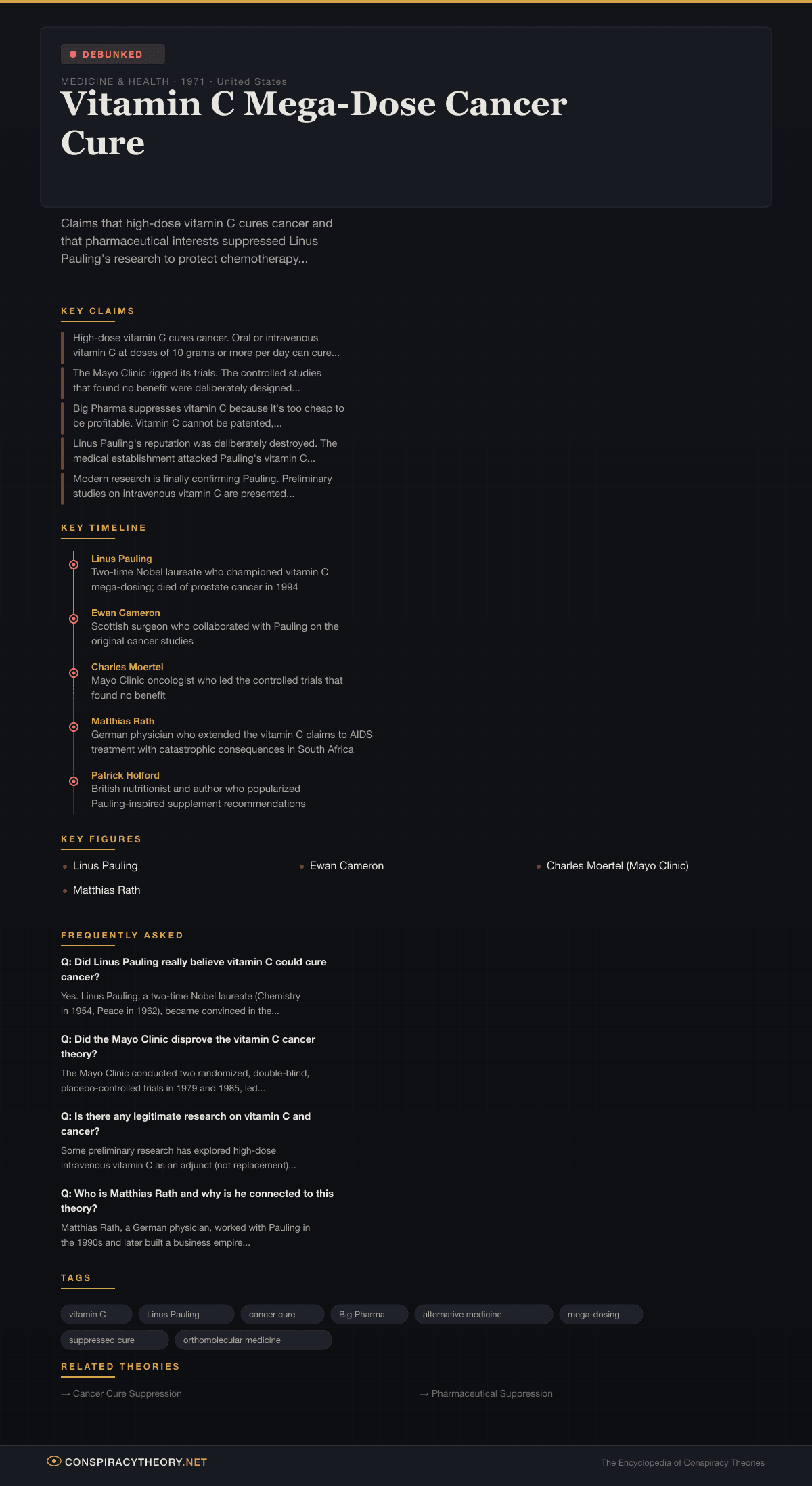
Vitamin C Mega-Dose Cancer Cure
Overview
This is a story about what happens when a genius goes wrong — and about the industry that grew up around the wreckage.
Linus Pauling was, by any measure, one of the most brilliant scientists of the twentieth century. He won the Nobel Prize in Chemistry for his work on chemical bonding. He won the Nobel Peace Prize for his campaign against nuclear weapons testing. He is one of only four people in history to win two Nobel Prizes, and the only person to win two unshared. When Linus Pauling talked, people listened — which is exactly what made his late-career crusade for vitamin C so devastating.
Beginning in the 1970s, Pauling became convinced that massive doses of vitamin C could cure everything from the common cold to cancer. He co-authored studies claiming that terminal cancer patients given intravenous vitamin C lived four times longer than those who didn’t receive it. He wrote bestselling books. He appeared on television. He lent his enormous scientific prestige to claims that, when rigorously tested by other researchers, fell apart. The Mayo Clinic’s controlled trials found no benefit. The scientific community, initially respectful of Pauling’s stature, eventually moved on. But Pauling never did, and the idea he championed metastasized into something far worse than a scientific error: it became the foundation of a conspiracy theory alleging that the pharmaceutical industry had suppressed a cheap, natural cancer cure to protect its chemotherapy profits.
That conspiracy theory has real body counts. People have refused conventional cancer treatment in favor of vitamin C mega-doses and died. A Pauling protege named Matthias Rath promoted vitamin supplements as an alternative to antiretroviral drugs in South Africa during the AIDS epidemic, with consequences that researchers have estimated in the tens of thousands of preventable deaths.
Origins & History
Pauling’s Vitamin C Journey
Pauling’s interest in vitamin C began with the common cold. In 1970, he published Vitamin C and the Common Cold, arguing that daily doses of 1,000 mg or more (far above the recommended daily allowance of 60 mg at the time) could prevent or reduce the severity of colds. The book was a massive bestseller and immediately controversial. The scientific evidence for the cold-fighting claims was mixed at best, but Pauling’s prestige carried enormous weight with the public.
From colds, Pauling’s claims escalated. By the mid-1970s, he had partnered with Ewan Cameron, a Scottish surgeon at Vale of Leven Hospital in Alexandria, Scotland. Cameron had been giving high-dose intravenous vitamin C to terminal cancer patients, and together he and Pauling published a 1976 paper in the Proceedings of the National Academy of Sciences claiming that patients receiving 10 grams of intravenous vitamin C daily survived, on average, more than four times longer than matched controls who didn’t receive it.
The paper was electrifying. A Nobel laureate was claiming, in a prestigious journal, that a cheap vitamin could dramatically extend the lives of terminal cancer patients. If true, it would be one of the most important medical discoveries of the century.
The Mayo Clinic Trials
The medical establishment responded appropriately: it tested the claim with rigorous controlled trials. Charles Moertel, a respected oncologist at the Mayo Clinic, led two double-blind, randomized, placebo-controlled studies.
The first trial (1979) gave 10 grams of oral vitamin C daily to patients with advanced, previously treated cancer. It found no benefit in survival or quality of life compared to the placebo group. The results were published in the New England Journal of Medicine.
The second trial (1985) specifically addressed Pauling’s objections to the first trial’s methodology. It focused on colorectal cancer patients who had not received prior chemotherapy. It again found no benefit.
Pauling was furious. He accused the Mayo Clinic of deliberately designing the trials to fail, of using oral rather than intravenous administration (though his original protocol with Cameron had recommended both), and of stopping the vitamin C too soon. These objections were examined and rejected by the broader scientific community. The Mayo Clinic’s methodology was sound, and the results were clear.
The Suppression Narrative
Pauling’s accusations against the Mayo Clinic and the medical establishment provided the raw material for the conspiracy theory that followed. The narrative crystallized into a familiar pattern:
- A brilliant scientist discovers a cure.
- The establishment tests the cure with rigged studies.
- The establishment declares the cure ineffective.
- The cure is suppressed because it threatens pharmaceutical profits.
This narrative has become a template applied to dozens of alleged suppressed cures — from apricot pits (laetrile) to hydrogen peroxide therapy to various herbal remedies. The vitamin C version is particularly potent because the scientist involved was genuinely brilliant and the substance involved is genuinely harmless (at reasonable doses) and readily available.
The Rath Catastrophe
The most consequential extension of the Pauling vitamin C theory came through Matthias Rath, a German physician who worked with Pauling at the Linus Pauling Institute in the early 1990s. After Pauling’s death in 1994, Rath took the vitamin C thesis and ran — in the worst possible direction.
Rath built a supplement empire selling high-dose vitamin formulations marketed as treatments for cancer, heart disease, and eventually AIDS. In the early 2000s, he brought this message to South Africa, where President Thabo Mbeki’s government was already skeptical of antiretroviral drugs. Rath ran newspaper advertisements claiming that his vitamin supplements were superior to antiretroviral therapy, conducted unauthorized clinical trials, and allegedly distributed vitamins to HIV-positive patients as an alternative to proven treatments.
A 2008 study published in the Journal of Acquired Immune Deficiency Syndromes estimated that the South African government’s delay in implementing antiretroviral programs — influenced in part by AIDS denialism with which Rath was aligned — contributed to approximately 330,000 preventable deaths.
In 2008, a South African court ruled that Rath’s foundation had conducted unauthorized clinical trials and ordered it to stop advertising its supplements as AIDS treatments. Rath retreated to Germany but continued selling supplements internationally.
Key Claims
- High-dose vitamin C cures cancer. Oral or intravenous vitamin C at doses of 10 grams or more per day can cure or significantly extend the lives of cancer patients.
- The Mayo Clinic rigged its trials. The controlled studies that found no benefit were deliberately designed to produce negative results to protect pharmaceutical interests.
- Big Pharma suppresses vitamin C because it’s too cheap to be profitable. Vitamin C cannot be patented, so pharmaceutical companies have no financial incentive to promote it and every incentive to suppress it.
- Linus Pauling’s reputation was deliberately destroyed. The medical establishment attacked Pauling’s vitamin C claims to discredit a dangerous truth.
- Modern research is finally confirming Pauling. Preliminary studies on intravenous vitamin C are presented as vindication of Pauling’s original claims.
Evidence
The Cameron-Pauling Studies
The original Cameron-Pauling studies were not randomized or blinded. The “control” patients were historical — patients who had been treated at the same hospital before vitamin C was available, matched retrospectively for age, sex, and cancer type. This methodology is significantly weaker than a prospective randomized controlled trial because it cannot control for differences in patient selection, standard of care changes over time, or other confounding variables.
The Mayo Clinic Studies
The Mayo Clinic trials used double-blind, randomized, placebo-controlled methodology — the gold standard of clinical research. Both trials found no benefit. These results have been replicated by other research groups.
Modern Research
Some modern research has explored intravenous (not oral) vitamin C as an adjunct to conventional cancer treatment. Small-scale studies have suggested possible benefits in quality of life and tolerability of chemotherapy. However:
- No large, phase III clinical trial has demonstrated that vitamin C cures cancer.
- The doses used in modern research are typically much higher than what is achievable through oral supplementation and can only be delivered intravenously.
- Researchers in this area explicitly do not claim that vitamin C is a cure for cancer or a substitute for conventional treatment.
Pauling’s Own End
Linus Pauling died on August 19, 1994, at age 93, of prostate cancer. He had been taking massive doses of vitamin C for over two decades. While his longevity is sometimes cited by proponents as evidence for the vitamin C thesis, dying of cancer after decades of mega-dosing vitamin C is not, by any reasonable standard, evidence that vitamin C cures cancer.
Debunking / Verification
The vitamin C cancer cure is debunked by the weight of clinical evidence:
-
The original studies were methodologically weak. Non-randomized, non-blinded, with historical controls — the Cameron-Pauling studies cannot support the extraordinary claims made on their basis.
-
Rigorous trials found no benefit. The Mayo Clinic trials, and subsequent studies, found no evidence that vitamin C cures or meaningfully treats cancer.
-
The suppression narrative is logically incoherent. Vitamin C is unpatentable and universally available. If it cured cancer, any government, hospital, or insurance company in the world could use it to slash healthcare costs. The idea that the entire global medical establishment is suppressing a cheap, accessible cure requires a conspiracy of millions of people across every country on Earth.
-
The “modern vindication” is overstated. Preliminary research on adjunctive IV vitamin C is interesting but does not validate Pauling’s original claims. Researchers in this area have explicitly distanced themselves from the “vitamin C cures cancer” narrative.
-
The human cost is real. People have died after choosing vitamin C over conventional cancer treatment. The Rath catastrophe in South Africa illustrates the lethal potential of the suppression narrative when applied to any disease where effective treatments exist.
Cultural Impact
The vitamin C mega-dose theory has had a lasting impact on alternative medicine culture. It helped establish several persistent tropes: the lone genius versus the establishment, the cheap natural cure suppressed by Big Pharma, and the conversion of scientific authority into alternative health credibility.
Pauling’s involvement gave the alternative medicine movement something it desperately craved — a genuine scientific heavyweight. His name continues to be invoked by supplement sellers, naturopaths, and alternative health practitioners decades after his death. The Linus Pauling Institute at Oregon State University, which Pauling founded, now conducts rigorous micronutrient research and explicitly does not endorse many of the claims made in Pauling’s name.
The vitamin C theory also contributed to the broader “orthomolecular medicine” movement — the idea that diseases can be treated by optimizing the concentrations of substances normally present in the body. While some orthomolecular concepts have legitimate scientific basis, the movement has largely positioned itself in opposition to conventional medicine, drawing heavily on the suppression narrative that Pauling’s experience crystallized.
In Popular Culture
- Linus Pauling, Vitamin C and the Common Cold (1970) — the bestseller that launched the vitamin C movement
- Linus Pauling, Cancer and Vitamin C (1979, with Ewan Cameron) — extended the claims to cancer
- Patrick Holford, The Optimum Nutrition Bible — popular alternative health book heavily influenced by Pauling’s vitamin C claims
- The documentary Vitamine C: La Vraie Histoire (France) — explored the controversy
- Ben Goldacre’s Bad Science (2008) — devoted a chapter to Matthias Rath and the South African vitamin supplement catastrophe
Key Figures
- Linus Pauling — Two-time Nobel laureate who championed vitamin C mega-dosing; died of prostate cancer in 1994
- Ewan Cameron — Scottish surgeon who collaborated with Pauling on the original cancer studies
- Charles Moertel — Mayo Clinic oncologist who led the controlled trials that found no benefit
- Matthias Rath — German physician who extended the vitamin C claims to AIDS treatment with catastrophic consequences in South Africa
- Patrick Holford — British nutritionist and author who popularized Pauling-inspired supplement recommendations
Timeline
| Date | Event |
|---|---|
| 1970 | Linus Pauling publishes Vitamin C and the Common Cold |
| 1976 | Cameron and Pauling publish their vitamin C and cancer study in PNAS |
| 1979 | First Mayo Clinic trial finds no benefit from high-dose vitamin C in cancer |
| 1979 | Pauling and Cameron publish Cancer and Vitamin C |
| 1985 | Second Mayo Clinic trial confirms no benefit |
| 1994 | Linus Pauling dies of prostate cancer at age 93 |
| Early 2000s | Matthias Rath promotes vitamin supplements as AIDS treatment in South Africa |
| 2008 | South African court bans Rath’s foundation from unauthorized clinical trials |
| 2008 | Study estimates 330,000 preventable AIDS deaths linked to SA antiretroviral delays |
| 2010s-present | Small-scale studies explore adjunctive IV vitamin C; do not support “cure” claims |
Sources & Further Reading
- Cameron, E., and Pauling, L., “Supplemental Ascorbate in the Supportive Treatment of Cancer,” PNAS 73, no. 10 (1976)
- Moertel, C., et al., “High-Dose Vitamin C versus Placebo in the Treatment of Patients with Advanced Cancer,” NEJM 312 (1985)
- Ben Goldacre, Bad Science (2008) — chapter on Matthias Rath and South Africa
- Padayatty, S.J., and Levine, M., “Vitamin C: The Known and the Unknown and Goldilocks,” Oral Diseases 22, no. 6 (2016)
- Thomas Hager, Linus Pauling and the Chemistry of Life (1998)
- Chung et al., “Vitamin C in the Prevention and Treatment of Cancer,” Integrative Cancer Therapies (2013)
Related Theories
- Cancer Cure Suppression — the broader theory that pharmaceutical interests suppress effective cancer treatments
- Pharmaceutical Industry Suppression — the general claim that Big Pharma suppresses cheap, effective treatments
Frequently Asked Questions
Did Linus Pauling really believe vitamin C could cure cancer?
Did the Mayo Clinic disprove the vitamin C cancer theory?
Is there any legitimate research on vitamin C and cancer?
Who is Matthias Rath and why is he connected to this theory?
Infographic
Share this visual summary. Right-click to save.