Watergate — The Conspiracy That Toppled a President
Overview
The Watergate scandal is the definitive example of a confirmed government conspiracy in American history. What began as a “third-rate burglary” — as Nixon’s press secretary Ron Ziegler dismissed it — ultimately revealed a vast pattern of political espionage, sabotage, and obstruction of justice directed from the highest levels of the executive branch. The scandal resulted in the resignation of President Richard Nixon, the imprisonment of over 40 administration officials, and a permanent transformation of American political culture.
On June 17, 1972, five men were arrested while breaking into the Democratic National Committee headquarters at the Watergate office complex in Washington, D.C. The burglars were connected to the Committee to Re-Elect the President (CRP, derisively nicknamed “CREEP”). Over the next two years, investigative reporting by Bob Woodward and Carl Bernstein of the Washington Post, congressional hearings led by Senator Sam Ervin, and the work of special prosecutors revealed that the break-in was part of a broader campaign of political espionage and that Nixon had personally directed efforts to cover it up.
Watergate is classified as confirmed — every major allegation was substantiated through testimony, documentary evidence, and most decisively, the White House’s own secret tape recordings.
Origins & History
The Plumbers and CREEP
The roots of Watergate extend to Nixon’s obsession with controlling information and punishing perceived enemies. In 1971, after Daniel Ellsberg leaked the Pentagon Papers to the New York Times, Nixon authorized the creation of the Special Investigations Unit — nicknamed “the Plumbers” because their job was to stop leaks. The unit, led by former CIA officer E. Howard Hunt and former FBI agent G. Gordon Liddy, operated from the White House basement.
The Plumbers’ first major operation was the September 1971 break-in at the office of Ellsberg’s psychiatrist, Dr. Lewis Fielding, seeking information to discredit Ellsberg. This established a pattern of illegal operations justified by national security claims.
For the 1972 re-election campaign, Liddy was transferred to the Committee to Re-Elect the President, where he proposed an elaborate intelligence-gathering operation codenamed GEMSTONE. The plan included bugging DNC offices, infiltrating Democratic campaigns, and various “dirty tricks.” Attorney General John Mitchell, who chaired CREEP, approved a scaled-down version of the plan.
The Break-In
On June 17, 1972, at approximately 2:30 AM, security guard Frank Wills noticed tape covering door latches in the Watergate complex. He called the police, who discovered five men inside the DNC offices equipped with wiretapping devices and cameras. The burglars — Bernard Barker, Virgilio González, Eugenio Martínez, Frank Sturgis, and James McCord (CREEP’s security director) — were arrested on the spot.
The group had actually broken in twice. A previous entry on May 28 had successfully planted wiretaps on two phones, but one tap malfunctioned. The June 17 operation was intended to fix the faulty tap and photograph documents.
The Cover-Up
Within days of the arrests, the cover-up began. Nixon’s chief of staff H.R. Haldeman, domestic affairs advisor John Ehrlichman, and counsel John Dean coordinated efforts to contain the damage. Key actions included:
- Directing the CIA to tell the FBI to limit its investigation on false national security grounds (the “smoking gun” tape of June 23, 1972)
- Paying hush money to the burglars through CREEP funds
- Destroying evidence, including Hunt’s files on the Fielding break-in
- Coaching witnesses in their testimony
- Using the IRS to harass political enemies
Nixon publicly denied any White House involvement, telling reporters on August 29, 1972: “I can say categorically that no one in the White House staff, no one in this administration, presently employed, was involved in this very bizarre incident.”
The Unraveling
The cover-up began to collapse in early 1973. Judge John Sirica’s aggressive sentencing of the burglars pressured James McCord to break his silence, writing a letter to Sirica stating that perjury had been committed and political pressure applied to maintain silence.
John Dean, recognizing he was being set up as a scapegoat, began cooperating with prosecutors. In June 1973, he testified before the Senate Watergate Committee that Nixon had direct knowledge of the cover-up, famously telling the president: “There is a cancer on the presidency.”
The Tapes
The most dramatic revelation came on July 13, 1973, when White House aide Alexander Butterfield disclosed the existence of a secret taping system that had recorded most Oval Office conversations since 1971. The tapes became the central evidence in the investigation, leading to a year-long legal battle culminating in the Supreme Court’s unanimous ruling in United States v. Nixon (1974) that the president must surrender the recordings.
The “smoking gun” tape from June 23, 1972 — recorded just six days after the break-in — captured Nixon directing Haldeman to use the CIA to obstruct the FBI’s investigation. This tape, released on August 5, 1974, destroyed any remaining support for Nixon.
Key Confirmed Facts
- Presidential direction of the cover-up: Nixon personally ordered obstruction of the FBI investigation within days of the break-in
- Hush money payments: Over $500,000 in campaign funds was paid to the burglars to ensure their silence
- FBI and CIA manipulation: The administration attempted to use both agencies to contain the investigation
- Political espionage campaign: The break-in was part of a broader campaign of sabotage, wiretapping, and “dirty tricks” against Democratic opponents
- The enemies list: The White House maintained a list of political opponents targeted for harassment through tax audits, denial of federal grants, and other punitive measures
- Saturday Night Massacre: On October 20, 1973, Nixon ordered the firing of special prosecutor Archibald Cox, leading Attorney General Elliot Richardson and Deputy AG William Ruckelshaus to resign in protest
- The 18½-minute gap: A critical section of a tape from June 20, 1972, was erased. Nixon’s secretary Rose Mary Woods claimed she accidentally erased it while answering the phone, but forensic analysis revealed 5-9 separate erasure segments
Evidence
The White House Tapes
The tapes remain the most direct evidence of presidential conspiracy in American history. Over 3,400 hours of recordings were preserved, and key conversations were transcribed and entered into the public record. The tapes captured Nixon discussing hush money, witness tampering, use of government agencies against enemies, and explicit direction of the cover-up.
Congressional Investigation
The Senate Watergate Committee, chaired by Sam Ervin (D-NC), held nationally televised hearings from May to August 1973. The hearings featured testimony from dozens of administration officials and produced a detailed documentary record of the conspiracy.
Criminal Convictions
The scandal resulted in criminal convictions for over 40 people, including:
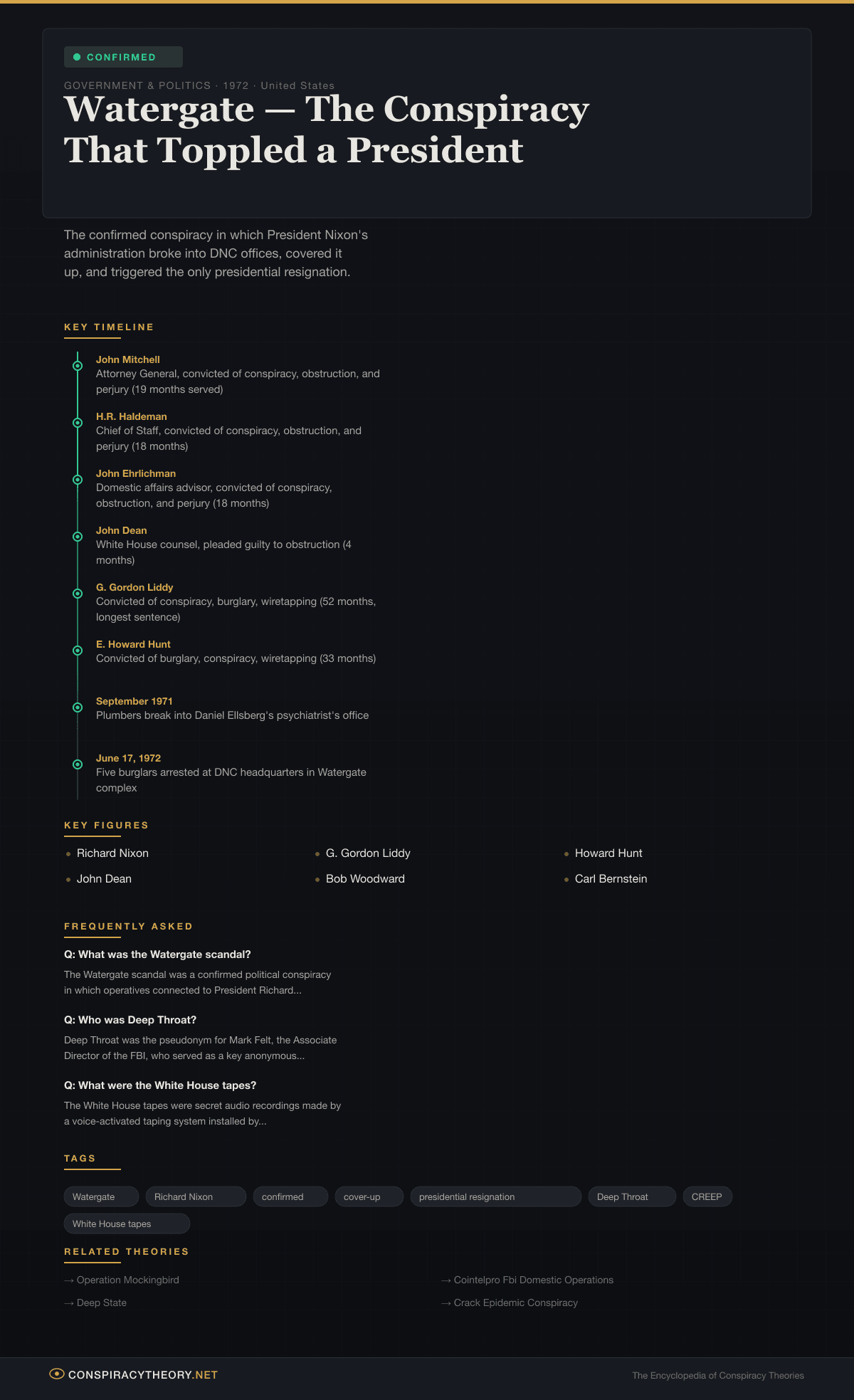
- John Mitchell — Attorney General, convicted of conspiracy, obstruction, and perjury (19 months served)
- H.R. Haldeman — Chief of Staff, convicted of conspiracy, obstruction, and perjury (18 months)
- John Ehrlichman — Domestic affairs advisor, convicted of conspiracy, obstruction, and perjury (18 months)
- John Dean — White House counsel, pleaded guilty to obstruction (4 months)
- G. Gordon Liddy — Convicted of conspiracy, burglary, wiretapping (52 months, longest sentence)
- E. Howard Hunt — Convicted of burglary, conspiracy, wiretapping (33 months)
Deep Throat
For over 30 years, the identity of Woodward’s key anonymous source, known by the pseudonym Deep Throat, remained one of journalism’s greatest mysteries. In May 2005, former FBI Associate Director Mark Felt, then 91 years old, revealed himself as Deep Throat through a Vanity Fair article. Felt had been motivated partly by being passed over for FBI director and partly by genuine concern about the administration’s abuses.
Cultural Impact
Transformation of American Politics
Watergate fundamentally altered the relationship between the American public and their government. Public trust in the presidency collapsed, and the scandal established a template for political suspicion that persists to this day. The suffix “-gate” became permanently attached to any political scandal — from “Irangate” to “Deflategate.”
Journalism’s Golden Age
Woodward and Bernstein’s investigation elevated investigative journalism to a heroic enterprise. The 1976 film All the President’s Men, starring Robert Redford and Dustin Hoffman, dramatized their work and inspired a generation of journalists. Journalism school applications surged in the years following the scandal.
Legislative Reforms
Watergate led directly to significant legislative reforms:
- The War Powers Resolution (1973) limited presidential military authority
- The Federal Election Campaign Act amendments (1974) created the Federal Election Commission and imposed campaign finance restrictions
- The Ethics in Government Act (1978) established the independent counsel mechanism
- The Foreign Intelligence Surveillance Act (FISA, 1978) required court approval for domestic intelligence surveillance
- The Presidential Records Act (1978) established public ownership of presidential records
Template for Conspiracy Awareness
Watergate is perhaps the most important event in the history of conspiracy theory culture, because it proved that the highest levels of government could and did engage in criminal conspiracies. It provides a factual foundation that conspiracy theorists frequently invoke: “If Watergate happened, what else are they hiding?”
Timeline
- September 1971 — Plumbers break into Daniel Ellsberg’s psychiatrist’s office
- June 17, 1972 — Five burglars arrested at DNC headquarters in Watergate complex
- June 23, 1972 — Nixon directs Haldeman to use CIA to block FBI investigation (the “smoking gun” tape)
- August 29, 1972 — Nixon publicly denies White House involvement
- November 1972 — Nixon wins re-election in a landslide over George McGovern
- January 1973 — Watergate burglars convicted; Judge Sirica pressures for full disclosure
- March 1973 — James McCord writes letter to Sirica alleging perjury and cover-up
- April 30, 1973 — Haldeman, Ehrlichman, and Dean resign/are fired
- May-August 1973 — Senate Watergate Committee holds televised hearings
- July 13, 1973 — Alexander Butterfield reveals White House taping system
- October 20, 1973 — Saturday Night Massacre: Cox fired, Richardson and Ruckelshaus resign
- April 30, 1974 — Edited transcripts of tapes released; public shocked by content
- July 24, 1974 — Supreme Court unanimously orders Nixon to surrender tapes (US v. Nixon)
- August 5, 1974 — “Smoking gun” tape released; remaining congressional support collapses
- August 8, 1974 — Nixon announces resignation in nationally televised address
- August 9, 1974 — Nixon resigns; Gerald Ford sworn in as president
- September 8, 1974 — Ford pardons Nixon for all federal crimes committed while president
- May 2005 — Mark Felt reveals himself as Deep Throat
Sources & Further Reading
- Woodward, Bob, and Carl Bernstein. All the President’s Men. Simon & Schuster, 1974.
- Bernstein, Carl, and Bob Woodward. The Final Days. Simon & Schuster, 1976.
- Dean, John W. Blind Ambition: The White House Years. Simon & Schuster, 1976.
- Kutler, Stanley I. The Wars of Watergate: The Last Crisis of Richard Nixon. Alfred A. Knopf, 1990.
- Emery, Fred. Watergate: The Corruption of American Politics and the Fall of Richard Nixon. Times Books, 1994.
- National Archives. “Nixon Presidential Materials: White House Tapes.”
- United States v. Nixon, 418 U.S. 683 (1974).
- Senate Select Committee on Presidential Campaign Activities. Final Report, 1974.
- Felt, Mark, and John D. O’Connor. “I’m the Guy They Called Deep Throat.” Vanity Fair, May 2005.

Frequently Asked Questions
What was the Watergate scandal?
Who was Deep Throat?
What were the White House tapes?
Infographic
Share this visual summary. Right-click to save.