Wealth Inequality as Engineered Conspiracy
Overview
The wealth inequality conspiracy theory posits that the extreme concentration of wealth observed in the early twenty-first century is not primarily the result of free market dynamics, individual merit, or technological change, but rather the product of a deliberate, multi-decade campaign by the ultra-wealthy to reshape economic policy, weaken democratic institutions, and redirect the gains of economic growth to the top fraction of the income distribution. Proponents argue that this campaign has been executed through lobbying, political donations, think tank funding, media ownership, regulatory capture, offshore tax evasion, and the systematic dismantling of labor protections and progressive taxation.
Unlike many conspiracy theories, this one draws on a substantial body of mainstream economic research, investigative journalism, and leaked financial documents. The Panama Papers, Paradise Papers, Pandora Papers, and other major financial leaks have confirmed that the global wealthy use elaborate offshore structures to minimize taxes and hide assets. Academic economists such as Thomas Piketty, Emmanuel Saez, and Gabriel Zucman have documented the mechanisms through which wealth concentrates and self-perpetuates. Investigative reporters have traced the influence networks connecting billionaire donors to specific policy outcomes.
The theory’s “mixed” status reflects its complex relationship with evidence. Many of its component claims are well-documented: wealthy individuals and corporations do spend billions on lobbying and political campaigns; tax policy has shifted to favor capital over labor; offshore tax havens do shelter trillions in wealth. Where the theory ventures into more speculative territory is in attributing these outcomes to a coordinated conspiracy rather than to the aggregate effect of many self-interested actors operating within legal (if ethically questionable) frameworks. The distinction between “the system works as designed by the powerful” and “there is a secret conspiracy to impoverish the masses” is often blurred in popular discourse.
Origins & History
Critiques of concentrated wealth and its distorting effects on democracy are as old as democracy itself. Aristotle warned that extreme inequality threatened republican government. The populist and progressive movements of the late nineteenth and early twentieth centuries explicitly targeted the power of industrial monopolists — the “robber barons” — and their influence over government. The New Deal era instituted progressive taxation, labor protections, and financial regulation that compressed the wealth distribution significantly between the 1930s and 1970s.
The modern version of the wealth inequality conspiracy theory traces its intellectual origins to a specific document: the Powell Memorandum of 1971. Lewis F. Powell Jr., a corporate attorney who would shortly be appointed to the Supreme Court by President Richard Nixon, wrote a confidential memo to the U.S. Chamber of Commerce titled “Attack on American Free Enterprise System.” The memo argued that the American business community was under assault from consumer advocates, environmentalists, and the political left, and that corporations needed to organize a coordinated, long-term campaign to influence academia, media, courts, and legislatures. The memo called for the creation of pro-business think tanks, the placement of sympathetic scholars in universities, and aggressive political engagement by the corporate sector.
Whether or not one views the Powell Memo as a “conspiracy,” the institutional infrastructure it recommended was subsequently built. The Heritage Foundation was founded in 1973. The Cato Institute was established in 1977 with funding from Charles Koch. The American Legislative Exchange Council (ALEC), founded in 1973, began drafting model legislation favorable to corporate interests for state legislatures to adopt. The Federalist Society, founded in 1982, worked to reshape the federal judiciary. These organizations operated openly, but their funding sources were often opaque, and their cumulative effect on American policy was profound.
The 1980s marked a decisive turning point. The Reagan administration’s tax cuts reduced the top marginal income tax rate from 70% to 28%, while deregulation of financial markets enabled new forms of wealth accumulation. Simultaneously, the decline of organized labor — accelerated by Reagan’s breaking of the PATCO air traffic controllers’ strike in 1981 — reduced the countervailing power that had historically checked corporate influence.
The trend continued through subsequent administrations of both parties. The Clinton administration’s deregulation of the financial sector, including the repeal of Glass-Steagall provisions through the Gramm-Leach-Bliley Act of 1999, enabled the consolidation of financial institutions. The Bush-era tax cuts of 2001 and 2003 disproportionately benefited high-income earners. The Obama administration’s response to the 2008 financial crisis, which bailed out major banks while millions of homeowners lost their properties, intensified public perception that the system was rigged.
The 2010 Supreme Court decision in Citizens United v. FEC, which held that corporate political spending was protected speech under the First Amendment, became a watershed moment. The decision enabled unlimited corporate and individual spending on political campaigns through super PACs and dark money organizations, dramatically increasing the influence of wealthy donors on the political process.
The 2010s saw a series of massive financial leaks that provided documentary evidence for claims that had previously been largely theoretical. The Panama Papers (2016), Paradise Papers (2017), FinCEN Files (2020), and Pandora Papers (2021) collectively revealed the global infrastructure of offshore tax avoidance and evasion used by the wealthy and powerful.
Key Claims
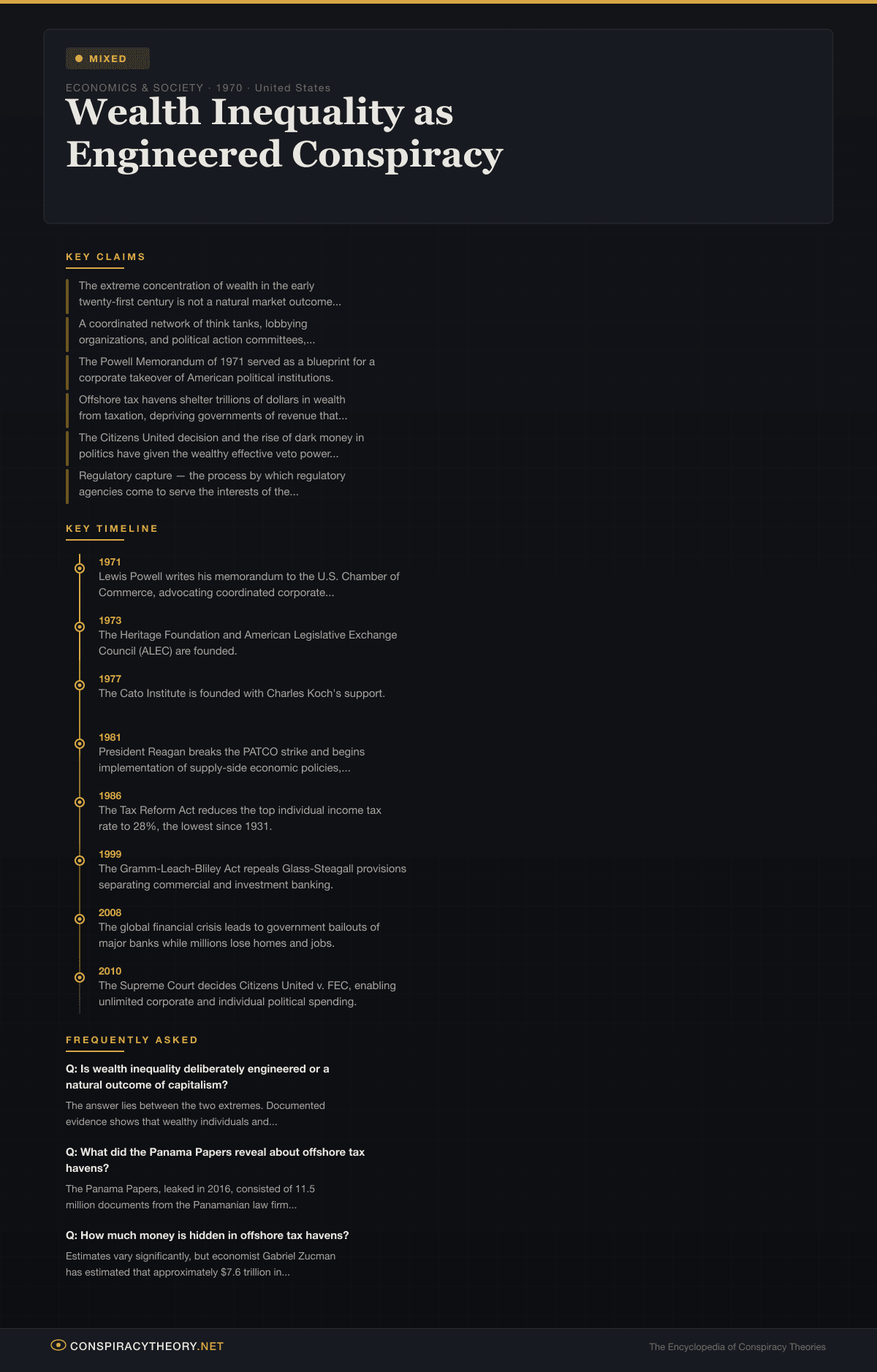
- The extreme concentration of wealth in the early twenty-first century is not a natural market outcome but the result of deliberate policy choices made under the influence of wealthy donors and corporate lobbyists.
- A coordinated network of think tanks, lobbying organizations, and political action committees, funded primarily by a small number of billionaire families and major corporations, has systematically reshaped tax policy, labor law, financial regulation, and trade policy to favor capital over labor.
- The Powell Memorandum of 1971 served as a blueprint for a corporate takeover of American political institutions.
- Offshore tax havens shelter trillions of dollars in wealth from taxation, depriving governments of revenue that could fund public services and reduce inequality.
- The Citizens United decision and the rise of dark money in politics have given the wealthy effective veto power over legislation that would threaten their economic interests.
- Regulatory capture — the process by which regulatory agencies come to serve the interests of the industries they regulate — ensures that even nominally protective regulations are designed with loopholes or weakly enforced.
- The decline of organized labor was not a natural market phenomenon but was engineered through right-to-work legislation, anti-union corporate practices, and NLRB appointments hostile to collective bargaining.
- Media consolidation, with a small number of wealthy individuals and corporations controlling major news outlets, ensures that fundamental challenges to the economic order receive minimal coverage.
- The global financial system is structured to allow capital to move freely across borders while labor remains constrained, creating a power asymmetry that systematically favors employers over workers.
Evidence
Documented Facts
Wealth Concentration Statistics: The evidence for extreme and growing wealth inequality is robust and largely undisputed among economists. According to Federal Reserve data, the top 1% of American households held approximately 31% of the nation’s wealth as of 2024, while the bottom 50% held roughly 2.6%. Globally, Oxfam reported in 2024 that the five richest men in the world had more than doubled their fortunes since 2020, while nearly five billion people had been made poorer. These statistics are drawn from Federal Reserve surveys, tax data, and Forbes wealth estimates.
Lobbying Expenditures: OpenSecrets data shows that lobbying spending in the United States has exceeded $3.5 billion annually in recent years. The financial sector, pharmaceutical industry, and technology companies are consistently the largest spenders. Studies have shown a strong correlation between lobbying expenditure and favorable regulatory outcomes.
The Panama Papers and Subsequent Leaks: The International Consortium of Investigative Journalists coordinated reporting on the Panama Papers, which revealed 214,488 offshore entities connected to people in more than 200 countries. The documents showed current and former world leaders, including the prime ministers of Iceland and Pakistan, maintaining offshore wealth. Subsequent leaks — the Paradise Papers from the law firm Appleby, the FinCEN Files from the U.S. Treasury’s Financial Crimes Enforcement Network, and the Pandora Papers from 14 offshore services firms — confirmed and extended these findings.
The Koch Network: Investigative journalist Jane Mayer’s reporting and book Dark Money documented how Charles and David Koch built a political network that spent hundreds of millions of dollars per election cycle to influence policy on taxes, regulation, and climate change. The network’s spending was often channeled through nonprofits that were not required to disclose their donors.
Tax Policy Changes: The historical record clearly shows that top marginal tax rates have declined dramatically since mid-century. The top U.S. income tax rate was 91% in the 1950s and 1960s, 70% through the 1970s, and has ranged between 28% and 39.6% since 1986. Capital gains tax rates have been consistently lower than income tax rates, benefiting those whose income derives primarily from investments.
Citizens United Impact: Following the Citizens United decision, outside spending on federal elections increased dramatically. In the 2020 election cycle, outside groups spent over $3.2 billion, compared to approximately $338 million in 2008. Much of this spending was “dark money” — funds from organizations not required to disclose their donors.
Academic Research
Thomas Piketty’s Capital in the Twenty-First Century (2013) provided an extensive empirical analysis showing that when the rate of return on capital exceeds the rate of economic growth — a condition he argued was the historical norm — wealth inequality tends to increase naturally. Piketty’s work was based on tax records spanning more than a century across multiple countries.
Political scientists Martin Gilens and Benjamin Page published a widely cited 2014 study analyzing 1,779 policy issues and finding that “economic elites and organized groups representing business interests have substantial independent impacts on U.S. government policy, while average citizens and mass-based interest groups have little or no independent influence.” The study concluded that the U.S. political system more closely resembled an oligarchy than a democracy in terms of policy outcomes.
Gabriel Zucman’s research on offshore wealth estimated that approximately 8% of the world’s financial wealth was held in tax havens, resulting in $190 billion in lost tax revenue annually.
Debunking / Verification
What is well-established: The factual components of this theory are largely confirmed. Wealth inequality has increased dramatically. The wealthy do spend enormous sums influencing policy. Offshore tax havens do shelter trillions. Policy has shifted to favor capital over labor. These are not conspiracy theories but documented features of the contemporary political economy.
Where the theory overreaches: The conspiratorial framing can oversimplify a complex reality. Wealth inequality has multiple causes, including technological change (which has disproportionately rewarded high-skilled workers), globalization (which has suppressed wages in developed countries while raising them in developing ones), assortative mating (high earners increasingly marrying other high earners), and winner-take-all dynamics in certain industries.
The coordination question: While organizations like ALEC, the Chamber of Commerce, and various donor networks do coordinate on policy goals, the broader wealthy class is not monolithic. Wealthy individuals fund causes across the political spectrum. George Soros, Tom Steyer, and Michael Bloomberg have spent heavily on liberal and progressive causes. Silicon Valley billionaires have funded both libertarian and progressive organizations. The image of a unified cabal of the wealthy conspiring against the rest of the population is an oversimplification.
Legitimate debate vs. conspiracy: Many mainstream economists, political scientists, and legal scholars share the concern that concentrated wealth distorts democracy. The question is whether this is better understood as a systemic problem arising from incentive structures and institutional design, or as a deliberate conspiracy. Most academic researchers favor the former framing while acknowledging that deliberate actions by specific actors have amplified systemic tendencies.
Global variation: Wealth inequality varies significantly across developed nations, suggesting that policy choices do matter but that a global conspiracy is not required to explain the phenomenon. Scandinavian countries have maintained lower levels of inequality through strong unions, progressive taxation, and robust social safety nets — outcomes that would be difficult to explain if a global conspiracy were effectively controlling all governments.
Cultural Impact
The wealth inequality conspiracy theory has significantly shaped political discourse in the twenty-first century, influencing movements, campaigns, and policy debates across the ideological spectrum.
The Occupy Wall Street movement of 2011 crystallized public anger about inequality with its “We are the 99%” framing, directly referencing the concentration of wealth in the top 1%. While the movement itself was short-lived, its language and framing became permanently embedded in political discourse. The “1% vs. 99%” framing simplified complex economic dynamics into a narrative of deliberate extraction.
Senator Bernie Sanders’s 2016 and 2020 presidential campaigns were built substantially on the narrative that the “billionaire class” had rigged the economy. Sanders’s rhetoric drew directly on the wealth inequality conspiracy framework, arguing that campaign finance corruption and corporate lobbying had produced an economy that worked only for the very wealthy. His campaigns generated enormous grassroots fundraising and demonstrated the political potency of inequality-focused messaging.
Senator Elizabeth Warren’s 2020 campaign similarly centered on structural corruption and inequality, with specific policy proposals like a wealth tax and anti-corruption legislation. The emergence of inequality as a central campaign issue reflected the mainstreaming of ideas that had previously been considered fringe.
On the right, populist movements have engaged with overlapping themes, though with different emphases. The Tea Party movement of 2009-2010, while initially focused on government spending and taxation, also channeled anger about bank bailouts and corporate influence. Donald Trump’s 2016 campaign rhetoric about “draining the swamp” and opposing unfair trade deals resonated with voters who believed the system was rigged, even as his policy prescriptions differed markedly from progressive approaches.
In popular culture, films such as The Big Short (2015), Inside Job (2010), and Parasite (2019) have explored themes of wealth inequality and financial system corruption. Thomas Piketty’s Capital in the Twenty-First Century became an unlikely bestseller. The publication of the Panama Papers inspired the film The Laundromat (2019).
The theory has also influenced policy. Proposals for wealth taxes, financial transaction taxes, increased capital gains taxation, and corporate minimum taxes have gained traction in mainstream policy debates. The OECD’s global minimum corporate tax agreement of 2021, adopted by over 130 countries, was a direct response to profit shifting and tax haven abuse documented in the various financial leaks.
Key Figures
Lewis F. Powell Jr. — Corporate attorney and later Supreme Court Justice whose 1971 memorandum to the U.S. Chamber of Commerce is cited as a blueprint for corporate political mobilization.
Charles Koch and David Koch — Billionaire industrialists whose political network spent hundreds of millions per election cycle funding think tanks, political campaigns, and advocacy organizations promoting free-market economics, deregulation, and tax reduction.
Thomas Piketty — French economist whose 2013 book Capital in the Twenty-First Century provided extensive empirical evidence for increasing wealth concentration and argued that inequality tends to grow when returns on capital exceed economic growth.
Gabriel Zucman — French economist specializing in offshore wealth and tax havens, whose research estimated trillions of dollars held in offshore accounts.
Warren Buffett — Billionaire investor who famously stated, “There’s class warfare, all right, but it’s my class, the rich class, that’s making war, and we’re winning,” drawing attention to how tax policy favored the wealthy.
The ICIJ (International Consortium of Investigative Journalists) — The journalistic organization that coordinated reporting on the Panama Papers, Paradise Papers, and Pandora Papers, exposing the global offshore finance system.
Robert Mercer — Billionaire hedge fund executive whose political donations funded Breitbart News, Cambridge Analytica, and numerous conservative organizations, illustrating how individual wealth can shape the political information environment.
Bernie Sanders — U.S. Senator whose presidential campaigns brought wealth inequality and the influence of billionaires to the center of mainstream political discourse.
Timeline
- 1971 — Lewis Powell writes his memorandum to the U.S. Chamber of Commerce, advocating coordinated corporate political engagement.
- 1973 — The Heritage Foundation and American Legislative Exchange Council (ALEC) are founded.
- 1977 — The Cato Institute is founded with Charles Koch’s support.
- 1981 — President Reagan breaks the PATCO strike and begins implementation of supply-side economic policies, including top marginal tax rate reductions.
- 1986 — The Tax Reform Act reduces the top individual income tax rate to 28%, the lowest since 1931.
- 1999 — The Gramm-Leach-Bliley Act repeals Glass-Steagall provisions separating commercial and investment banking.
- 2008 — The global financial crisis leads to government bailouts of major banks while millions lose homes and jobs.
- 2010 — The Supreme Court decides Citizens United v. FEC, enabling unlimited corporate and individual political spending.
- 2011 — Occupy Wall Street launches in Zuccotti Park, popularizing the “99% vs. 1%” framework.
- 2013 — Thomas Piketty publishes Capital in the Twenty-First Century, providing extensive data on wealth concentration.
- 2014 — Gilens and Page publish their study concluding that U.S. policy outcomes correlate with elite preferences rather than majority opinion.
- 2016 — The Panama Papers are published, revealing the offshore financial activities of world leaders, billionaires, and criminals.
- 2017 — The Paradise Papers leak exposes offshore dealings through the law firm Appleby. The Tax Cuts and Jobs Act reduces the corporate tax rate from 35% to 21%.
- 2020 — The FinCEN Files reveal suspicious activity reports from major banks. COVID-19 pandemic accelerates wealth concentration as billionaire wealth surges while working-class employment collapses.
- 2021 — The Pandora Papers expose the offshore holdings of 35 current and former world leaders. Oxfam reports that billionaire wealth increased by $3.9 trillion during the pandemic while 160 million people were pushed into poverty.
- 2021 — Over 130 countries agree to a 15% global minimum corporate tax rate under the OECD framework.
- 2023 — ProPublica’s reporting on leaked IRS data reveals that the wealthiest Americans pay effective tax rates far below those of middle-income earners.
- 2024 — Oxfam reports that the five richest men have more than doubled their fortunes since 2020.
Sources & Further Reading
- Piketty, Thomas. Capital in the Twenty-First Century. Cambridge: Harvard University Press, 2014.
- Mayer, Jane. Dark Money: The Hidden History of the Billionaires Behind the Rise of the Radical Right. New York: Doubleday, 2016.
- Zucman, Gabriel. The Hidden Wealth of Nations: The Scourge of Tax Havens. Chicago: University of Chicago Press, 2015.
- Gilens, Martin and Benjamin I. Page. “Testing Theories of American Politics: Elites, Interest Groups, and Average Citizens.” Perspectives on Politics 12, no. 3 (2014): 564-581.
- International Consortium of Investigative Journalists. “The Panama Papers: Exposing the Rogue Offshore Finance Industry.” 2016.
- Saez, Emmanuel and Gabriel Zucman. The Triumph of Injustice: How the Rich Dodge Taxes and How to Make Them Pay. New York: W.W. Norton, 2019.
- Powell, Lewis F. Jr. “Attack on American Free Enterprise System.” Memorandum to the U.S. Chamber of Commerce, August 23, 1971.
- Hacker, Jacob S. and Paul Pierson. Winner-Take-All Politics: How Washington Made the Rich Richer — and Turned Its Back on the Middle Class. New York: Simon & Schuster, 2010.
- Citizens United v. Federal Election Commission, 558 U.S. 310 (2010).
- Oxfam International. “Inequality Inc.” Report, January 2024.
- Eisinger, Jesse, Jeff Ernsthausen, and Paul Kiel. “The Secret IRS Files: Trove of Never-Before-Seen Records Reveal How the Wealthiest Avoid Income Tax.” ProPublica, June 8, 2021.
Related Theories
- Banking Corruption Conspiracy — Claims that the global banking system is designed to extract wealth from ordinary people through predatory lending, market manipulation, and government bailouts.
- Corporate Corruption Conspiracy — Allegations that major corporations systematically engage in fraud, regulatory capture, and political corruption to maximize profits at public expense.
- Bilderberg Group — The annual private conference of political leaders, business executives, and intellectuals that some claim is used to coordinate global economic policy in favor of elite interests.
- Goldman Sachs Conspiracy — Specific claims about the investment bank Goldman Sachs and its revolving door with government, market manipulation, and outsized political influence.
Frequently Asked Questions
Is wealth inequality deliberately engineered or a natural outcome of capitalism?
What did the Panama Papers reveal about offshore tax havens?
How much money is hidden in offshore tax havens?

Infographic
Share this visual summary. Right-click to save.