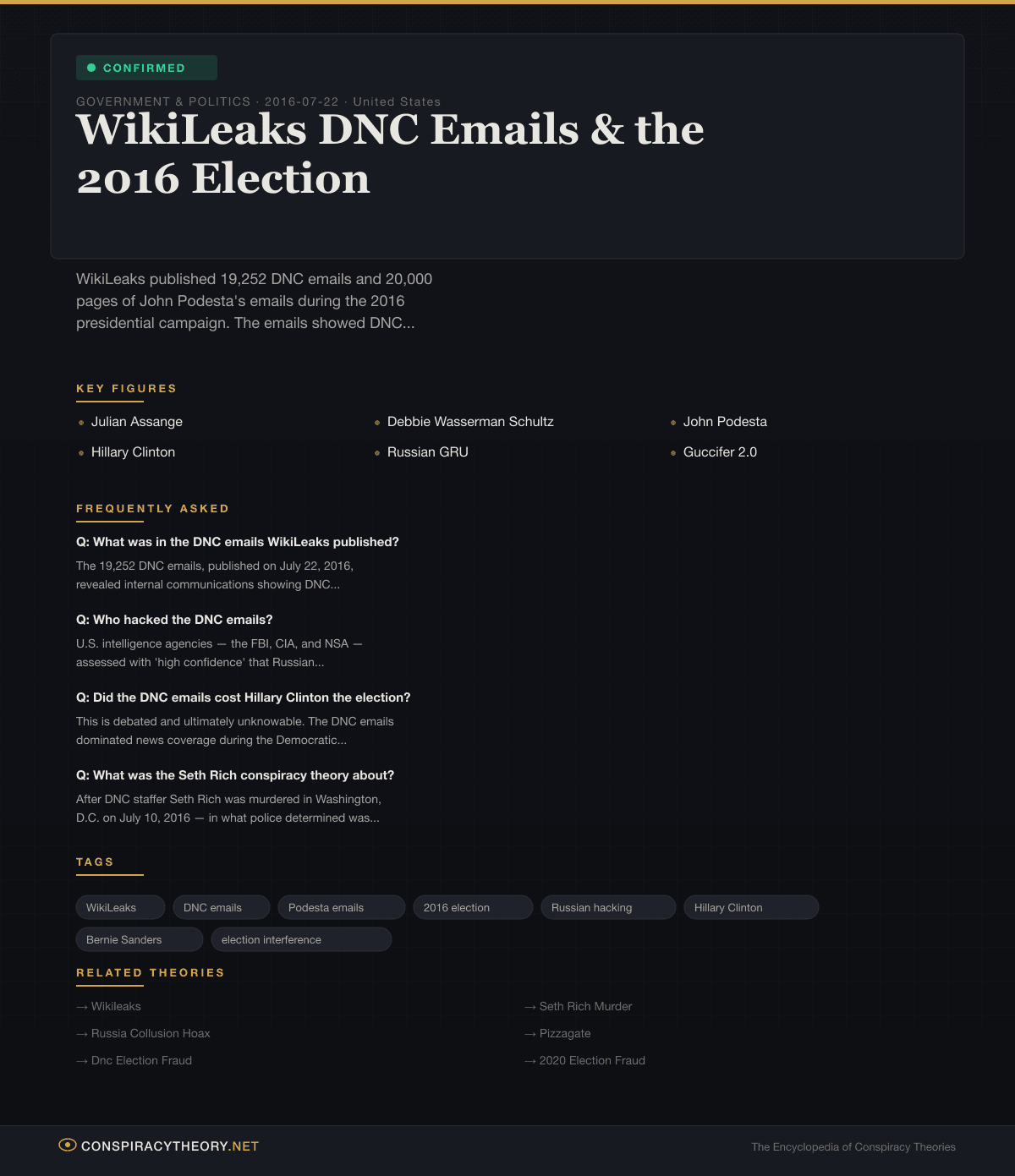
WikiLeaks DNC Emails & the 2016 Election
Overview
On July 22, 2016 — three days before the Democratic National Convention was scheduled to open in Philadelphia — WikiLeaks published 19,252 emails from the Democratic National Committee’s servers. The timing was surgical. The content was devastating. And the source, as the world would spend years debating, appeared to be Russian military intelligence.
The DNC email release, followed three months later by 20,000 pages of emails from Clinton campaign chairman John Podesta, became the most consequential WikiLeaks publication since Cablegate — and the most controversial. The emails confirmed genuine bias within the DNC. They also arrived through what U.S. intelligence agencies concluded was a Russian intelligence operation designed to influence the American presidential election. They generated one of the internet’s most dangerous conspiracy theories (Pizzagate). They fueled the investigation that consumed the first two years of the Trump presidency. And they permanently changed the relationship between WikiLeaks, the American political establishment, and the concept of transparency itself.
The 2016 email releases are where WikiLeaks stopped being a simple story about transparency versus secrecy and became something much more complicated — a story about how leaked information can be simultaneously true and weaponized, simultaneously newsworthy and strategically timed, simultaneously a public service and a political operation.
The DNC Hack
How It Happened
The breach of the DNC’s computer network was not a single event but two separate intrusions by two Russian military intelligence (GRU) units:
Cozy Bear (APT29): This unit, associated with Russia’s Foreign Intelligence Service (SVR), penetrated the DNC network in the summer of 2015 — more than a year before the emails were published. They maintained persistent access, monitoring communications.
Fancy Bear (APT28): This unit, associated with the GRU’s Main Intelligence Directorate, breached the network separately in March 2016. It was the Fancy Bear intrusion that resulted in the exfiltration of the emails that were eventually published.
The DNC became aware of the breach in April 2016 and hired CrowdStrike, a cybersecurity firm, to investigate. CrowdStrike identified both intrusions and attributed them to Russian state actors based on the malware, infrastructure, and techniques used — fingerprints consistent with previously identified Russian operations.
The Attribution
The U.S. intelligence community’s attribution of the DNC hack to Russian intelligence rests on multiple lines of evidence:
- Technical forensics: The malware and command-and-control infrastructure matched tools previously attributed to GRU operations against NATO, the German parliament, and other targets
- Signal intelligence: The NSA intercepted communications discussing the operation
- Human intelligence: The CIA obtained information from sources within the Russian government
- Grand jury indictments: The Mueller investigation indicted 12 named GRU officers, citing specific actions, times, and methods
The Mueller investigation’s February 2018 and July 2018 indictments provided the most detailed public accounting of the operation, including the GRU officers’ unit numbers, their targets, and the timeline of their activities.
Guccifer 2.0
The stolen emails reached WikiLeaks through intermediaries, including an online persona calling itself “Guccifer 2.0” (a reference to Marcel Lehel Lazăr, a Romanian hacker known as “Guccifer”). Guccifer 2.0 claimed to be a lone Romanian hacker but was identified by the intelligence community — and later by The Daily Beast, which traced the persona’s login to a GRU-associated IP address — as a GRU front.
Guccifer 2.0 published some stolen DNC documents directly and communicated with Roger Stone, a Trump campaign adviser, via Twitter direct messages. The persona also provided materials to DCLeaks.com, another GRU-operated site.
The DNC Emails
What They Showed
The 19,252 DNC emails, spanning January 2015 to May 2016, revealed:
Anti-Sanders bias: DNC officials, who were supposed to be neutral in the primary, clearly favored Clinton. Emails showed staffers discussing ways to undermine Sanders’ campaign, including:
- DNC CFO Brad Marshall suggesting that someone ask Sanders about his religious beliefs (or lack thereof) in an upcoming debate, noting “this could make several points difference with my peeps” in Southern states
- DNC Communications Director Luis Miranda coordinating negative narratives about Sanders with media outlets
- Wasserman Schultz referring to Sanders campaign manager Jeff Weaver as a “damn liar” and dismissing Sanders’ chances
Media coordination: Emails showed DNC officials suggesting questions for media to ask Sanders, requesting changes to stories before publication, and maintaining unusually close relationships with reporters covering the primary.
Fundraising arrangements: The emails documented the joint fundraising agreement between the DNC and the Clinton campaign that Sanders supporters had alleged gave Clinton an unfair advantage.
The Convention Impact
The emails were published on July 22, 2016 — the Friday before the Democratic National Convention opened on Monday. The timing was devastating. What should have been a unifying event became a crisis:
- Debbie Wasserman Schultz resigned as DNC Chair before the convention started
- Sanders supporters, feeling vindicated in their claims of bias, staged protests inside and outside the convention
- The convention’s first day was marred by boos and disruptions
- The email story dominated media coverage, overshadowing Clinton’s historic nomination
The Podesta Emails
The Drip Campaign
On October 7, 2016 — exactly one month before the election and less than an hour after the Access Hollywood tape of Donald Trump was released — WikiLeaks published the first batch of John Podesta’s emails. Over the following month, WikiLeaks released approximately 20,000 pages in near-daily installments.
The timing of the first release — coinciding with the Access Hollywood tape — was either a coincidence or a deliberate strategy to provide media with a counter-narrative whenever the Trump campaign was under pressure. Assange has never confirmed which.
What They Contained
The Podesta emails contained:
- Paid speech transcripts: Excerpts from Clinton’s paid speeches to Wall Street firms, including a Goldman Sachs speech where she described having “both a public and a private position” on policy issues
- Campaign strategy discussions: Internal debates about messaging, policy positions, and political calculations
- Foundation concerns: Discussions about potential conflicts of interest between the Clinton Foundation and the State Department
- Personal correspondence: Podesta’s personal communications, dinner invitations, and family exchanges
The emails contained no bombshells — no evidence of criminal activity, corruption, or conspiracy. But they provided a steady stream of unflattering content that kept negative Clinton coverage constant throughout October.
The Pizzagate Mutation
The most consequential — and most destructive — outcome of the Podesta emails was Pizzagate. Amateur “investigators” on 4chan and Reddit combed through the emails looking for hidden meanings. References to pizza and other food items in Podesta’s personal correspondence were interpreted as code for pedophilia. A ping-pong restaurant in Washington, D.C. where Podesta had hosted fundraisers — Comet Ping Pong — was identified as the center of a child trafficking ring.
On December 4, 2016, a man from North Carolina drove to Washington and fired an AR-15 rifle inside Comet Ping Pong, looking for the non-existent basement where children were supposedly being held. No one was injured. The restaurant doesn’t have a basement.
Pizzagate was entirely fabricated. But it demonstrated the destructive potential of real leaked documents in an environment of conspiracist pattern-matching — how legitimate emails can be twisted into fictional narratives that motivate real violence.
The Russia Question
WikiLeaks’ Shifting Credibility
The 2016 releases permanently altered perceptions of WikiLeaks. For much of its existence, WikiLeaks had been viewed primarily as a transparency organization — controversial, certainly, but fundamentally in the business of publishing true information that powerful institutions wanted to hide.
The 2016 releases raised a different set of questions:
-
Source awareness: Did WikiLeaks know the DNC emails came from Russian intelligence? Assange claimed not to know the identity of sources, but communications revealed by the Mueller investigation showed WikiLeaks’ Twitter account communicating with Guccifer 2.0 and other Russian-linked entities.
-
Timing as editorial choice: The strategic timing of releases — the DNC emails before the convention, the Podesta emails to counter the Access Hollywood tape, the daily drip throughout October — suggested political intent rather than pure transparency.
-
Selective transparency: WikiLeaks published material damaging to Clinton but did not publish material from the Republican side. Whether this reflected the materials available to them or an editorial preference was never resolved.
-
The false alternative: Assange promoted the Seth Rich conspiracy theory — implying the DNC emails came from an insider rather than Russian hackers — which served to undermine the intelligence community’s attribution and obscure the Russian connection.
The Mueller Investigation
Special Counsel Robert Mueller’s investigation (2017-2019) devoted significant attention to WikiLeaks. The investigation concluded that:
- Russia’s GRU hacked the DNC and provided materials to WikiLeaks
- WikiLeaks published the materials with timing designed for maximum political impact
- The Trump campaign was aware of and encouraged the WikiLeaks releases
- However, the investigation “did not establish that members of the Trump Campaign conspired or coordinated with the Russian government in its election interference activities”
The investigation treated WikiLeaks as a conduit — not a co-conspirator but not a neutral publisher either.
Legacy
The 2016 email releases created a template for information warfare that has been replicated globally. The combination of authentic stolen documents, strategic timing, willing media amplification, and social media conspiracy generation proved devastatingly effective — regardless of whether the emails themselves contained genuinely damaging information.
The emails’ content was largely mundane. The DNC bias against Sanders was significant but unsurprising. The Podesta emails revealed standard political calculation, not criminal conspiracy. The damage came not from what was in the emails but from the ecosystem of interpretation, amplification, and conspiratorial pattern-matching that processed them.
This is the lasting lesson of the 2016 WikiLeaks releases: in a fragmented media environment, the most powerful weapon isn’t the information itself — it’s the ability to inject authentic information into a system that will radicalize, distort, and weaponize it.
Timeline
| Date | Event |
|---|---|
| Summer 2015 | Cozy Bear (APT29) breaches DNC network |
| March 2016 | Fancy Bear (APT28) breaches DNC network separately |
| April 2016 | DNC discovers breach; hires CrowdStrike |
| June 2016 | CrowdStrike attributes hack to Russian intelligence |
| June 2016 | ”Guccifer 2.0” persona begins publishing stolen DNC documents |
| July 10, 2016 | DNC staffer Seth Rich murdered in Washington, D.C. |
| July 22, 2016 | WikiLeaks publishes 19,252 DNC emails |
| July 24, 2016 | Debbie Wasserman Schultz resigns as DNC Chair |
| July 25, 2016 | Democratic National Convention opens amid turmoil |
| Oct 7, 2016 | WikiLeaks publishes first batch of Podesta emails |
| Oct 7, 2016 | Access Hollywood tape released same day |
| Oct-Nov 2016 | Daily Podesta email releases continue through Election Day |
| Nov 8, 2016 | Donald Trump wins presidential election |
| Dec 4, 2016 | Gunman fires shots inside Comet Ping Pong restaurant |
| Jan 2017 | Intelligence community releases assessment of Russian interference |
| May 2017 | Mueller appointed Special Counsel |
| Feb 2018 | Mueller indicts 13 Russians for election interference |
| July 2018 | Mueller indicts 12 GRU officers for DNC hack |
| April 2019 | Mueller Report released |
Sources & Further Reading
- Mueller, Robert S. III. Report on the Investigation into Russian Interference in the 2016 Presidential Election. U.S. Department of Justice, 2019.
- Office of the Director of National Intelligence. “Assessing Russian Activities and Intentions in Recent US Elections.” Intelligence Community Assessment, January 2017.
- Lipton, Eric, David E. Sanger, and Scott Shane. “The Perfect Weapon: How Russian Cyberpower Invaded the U.S.” New York Times, December 13, 2016.
- Isikoff, Michael, and David Corn. Russian Roulette: The Inside Story of Putin’s War on America and the Election of Donald Trump. Twelve Books, 2018.
- Senate Select Committee on Intelligence. Report on Russian Active Measures Campaigns and Interference in the 2016 U.S. Election. 5 volumes, 2019-2020.
Related Theories
- WikiLeaks — The organization that published the emails
- Seth Rich Murder — The conspiracy theory about the DNC leak source
- Pizzagate — The conspiracy theory generated from the Podesta emails
- Russia Collusion Hoax — The counter-theory that Russian interference was fabricated
- DNC Election Fraud — Broader claims about DNC manipulation
Frequently Asked Questions
What was in the DNC emails WikiLeaks published?
Who hacked the DNC emails?
Did the DNC emails cost Hillary Clinton the election?
What was the Seth Rich conspiracy theory about?

Infographic
Share this visual summary. Right-click to save.